
Introduction: What Is the Income Tax Bill, 2025 and Why It Matters
India has initiated a major structural reform of its direct tax legislation through the Income tax Bill, 2025, which is proposed to replace the Income-tax Act, 1961. The Bill has been officially released along with explanatory notes and FAQs by the Government, making its objectives and scope publicly verifiable.
Over more than sixty years, the Income tax Act, 1961 was amended repeatedly through annual Finance Acts and special amendment laws. While these changes addressed evolving economic and policy needs, they also caused the law to become bulky, fragmented, and difficult to read. Provisions expanded through layered provisos, explanations, and cross-references, often without a corresponding reorganisation of the statute.
Importantly, the Income tax Bill, 2025 does not seek to change the fundamentals of taxation. Tax rates, slabs, heads of income, and the overall tax framework continue to be governed separately through Finance Acts. Instead, the Bill focuses on restructuring, consolidating, and simplifying the law so that it is easier to understand, navigate, and apply—especially in a modern, digital tax administration environment.
This article explains the key structural changes in the Income tax Bill 2025, the difference between the Income-tax Act 1961 and the 2025 Bill, and what has changed—and not changed—for taxpayers.
Why the Income-tax Act, 1961 Became Difficult to Navigate
The complexity of the Income tax Act, 1961 developed gradually over decades. The key structural difficulties were:
- Layering of amendments over time
Core provisions were amended repeatedly, with new provisos and explanations added without restructuring the original sections. - Provisos overshadowing the main provisions
In several cases, provisos became longer than the substantive rule itself, making interpretation cumbersome. - Fragmentation of related provisions
Rules dealing with similar subjects—such as exemptions, procedures, or compliance conditions—were spread across different chapters. - Multiple and scattered definitions
Important terms appeared in more than one place, sometimes with slight variations. - Heavy reliance on cross-referencing
Understanding one provision often required referring to several other sections and explanations. - Procedural inconsistency
Assessment, reassessment, penalty, and appeal provisions evolved independently, leading to uneven drafting styles. - Poor readability for non-experts
Dense legal drafting made the law difficult for students, small businesses, and first-time readers. - Mismatch with digital administration
The Act was originally designed for a manual compliance era, while tax administration today is largely electronic.
These issues made the statute difficult to navigate, even though its underlying tax principles remained broadly stable.

The Core Philosophy Behind the Income tax Bill, 2025
The Income tax Bill, 2025 is founded on a clear principle: simplify the structure without altering the substance of taxation.
As confirmed in the Bill and its explanatory material, the Government recognised that tax complexity in India was largely structural rather than conceptual. Accordingly, the Bill focuses on reorganising existing provisions into a more logical and internally consistent framework, instead of introducing new tax policies.
Key philosophical features include:
- Simplification without dilution
Redundant provisions are removed and related rules are consolidated without reducing their scope. - Reorganisation, not policy overhaul
Charging provisions, heads of income, and computation principles remain unchanged. - Uniform drafting style
Clauses follow a consistent structure across chapters, improving readability. - Improved accessibility
Shorter clauses and simpler language make the law easier to understand. - Alignment with digital tax systems
The statute reflects practices such as electronic filing and faceless procedures that are already in use.
This approach ensures continuity while improving clarity.
How the Structure of the Law Has Changed (1961 Act vs 2025 Bill)
The most visible reform under the Income tax Bill 2025 is its structural redesign, as reflected in the Table of Clauses.
Reduction in Size
- The Income tax Act, 1961 expanded to over 700 sections through amendments.
- The Income Tax Bill 2025 contains 536 clauses, achieved through consolidation and removal of redundancy.
This reduction reflects better organisation, not fewer rules.
Clause-based Drafting
Each clause is designed to deal with a specific concept, reducing reliance on lengthy explanations and multiple provisos.
Logical Chapter Flow
Chapters now follow the natural lifecycle of taxation:
- charge of tax
- computation of income
- treatment of specific incomes
- set-off and carry forward
- administration and procedures
- assessments, appeals, penalties, and prosecution
Use of Schedules
Exemptions, rates, and list-based provisions are moved to schedules, keeping the main law concise and readable.
Improved Navigation
Grouping related provisions together significantly reduces cross-referencing.
Key Design Changes That Improve Readability and Compliance
Several design-level changes enhance usability:
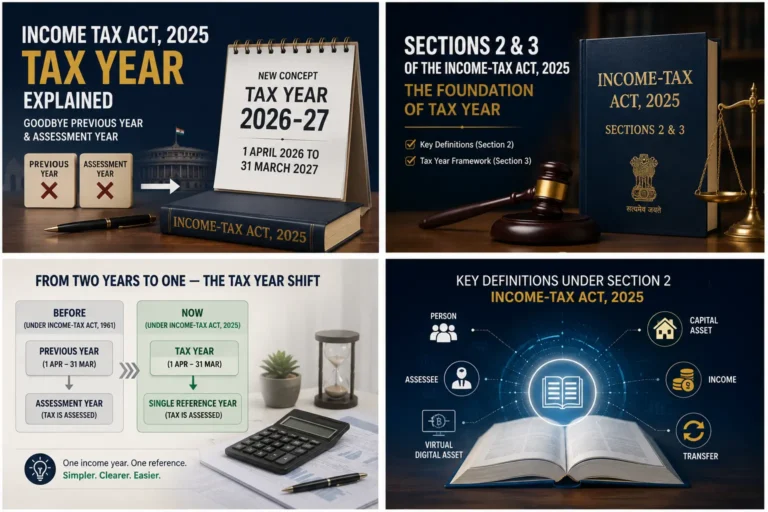
- Unified “Tax Year”
The Bill introduces a single Tax Year, replacing the earlier Previous Year and Assessment Year terminology. - Plain-language drafting
Shorter clauses and direct language improve readability without changing legal intent. - Consolidated TDS/TCS framework
Deduction and collection provisions are grouped logically, often in structured formats. - Exemptions moved to schedules
Reference-heavy lists are separated from the main text. - Digital procedures codified
Electronic filing, faceless assessments, and digital communication are embedded in the statute.
What the Income tax Bill 2025 Changes — and What It Does Not
What Changes
- Structure and sequencing of provisions
- Drafting style and organisation
- Consolidation of definitions and procedures
- Statutory recognition of digital administration
What Does Not Change
- Tax rates and slabs
- Old vs new tax regime choice
- Heads of income
- Core charging principles
- Appeal hierarchy
This distinction preserves continuity and avoids disruption.
Practical Implications of the New Structure of Income tax Bill, 2025
The Income tax Bill, 2025 does not alter tax rates or introduce new tax obligations, but its restructured format has meaningful practical implications for how tax law is understood, learned, and applied in everyday situations. These implications arise purely from better organisation, clearer drafting, and logical sequencing of provisions.
1. Easier Understanding of the Law for First-time Readers
One of the biggest benefits of the new structure is improved readability. When related provisions are grouped together and written in simpler language, readers can understand a topic without constantly referring to multiple sections. This is especially helpful for students and first-time readers, who can now focus on understanding concepts rather than searching for provisions across the statute.
2. Better Compliance Awareness for Small Businesses and Individuals
For small businesses and individual taxpayers, compliance difficulties often arise not from complexity of tax rules, but from difficulty in identifying applicable provisions. A clearer structure helps taxpayers quickly locate rules related to income computation, deductions, or procedural requirements. This reduces the risk of non-compliance caused by oversight rather than intent.
3. Reduced Dependence on Secondary Guides and Summaries
Under the earlier law, even basic understanding often required reliance on summaries, charts, or third-party guides. With a logically organised statute, readers can increasingly rely on the law itself for clarity. This strengthens legal awareness and reduces confusion arising from inconsistent external explanations.
4. Improved Learning and Teaching of Tax Law
A well-structured statute forms a stronger foundation for learning and teaching. Students can follow the flow of taxation—from charge to computation to administration—without conceptual breaks. Educators and trainers can explain provisions in sequence, making tax law more approachable and less intimidating.
5. Clearer Understanding of Procedures and Timelines
By grouping procedural provisions and aligning them with digital administration, the new structure helps readers understand how assessments, communications, and compliance processes operate in practice. This clarity reduces anxiety around procedures and improves confidence in dealing with the tax system.
6. Lower Scope for Misinterpretation Due to Drafting Issues
Ambiguity in tax law often arises from drafting complexity rather than policy intent. Cleaner drafting, fewer provisos, and consistent terminology reduce the likelihood of confusion caused purely by wording. While interpretation disputes cannot be eliminated entirely, structural clarity helps narrow the scope of disagreement.
7. Better Alignment with a Digital Tax Environment
Modern tax compliance is largely electronic. By embedding digital processes directly into the statute, the law now reflects actual practice. This alignment improves trust in system-driven administration and provides legal certainty to digital interactions between taxpayers and the tax department.
8. Long-term Reduction in Compliance Friction
Over time, a clearer statute can reduce friction between taxpayers and the administration. When obligations are easier to understand, compliance improves naturally. This benefits not only taxpayers but also the tax system as a whole by reducing avoidable disputes and procedural misunderstandings.
In summary, the practical impact of the Income tax Bill 2025 lies not in changing how much tax is paid, but in reducing the effort required to understand and comply with the law. Structural clarity itself becomes a meaningful reform, particularly for those engaging with tax law on a regular basis.

Conclusion: A Clearer Tax Law Without Changing the Tax Burden
The Income tax Bill, 2025 marks a rare and important moment in India’s tax history. Rather than introducing new taxes or altering long-standing principles, the Bill focuses on something equally significant—clarity of the law itself. By reorganising, consolidating, and simplifying the Income tax Act, 1961, the Government has addressed structural issues that had accumulated over decades of amendments.
What makes this rewrite distinctive is its balanced approach. The fundamentals of taxation remain stable, ensuring continuity for taxpayers and businesses, while the presentation of the law becomes more logical and easier to follow. Provisions that were once scattered and layered are now grouped coherently, supported by clearer drafting and well-structured schedules.
For readers, the benefit lies not in reduced tax liability, but in reduced complexity. A clearer statute improves understanding, supports smoother compliance, and lowers the risk of confusion arising purely from drafting and placement of provisions. Over time, this structural clarity can also contribute to more consistent administration and fewer interpretational disputes.
In essence, the Income tax Bill, 2025 represents modernisation without disruption—a thoughtful reset of India’s income-tax law that respects its core framework while making it better suited for today’s digital and compliance-driven environment.
Explore Our Income Tax Articles Hub and Utility
- Income Tax Filing & Compliance Guides | TaxBizMantra
- Clause 1 Of The Income-tax Bill, 2025: Scope And Commencement
- Income Tax Act 2025 Section Mapping (Old Vs New Sections)
Sources & References
You may cite the following reliable and primary sources for verification:
- Income Tax Department – Income tax Bill, 2025 (Official Portal)
https://www.incometaxindia.gov.in/Pages/income-tax-bill-2025.aspx - PRS Legislative Research – Bill Tracker & Analysis
https://prsindia.org/billtrack/the-income-tax-bill-2025 - Press Information Bureau (PIB) – Official Government Note
https://www.pib.gov.in