
PAS-3 Filing Fee Calculator for Share Allotment (India)
Calculate PAS-3 filing fees instantly based on share allotment value and company type. Accurate, fast, and based on latest ROC fee rules.
Based on Latest MCA Rules | Instant & Accurate | No Signup Required
How to Calculate PAS-3 Filing Fee for Share Allotment?
The PAS-3 filing fee is calculated based on the value of shares allotted and the type of company. As per ROC fee rules, small companies and OPCs pay lower fees compared to other companies.
For example, if shares worth ₹5,00,000 are allotted, the applicable fee depends on the company type and ROC slab.
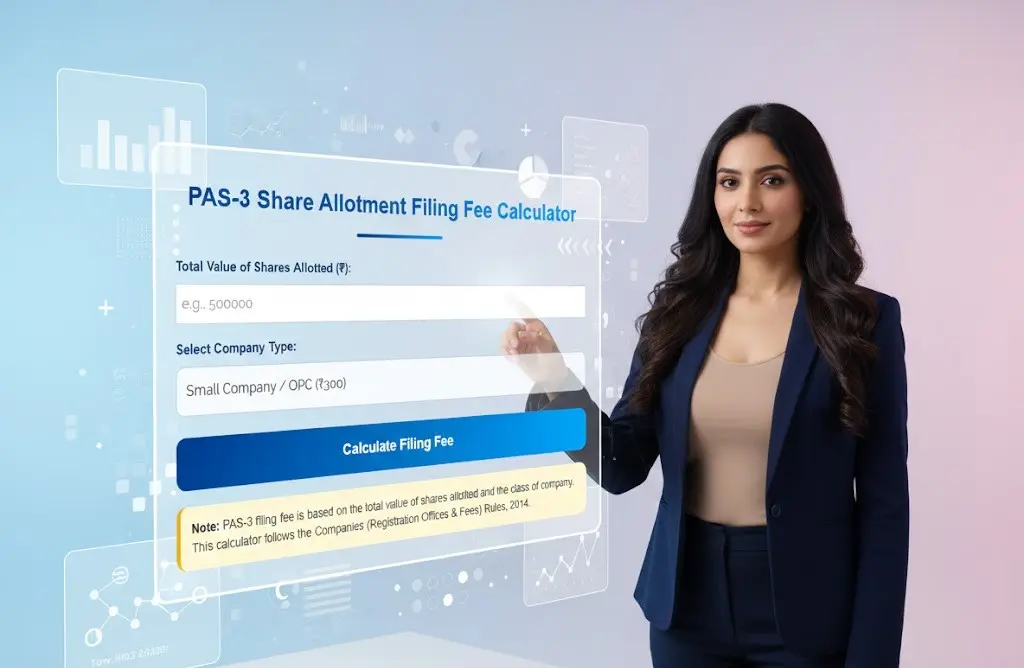
Use the calculator below to get the exact PAS-3 filing fee instantly and avoid errors in ROC filing. Calculate your PAS-3 filing fee below
What is PAS-3 Form in Share Allotment?
The PAS-3 form (Return of Allotment) is a mandatory ROC filing that companies must submit after issuing shares to shareholders. Under Section 39(4) of the Companies Act, 2013, every company is required to report the details of share allotment to the Registrar of Companies (ROC) through Form PAS-3.
In simple terms, PAS-3 is used to disclose who received shares, number of shares allotted, share value, and consideration received. This filing ensures transparency in share capital and helps the government maintain updated ownership records.
The requirement applies to all types of companies, including private limited companies, One Person Companies (OPC), and small companies. PAS-3 must be filed after events such as private placement, rights issue, bonus shares, or preferential allotment.
From a compliance perspective, understanding what is PAS-3 form in share allotment under Companies Act, 2013 is essential to avoid penalties and ensure proper ROC filing. Many professionals search for “PAS-3 form meaning”, “return of allotment filing requirements”, and “ROC filing for share allotment”, making this a high-intent topic.
👉 Quick Answer:
PAS-3 is a ROC filing form used to report share allotment details, including shareholders, number of shares, and allotment value. It must be filed within 30 days of allotment under the Companies Act, 2013.
PAS-3 Filing Fee Structure as per ROC Rules (Latest 2026 Update)
The PAS-3 filing fee is calculated based on the value of shares allotted and the type of company, in accordance with the Companies (Registration Offices and Fees) Rules, 2014.
For most private companies, the ROC filing fee is determined using slab-based rates that increase with the total allotment value. However, small companies and One Person Companies (OPC) are eligible for reduced PAS-3 filing fees compared to other companies.
Understanding this fee structure is important to ensure accurate compliance and avoid errors during filing. Instead of manually checking ROC fee slabs, using an online PAS-3 filing fee calculator allows you to quickly determine the exact amount payable as per the latest MCA rules.
👉 Quick Answer:
PAS-3 filing fee is based on share allotment value and company type. Small companies and OPCs pay lower ROC fees as per Companies (Fees) Rules, 2014.
Due Date for Filing PAS-3 After Share Allotment (Time Limit Explained)
As per the Companies Act, 2013, every company must file the PAS-3 form (Return of Allotment) within 30 days from the date of share allotment. This timeline applies to all types of companies, including private companies, OPCs, and small companies.
Timely filing of PAS-3 is crucial to ensure proper compliance with ROC requirements. Any delay beyond the prescribed 30 days can result in additional fees and penalties, as per the applicable ROC rules.
To avoid late filing issues, companies should calculate the correct PAS-3 filing fee in advance and complete the filing within the due date using the MCA portal.
👉 Quick Answer:
PAS-3 must be filed within 30 days of share allotment under the Companies Act, 2013. Delay attracts additional ROC fees.
Penalty for Late Filing of PAS-3 Form (ROC Additional Fees)
If a company fails to file the PAS-3 form (Return of Allotment) within 30 days of share allotment, it is required to pay additional ROC filing fees as per the Companies (Registration Offices and Fees) Rules, 2014. The penalty increases with the number of days of delay and can significantly raise the total filing cost.
Late filing of PAS-3 may also lead to compliance issues and delays in updating company records with the Registrar of Companies (ROC). Therefore, it is important to calculate the correct filing fee in advance and complete the filing within the prescribed time limit.
Using an online PAS-3 filing fee calculator helps ensure accurate fee estimation and reduces the risk of penalties due to incorrect filing.
👉 Quick Answer:
Late filing of PAS-3 attracts additional ROC fees, which increase based on the delay period as per Companies (Fees) Rules, 2014.
Documents Required for Filing PAS-3 Form on MCA Portal
To file the PAS-3 form (Return of Allotment) on the MCA portal, companies must keep all required documents ready to ensure smooth and accurate filing. These documents provide details of the share allotment and support compliance with ROC requirements.
Key documents typically required include the list of allottees, board resolution for share allotment, and valuation report (if applicable). In case of preferential allotment or private placement, additional supporting documents may also be needed.
Ensuring proper documentation helps avoid rejection of the PAS-3 form and delays in ROC approval. It is advisable to verify all details before submission and calculate the correct filing fee using a PAS-3 filing fee calculator.
👉 Quick Answer:
PAS-3 requires documents like list of allottees, board resolution, and supporting reports for share allotment filing on MCA portal.
Step-by-Step Process to File PAS-3 Online on MCA Portal
Filing the PAS-3 form (Return of Allotment) on the MCA portal involves a structured process that ensures proper reporting of share allotment details to the Registrar of Companies (ROC). Companies must complete the filing within 30 days of allotment to avoid additional fees.
First, download the PAS-3 form from the MCA portal and fill in details such as company information, share allotment data, and list of allottees. Next, attach the required documents, including the board resolution and supporting reports. After completing the form, it must be digitally signed by an authorized director or professional and uploaded on the MCA portal.
Once submitted, pay the applicable ROC filing fee based on the share allotment value and company type. Using a PAS-3 filing fee calculator before submission helps ensure accurate fee payment and smooth filing without errors.
👉 Quick Answer:
File PAS-3 by filling the form, attaching documents, digitally signing, uploading on MCA portal, and paying ROC fees within 30 days of allotment.
Common Mistakes in PAS-3 Filing (Avoid Penalties & Rejection)
While filing the PAS-3 form (Return of Allotment), companies often make errors that can lead to rejection or additional ROC fees. One common mistake is entering incorrect share allotment details, such as number of shares or allotment value, which can impact the accuracy of the PAS-3 filing fee calculation.
Another frequent issue is preparing an incomplete or incorrect list of allottees, which is a critical attachment in PAS-3 filing. Missing or invalid supporting documents, such as board resolutions or valuation reports, can also result in delays or rejection on the MCA portal.
Many companies also fail to correctly estimate the PAS-3 filing fee for share allotment India, especially when the fee varies based on share capital and company type. Errors in understanding the ROC filing fee PAS-3 based on share capital can lead to underpayment or overpayment.
Delay in filing beyond the prescribed 30 days is another major mistake, leading to additional ROC fees and penalties. To avoid these issues, companies should verify all details carefully and use a reliable PAS-3 filing fee calculator to ensure accurate fee calculation before submission.
👉 Quick Answer:
Common PAS-3 mistakes include incorrect share details, incomplete allottee list, missing documents, and late filing, leading to rejection or additional ROC fees.
Explore More Finance Tools & Templates
Discover more free finance and compliance tools for quick calculations and accurate filings.
For advanced needs, explore premium finance templates on CamsRoy designed for professionals and businesses.
PAS-3 Filing Fee FAQs
Related Company Law Tools & Calculators
Explore more practical tools designed to help you manage share allotment, ROC compliance, and company law filings efficiently:
- DIR-3 KYC Penalty Calculator
- 👉 Check late filing penalties for directors instantly
- AOC-4 Late Filing Penalty Calculator
- 👉 Calculate penalty for delayed financial statement filing
- MGT-7 / MGT-7A Penalty Calculator
- 👉 Estimate ROC penalties for annual return delays
- MCA Late Filing Fee Calculator
- 👉 Compute additional fees for delayed ROC filings
- MOA / AOA Stamp Duty Calculator
- 👉 Calculate stamp duty payable during incorporation
- Authorised Share Capital Cost Estimator (MCA)
- 👉 Estimate cost of increasing authorised capital
Stay updated with the latest tax, compliance, and finance tools.
Get practical insights, calculators, and templates delivered to your inbox.
Disclaimer
This tool is for informational purposes only and is based on publicly available rules under the Companies Act, 2013. While efforts are made to ensure accuracy, users are advised to verify details or consult a professional before making any filing or financial decisions.