

Every extra month you wait doesn’t just add a fee — it compounds interest, wipes out your loss carry-forwards, and locks you into a tax regime you never chose.
Missed the 31 July deadline? You’re not out of options — but every extra week you wait costs you more than you think. A belated return under Section 139(4) is the Income Tax Department’s safety net for taxpayers who miss their original due date, and understanding exactly how it works can save you from an avoidable penalty spiral.
Note on section numbers: This article uses section references from the Income-tax Act, 1961, which still govern your FY 2025-26 (AY 2026-27) return. Where relevant, the corresponding provision under the new Income-tax Act, 2025 is noted in brackets — but that renumbering only applies from Tax Year 2026-27 returns onward (filed from July 2027), not this filing season.
What Is a Belated Return Under Section 139(4)? (Section 263, Income-tax Act, 2025)
A belated return is simply an Income Tax Return filed after the original due date under Section 139(1) has passed, but before the final cut-off allowed by law. It’s filed under Section 139(4) of the Income-tax Act, 1961, and it’s a legitimate, fully valid way to file — it just comes with financial consequences that an on-time return doesn’t.
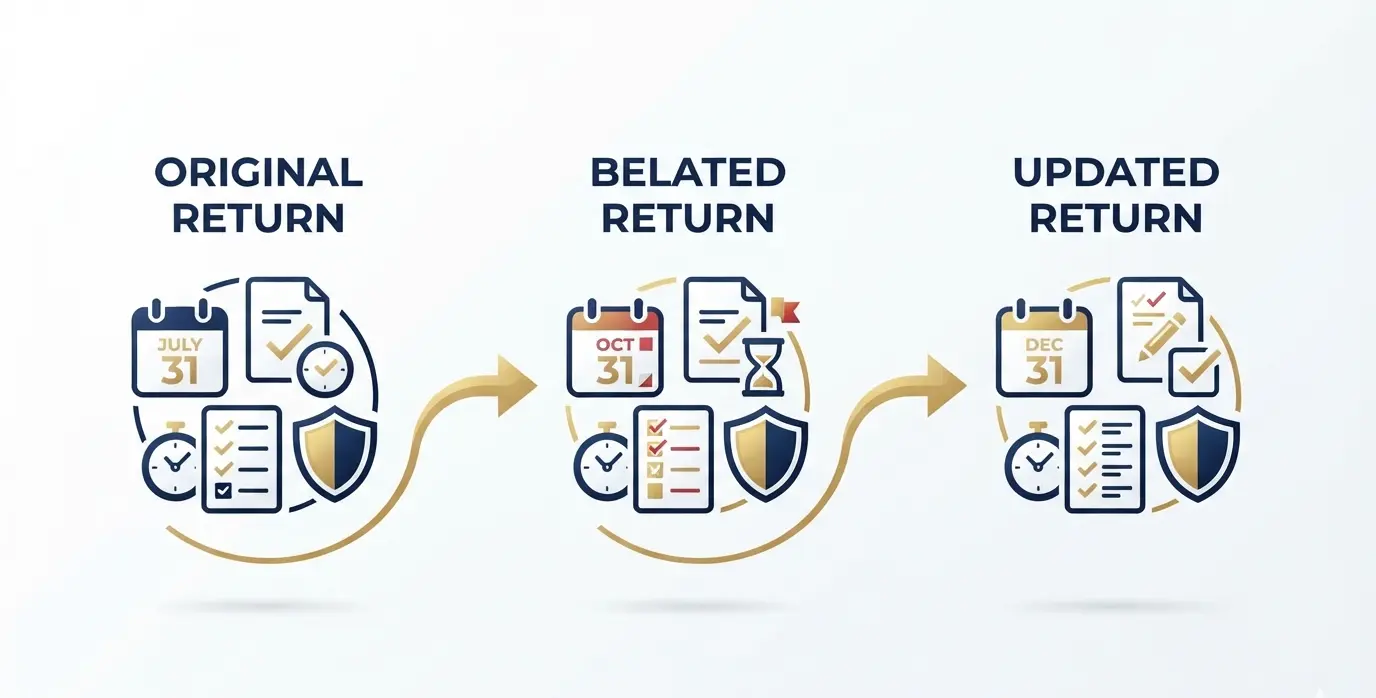
For most salaried individuals, the original due date for FY 2025-26 (AY 2026-27) was 31 July 2026 (ITR-1/ITR-2) or 31 August 2026 (ITR-3/ITR-4, non-audit). Miss that, and you automatically fall into belated-return territory the very next day.

Belated Return Due Date for AY 2026-27
Belated Return Last Date
31 Dec 2026
Under Section 139(4)
Applicable From
1 Aug 2026
Day after most original due dates
Can It Be Revised?
Yes
Up to 31 March 2027 under Sec 139(5)
Penalty Under Section 234F (Section 428, Income-tax Act, 2025)
Section 234F imposes a flat late filing fee the moment you cross the original due date — regardless of whether you owe any tax at all. Here’s exactly how it’s structured:
Income up to ₹5 lakh
₹1,000
Flat late filing fee
Income above ₹5 lakh
₹5,000
Flat late filing fee
Below taxable limit
₹0
No fee if no tax liability
This fee applies as soon as you file — it isn’t scaled by how many months late you are. Whether you file on 2 August or 20 December, the Section 234F fee stays the same for your income bracket. What does scale with time is the interest under Section 234A, covered next.
Interest Under Section 234A (Section 423, Income-tax Act, 2025)
If you have any unpaid tax liability, Section 234A charges interest at 1% per month or part of a month, calculated from the day after your original due date until the date you actually file and pay.
Here’s the detail people miss: even one extra day into a new month counts as a full month for interest purposes. So if your original due date was 31 July and you file on 1 September, that’s charged as 2 full months of interest — not “one month and one day.”
Suppose you owe ₹40,000 in unpaid tax and file your belated return on 15 October 2026 — two and a half months after the 31 July deadline. You’d be charged 3 months of interest under Section 234A (part-months round up), which works out to ₹1,200 in interest, on top of the ₹5,000 late fee under 234F if your income exceeds ₹5 lakh.
- Old tax regime option is forfeited — the choice to opt for the old regime under Section 115BAC(6) (Section 202, Income-tax Act, 2025) must be exercised within the original due date; a belated return is automatically processed under the new tax regime, with no exceptions
- Business and capital losses cannot be carried forward — if you had losses to set off against future income, filing late permanently forfeits that right
- House property loss is the one exception — this specific loss category can still be carried forward even in a belated return
- Delayed refund processing — any refund due to you takes longer to reach you the later you file
Step-by-Step: How to File a Belated Return
- Log in to the Income Tax e-filing portal using your PAN and password.
- Go to “File Income Tax Return” and select the correct Assessment Year (AY 2026-27 for FY 2025-26 income).
- When prompted for the return filing section, select “139(4) – Belated Return” instead of the default original return option.
- Choose the correct ITR form based on your income sources (ITR-1 through ITR-4 for most individuals).
- Fill in income details, reconcile figures against Form 26AS and AIS, and compute your tax liability including any 234F fee and 234A interest — the portal auto-calculates both.
- Pay any outstanding tax and the applicable late fee via challan before final submission.
- Submit the return and complete e-verification within 30 days using Aadhaar OTP, net banking, or another accepted method — an unverified return is treated as not filed at all.
Frequently Asked Questions
Can I file a belated return if I have zero tax liability?
Yes. You can still file a belated return under Section 139(4) even if no tax is due. However, if your total income exceeds the basic exemption limit, the Section 234F late fee still applies — it isn’t waived just because your tax payable is nil.
What happens if I miss the belated return deadline too?
If you miss 31 December 2026, your only remaining option is an Updated Return (ITR-U) under Section 139(8A) (Section 263, Income-tax Act, 2025), filable within 48 months from the end of the relevant assessment year — but with additional tax costs and no ability to claim fresh deductions or refunds beyond what was already reported.
Can a belated return be revised later if I find an error?
Yes. A belated return can be revised under Section 139(5) (Section 263, Income-tax Act, 2025), the same as an original return, up to 31 March 2027 for AY 2026-27 — following Budget 2026’s extension of the revised return deadline.
Does filing a belated return increase my chances of a tax notice?
Not directly — a belated return is a legally valid filing mechanism, not a red flag by itself. However, persistent late filing across multiple years, or mismatches between your return and AIS/Form 26AS data, are more likely triggers for scrutiny than the mere fact of filing after the original due date.
If I’ve already paid all my tax through TDS, do I still owe interest under Section 234A?
Generally, no. Section 234A interest is charged on unpaid tax, not on the delay itself. If your entire tax liability was already covered through TDS, advance tax, or self-assessment tax paid before the original due date, there’s no outstanding tax for the interest to apply to — even though your return is technically filed late. You would still owe the Section 234F late filing fee, since that applies regardless of whether any tax is due. This is a common point of confusion: the fee and the interest are two separate consequences, and only one of them depends on your outstanding tax balance.
ITR Filing & Return Correction — Complete Guide Series
ITR Filing FY 2025-26: Due Dates, Penalties & AY 2026-27 Return Guide
Every due date by taxpayer category, Section 234F penalty and ITR forms overview.
Part 2ITR Forms AY 2026-27: Key Changes in ITR-1, ITR-2, ITR-3 & ITR-4
Capital gains disclosures, F&O reporting and which form applies to you.
Belated Return Under Section 139(4): Rules, Penalty & How to File
234F penalty, 234A interest, regime lock-in and loss carry-forward rules.
Revised Return Under Section 139(5): How to Correct ITR Mistakes
Missed deductions or wrong figures? Here’s how to fix a filed return.
Coming SoonUpdated Return (ITR-U) Under Section 139(8A): Complete Guide
Your last resort after missing every other filing window.
Coming SoonThe real cost of a belated return isn’t just the ₹1,000 or ₹5,000 fee — it’s the compounding interest, the forfeited old-regime choice, and the losses you can never carry forward again. If you’ve already missed 31 July or 31 August, file as soon as possible rather than waiting until December; every additional month adds another slice of Section 234A interest. And if your situation involves capital losses or business losses you were planning to carry forward, it’s worth having a Chartered Accountant review your numbers before you file, since that decision can’t be undone afterward.

Disclaimer: This article is for general informational purposes only and does not constitute tax or legal advice. Tax laws, fees, and due dates are subject to change based on CBDT notifications. Please consult a qualified Chartered Accountant for advice specific to your situation.