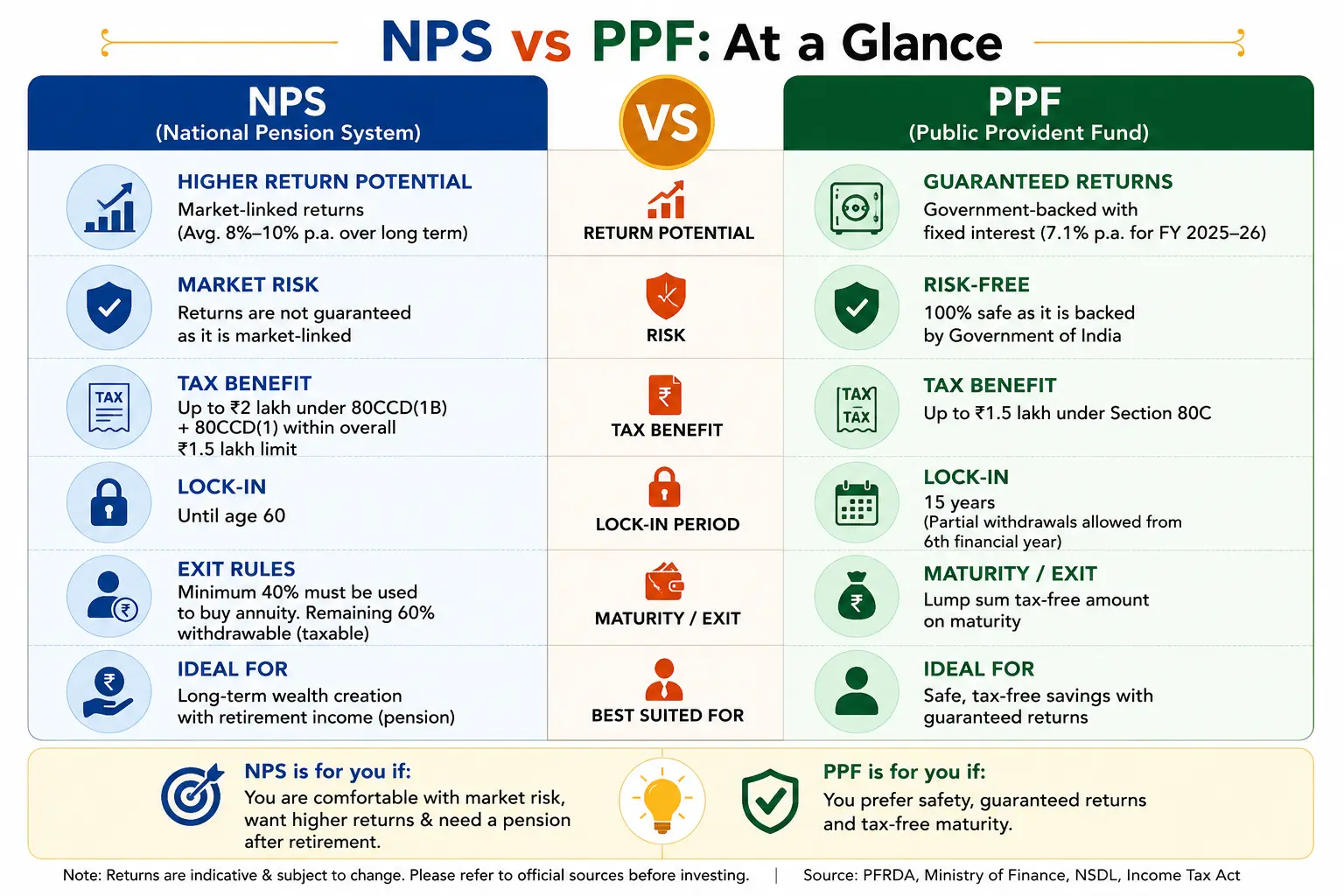

NPS vs PPF: The Better Choice Depends on More Than Returns
PPF guarantees your money and delivers a completely tax-free exit. NPS chases higher returns through equity and provides a structured pension income. After PFRDA’s December 2025 reforms, the comparison is more nuanced than ever — and which one wins depends entirely on your age, employment type, and which tax regime you file under.
Every serious conversation about retirement planning in India arrives at the same fork: NPS or PPF? Both are government-backed. Both have built financial security for lakhs of Indian families across generations. And yet they are built on entirely different philosophies about what retirement money should do — and those differences became even more pronounced after PFRDA’s landmark December 2025 reforms restructured the NPS exit framework for non-government subscribers, changing the annuity calculations that most comparison articles still get wrong.
The question of NPS vs PPF for retirement does not have one universal answer. It has the right answer for your specific situation — your age, your income, your employer, your tax regime, and how much market risk you can genuinely stomach for the next two decades. This article gives you the verified data, the honest numbers, and a clear framework to find yours.
NPS vs PPF — Complete Comparison Table 2026
Every meaningful dimension compared. Numbers verified against current 2026 rates, PFRDA December 2025 Amendment Regulations, and the Income Tax Act.
| Parameter | 🔵 NPS (Tier I) | 🟢 PPF | ⚖️ Edge |
|---|---|---|---|
| Return type | Market-linked; 9–12% historically (Scheme E 10-yr avg) | Govt-fixed; 7.1% p.a. (Q1 FY 2026–27, unchanged since Apr 2020) | NPS — growth |
| Return guarantee | None — full market risk | Full sovereign guarantee by Govt of India | PPF — safety |
| Annual contribution cap | No upper limit (min ₹1,000/yr to stay active) | Max ₹1.5 lakh per financial year | NPS — flexibility |
| Equity exposure | Up to 75% in Scheme E — real inflation hedge | None — fixed income only | NPS — inflation |
| Fund management cost | 0.12%–0.30% p.a. — among lowest globally | Zero — govt administered | PPF — no cost |
| Tax: contribution (old regime) | 80C (₹1.5L) + 80CCD(1B) ₹50K extra + 80CCD(2) employer | 80C only (within ₹1.5L ceiling) | NPS — wider deductions |
| Tax: contribution (new regime) | 80CCD(2) employer only (up to 14% of Basic+DA) — own contribution: no deduction | No deduction available under new regime | NPS — 80CCD(2) only |
| Exit tax — lump sum (normal exit) | 60% tax-free (Sec 10(12A)); additional 20% if taken as lump sum is currently taxable | 100% tax-free — full EEE always | PPF — clean exit |
| Annuity obligation at normal exit | Corpus ≤₹8L: nil. ₹8L–₹12L: ₹6L lump sum + SUR. >₹12L (non-govt): min 20% annuity. Govt employees: 40% always | None — 100% lump sum at all times | PPF — no lock-in |
| Post-exit income tax | Annuity pension — 100% taxable at slab every year under Sec 80CCD(3) | None — no post-exit obligation | PPF — zero tax |
| Partial withdrawal | From year 3; up to 25% of self-contributions; max 4 times before 60 (4-yr gap); approved reasons only | From year 7; up to 50% of 4th-year balance; no conditions. Loan from year 3–6 | Split: NPS earlier; PPF simpler |
| Deferral option | Can stay invested until age 85 (PFRDA Dec 2025) | Extendable in 5-yr blocks indefinitely after 15 yrs | Tie — both flexible |
| Pension income structure | Compulsory annuity provides monthly income — structured | No — lump sum only, self-managed | Depends on preference |
| Eligibility | Indian residents + some NRIs; 18–70 yrs at registration | Resident Indians only; NRIs cannot open new accounts | NPS — broader |
| Source(s): Pension Fund Regulatory and Development Authority (PFRDA), NPS Trust, Ministry of Finance (PPF Interest Rate Notification – Q1 FY 2026–27), and the Income Tax Act, 2026. Historical NPS returns are based on past performance and do not guarantee future returns. Annuity rules reflect the PFRDA Amendment Regulations, December 2025. | |||

Returns Comparison: Corpus at 25 Years and 35 Years
Most comparison articles only model 25 years. But a 30-year-old joining NPS or PPF today will be invested for 30 to 35 years before retirement. Here is what ₹1.5 lakh per year actually builds across both time horizons — using verified 2026 rates.
After 25 Years (₹1.5L/year)
Min 20% to annuity = ₹31.8L
Max lump sum: ₹1.27 cr (60% tax-free;
extra 20% currently taxable)
No annuity. No post-exit tax.
Extend for 5 more years at 7.1%
After 35 Years (₹1.5L/year)
Max lump sum: ₹3.25 cr (60% tax-free)
Annuity at 4.5%: ~₹3.65L/yr (fully taxable)
No annuity, no further tax liability,
no conditions. (₹2.13 cr at 25 yrs; 10 more yrs of compounding adds ~₹77L)
At 35 years, NPS at 10% builds ₹4.06 crore — meaningfully ahead of PPF’s ~₹2.9 crore. But this gap narrows significantly in practice. The NPS subscriber (non-govt, corpus >₹12L) must park at least 20% (₹81.2L) in a compulsory annuity. The resulting pension income — roughly ₹3.7L/year at 4.5% rate — is 100% taxable at slab every year until death. Over a 20-year retirement, that annual tax drag compounds. PPF’s ₹2.13 crore is entirely yours, entirely tax-free, and entirely deployable as you choose. Always model the lifetime post-tax picture, not just the headline corpus.
Tax Benefits: NPS vs PPF in Old Regime vs New Tax Regime
PPF — EEE Status Is Regime-Neutral Where It Matters
PPF enjoys full EEE (Exempt-Exempt-Exempt) status. Contributions up to ₹1.5 lakh per year are deductible under Section 80C — but only under the old tax regime. Switch to the new regime and you lose the 80C deduction on PPF contributions. However, the interest earned and the maturity amount are completely tax-free in both regimes. PPF’s compounding and exit advantage is permanent and regime-neutral — a structural benefit that NPS cannot replicate at the withdrawal stage.
NPS — One Big Deduction Gone, One Survived and Grew Stronger
Under the new tax regime, the ₹50,000 Section 80CCD(1B) deduction — the reason most people joined NPS — is gone. What survived is more powerful for salaried employees: Section 80CCD(2) allows employer contributions to NPS to be deducted up to 14% of Basic+DA for all employees (raised from 10% for private sector from FY 2025–26). No other instrument — not PPF, ELSS, or insurance — offers a deduction of this kind in the new regime.
- Section 80CCD(2): NPS only — employer contribution up to 14% of Basic+DA, fully deductible. PPF has no equivalent. Available over and above standard deduction.
- Section 80CCD(1B) ₹50,000: Old regime only. Not available for new regime filers — neither NPS own contribution nor PPF qualifies.
- Section 80C ₹1.5L: Both NPS and PPF qualify — but only under the old tax regime.
- Exit tax: PPF wins decisively — 100% EEE. NPS = EET: partially taxable at exit, annuity income 100% taxable annually forever.
Liquidity Compared: PPF Loan Facility vs NPS Partial Withdrawal
This is the dimension most articles treat superficially. Both NPS and PPF offer access to your money before retirement — but they work very differently, and PPF has a facility that virtually no comparison article mentions.
PPF Liquidity — Loan + Partial Withdrawal
Loan facility (year 3 to year 6): From the 3rd financial year onwards, you can take a loan against your PPF balance — up to 25% of the balance at the end of the 2nd preceding year. The interest rate is just 1% above the PPF rate (currently 8.1%), and the loan must be repaid within 36 months. This is available with no questions asked, no approved reasons, and no impact on your long-term balance.
Partial withdrawal (from year 7): Up to 50% of the balance at the end of the 4th preceding year, once per financial year. No conditions beyond the tenure rule.
NPS Partial Withdrawal — More Conditions, Earlier Access
Available from year 3. Limited to 25% of your own self-contributions (excluding employer contributions and investment returns). Maximum 4 times before age 60, with a minimum 4-year gap between each withdrawal. Only for approved purposes: higher education of children, marriage, purchase of residential property, treatment of critical illness, loan settlement, or skill development.
NPS Scheme E’s 10–12% historical CAGR is compelling on a 30-year horizon. But equity markets can fall sharply. A major correction in the 2–3 years just before your retirement can permanently reduce your final corpus at exactly the moment you cannot recover losses. PPF at 7.1% has never had a negative year. If you are within 5 years of retirement with heavy NPS equity exposure, shift your allocation progressively toward Scheme G (government securities). For NPS subscribers, this is the single most important risk management action they can take.
NPS SLW vs PPF Extension — The Comparison Nobody Makes
This is the most underreported dimension in the entire NPS vs PPF debate — and it can make a material difference to how much income you actually receive in retirement.
Both NPS and PPF now offer an alternative to a big one-time exit at age 60: NPS has the Systematic Lump Sum Withdrawal (SLW) facility; PPF has the 5-year extension block. Understanding which serves you better is genuinely useful.
Instead of taking the 60% (or 80%) lump sum all at once at age 60, PFRDA now allows subscribers to defer the withdrawal and draw the corpus in structured installments — monthly, quarterly, half-yearly, or yearly — until age 85. The undrawn corpus stays invested in your chosen NPS funds and continues to earn market-linked returns. Each installment drawn is treated as lump sum withdrawal under Section 10(12A), giving you the 60% tax exemption spread across multiple years rather than all at once — potentially reducing your tax burden in any single year.
Key benefit: The remaining NPS corpus keeps compounding during the SLW phase. If the equity market performs well, your later installments are larger than they would have been at a one-time exit. The tax on the SUR receipt of the non-exempt portion is still being clarified — consult a CA for the latest position.
After the mandatory 15-year lock-in, PPF can be extended in 5-year blocks indefinitely. During extension, two options exist: (a) Extension without contribution — you withdraw once per financial year, any amount; the remaining balance earns 7.1% tax-free and there is no ceiling on the amount withdrawn per year. (b) Extension with contribution — you continue adding up to ₹1.5L/year; only one partial withdrawal per year, up to 60% of the balance at the start of the extension block.
Key benefit: 100% guaranteed return continues to compound, fully tax-free, for as long as you choose to extend. Withdrawals are completely tax-free with no annuity and no conditions. For risk-averse retirees, this is a significantly more predictable retirement income structure than NPS SLW.
NPS SLW wins if your corpus is large and you want continued equity upside while drawing income. PPF extension wins if you want guaranteed, tax-free, condition-free flexibility with zero market risk. They serve different investor profiles — not the same one. For a 60-year-old with both NPS and PPF: use PPF extension for your living expenses (guaranteed, tax-free), and use NPS SLW as your growth bucket that you draw from less frequently. This is the optimal two-bucket retirement strategy for Indian investors with both instruments.
Age-Based Strategy: What to Do in Your 30s, 40s and 50s
The right NPS vs PPF allocation for retirement is not static. It should evolve as you move through the decades — your risk capacity, your tax situation, and your proximity to retirement all change, and your retirement savings strategy must change with them.
- Max NPS Scheme E (75% equity) — 30 yrs of compounding ahead
- Start PPF simultaneously — ₹1.5L/yr guaranteed floor
- If employer has Corporate NPS: use 80CCD(2) to the maximum
- Old regime filers: claim 80CCD(1B) ₹50K — highest-value window
- Risk is your friend at this stage — lean into NPS equity
- Review NPS equity allocation — begin gradual shift if volatile
- Continue PPF ₹1.5L/yr — it reaches maturity in your mid-50s
- Extend PPF at 15 years — do not close; keep compounding
- Check if employer NPS has better fund manager options
- Model annuity impact at current corpus: how much pension will you actually receive after tax?
- Shift NPS to Scheme G (govt securities) — reduce equity to 25–30%
- Choose annuity type carefully — rates locked at purchase, irreversible
- Consider NPS SLW instead of lump sum if corpus is large
- PPF extension (without contribution) = tax-free annual income
- Model total retirement income: NPS pension + PPF withdrawals + EPF if applicable

Who Should Choose NPS, PPF — or Both
- Are salaried with employer 80CCD(2) NPS available
- Are in your 30s or early 40s with 20+ years to retire
- Want a structured pension income in retirement
- File under the old tax regime and want the ₹50K extra deduction
- Can accept market volatility for higher long-term returns
- Want inflation-beating returns at 0.12% management cost
- Are self-employed with no access to employer NPS or 80CCD(2)
- File under the new tax regime without employer NPS benefit
- Want 100% guaranteed, zero-risk retirement savings
- Want a fully tax-free, annuity-free exit at retirement
- Are within 10 years of retirement and need capital preservation
- Want the loan facility (year 3–6) as a liquidity backstop
The most important insight in the NPS vs PPF debate for Indian investors is this: you do not have to choose. Use PPF as your guaranteed, EEE tax-free safety floor — the part of your retirement wealth that is never at risk and never taxed. Use NPS (via Section 80CCD(2) or old-regime 80CCD(1B)) as your equity-linked growth and pension engine — the part that chases higher returns over the long haul at ultra-low cost. They solve different problems. Run them simultaneously, and your retirement portfolio is materially more resilient than either instrument could deliver alone.