
Every rupee you owe the government traces back to two sections most taxpayers never read. Section 4 says tax exists. Section 5 says how much of your income it actually reaches.
Most of what shows up on your ITR — deductions, exemptions, heads of income — is really just detail sitting on top of one foundational question: which of your income is India even allowed to tax? Sections 4 and 5 of the Income-tax Act 2025 answer exactly that. Section 4 establishes the charge of income-tax, while Section 5 determines the scope of total income based on residential status. They’re short, but they form the foundation on which much of the rest of the Act operates.
Applicability note: Sections 4 and 5 apply from Tax Year 2026-27 onward. For FY 2025-26 (AY 2026-27), the equivalent Sections 4 and 5 of the 1961 Act continue to govern your filing — the underlying principles carry forward largely unchanged.
Charge of Income-tax Under Section 4 of the Income Tax Act 2025
Section 4 is deceptively simple, and that’s rather the point. It does one job: it’s the provision that actually gives the government the legal authority to tax you. Without a charging section, every other computation rule in the Act would have nothing to operate on.
- Where a Central Act — meaning the annual Finance Act — enacts that income-tax shall be charged for a Tax Year at a given rate, tax for that year is charged at that rate, subject to the rest of the Act’s provisions.
- The charge falls on the total income of the Tax Year of every person, computed according to the Act.
- “Income-tax” also includes any additional income-tax levied under the Act, whatever name the relevant provision gives it.
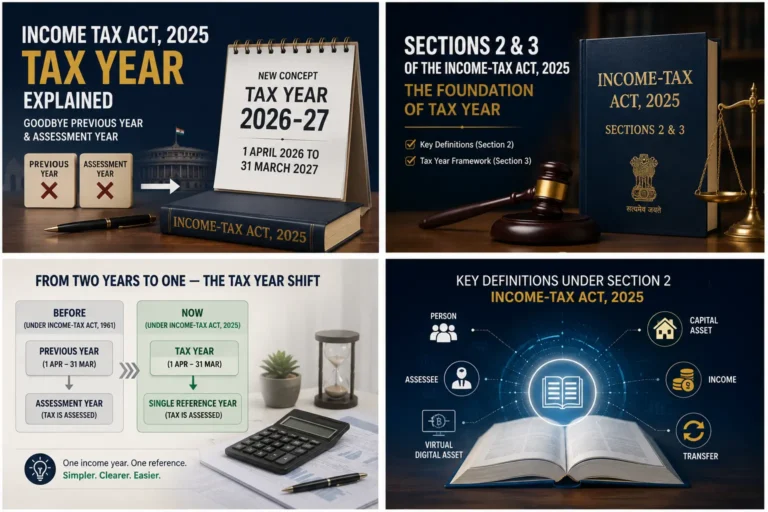
Notice what Section 4 deliberately does not do: it doesn’t set the actual tax rates. That’s the Finance Act’s job, passed fresh every year at Budget time. Section 4 just says: whatever rate Parliament sets this year, here’s the legal mechanism that makes it bite. This is precisely how Section 4 worked under the 1961 Act too — the charging logic hasn’t moved, only the year-label running through it has, from “previous year” to “Tax Year.”

Scope of Total Income Under Section 5: Who Pays Tax on What
Section 4 tells you tax exists. Section 5 tells you how much of your income it can actually reach — and that answer depends entirely on where you fall on the residential status spectrum defined in Section 6. Three categories, three different nets:
Resident & Ordinarily Resident
Taxed on global income
Indian salary, foreign rental income, US bank interest — all of it counts
Resident, Not Ordinarily Resident
Indian income + limited foreign income
Foreign income only if from a business controlled, or profession set up, in India
Non-Resident
Taxed only on India-linked income
Received, accrued, or deemed to accrue or arise in India — nothing beyond that
This three-tier structure is essentially a direct carry-forward from the 1961 Act’s Section 5, and it exists for a fairly intuitive reason: In broad terms, the residential-status framework determines how much of a person’s worldwide income falls within India’s domestic tax scope. An RNOR sits deliberately in between — often a returning NRI who hasn’t yet reset their residency clock — and gets treated closer to a non-resident on foreign income specifically, even while being classified a “resident” for other purposes.

The Three Income Buckets Under Section 5
Strip away the residential-status labels for a moment, and Section 5 is really just sorting every rupee of income into three buckets, then deciding which buckets apply to which taxpayer:
| Income Bucket | ROR | RNOR | Non-Resident |
|---|---|---|---|
| Received or deemed received in India | Taxable | Taxable | Taxable |
| Accrues or arises (or is deemed to) in India | Taxable | Taxable | Taxable |
| Accrues outside India, from a foreign business controlled or profession set up in India | Taxable | Taxable | Not taxable |
| Accrues outside India, unrelated to any India-controlled business | Taxable | Not taxable | Not taxable |
Rohan moved to Singapore in 2019 and qualifies as a non-resident for Tax Year 2026-27. He earns a Singapore salary, holds a rental property in Chennai, and receives dividends from a UK brokerage account. Assuming the Singapore salary and UK dividends are received outside India and do not otherwise accrue or arise, or become deemed to accrue or arise, in India, only the Chennai rental income falls within the scope of Section 5. Compare this to his cousin Priya, an ROR living in Mumbai with the same UK dividend income: for her, that dividend is fully taxable in India, simply because her global income is in scope.

Income Tax Act 2025 Sections 4 and 5 vs the 1961 Act
| 1961 Act | 2025 Act | What Changed |
|---|---|---|
| Section 4 — Charge of income-tax | Section 4 — Charge of income-tax | Same section number, same charging logic |
| Section 5 — Scope of total income | Section 5 — Scope of total income | Same section number, three-tier structure retained |
| “Previous year” as the taxed period | “Tax Year” as the taxed period | Terminology only, per Section 3 |
| Residential status defined in Section 6 | Residential status defined in Section 6 | Structure unchanged, drafting tightened |
- Assuming NRI status alone exempts all foreign income — it doesn’t. Indian-sourced income, like rent from a Chennai flat or interest from an NRO account, stays taxable in India regardless of where you live
- Treating RNOR as identical to non-resident — RNOR is genuinely a middle category; foreign business income controlled from India can still be taxable even though most other foreign income isn’t
- Ignoring Section 9’s deeming provisions — Section 5 sets the scope, but Section 9 contains deeming provisions that can treat certain income as accruing or arising in India, including specified royalty, fees for technical services and income connected with a significant economic presence in India.
- Forgetting DTAA relief exists separately — Section 5 determines what’s taxable in India on paper; a Double Taxation Avoidance Agreement can still reduce or eliminate the actual tax where the same income is also taxed abroad

Frequently Asked Questions: Sections 4 and 5 of the Income-tax Act, 2025
What’s the actual difference between Section 4 and Section 5?
Section 4 establishes that income-tax exists and applies to the total income of a Tax Year, at whichever rate the year’s Finance Act sets. Section 5 defines whose income, and how much of it, actually falls inside that net — the answer depends on residential status under Section 6.
Does a Non-Resident Indian pay tax on salary earned abroad?
Generally, salary for services performed outside India by a non-resident is outside the Indian tax scope if it is neither received or deemed received in India nor accrued or deemed to accrue or arise in India. However, the place of receipt and the deeming provisions under Section 9 must also be considered. Indian-source income, such as rent from an Indian property, remains within the scope of Section 5.
How is RNOR different from a regular resident for tax purposes?
An RNOR is taxed on Indian income the same way any resident is, but their foreign income is taxable only if it comes from a business controlled in India or a profession set up in India. Foreign income unrelated to any India-based business or profession stays out of scope — unlike a full ROR, who’s taxed on global income without that carve-out.
Have Sections 4 and 5 changed in substance under the 2025 Act?
No. Both sections retain the same section numbers and the same underlying structure as the 1961 Act. The charging mechanism and the three-tier residential-status scope are unchanged — the drafting has been tightened, and “previous year” has become “Tax Year,” but the tax outcome is the same.
Does Section 5 override India’s tax treaties?
No. Section 5 determines what’s taxable in India under domestic law. Where a Double Taxation Avoidance Agreement applies and the same income is also taxed in another country, treaty relief operates separately, typically through exemption or credit, and can reduce what’s actually payable even where Section 5 brings the income into scope.
Income Tax Act 2025 — Chapter I to III Series
Income Tax Bill, 2025: Major Structural Changes In Income Tax
Why the 1961 Act got rewritten, and what changed structurally.
Part 1Income Tax Act 2025: Tax Year, Previous Year & AY Explained
One term instead of two, and a consolidated definitions clause.
Charge of Income-tax & Scope of Total Income (§4–5)
Who’s taxed, on what, and how residential status decides the scope.
Residential Status of Individuals Under Section 6
The day-count tests that decide which category you fall into.
Section 4 is the foundation: it establishes the charge of income-tax on the total income of a Tax Year at the rates prescribed by law. Section 5 then determines which income falls within India’s tax scope, and residential status plays a central role in that determination. The final tax payable, however, depends on the wider provisions of the Act, including applicable exemptions, deductions, rebates, special rates and other reliefs. If you’re planning a move abroad or back to India, understanding your residential status — and knowing which income falls within the relevant scope — can therefore be one of the most important starting points for your tax planning.

Sources & References
- Income Tax Department — Income-tax Act, 2025 (official downloads)Income Tax Department, Government of India
- Income-tax Act, 2025 [Act No. 30 of 2025] — full text, as amended by Finance Act, 2026Income Tax India, incometaxindia.gov.in
- Gazette of India — Income-tax Act, 2025 notification (CG-DL-E-22082025-265620)Official Gazette of India
- CBDT Press Release — Income-tax Act, 2025 comes into force from 1 April 2026Central Board of Direct Taxes, Ministry of Finance
Sections 4 and 5 discussed in this article are reproduced and explained in summary form for reader convenience. Always cross-check against the official Gazette text linked above before relying on this for compliance or filing decisions.
Disclaimer: This article is for general informational purposes only and does not constitute tax or legal advice. The Income-tax Act, 2025 and related rules are subject to notifications and amendments by the CBDT. Please consult a qualified Chartered Accountant for advice specific to your situation.