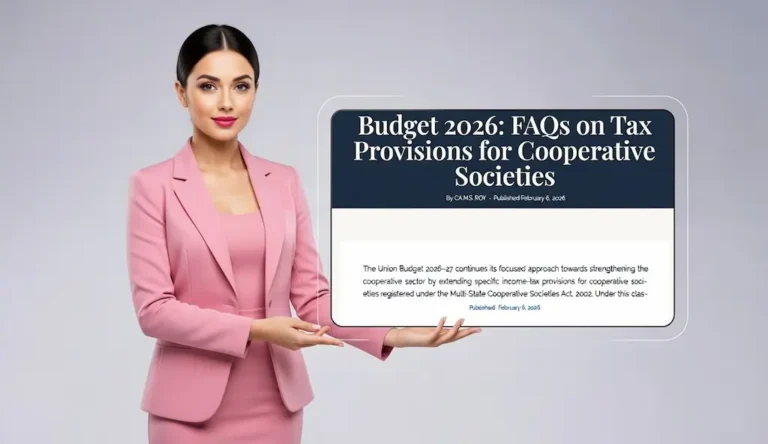
You already know the drill: income earned in the “previous year” gets taxed in the “assessment year.” The Income-tax Act, 2025 stops asking you to hold both terms in your head at once.
If you’ve filed income-tax returns for a few years, the distinction between “previous year” and “assessment year” probably feels routine — even though it has long been one of the more confusing parts of Indian income-tax terminology. The Income Tax Act 2025 Tax Year framework changes that approach by using a single Tax Year reference for income earned under the new Act. Sections 2 and 3 of the Income-tax Act, 2025 are central to this change: Section 2 sets out the key definitions, while Section 3 establishes the Tax Year framework that replaces the earlier previous year and assessment year terminology.
Applicability note: The Income-tax Act, 2025 applies from 1 April 2026. Accordingly, income earned during FY 2026-27 is governed by the new Act and is referred to as Tax Year 2026-27. Income for FY 2025-26 continues to be governed by the Income-tax Act, 1961 and is assessed as AY 2026-27.
Why Two Years Became One
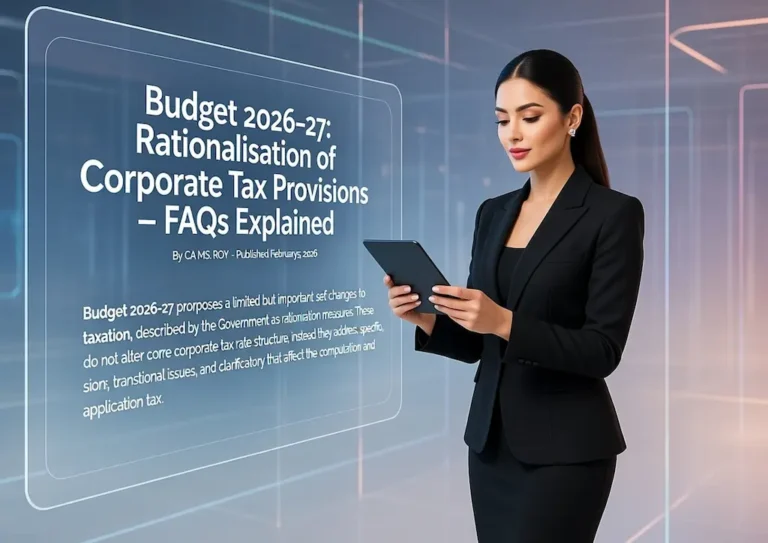
Under the 1961 Act, income earned between April 2025 and March 2026 was your “previous year.” It wasn’t taxed, though, until the “assessment year” that followed: April 2026 to March 2027. Two labels for one financial year’s income, and in my experience, it’s the single most common point of confusion for anyone filing a return for the first time — including some who’ve been doing this for years and still pause to double-check which label applies where.
Previous Year
The year income was earned
e.g. FY 2025-26: 1 Apr 2025 – 31 Mar 2026
1961 Act termAssessment Year
The year income was assessed
e.g. AY 2026-27: 1 Apr 2026 – 31 Mar 2027
1961 Act termTax Year
One term, income earned = income assessed
Same 1 Apr – 31 Mar window, single label
2025 Act termSection 3 collapses that old pair into a single Tax Year: the same 12-month window in which income is earned. The assessment still happens afterward — that part of the process hasn’t gone anywhere — the law simply no longer needs a separate name for it. Section 536(3) provides the transitional bridge for earlier years: references to a Tax Year beginning on or before 1 April 2025 are to be read with reference to the corresponding previous year under the Income-tax Act, 1961. The transition does not by itself change the tax treatment applicable to those earlier years. In simple terms, the new Tax Year terminology replaces the old previous year and assessment year pairing for periods governed by the new Act.

The One Genuine Exception: Newly Set-Up Businesses
There’s a scenario where the Tax Year doesn’t simply run 1 April to 31 March — worth knowing if you’re starting a business or a new income stream mid-year.
- Under Section 3(2), where a business or profession is newly set up, or a new source of income arises during a financial year, the Tax Year for that specific business or source begins on the date it was set up — not on 1 April.
- It still ends on 31 March of that same financial year, giving you a shorter-than-12-month first Tax Year for that source.
- From the following year onward, it reverts to the standard 1 April–31 March cycle like any other source of income — the shortened first year is a one-time event, not a recurring feature.
Suppose you launch a consulting practice on 1 December 2026. Your Tax Year for that practice runs from 1 December 2026 to 31 March 2027 — a four-month period, not twelve. From the next year onward, it follows the standard 1 April–31 March cycle. This mirrors exactly how “previous year” worked for new businesses under the 1961 Act — the logic hasn’t changed, just the name of the concept carrying it.
One Definitions Clause Instead of Many Under Section 2 of Income Tax Act 2025
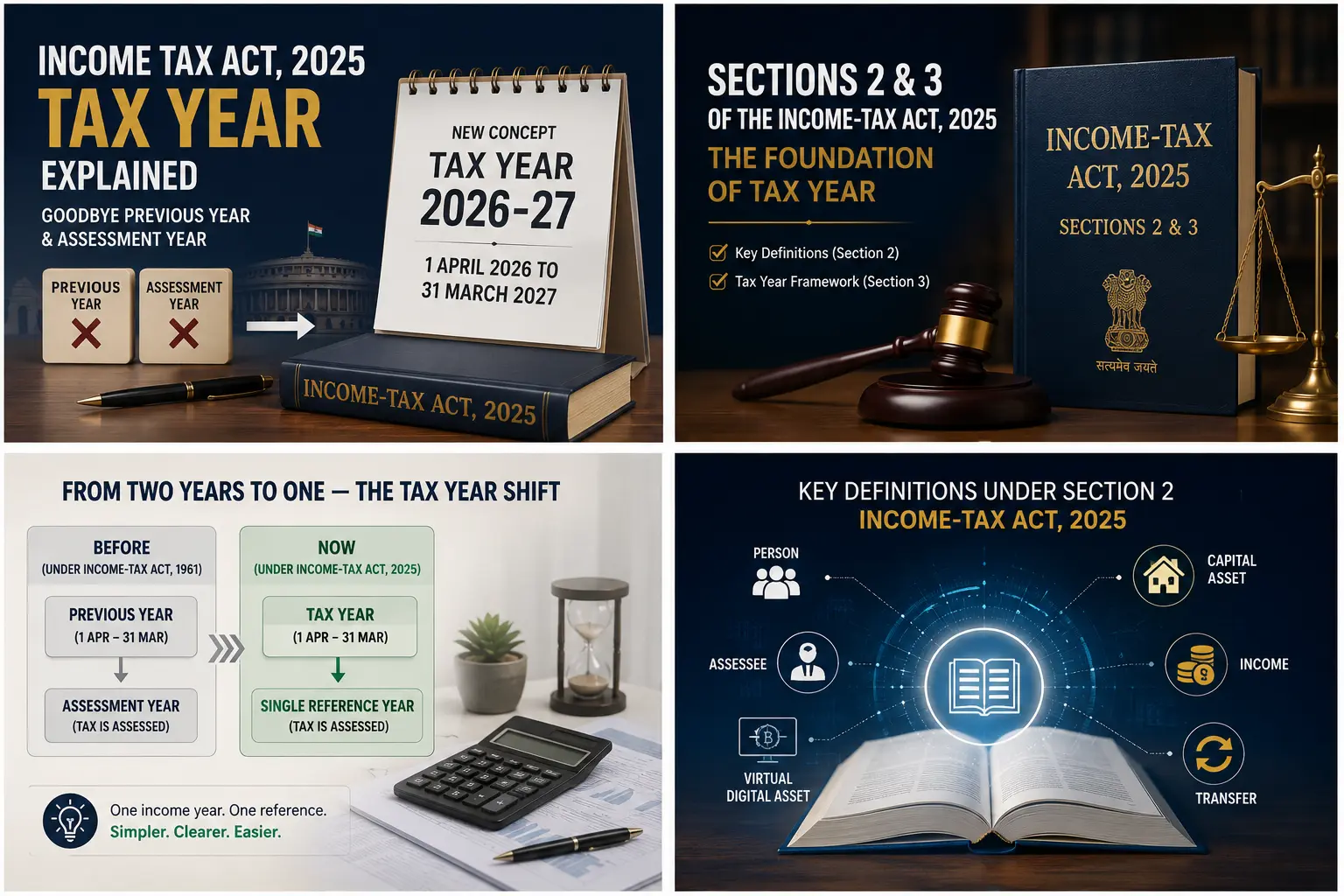
The Income-tax Act, 2025 makes it easier to understand the important terms used throughout the law. Section 2 brings together a wide range of key definitions in one place, making it easier for taxpayers and professionals to check the meaning of a term without having to search through multiple provisions. Many familiar concepts from the Income-tax Act, 1961 continue under the new Act, including person, assessee, income, capital asset and transfer. The main change here is not that these concepts have been completely reinvented, but that the new Act presents these important definitions within a more consolidated framework.
Person
Still the seven-category structure: individuals, HUFs, companies, firms, associations of persons or bodies of individuals, local authorities, and every other artificial juridical person.
Assessee
A person liable to pay tax or any sum under the Act, or a person in respect of whom any proceeding has been initiated — including where someone is assessable for another’s income.
Virtual Digital Asset
Meaningfully expanded — now explicitly covers cryptocurrencies, NFTs, and any other digital asset category the government notifies going forward.
Capital Asset, Income, Transfer
Retained largely in substance from the 1961 Act, but drafted with fewer cross-references and less reliance on judicial interpretation to fill gaps.
The practical upshot for anyone reading the Act directly: you’re far less likely to need three other sections open in separate tabs just to understand what one term means.

Old Term vs New Term, Side by Side
| 1961 Act | 2025 Act | What Changed |
|---|---|---|
| Previous Year + Assessment Year | Tax Year | Two overlapping year-labels merged into one |
| Section 2 (definitions, cross-referenced elsewhere) | Section 2 (consolidated clause) | Definitions gathered into one place |
| Section 3 (previous year) | Section 3 (tax year) | Same 12-month logic, single name |
| Narrower VDA definition (2022-era) | Expanded VDA definition | Explicitly covers crypto, NFTs, notified digital assets |
- Your accounting year stays the same — books, GST filings, and financial statements are unaffected by the Tax Year rename
- Tax liability is unchanged — Section 536(3) confirms this is a terminology shift, not a computation change
- The seven categories of “person” are unchanged — consolidation into one clause doesn’t alter who qualifies as an assessee
- Historical notices and orders still use old terms — you’ll need to mentally map “Tax Year 2026-27” back to “AY 2027-28” when reading older records
Income Tax Act 2025 Tax Year — Frequently Asked Questions
When does the Tax Year concept actually take effect?
The Income-tax Act, 2025 comes into force from 1 April 2026. Therefore, income earned during FY 2026-27 is governed by the new Act and is referred to as Tax Year 2026-27. Income earned during FY 2025-26 continues to be governed by the Income-tax Act, 1961 and is assessed as AY 2026-27.
Does replacing “previous year” and “assessment year” with “Tax Year” change how much tax I pay?
No. The change primarily replaces the previous year / assessment year terminology with a single Tax Year reference. The tax computation and assessment process continue to operate under the substantive provisions of the new Act; the change in terminology does not itself increase or reduce your tax liability.
What’s the Tax Year for a business I start partway through the year?
It begins on the date the business is set up (or the new income source arises) and ends on 31 March of that same financial year — a shorter first Tax Year. From the next year onward, it follows the standard 1 April–31 March cycle.
Has the definition of “person” or “assessee” changed under the new Act?
Not in substance. Both retain their 1961 Act structure — the seven categories of “person” and the liability-based test for “assessee” carry forward largely unchanged, just consolidated into a single, more readable clause.
Is the virtual digital asset definition broader under the 2025 Act?
Yes. It expressly extends to cryptocurrencies, NFTs, and any other digital asset category the government notifies going forward — wider than the 1961 Act’s original 2022 definition.
Is Assessment Year completely abolished under the Income-tax Act, 2025?
For income governed by the Income-tax Act, 2025, the separate “assessment year” terminology is replaced by the Tax Year framework. However, earlier years continue to be governed by the Income-tax Act, 1961 and may continue to use the previous year and assessment year terminology.
What is the difference between FY 2025-26 and Tax Year 2026-27?
FY 2025-26 covers income earned from 1 April 2025 to 31 March 2026 and remains governed by the Income-tax Act, 1961, with Assessment Year 2026-27. Income earned from 1 April 2026 to 31 March 2027 is governed by the Income-tax Act, 2025 and is referred to as Tax Year 2026-27. There is no gap or overlap between the two periods.
Do businesses need to change their accounting year because of the new Tax Year concept?
No. The introduction of Tax Year does not require businesses to change their accounting period or financial year. The Tax Year ordinarily follows the same 1 April to 31 March period as the financial year.
Income Tax Act 2025 — Chapter I to III Series
Income Tax Bill, 2025: Major Structural Changes In Income Tax
Why the 1961 Act got rewritten, and what changed at a structural level.
Clause 1Clause 1 of the Income-tax Bill, 2025: Scope and Commencement
Short title, territorial extent, and the notification-based commencement mechanism.
Key Definitions & the “Tax Year” Under Income Tax Act 2025 (§2–3)
One term instead of two, and a consolidated definitions clause.
Charge of Income-tax & Scope of Total Income (§4–5)
Who’s taxed, on what, and how residential status changes the scope.
The Tax Year change is primarily a change in terminology and structure: the new Act uses a single Tax Year reference instead of the previous year and assessment year pairing. The key exception to remember is the shortened first Tax Year for a newly set-up business or new source of income. For existing taxpayers, the familiar 1 April to 31 March cycle continues, while other provisions of the Income-tax Act, 2025 may introduce separate substantive or procedural changes.

Primary source: Income-tax Act, 2025 — official text published by the Income Tax Department, Ministry of Finance, Government of India.
This article primarily refers to Sections 2 and 3 of the Income-tax Act, 2025 and the relevant transitional provisions under Section 536.
The Act is subject to amendments, rules, notifications and clarifications issued by the Government and the CBDT. Readers should refer to the latest official version for the law applicable to their circumstances.
Disclaimer: This article is for general informational purposes only and does not constitute tax or legal advice. The Income-tax Act, 2025 and related rules are subject to notifications and amendments by the CBDT. Please consult a qualified Chartered Accountant for advice specific to your situation.