No form to fill, no bill to save, no proof to submit. This is the deduction that just happens, quietly, on every single payslip in the country.
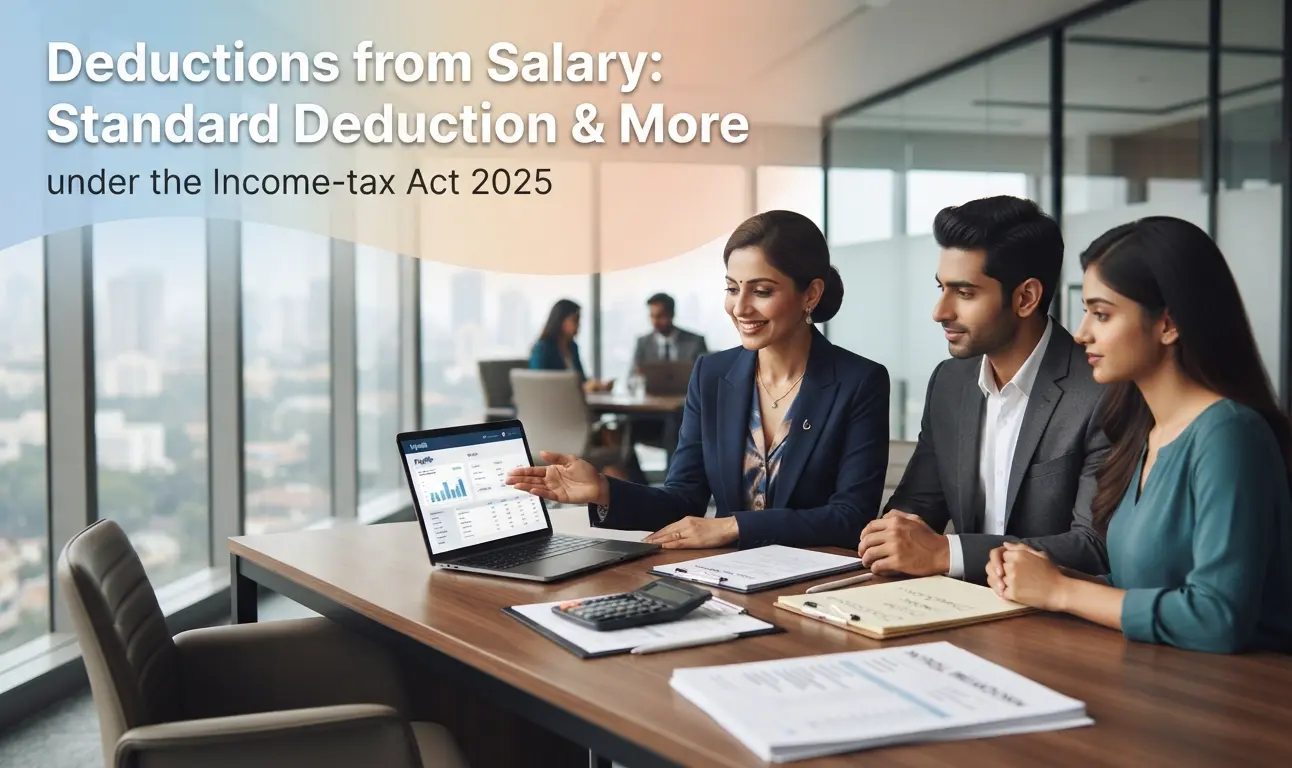
The last two parts of this series covered exits, retirement, resignation, a job ending one way or another. This part is about something far more routine: the standard deduction under the Income Tax Act, 2025 is dealt by Section 19., the flat deduction nearly every salaried person and pensioner in India claims automatically, whether they realise it or not. Alongside it sit two smaller deductions with a genuinely important catch: professional tax and entertainment allowance are the two items in this section that the new tax regime simply doesn’t allow.
Applicability note: These figures apply for Tax Year 2026-27 onward. Standard deduction sits at Section 19, Table Sl. No. 2 (corresponding broadly to Section 16(ia) of the Income-tax Act, 1961); professional tax at Table Sl. No. 1 (corresponding to old Section 16(iii)); and entertainment allowance elsewhere within the same Section 19 table (corresponding to old Section 16(ii)). This is the reverse pattern from everything else in this series: professional tax and entertainment allowance, not the rest, are the items excluded from the new-regime computation.
Standard Deduction Under the Income Tax Act 2025
The standard deduction is about as simple as tax law gets: a flat amount subtracted from your salary before tax is calculated, with no expenditure to prove and no investment to make. It exists to give salaried taxpayers something close to the blanket relief that business owners get through their actual expense deductions, without the paperwork.
| Regime | Standard Deduction |
|---|---|
| Old Tax Regime | ₹50,000 |
| New Tax Regime | ₹75,000 |
It’s worth knowing how this figure got here. The standard deduction was scrapped entirely in 2005, reintroduced in 2018 at ₹40,000, raised to ₹50,000 the following year, and then specifically increased to ₹75,000 for the new regime as part of the 2024 Budget changes, a deliberate move to make the new regime’s trade-off, fewer exemptions in exchange for lower slab rates, feel less one-sided. It’s now one of only a handful of deductions the new regime actually allows, which is exactly why it’s worth claiming correctly rather than assuming your payroll software has already handled it perfectly.
Who Actually Gets the Standard Deduction
The deduction applies to anyone with income taxable under the “Salaries” head, which is broader than just people currently drawing a paycheque.
Salaried Employees
Including Non-Resident Indians with salary income taxable in India
Pensioners
Since pension from a former employer is itself treated as salary income
What it doesn’t cover is just as important: income from business or profession, rental income, or capital gains don’t attract this deduction at all, since it’s specifically tied to the Salaries head. And if you switched jobs mid-year, or worked two jobs at once, the deduction still doesn’t multiply. It’s an annual ceiling on the person, not a per-employer allowance, someone with two employers in the same year still claims one ₹50,000 or ₹75,000 total, not one for each job.
Professional Tax Deduction: Old Regime Only
Professional tax isn’t really a tax on professionals specifically, despite the name, it’s a small tax that individual states are permitted to levy on employment, trade, and profession, capped constitutionally at a modest amount per year under Article 276(2) of the Constitution. Whatever amount you actually pay is fully deductible from your salary income, no partial limits, no formula.
The catch is entirely about which regime you’re in. Professional tax is one of two items in Section 19’s table that Section 202 specifically strips out of the new-regime computation, everything else in this series, gratuity, leave encashment, pension commutation, retrenchment, VRS, and the standard deduction itself, survives under both regimes. Professional tax and entertainment allowance, covered next, are the exceptions, and both run the opposite direction: available under the old regime, unavailable under the new one.
Whether this even applies to you depends on where you work. Professional tax isn’t levied uniformly across India; several states impose it on salaried employees, while others don’t levy it at all. If your payslip doesn’t show a professional tax deduction, it may simply be that your state doesn’t collect it, rather than any error in how it’s been computed.

Entertainment Allowance: A Narrower Deduction Than It Sounds
Entertainment allowance, paid to cover hospitality expenses like client meetings or official functions, is fully taxable for almost everyone who receives it. The one exception is a deduction available exclusively to Central and State Government employees, not PSU staff, not local authority employees, not private-sector employees of any kind. If you work for a state-owned enterprise or a statutory body rather than the government itself, this deduction doesn’t apply to you even though the two can feel similar on paper.
For the government employees who do qualify, the deduction is the least of three figures: the actual entertainment allowance received, 20% of salary, calculated excluding other allowances, benefits, and perquisites, or a flat ₹5,000. Like professional tax, it’s available only under the old tax regime; opting for the new regime removes this deduction entirely, regardless of how much entertainment allowance you actually receive.
Don’t Confuse This With the Family Pension Deduction
Here’s a distinction worth being precise about, because the two deductions share a name and nothing else. A pensioner receiving their own pension gets the regular standard deduction covered above, ₹50,000 or ₹75,000 depending on regime, exactly like any other salaried taxpayer, because that pension is taxed under the Salaries head.
A family member receiving a deceased pensioner’s family pension is in a completely different position. That income isn’t taxed under Salaries at all, it falls under Income from Other Sources, and it carries its own, much smaller deduction: the lower of one-third of the family pension received, or ₹25,000 a year, a figure itself raised from ₹15,000 in a recent Budget. If you’re helping a family member file a return that includes a family pension, don’t apply the salary standard deduction to it by mistake, the two figures, the two heads of income, and the two mechanisms are all different.
Meera earns a salary of ₹9,00,000 a year and has opted for the new tax regime. Her taxable salary, before any other adjustment, is reduced by the ₹75,000 standard deduction alone, bringing it down to ₹8,25,000. Her father, a retired bank employee, receives his own pension of ₹4,00,000 a year, which also gets the standard deduction since it’s taxed as salary. Her mother separately receives a family pension of ₹1,80,000 a year following her husband’s death some years earlier; that income sits under Other Sources, and the deduction available is the lower of one-third of ₹1,80,000 (which is ₹60,000) or ₹25,000, so only ₹25,000 is deducted, not the larger figure the one-third calculation would otherwise suggest.
- Assuming the standard deduction needs bills or proof — it doesn’t. It’s automatic, applied by your employer during TDS computation and pre-filled on your ITR
- Claiming the standard deduction twice for two employers in the same year — the ₹50,000 or ₹75,000 figure is a single annual ceiling, not a per-employer allowance
- Expecting professional tax deduction under the new regime — it isn’t available there at all, regardless of how much was actually deducted from your salary during the year
- Assuming entertainment allowance deduction applies to any government-adjacent job — it’s restricted specifically to Central and State Government employees; PSU staff, local authority employees, and statutory body employees don’t qualify, even though the distinction can feel arbitrary
- Applying the salary standard deduction to a family pension — family pension uses a separate, smaller deduction under an entirely different head of income
Frequently Asked Questions
What is the standard deduction limit under the Income Tax Act 2025?
₹50,000 under the old tax regime and ₹75,000 under the new tax regime. It applies automatically to salaried employees and pensioners, with no bills or investment proof required.
Is professional tax deductible under the new tax regime?
No. Professional tax, the deduction at Section 19’s Table Sl. No. 1, is specifically excluded from the new-regime computation under Section 202. It remains fully deductible only under the old tax regime.
Who can claim the entertainment allowance deduction?
Only Central and State Government employees. Private-sector, PSU, and local authority employees receive no deduction on entertainment allowance at all; the entire amount is taxable for them. Where it applies, the deduction is the least of the actual amount received, 20% of salary, or ₹5,000, and it’s available only under the old tax regime.
Can I claim the standard deduction from two employers in the same year?
No. The standard deduction is an annual ceiling on the individual, not a per-employer allowance. If you had two employers in the same Tax Year, you still claim only one ₹50,000 or ₹75,000 total, based on your chosen regime.
Do pensioners get the standard deduction too?
Yes. Pension received from a former employer is treated as salary income, so pensioners receive the same standard deduction as any other salaried taxpayer. This is different from family pension received by a deceased pensioner’s family, which follows a separate rule under Income from Other Sources.
What is the deduction limit for family pension?
The lower of one-third of the family pension received, or ₹25,000 a year, recently raised from ₹15,000. This is a distinct deduction under Income from Other Sources, not the salary standard deduction, since family pension isn’t taxed as salary income to the recipient.
Income From Salaries — Series Index
Gratuity & Leave Encashment: Exemption Rules Explained
The statutory formulas under Section 19, and why regime choice doesn’t touch either one.
Part 7Pension, Retrenchment & VRS: The Rest of Section 19
Commuted pension, retrenchment compensation, and the once-in-a-lifetime VRS exemption.
Deductions from Salary: Standard Deduction & More
The automatic deduction everyone gets, and the two deductions the new regime doesn’t allow.
This is the least dramatic article in the series, no formulas to compute, no ceilings to negotiate, no once-in-a-lifetime decisions to get right. But that’s also why it’s worth a second look: the standard deduction is applied automatically, which makes it easy to assume it’s always applied correctly. Check your payslip and Form 16 for the actual figure your employer has used, particularly if you’ve changed jobs mid-year or moved between regimes, and you’ll close out this series with your salary computation genuinely complete rather than merely assumed to be.
Sources & References
- Income-tax Act, 2025 [Act No. 30 of 2025] — full text, as amended by Finance Act, 2026Income Tax India, incometaxindia.gov.in
- Section 19 — Deductions From SalariesIncome Tax India, incometaxindia.gov.in
- Section 202 — New Tax Regime for Individuals, HUF and OthersIncome Tax India, incometaxindia.gov.in
Standard deduction and professional tax figures discussed here are summarised for reader convenience. The family pension deduction is governed under a different head of income entirely and is included here only to prevent confusion with the salary standard deduction. Always cross-check against the official Act text linked above and consult a Chartered Accountant before relying on this for a filing decision.
Disclaimer: This article is for general informational purposes only and does not constitute tax or legal advice. The Income-tax Act, 2025 and related rules are subject to notifications and amendments by the CBDT. Please consult a qualified Chartered Accountant for advice specific to your situation.