An email lands from the Income Tax Department saying your return is “defective.” Before you panic — this isn’t an accusation, it’s a 15-day invitation to fix something small.
You filed on time, checked it twice, and moved on — then an email arrives calling your return “defective.” It sounds alarming, but a defective return notice u/s 139(9) is one of the most routine, fixable communications the Income Tax Department sends. It simply means your return is missing something or doesn’t reconcile with the department’s own records — and you get 15 days to correct it before anything more serious happens.
Note on section numbers: This article uses section references from the Income-tax Act, 1961, which still govern your FY 2025-26 (AY 2026-27) return. The corresponding provision under the new Income-tax Act, 2025 is noted in brackets — that renumbering applies only from Tax Year 2026-27 returns onward (filed from July 2027), not this filing season.
What Is a Defective Return Notice Under Section 139(9)? (Section 263, Income-tax Act, 2025)
Section 139(9) empowers the Assessing Officer to treat your return as “defective” if it fails certain completeness or consistency checks laid down in the Act — and to notify you of exactly what’s wrong so you can fix it. It’s a curative provision, not a punitive one: the law’s intent is to give you a genuine chance to correct a technical or procedural gap before the return is rejected outright.
You’ll receive the notice by email (and it also appears on the e-filing portal under Pending Actions → e-Proceedings) with the subject line referencing “Communication under section 139(9)” and your PAN. The notice is a password-protected PDF — the password is your PAN in lowercase followed by your date of birth in DDMMYYYY format.
In practice, most defects are mechanical, not substantive. In my experience, the two most common triggers by far are a mismatch between reported income and what shows up in Form 26AS or the AIS, and selecting the wrong ITR form for your income profile. Neither reflects dishonesty — they reflect the sheer volume of cross-matched data the department now checks automatically.

Why Returns Get Marked Defective
TDS/TCS Mismatch
Most common
Claimed TDS doesn’t match Form 26AS/AIS
Wrong ITR Form
Frequent
e.g. ITR-1 filed despite capital gains income
Missing Schedules
Business filers
P&L or balance sheet not furnished
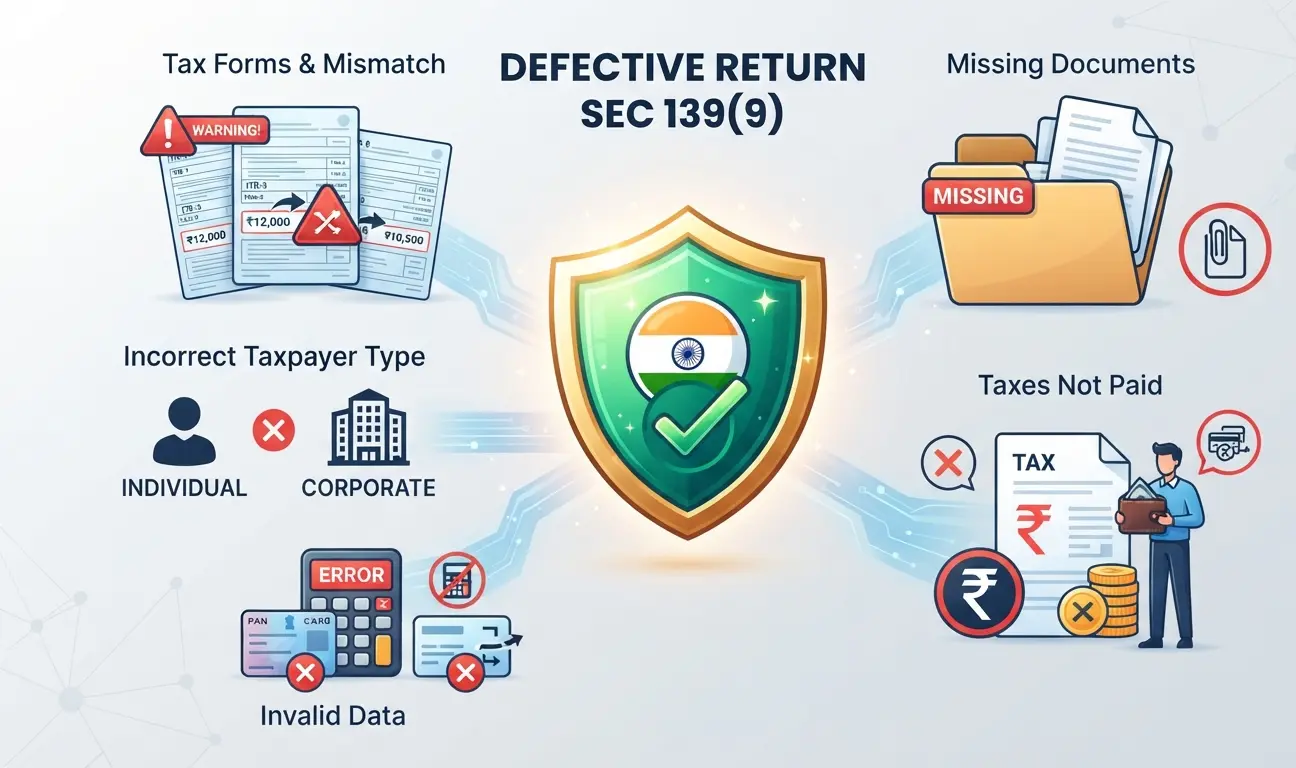
Beyond these three, other recognised defects include tax paid but the challan details not reflected in the return, income shown in your Form 26AS/AIS that’s absent from your return, incomplete mandatory fields, and inconsistent personal details such as name or PAN. For a quick-reference rundown of these definitions, see our Defective Return FAQ.
Time Limit to Respond: 15 Days
Standard Response Window
15 Days
From the date of the notice
Extension Available?
Yes
Written request to the Assessing Officer
Can You Withdraw a Response?
No
Once submitted, it’s final
The 15-day clock starts from the date of the notice, not the date you happen to read the email — so check the portal regularly rather than relying solely on your inbox. If you genuinely need more time, you can write to the Assessing Officer requesting an extension with valid reasons; this is discretionary, but commonly granted. Even if you miss the window entirely, the Assessing Officer retains discretion to condone the delay and treat the return as valid, provided you rectify it before assessment is completed — but that’s a concession, not a right, so don’t treat it as a safety net.
- Your return becomes invalid — treated as if you never filed a return for that year at all
- Section 234F late fee applies — since an invalid return is functionally a non-filed return
- Refunds stop — any refund due under the original return will not be processed
- Loss carry-forward is denied — the same restriction that applies to belated returns kicks in here too
- You may need to file a belated return instead — subject to the belated return deadline still being open
Priya filed ITR-1 for AY 2026-27, but her portfolio had ₹40,000 in capital gains from mutual fund redemptions that ITR-1 cannot report. The department flags this as defective under Section 139(9), since ITR-1 isn’t the correct form for her income profile. She has 15 days to respond — practically, this means preparing and submitting ITR-2 with the capital gains correctly disclosed. She does it in a week; her original filing date is preserved, and no penalty applies, because she acted within the window.

Defective Return (139/9) vs Revised Return (139/5): What’s the Difference?
These two get confused constantly, and the distinction matters: a defective return notice is the department telling you something is wrong and giving you a fixed 15-day window to correct it. A revised return under Section 139(5) is something you initiate voluntarily, on your own timeline, because you spotted an error yourself — with a much longer window (31 March 2027 for AY 2026-27).
If you’re responding to a 139(9) notice, you correct the defect through the notice-response workflow itself, not by filing an independent revised return outside that process. Once the 15-day window for a notice has lapsed and you still want to correct something, that route shifts to filing under Section 139(5) instead. Worth knowing too: Section 139(5) remains available to you even after receiving a 139(9) notice, for genuine errors beyond what the notice specifically flagged.
How to Respond to a Defective Return Notice: Step by Step
- Log in to the Income Tax e-filing portal and go to Pending Actions → e-Proceedings (or Response to Outstanding Demand, depending on the portal version).
- Open the Section 139(9) notice, download the Notice/Letter PDF, and read the specific defect code and description the department has identified.
- Click Submit Response. You’ll be shown two paths: Agree (you accept the defect and will correct it) or Disagree (you believe the return is not actually defective, with reasons).
- If you agree, download the JSON of your original return, correct the specific defect — wrong form, missing schedule, TDS mismatch — and upload the corrected file.
- If you disagree, enter your remarks explaining why the flagged item isn’t actually a defect, and submit for the Assessing Officer’s review.
- Review everything carefully before submitting — you cannot withdraw or edit a response once submitted.
- Save the acknowledgement; the status will update to “Response to notice under 139(9) submitted.”

How to Avoid a Defective Return Notice in the First Place
- Reconcile against Form 26AS, AIS and TIS before filing — the single highest-impact habit; most defects trace back to a mismatch here
- Choose the correct ITR form based on your actual income sources, not just what you filed last year
- Attach required schedules — P&L and balance sheet for business/professional income, audit reports where applicable
- Double-check personal details — PAN, name, and address exactly as registered
- Use pre-filled data as a starting point, not a final answer — always cross-verify auto-populated figures rather than assuming they’re complete
Frequently Asked Questions
What happens if I don’t respond to a Section 139(9) notice within 15 days?
Your original return is treated as invalid — as if you never filed a return for that assessment year. This exposes you to the Section 234F late fee, denial of loss carry-forward, and delayed or blocked refunds. You may still be able to file a belated return, subject to that deadline still being open, or request the Assessing Officer to condone the delay.
Is a defective return notice the same as a revised return?
No. A defective return notice under Section 139(9) is issued by the department pointing out a specific flaw, with a fixed 15-day window to respond. A revised return under Section 139(5) is filed voluntarily by the taxpayer, on a much longer timeline, to correct self-discovered errors — not in response to a departmental notice.
Can I get an extension to respond to a defective return notice?
Yes. You can submit a written application to the Assessing Officer requesting additional time, with valid reasons. Granting an extension is discretionary, but it’s commonly allowed when the request is reasonable and timely.
Can I withdraw or edit my response after submitting it?
No. Once you submit your response to a Section 139(9) notice, it cannot be updated or withdrawn. Review the corrected return and your remarks carefully before final submission.
Does receiving a defective return notice mean I’ll face a penalty?
Not by itself. Issuance of a defective return notice does not automatically attract a penalty — it’s an opportunity to correct the return. Penalties and interest can arise only if the return ultimately becomes invalid due to non-rectification, or if the underlying issue involves concealment rather than a genuine technical defect.
Can my CA respond to the defective return notice on my behalf?
Yes. You can authorise a Chartered Accountant or another representative to view and respond to the notice through their registered access on the e-filing portal, which is common practice for anything beyond a straightforward correction.

ITR Filing & Return Correction — Complete Guide Series
ITR Filing FY 2025-26: Due Dates, Penalties & AY 2026-27 Return Guide
Every due date by taxpayer category, Section 234F penalty and ITR forms overview.
Part 2ITR Forms AY 2026-27: Key Changes in ITR-1, ITR-2, ITR-3 & ITR-4
Capital gains disclosures, F&O reporting and which form applies to you.
Part 3Belated Return Under Section 139(4): Rules, Penalty & How to File
234F penalty, 234A interest, regime lock-in and loss carry-forward rules.
Part 4Revised Return Under Section 139(5): How to Correct ITR Mistakes
Missed deductions or wrong figures? Here’s how to fix a filed return.
Part 5Updated Return (ITR-U) Under Section 139(8A): Complete Guide
Your last resort after missing every other filing window.
Defective Return Notice Under Section 139(9): How to Respond
Received a “defective return” email? Here’s exactly what to do within 15 days.
Defective Return u/s 139(9) — FAQs
Short, direct answers if you just need one quick fact fast.
The defective return notice exists precisely so honest mistakes don’t become permanent problems — but it only works if you act inside the window. The moment you receive it, read the defect code carefully, don’t guess at what’s wrong, and reconcile against Form 26AS and AIS one more time before you respond, since the same mismatch that triggered the notice can easily reappear in your correction if you don’t check the source data again. If the defect involves your ITR form choice or a schedule you’re unfamiliar with, it’s worth fifteen minutes with a Chartered Accountant rather than guessing your way through the “Agree” workflow.

Disclaimer: This article is for general informational purposes only and does not constitute tax or legal advice. Tax laws and procedures are subject to change based on CBDT notifications. Please consult a qualified Chartered Accountant for advice specific to your situation.