
Under GST, the supplier normally collects and pays tax to the Government. However, in certain notified transactions, the liability shifts to the recipient under the Reverse Charge Mechanism (RCM). This system is mainly used in sectors where tracking small suppliers is difficult and also applies to specific import and cross-border services.
For many businesses, GST Reverse Charge Mechanism becomes confusing because it affects invoicing, payment timing, GSTR-3B reporting and input tax credit (ITC) claims. Wrong reporting may lead to notices, interest or ITC mismatches.
This updated 2026 guide explains Reverse Charge Mechanism (RCM) under GST in simple terms, including when RCM applies, GTA rules, rent under RCM, time of supply, invoicing requirements and how to claim ITC correctly. If you want a quick understanding first, you can jump directly to the RCM quick summary section below.
Quick Summary — GST Reverse Charge in 60 Seconds (2026)
- Who pays GST?
Under RCM under GST, the recipient/buyer pays GST instead of the supplier, but only for notified goods/services and specified Section 9(4) transactions. - Common RCM cases:
- Advocate → Business entity
- GTA services (where forward charge is not opted)
- Director services → Company
- Certain Government services → business entities
- Import of services under GST
- Important 2025–26 update:
From 16-Jan-2025, composition taxpayers are excluded from the notified renting by unregistered → registered person RCM entry. Also, sponsorship services by a body corporate shifted to forward charge. - How to pay RCM?
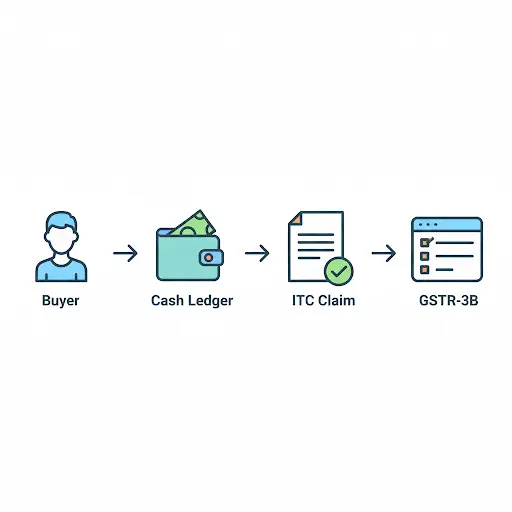
GST under reverse charge must be paid through the electronic cash ledger only. ITC cannot be used to discharge RCM liability. Once paid, eligible businesses may claim Input Tax Credit (ITC). - Where to report in GSTR-3B?
- RCM liability: Table 3.1(d)
- Domestic RCM ITC: Table 4(A)(3)
- Import of services ITC: Table 4(A)(2)
- Do not report RCM inward supplies in GSTR-1.
- Time of Supply under RCM:
- Goods: Earliest of receipt/payment/30 days from invoice
- Services: Earlier of payment/60 days from invoice (otherwise, book-entry date)
- Documents required:
- Supplier invoice should mention: “Tax payable on reverse charge”
- For notified 9(4) transactions from unregistered suppliers, issue:
- Self-invoice
- Payment voucher
- Simple mental model:
Pay RCM first → Claim eligible ITC → Maintain proper audit trail and invoices.
What is Reverse Charge Mechanism (RCM) Under GST?
Under the normal GST system, the supplier collects and pays GST to the Government. However, under the Reverse Charge Mechanism (RCM), the responsibility to pay GST shifts from the supplier to the recipient of goods or services for specified notified transactions.
RCM provisions mainly operate through:
- Section 9(3) of the CGST Act
- Section 5(3) of the IGST Act
These sections empower the Government to notify categories of goods and services where the recipient must pay GST directly.
Certain transactions involving purchases from unregistered suppliers may also attract RCM under Section 9(4), but only for specifically notified classes of taxpayers and transactions. The earlier blanket reverse charge system on all purchases from unregistered persons is no longer applicable.
In practical terms, the nature of GST does not change under RCM — only the person responsible for payment and compliance changes.
Example: Why RCM Under GST Matters
Suppose ABC Manufacturing Ltd. obtains a legal opinion from Advocate Mr. Sharma for a professional fee of ₹50,000.
Since legal services provided by an individual advocate to a business entity fall under notified RCM provisions, the advocate issues an invoice without charging GST.
ABC Manufacturing Ltd. must then:
- Pay ₹9,000 GST (18%) directly to the Government through the electronic cash ledger while filing GSTR-3B
- Report the liability under the applicable RCM table
- Claim Input Tax Credit (ITC) of ₹9,000, subject to satisfaction of Section 16 conditions
The Government ultimately receives the same tax revenue. The difference is that the compliance responsibility shifts to the business recipient, which is generally considered better equipped to handle tax payment, reporting and documentation requirements properly.
Example: GTA Services — RCM vs Forward Charge
Suppose Mumbai Traders Ltd. hires a Goods Transport Agency (GTA) for transportation services worth ₹25,000.
Scenario 1 — GTA Under Reverse Charge (RCM)
If the GTA has not opted for forward charge, GST liability shifts to the recipient under RCM.
In this case:
- Mumbai Traders Ltd. pays 5% GST (₹1,250) under reverse charge
- The tax must be paid through the electronic cash ledger while filing GSTR-3B
- Subject to eligibility, the company can later claim ITC of ₹1,250
The GTA invoice is generally issued without charging GST under forward charge.
Scenario 2 — GTA Under Forward Charge
If the GTA has exercised the option to pay GST under forward charge by filing the required declaration under Notification No. 3/2022 – CTR (Annexure V), the compliance position changes completely.
In that situation:
- The GTA charges 12% GST directly on the invoice
- Mumbai Traders Ltd. pays the invoice including GST to the transporter
- No reverse charge liability arises for the recipient on that freight transaction
Practical Tip
A GTA’s choice between RCM and forward charge directly changes the recipient’s GST compliance responsibility.
Businesses should therefore:
- Obtain the GTA’s declaration status at the beginning of the financial year
- Maintain the declaration copy in GST records
- Configure vendor masters correctly in the ERP/accounting system to avoid incorrect GST treatment

Legal Framework and Key Provisions
The legal foundation of RCM under GST is primarily contained in the following provisions:
- Section 9(3) of the CGST Act — empowers the Government to notify specific goods or services where the recipient pays GST instead of the supplier.
- Section 9(4) of the CGST Act — covers certain notified purchases from unregistered suppliers by specified classes of registered persons.
Similar provisions are contained under:
- Section 5(3) of the IGST Act
- Section 5(4) of the IGST Act
for inter-State transactions and import-related cases.
Once a transaction falls under reverse charge, the recipient becomes the person liable to pay GST, and the related compliance responsibilities also shift accordingly, including:
- Payment of GST
- Reporting in GSTR-3B
- Maintenance of records and documentation
- Claim of eligible ITC
Types of Reverse Charge Scenarios
Type 1 – Nature-Based RCM
Under this category, the nature of the goods or services itself triggers RCM because the transaction is specifically notified by the Government.
Common examples include:
- Legal services provided to business entities
- GTA services in specified cases
- Director services to a company
- Certain Government services
- Renting of immovable property in notified situations
These transactions are mainly covered through Notification No. 13/2017 – Central Tax (Rate) and related amendments.
Type 2 – Registration-Based RCM
This category applies to certain notified purchases from unregistered suppliers under Section 9(4).
However, it is important to note that:
Not every purchase from an unregistered supplier attracts RCM today.
Only specifically notified classes of recipients and transactions are covered under the present framework. (source: Notification No. 13/2017- Central Tax (Rate)
Goods Subject to Reverse Charge (Illustrative List)
Certain notified goods are also covered under reverse charge provisions. Common examples include:
- Cashew nuts (not shelled or peeled)
- Tendu leaves
- Tobacco leaves
- Silk yarn
- Used vehicles sold by Government departments
- Seized or confiscated goods
- Old and used goods
- Waste and scrap supplied by Government authorities to registered persons
Since RCM applicability depends on the exact supplier-recipient combination and notification wording, businesses should always verify the latest provisions under:
- Notification No. 4/2017 – Central Tax (Rate)
- Subsequent amendments such as Notification No. 36/2017 – CTR and later updates. (source: Refer Circular No. 76/50/2018-GST)
Services Under Reverse Charge (Key RCM Entries)
The following are some of the most important services covered under GST Reverse Charge Mechanism (RCM):
- Legal services provided by an individual advocate or law firm to a business entity
- Goods Transport Agency (GTA) services where the GTA has not opted for forward charge
- Director services provided to a company
- Certain Government services supplied to business entities, including specified renting of immovable property cases
- Services provided by insurance agents to insurance companies
- Services provided by recovery agents to banks, financial institutions or NBFCs
- Services provided by an arbitral tribunal to a business entity
Since GST RCM entries are amended from time to time, businesses should always verify the latest applicability under Notification No. 13/2017 – Central Tax (Rate) and related amendments before making compliance decisions. (source: refer full list of N/no. 13/2017)
Recent Changes in 2025-2026
On 16 January 2025, CBIC implemented key recommendations of the 55th GST Council Meeting through amended GST rate notifications affecting certain RCM under GST entries.
Two major practical changes are important for businesses:
- Sponsorship services provided by a body corporate were shifted from reverse charge to forward charge, meaning the supplier is now responsible for charging and paying GST.
- Composition taxpayers were excluded from the notified RCM entry relating to renting of commercial/immovable property by an unregistered person to a registered person.
The GST Council also recommended regularisation of the period from 10 October 2024 to 15 January 2025 for these transactions.
Because RCM applicability depends heavily on the invoice date, supplier status, and recipient registration category, businesses should carefully verify the facts before determining who is liable to pay GST. Official guidance may be referred from the relevant CBIC notifications, circulars and GST updates issued during 2025. (source: circular no. 245/02/2025 and GST newsletter)
Example: Impact of Changes on Businesses
Consider a small restaurant registered under the composition scheme that rents a shop from an unregistered individual. For invoices dated on or after 16 January 2025, that tenant is not covered by the relevant RCM entry, so the tenant does not pay RCM under GST on that rent. If monthly rent is ₹2,00,000, the earlier potential outflow of ₹36,000 (18%) vanishes from the effective date, freeing cash and avoiding extra paperwork. The landlord’s status and the tenant’s scheme matter, so keep a copy of the scheme certificate and note the effective dates on your rent working papers.

Registration Requirements Under RCM
Any person liable to pay tax under the Reverse Charge Mechanism (RCM) must obtain GST registration, even if the normal turnover threshold limit has not been crossed. (source: CGST-Act)
Registration is necessary because GST under RCM must be paid through the electronic cash ledger, and eligible taxpayers can claim Input Tax Credit (ITC) only after complying with GST registration and return filing requirements.
Businesses dealing in transactions covered under RCM should therefore review their liability carefully instead of relying only on turnover-based exemption limits.
Time of Supply Under Reverse Charge
Under GST RCM, the time of supply determines when GST liability arises. Getting this date wrong may lead to interest liability, even if the tax is paid later.
For Goods Under RCM
The time of supply is the earliest of the following:
- Date of receipt of goods
- Date of payment
- Day immediately after 30 days from the supplier’s invoice date
If none of these can be determined, use the date of entry in the books of account.
For Services Under RCM
The time of supply is the earlier of:
- Date of payment
- Day immediately after 60 days from the supplier’s invoice date
If this still cannot be determined, use the date recorded in the books of account.
Since RCM liability arises automatically once the applicable time limit is crossed, businesses should regularly monitor unpaid invoices to avoid unnoticed interest exposure. (source: Sec 13 of CGST)
Example: Time of Supply for Services Under RCM
Suppose a consulting invoice dated 5 April is received by your company, but payment is delayed.
- If payment is made on 10 May, the payment date becomes the time of supply, and GST should be discharged accordingly.
- However, if payment is still pending after 60 days, the time of supply shifts automatically to 5 June (the day immediately after completion of 60 days from invoice date).
If GST under RCM is not paid by that date, interest liability may start accruing even though actual payment to the vendor has not yet been made.
A practical compliance habit is to maintain a weekly review of unpaid RCM invoices approaching the 30-day or 60-day limit. This simple control can prevent avoidable notices and interest costs later.
GST Liability & ITC on Reverse Charge
GST payable under the Reverse Charge Mechanism (RCM) must be discharged through the electronic cash ledger while filing GSTR-3B. Input Tax Credit (ITC) cannot be used for payment of RCM liability.
Once the tax has been paid, eligible taxpayers may claim ITC in the same tax period, subject to fulfillment of conditions under Section 16 of the CGST Act, including:
- Possession of a valid tax invoice or prescribed document
- Receipt of goods or services
- Tax actually paid to the Government
- Filing of GST return within the prescribed time
In GSTR-3B, RCM liability is generally reported in:
- Table 3.1(d) → Inward supplies liable to reverse charge
- Table 4(A)(3) → Domestic RCM ITC
- Table 4(A)(2) → Import of services ITC
RCM inward supplies are not reported in GSTR-1 by the recipient. Proper disclosure and reconciliation are important because mismatches in RCM liability and ITC claims may trigger GST notices later. (source: FAQ GSTR 3B)
Invoicing & Documentation for Reverse Charge
Under Rule 46(p) of the CGST Rules, the supplier’s invoice must clearly mention that the tax is “payable on reverse charge.”
In notified cases covered under Section 9(4), where taxable supplies are received from an unregistered supplier, the recipient is required to issue:
- A self-invoice under Section 31(3)(f)
- A payment voucher under Section 31(3)(g) read with Rule 52
Businesses should maintain a proper documentation trail, including:
- Supplier invoices
- Self-invoices and payment vouchers
- RCM computation workings
- GST payment challans
- GSTR-3B copies and reconciliation records
A well-maintained audit trail helps during departmental scrutiny, GST audit and annual return reconciliation.
Payment & Compliance Requirements Under RCM
GST under reverse charge must be paid strictly through the electronic cash ledger before filing GSTR-3B. Businesses should maintain payment proofs and complete internal approval processes sufficiently before the return due date.
Taxpayers under the QRMP scheme should monitor quarterly cash-flow planning carefully because RCM liability must still be discharged within the applicable timelines.
It is also advisable to review unpaid vendor invoices regularly so that the 30-day and 60-day time-of-supply limits under RCM are not crossed unintentionally, which could otherwise result in interest liability. (source: FAQ GSTR3B)
Common Compliance Pitfalls (What to Avoid)
Treating every unregistered purchase as RCM without checking Section 9(4) notifications; trying to pay RCM with ITC; forgetting to issue a self‑invoice or payment voucher; or reporting RCM in GSTR‑1 instead of GSTR‑3B. Another frequent miss is failing to obtain the GTA’s forward‑charge declaration at the start of the year, which leads to wrong treatment all year. (source: Notification13/2017-CGST)
Practical RCM Compliance Checklist
Before filing GSTR-3B each month, quickly review these points to avoid RCM mistakes, interest and ITC issues:
- Check whether the goods or services fall under a notified RCM entry.
- Confirm the supplier’s status — registered/unregistered, GTA under forward charge or reverse charge, etc.
- For notified Section 9(4) transactions, prepare:
- Self-invoice
- Payment voucher
- Pay RCM liability through the electronic cash ledger only and report it in GSTR-3B Table 3.1(d).
- Claim eligible Input Tax Credit (ITC) in Table 4(A) after payment.
- Monitor the 30-day limit for goods and 60-day limit for services to avoid interest exposure.
- Maintain a proper monthly RCM file with invoices, challans, vouchers and reconciliation workings for future audit or scrutiny purposes.
Important RCM Case Laws
1) Union of India v. Mohit Minerals Pvt. Ltd.
Supreme Court | 19 May 2022
Issue:
Whether IGST under RCM could be levied separately on ocean freight in CIF import contracts.
Supreme Court ruling:
The Supreme Court struck down the levy and held that IGST is already charged on the entire CIF import value at the time of customs clearance. Charging GST again under RCM on ocean freight would result in double taxation. The Court also observed that, in CIF contracts, the importer is not the actual recipient of the freight service.
Practical takeaway:
- No separate RCM on ocean freight for CIF imports.
- Businesses facing past demands may review refund or litigation options subject to limitation and procedural requirements. (Source: SCI API)
2) M/s Anjani Cotton Industries v. Principal Commissioner of CGST
Gujarat High Court | 3 May 2024
Issue:
Whether RCM applied on purchase of raw cotton from agriculturists and whether “revenue neutrality” could be used as a defence.
High Court ruling:
The Gujarat High Court upheld the applicability of RCM under Section 9(3) for notified raw cotton transactions. The Court also rejected the argument that no tax loss occurred because the goods were exported later.
Practical takeaway:
- Registered buyers purchasing notified raw cotton from agriculturists must comply with RCM provisions strictly.
- Proper documentation, timely cash payment and accurate reporting are important because “revenue neutrality” may not protect against demand and penalty proceedings. (Official record of SLP against this HC judgment is on the Supreme Court site- SCI API)
Technology Tips for RCM Compliance
A few simple ERP or accounting controls can significantly reduce RCM compliance mistakes:
- Tag vendors that regularly fall under RCM provisions
- Configure systems to ensure RCM liability is paid through cash ledger only
- Auto-generate:
- Self-invoices
- Payment vouchers
- Run a monthly exception report to identify expense entries where RCM may have been missed
- Track vendor category, invoice date and 30-/60-day limits through an ERP dashboard or even a simple spreadsheet tracker
Even basic automation and reminder systems can help businesses avoid interest, notices and ITC mismatches.
Conclusion
The Reverse Charge Mechanism (RCM) under GST becomes much easier to manage once businesses follow a consistent compliance process:
- Check whether the transaction falls under a notified RCM entry
- Identify who is liable to pay GST
- Discharge the tax through the electronic cash ledger
- Report the liability correctly in GSTR-3B
- Claim eligible Input Tax Credit (ITC) after payment
Businesses should also maintain proper documentation, monitor the 30-day and 60-day time-of-supply limits, and stay updated with important changes introduced during 2025–26 relating to sponsorship services and renting transactions under RCM.

FAQ on RCM Under GST
Q. Do I always pay RCM when I buy from an unregistered person?
A. No. Section 9(4) now applies only to notified classes/situations. Check the latest notification before treating such purchases as RCM.
Q. Where do I report RCM in returns?
A. Report liability in GSTR‑3B Table 3.1(d) and claim eligible ITC in Table 4(A). Do not show these inward supplies in GSTR‑1.
Q. Can I claim ITC of RCM in the same month?
A. Yes, provided Section 16 conditions are met. Remember that the RCM payment itself must be made in cash.
Q. When is RCM applicable on GTA?
A. RCM applies when the GTA has not opted for forward charge; if the GTA opts via Annexure V (Notification 3/2022‑CTR), the GTA charges 12% and RCM does not apply for that supply.
Q. What changed in January 2025 for renting and sponsorship?
A. Composition taxpayers were excluded from RCM for the notified renting entry, and sponsorship by a body corporate moved to forward charge per 55th Council decisions notified on 16 January 2025
Q6. Does RCM apply on import of goods?
A. No. IGST on import of goods is paid at customs on the Bill of Entry (not through GSTR-3B 3.1(d)). You may claim ITC from that Bill of Entry. RCM in GSTR-3B applies to import of services, not goods.
Q7. Are advances under RCM taxable?
A. For services, yes—paying an advance can trigger time of supply (earlier of payment date or 60 days from invoice). For goods under RCM, the time of supply is the earliest of receipt of goods, payment date, or 30 days from the supplier invoice—so an advance can also trigger liability. Keep dates tight to avoid interest.
Q8. If I pay RCM, do I always get ITC?
A. You can take ITC only if the supply is used for business, not hit by blocked-credit rules (Section 17(5)), and you meet basics: valid document (or self-invoice/payment voucher where required), tax actually paid, and returns filed. If it’s a blocked category (e.g., certain motor vehicles), ITC won’t be allowed even though you paid RCM.
Q9. I missed RCM earlier—what now?
A. Pay the tax with interest (Section 50) immediately, then claim ITC in the current return if still within the Section 16(4) time limit for that financial year. Keep a small working paper showing the original invoice date, when you paid, and where you claimed ITC.
Q10. Do I need GST registration if my only liability is under RCM?
A. Yes. Persons liable to pay tax under reverse charge must register compulsorily (even if turnover is below threshold). Registration lets you discharge RCM and, where eligible, claim ITC.
Key Official Sources & References
- Notification 13/2017-CTR (Services under RCM) –Read now
- Notification 4/2017-CTR (Goods under RCM) – GST Council page: Read now
- Clarification referencing 36/2017-CTR (Govt supplies of used vehicles, scrap): Read now
- Notification 3/2022-CTR (GTA forward-charge option, Annexure V): Read Now
- 55th GST Council services circular / update (covers 07/2025-CTR effects): Read now
- GST Council newsletter (Jan 2025) – composition exclusion note: Read now
- GSTR‑3B Help – where to report RCM (Table 3.1(d), 4(A)): Read now
- CGST Act (Sections 9, 12, 13, 31) – CBIC consolidated PDF: Read now
- GST Council flyer – Tax invoice & other documents (Rule 46 mention): Read now
- Rule 52 (payment voucher) – CBIC Tax Information: Read now
Note: This guide is based on provisions as of January 2025. Readers should verify current notifications and amendments for latest compliance requirements
Disclaimer
This article is for general information only and is based on Indian GST law and guidance as of September 2025. It is not professional advice or a legal opinion, and reading it does not create a CA–client relationship with TaxBizMantra or the author. GST provisions, notifications, and judicial positions change over time and their application depends on your specific facts. Examples are illustrative; your eligibility for ITC, rate, place/time of supply, and reporting may differ. Always verify with official sources and consult your professional advisor before acting. While we strive for accuracy, no warranty is given and no liability is accepted for any loss arising from reliance on this content. External links are provided for convenience—we are not responsible for their content or updates. Case-law notes are summaries; check the full judgments and any subsequent orders/appeals before relying on them.