
Quick Answer: HRA vs Home Loan
Situation Better Option Staying on rent HRA Self-occupied property Home loan Different city property Both possible New tax regime Limited benefits under the old regime if total deductions exceed ₹3.75–4 lakh
Introduction: Why HRA vs Home Loan Tax Saving 2026 Matters
HRA vs home loan tax saving 2026 is one of the most important decisions for salaried employees trying to reduce their tax liability this year.
At first glance, it seems simple—if you pay rent, claim HRA; if you have a home loan, claim deductions. But in reality, many taxpayers end up choosing the wrong option and losing significant tax savings every year.
The decision has become even more critical for FY 2025–26 (AY 2026–27). Under the new tax regime (Section 115BAC), you cannot claim HRA exemption or home loan interest deduction for a self-occupied property. On the other hand, the old tax regime still allows both—but only if your total deductions are high enough to offset the benefit of lower tax rates under the new regime.
👉 This means your choice is no longer just about rent vs EMI—it directly impacts how much tax you actually pay.
Before we compare HRA and home loan benefits in detail, there is one important legal point to understand. Your income for FY 2025–26 will be taxed under the Income Tax Act, 1961 and Income Tax Rules, 1962. Even though the new Income Tax Act, 2025 comes into effect from April 2026, it applies only from the next tax year. Your return due in July 2026 will still follow the current law.
The Two Tax Regimes: Know Your Battlefield First
Neither HRA nor home loan tax benefits exist in a vacuum. Their value depends entirely on which tax regime you choose. Here is the foundation you need before running any comparison.
New Tax Regime (Section 115BAC) — Default from AY 2024-25
The New Tax Regime is automatically applicable unless you actively opt out. For FY 2025-26, it offers:
- Zero tax on income up to ₹12,00,000 via the Section 87A rebate (effectively ₹12,75,000 for salaried employees after the ₹75,000 standard deduction)
- Standard deduction of ₹75,000 for salaried individuals
- Lower slab rates across all income brackets
- Almost no exemptions or deductions — including no HRA, no Section 24(b) interest on self-occupied property, and no Section 80C principal repayment
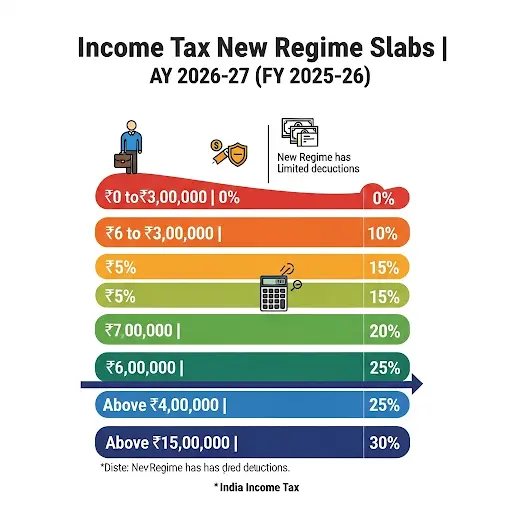
New Tax Regime slabs for FY 2025-26:
| Income Slab | Tax Rate |
|---|---|
| Up to ₹4,00,000 | Nil |
| ₹4,00,001 – ₹8,00,000 | 5% |
| ₹8,00,001 – ₹12,00,000 | 10% |
| ₹12,00,001 – ₹16,00,000 | 15% |
| ₹16,00,001 – ₹20,00,000 | 20% |
| ₹20,00,001 – ₹24,00,000 | 25% |
| Above ₹24,00,000 | 30% |
Old Tax Regime — Optional, Requires Opt-In
The Old Tax Regime preserves all traditional deductions. Salaried employees can switch between regimes every year at the time of filing their ITR. The standard deduction under the old regime is ₹50,000. The Section 87A rebate under the old regime applies only to taxable income up to ₹5,00,000.
Old Tax Regime slabs for FY 2025-26:
| Income Slab | Tax Rate |
|---|---|
| Up to ₹2,50,000 | Nil |
| ₹2,50,001 – ₹5,00,000 | 5% |
| ₹5,00,001 – ₹10,00,000 | 20% |
| Above ₹10,00,000 | 30% |
The central question this article answers is: for those with income above ₹12.75 lakh (where the new regime’s rebate no longer makes tax zero), do the HRA or home loan deductions available in the old regime outweigh its higher slab rates?
HRA vs Home Loan: Key Comparison (Quick View)
Before diving into detailed calculations, here is a quick comparison of how HRA and home loan tax benefits differ under the old tax regime.
| Feature | HRA (House Rent Allowance) | Home Loan Tax Benefit |
|---|---|---|
| Applicable Section | Section 10(13A) | Section 24(b) + 80C |
| Available In | Old Regime Only | Mostly Old Regime (limited in new) |
| Who Can Claim | Salaried employees only | Salaried + self-employed |
| Maximum Benefit | Depends on rent & salary | Up to ₹3.5L (₹5L with 80EEA) |
| Type of Benefit | Exemption (reduces salary) | Deduction (reduces taxable income) |
| Requires Rent Payment | Yes | No |
| Requires Property Ownership | No | Yes |
| Available in New Regime | ❌ No | ❌ No (for self-occupied) |
| Can Both Be Claimed Together | ✅ Yes (conditions apply) | ✅ Yes |

HRA Exemption: Law, Formula, and Full Calculation
Legal Provision
HRA exemption is governed by Section 10(13A) of the Income Tax Act, 1961, read with Rule 2A of the Income Tax Rules, 1962. It is available exclusively under the Old Tax Regime. Under the New Tax Regime, the entire HRA component in your salary is added to taxable income.
The exemption is available to salaried employees only — not to self-employed professionals or business owners (they have a separate provision under Section 80GG, discussed in Section 8).
Eligibility Conditions
To claim HRA exemption for AY 2026-27:
- You must be a salaried employee receiving HRA as a named component in your salary structure
- You must actually be paying rent for residential accommodation
- You must not be living in a property you own
The HRA Exemption Formula
The exempt amount is the lowest of the following three figures:
Condition A: Actual HRA received from the employer during the year
Condition B: 50% of Basic Salary (if your place of residence is in Delhi, Mumbai, Kolkata, or Chennai) OR 40% of Basic Salary (for all other cities)
Condition C: Actual Rent Paid during the year minus 10% of Basic Salary
Important legal note for AY 2026-27: The 50% HRA rate for Bengaluru, Pune, Hyderabad, and Ahmedabad is a change introduced under the Income Tax Rules, 2026. This applies only from Tax Year 2026-27 (i.e., income earned from April 1, 2026). For FY 2025-26 filings, residents of these four cities must use the 40% non-metro rate, not 50%. Many articles published in early 2026 incorrectly apply the new rule to current-year filings. The correct metro cities for the 50% rate in AY 2026-27 are: Delhi, Mumbai, Kolkata, and Chennai only.
Salary definition for HRA: “Salary” here means Basic Pay + Dearness Allowance (if it forms part of the retirement benefit) + Commission as a fixed percentage of turnover. It does not include HRA itself, special allowances, or other perquisites.
HRA Calculation Example
Profile: Priya, salaried employee in Mumbai | Basic Salary: ₹10,00,000/year | HRA received: ₹4,20,000/year | Annual rent paid: ₹3,60,000
| Condition | Calculation | Amount |
|---|---|---|
| A – Actual HRA received | As per salary slip | ₹4,20,000 |
| B – 50% of basic (metro) | 50% × ₹10,00,000 | ₹5,00,000 |
| C – Rent minus 10% of basic | ₹3,60,000 − ₹1,00,000 | ₹2,60,000 |
| HRA Exempt (least of A, B, C) | ₹2,60,000 | |
| HRA taxable (₹4,20,000 − ₹2,60,000) | ₹1,60,000 |
Priya’s tax saving from HRA exemption at the 30% slab: ₹2,60,000 × 30% = ₹78,000 (plus 4% cess = ₹81,120).
Home Loan Tax Benefits: Every Deduction You Can Claim
Section 24(b) — Interest Deduction
Section 24(b) of the Income Tax Act, 1961 allows a deduction on interest paid on a home loan under the head “Income from House Property.”
For a self-occupied property (SOP): The maximum deduction is ₹2,00,000 per year under the Old Tax Regime. Under the New Tax Regime, this deduction is not available for self-occupied property.
For a let-out (rented-out) property: The entire interest paid is deductible without any upper limit under both the Old and New Tax Regimes. However, the set-off of resulting house property loss against other income (such as salary) is capped at ₹2,00,000 per year under the old regime. The unabsorbed loss can be carried forward for up to 8 assessment years.
Pre-construction interest: If your home was under construction and you paid interest before taking possession, that pre-construction period interest is bundled together and deducted in five equal annual instalments starting from the year of possession. This is subject to the overall ₹2,00,000 limit for self-occupied property.
Section 80C — Principal Repayment
Under Section 80C of the Income Tax Act, 1961, the principal amount repaid on a home loan qualifies for deduction, available only in the Old Tax Regime. The maximum combined deduction under Section 80C is ₹1,50,000 per year, shared across all eligible investments including Employee Provident Fund (EPF), Public Provident Fund (PPF), ELSS mutual funds, life insurance premiums, National Savings Certificate (NSC), and home loan principal.
This deduction is available only after the property is complete and possession has been handed over. Principal repayment during construction does not qualify.
Additionally, stamp duty and registration charges paid for the property are also deductible under Section 80C in the year of payment, subject to the same ₹1,50,000 cap.
Section 80EEA — Additional Interest Deduction for First-Time Buyers
Section 80EEA provided an additional deduction of up to ₹1,50,000 per year on home loan interest, over and above the ₹2,00,000 under Section 24(b), for first-time homebuyers of affordable housing (stamp duty value of the property not exceeding ₹45,00,000). This was available only in the Old Tax Regime.
Critical note: This deduction was available only for loans sanctioned between April 1, 2019 and March 31, 2022. No new home loan sanctioned after March 31, 2022 qualifies for Section 80EEA. For AY 2026-27, only taxpayers who took eligible loans before the cut-off and are still repaying them can continue to claim this benefit.
Complete Home Loan Deduction Summary
| Deduction | Section | Maximum Limit | Regime Availability |
|---|---|---|---|
| Interest – self-occupied | 24(b) | ₹2,00,000/year | Old Regime only |
| Interest – let-out property | 24(b) | No upper limit | Both regimes |
| Principal repayment | 80C | ₹1,50,000/year (shared) | Old Regime only |
| Stamp duty & registration | 80C | Within ₹1,50,000 cap | Old Regime only |
| Additional interest (affordable housing) | 80EEA | ₹1,50,000/year | Old Regime only (loans up to Mar 2022) |
| Maximum total (normal SOP, old regime) | ₹3,50,000 | Old Regime | |
| Maximum total (80EEA eligible, old regime) | ₹5,00,000 | Old Regime |
Can You Claim Both HRA and Home Loan in the Same Year?
This is one of the most searched tax questions in India, and the answer is: yes, under the Old Tax Regime, subject to specific conditions.
Many taxpayers assume that owning a home disqualifies them from HRA exemption, or that claiming HRA means forfeiting home loan deductions. This is incorrect. HRA exemption under Section 10(13A) and home loan interest deduction under Section 24(b) operate under entirely different heads of income — they are not mutually exclusive.
When You Can Claim Both
The Income Tax Act permits claiming both benefits simultaneously when:
Scenario 1 — Property in a different city: You own a house with a home loan in City A (say, Pune), but your workplace is in City B (say, Bengaluru), where you live on rent. You can claim HRA for the rent paid in Bengaluru and simultaneously claim the Section 24(b) interest deduction on your Pune property (treating it as self-occupied or let-out depending on its actual use).
Scenario 2 — Property in the same city, genuine reason for not occupying it: You own a house in Mumbai (with a home loan) but live in a rented flat because the owned property is under construction, too far from your workplace, occupied by family members (parents or in-laws), or not yet fit for occupation. Courts and tax tribunals have consistently held that if there is a credible reason for not occupying the owned property, both claims are valid.
Scenario 3 — Property let out: You have a home loan on a property you rent out to a tenant, and you yourself live in another rented accommodation. Here, you claim HRA for your own rent and unlimited interest deduction (Section 24(b)) against the rental income from your let-out property — under both the old and new regimes for the interest part.
What Is Not Allowed
You cannot claim HRA exemption for rent paid to live in the same property on which you are claiming the home loan benefit as a self-occupied residence. The logic is straightforward: if you live in the house, you are not paying rent for a different accommodation.
You also cannot claim HRA under the New Tax Regime, regardless of the scenario.
Documentation Required to Claim Both
When claiming both benefits, maintain:
- Rent receipts and a valid rental agreement for your rented accommodation
- Employer’s PAN (if rent exceeds ₹1,00,000 per year, landlord’s PAN is mandatory under Circular No. 8/2013 dated October 10, 2013)
- Home loan statement from the lender showing principal and interest breakup
- If same city: written explanation or documentary evidence for why the owned property is not self-occupied (e.g., workplace distance, construction completion certificate, family occupancy proof)
- Form 12BB submitted to your employer for TDS purposes
Three Real Salary Examples with Full Tax Calculations
Example 1 — ₹12,00,000 Salary, Delhi, Renting (No Home Loan)
Profile: Rahul, software developer, Delhi | Basic: ₹6,00,000 | HRA received: ₹3,00,000 | Rent paid: ₹2,40,000/year | No home loan
HRA Exemption Calculation:
- Actual HRA received: ₹3,00,000
- 50% of basic (metro): ₹3,00,000
- Rent − 10% of basic: ₹2,40,000 − ₹60,000 = ₹1,80,000
- HRA exempt = ₹1,80,000 (least of three)
| Old Regime | New Regime | |
|---|---|---|
| Gross Salary | ₹12,00,000 | ₹12,00,000 |
| Less: Standard Deduction | ₹50,000 | ₹75,000 |
| Less: HRA Exemption | ₹1,80,000 | Nil |
| Taxable Income | ₹9,70,000 | ₹11,25,000 |
| Income Tax | ₹1,06,500 | Nil (87A rebate applies, income under ₹12L) |
| Add: 4% Health & Education Cess | ₹4,260 | Nil |
| Total Tax | ₹1,10,760 | ₹0 |
Verdict for Rahul: The New Regime wins decisively. Even with HRA exemption, the old regime results in ₹1.21 lakh in taxes, while the new regime results in zero tax (income after standard deduction = ₹11,25,000, below the ₹12 lakh rebate threshold).
Example 2 — ₹18,00,000 Salary, Mumbai, Renting + Home Loan in Pune
Profile: Sneha, finance manager, Mumbai (renting) | Home loan on Pune flat (let out to tenant) | Basic: ₹9,00,000 | HRA received: ₹4,50,000 | Rent paid in Mumbai: ₹3,60,000/year | Home loan interest paid (Pune flat): ₹1,80,000 | Rental income from Pune flat: ₹1,20,000 | 80C investments (PF + principal): ₹1,50,000
HRA Exemption (Old Regime):
- Actual HRA received: ₹4,50,000
- 50% of basic (metro): ₹4,50,000
- Rent − 10% of basic: ₹3,60,000 − ₹90,000 = ₹2,70,000
- HRA exempt = ₹2,70,000
Income from House Property (Pune flat, let-out):
- Gross Annual Value (rent received): ₹1,20,000
- Less: 30% standard deduction (Section 24(a)): ₹36,000
- Less: Home loan interest (Section 24(b), no limit for let-out): ₹1,80,000
- Income from House Property = −₹96,000 (loss)
- Loss set-off against salary: ₹96,000 (within ₹2,00,000 limit)
| Old Regime | New Regime | |
|---|---|---|
| Gross Salary | ₹18,00,000 | ₹18,00,000 |
| Less: Standard Deduction | ₹50,000 | ₹75,000 |
| Less: HRA Exemption | ₹2,70,000 | Nil |
| Income from House Property | −₹96,000 | +₹0 (let-out interest allowed; NAV = rent − interest = loss but set-off against other income only in old regime up to ₹2L) |
| Less: Section 80C | ₹1,50,000 | Nil |
| Taxable Income | ₹12,34,000 | ₹17,25,000 |
| Income Tax | ₹1,82,700 | ₹1,45,000 |
| Add: 4% Cess | ₹7,308 | ₹5,800 |
| Total Tax | ₹1,90,008 | ₹1,50,800 |
Verdict for Sneha: Old Regime saves ₹39,208 in taxes. The combination of HRA + home loan deductions + 80C makes the old regime significantly better at ₹18 lakh income.
Example 3 — ₹25,00,000 Salary, Bengaluru, Self-Occupied Home Loan
Profile: Arjun, IT manager, Bengaluru (owns flat, self-occupied) | Basic: ₹12,50,000 | Home loan interest: ₹2,00,000/year | Principal repaid: ₹1,20,000/year | Other 80C investments: ₹30,000 | No HRA claim (living in own flat)
| Old Regime | New Regime | |
|---|---|---|
| Gross Salary | ₹25,00,000 | ₹25,00,000 |
| Less: Standard Deduction | ₹50,000 | ₹75,000 |
| Less: Section 24(b) interest | ₹2,00,000 | Nil |
| Less: Section 80C (₹1,20,000 principal + ₹30,000 other) | ₹1,50,000 | Nil |
| Taxable Income | ₹21,00,000 | ₹24,25,000 |
| Income Tax | ₹4,42,500 | ₹3,27,500 |
| Add: 4% Cess | ₹17,700 | ₹13,100 |
| Total Tax | ₹4,60,200 | ₹3,40,600 |
Verdict for Arjun: New Regime saves ₹1,19,000. The ₹3,50,000 in combined home loan deductions is not enough to tilt the balance in favour of the old regime at ₹25 lakh income. Old Regime may be favorable if there is other exempt allowances /perquisite in salary structure. Like Car lease.
Note on Bengaluru HRA for AY 2026-27: Arjun lives in his own flat and does not claim HRA. Had he been renting, his HRA exemption for FY 2025-26 would use the 40% rate (non-metro rule under IT Rules 1962), not 50%, since the expanded metro list applies only from Tax Year 2026-27 under the new IT Act 2025.
💡 HRA vs Home Loan Calculator
Decision Framework: When Does HRA Save More?
Use this framework to identify your best tax position before filing for AY 2026-27.
Step 1: Check if New Regime is better by default
If your total income (after standard deduction) is ₹12,00,000 or less (₹12,75,000 for salaried), choose the New Regime. Tax = ₹0. No comparison needed. Neither HRA nor home loan deductions matter.
Step 2: For income above ₹12.75 lakh, calculate your total Old Regime deductions
Add up: HRA exemption + Section 24(b) interest + Section 80C eligible amount + 80D (health insurance) + any other deductions. If this total exceeds approximately ₹3,75,000–₹4,00,000, the old regime is likely better.
Step 3: Compare HRA vs Home Loan value directly
HRA wins when:
- You pay high rent in a metro city (HRA exemption can reach ₹2–4 lakh or more)
- Your home loan interest component is low (early EMIs are high interest, later EMIs shift toward principal)
- You do not own a property or your owned property is in another city
Home Loan wins when:
- You own a self-occupied property and your annual loan interest is close to or at the ₹2,00,000 cap
- You are eligible for Section 80EEA (loan sanctioned before March 31, 2022)
- You have a joint loan with your spouse — each co-borrower who is also a co-owner can independently claim up to ₹2,00,000 interest + ₹1,50,000 principal
Claim both when:
- You pay rent at your place of work and hold a home loan on a property elsewhere
- Total combined deductions (HRA + interest + principal + 80C + 80D) exceed ₹5,00,000 — making old regime decisively better
Special Case: Self-Employed Professionals
Self-employed individuals and business owners cannot claim HRA exemption under Section 10(13A) because this benefit is exclusively for salaried employees receiving HRA from an employer.
However, if you pay rent for your residence and do not own residential property, you can claim Section 80GG of the Income Tax Act. The deduction under 80GG is the lowest of:
- ₹5,000 per month (₹60,000 per year)
- 25% of adjusted total income
- Actual rent paid minus 10% of adjusted total income
Section 80GG is available under the Old Tax Regime only, and you must file Form 10BA to claim it. You (or your spouse or minor child) must not own any residential property at the place where you reside or work.
For home loan deductions, self-employed taxpayers follow the same rules as salaried individuals — Section 24(b), 80C, and (where eligible) 80EEA are all available under the Old Tax Regime.
Documentation Checklist for AY 2026-27
For HRA Exemption
- Salary slips showing HRA as a separate component
- Rent receipts (monthly or quarterly) signed by the landlord
- Rental agreement / lease deed
- Landlord’s PAN card copy — mandatory if annual rent exceeds ₹1,00,000 (approximately ₹8,334/month) under Circular No. 8/2013 dated October 10, 2013
- If landlord has no PAN: a self-declaration signed by the landlord (per the same circular)
- Form 12BB submitted to your employer before the financial year-end (or as required by your employer)
- Bank transfer records for rent payments (preferred by assessing officers)
For Home Loan Deductions
- Loan sanction letter from the bank or NBFC
- Annual interest certificate / home loan statement showing principal and interest breakup for FY 2025-26
- Possession certificate (required to begin claiming both principal and interest deductions)
- Sale deed and registration document
- Certificate for stamp duty paid (if claiming under 80C)
- Form 16A (TDS certificate) from lender if TDS has been deducted on interest
If Claiming Both HRA and Home Loan
All documents from both lists above, plus:
- Documentary evidence explaining why you are not living in the owned property (distance from workplace, construction status, tenancy agreement for let-out property, or family occupation proof)
- Rental income receipts if the owned property is let out

Verdict: Which Saves More Tax in FY 2025-26?
INo universal winner — the choice depends on your salary structure and deductions, not just income.
Choose New Regime if:
Your salary is mostly fixed (low HRA/allowances)
You don’t claim major deductions
Total deductions are below ~₹3.5 lakh
👉 In many cases, tax may be nil up to ~₹12L (rebate benefit)
Choose Old Regime if:
You have HRA exemption (especially metro)
You claim home loan interest (Sec 24)
You fully use 80C + 80D + other deductions
Your salary includes structured benefits (car lease, reimbursements, etc.)
Important Note:
Home loan alone is usually not enough to beat the new regime
Old regime works only when multiple deductions combine meaningfully
Final Rule
👉 New regime = better for simplicity and low deductions
👉 Old regime = better only with strong, structured tax-saving components
Frequently Asked Questions-HRA vs Home Loan Tax Saving 2026
Q1. Is HRA available in the new tax regime for FY 2025-26?
No. Under the New Tax Regime (Section 115BAC), HRA exemption under Section 10(13A) is not available. The entire HRA component is taxable as part of salary income. This applies from AY 2024-25 onwards and continues for AY 2026-27.
Q2. Which cities qualify for the 50% HRA rate in AY 2026-27?
For FY 2025-26 (AY 2026-27), the 50% rate applies only to Delhi, Mumbai, Kolkata, and Chennai. The expansion to include Bengaluru, Pune, Hyderabad, and Ahmedabad takes effect from Tax Year 2026-27 under the Income Tax Rules, 2026 — not for the current year’s ITR.
Q3. Can I claim both HRA and home loan interest deduction?
Yes, under the Old Tax Regime, provided you are paying rent for actual accommodation you live in and your home loan is on a different property (or on a property you are not currently occupying for a genuine reason). Both benefits operate under different sections of the Income Tax Act and are not mutually exclusive.
Q4. What is the maximum home loan deduction I can claim under the old regime?
For a self-occupied property, you can claim up to ₹2,00,000 under Section 24(b) for interest and up to ₹1,50,000 under Section 80C for principal repayment — a combined maximum of ₹3,50,000. If eligible under Section 80EEA (loans sanctioned before March 31, 2022), an additional ₹1,50,000 on interest brings the total to ₹5,00,000.
Q5. Is Section 80C principal repayment allowed in the new regime?
No. Section 80C deductions, including home loan principal repayment, are not available under the New Tax Regime. Only the Old Tax Regime allows Section 80C.
Q6. Can self-employed professionals claim HRA?
No. HRA exemption under Section 10(13A) is only for salaried employees. Self-employed individuals who pay rent can claim a deduction under Section 80GG instead — up to ₹60,000 per year (or lower if the formula results in a smaller amount). This is available under the Old Tax Regime only.
Q7. What if my home loan property is under construction?
You can claim the principal repayment under Section 80C only after possession. However, you can claim the pre-construction interest in five equal instalments once possession is received. HRA can be claimed throughout the construction period if you are paying rent elsewhere.
Q8. Should I switch to the old regime just for home loan benefits?
Only if your total deductions under the old regime exceed approximately ₹3.75–4.00 lakh. Below this threshold, the new regime’s lower slab rates and higher rebate produce a lower or equal tax liability even without deductions. Always calculate both scenarios with your actual numbers before filing.
Related Articles
To better understand the income tax changes 2026 for salaried employees, you may also refer to the following guides:
- HRA Rules 2026 Explained: Higher Exemption, New Cities & Tax Impact
- HRA Calculation 2026 With Example: Save Tax Using Latest Rules
- Can You Claim HRA Without Paying Rent? Tax Consequences (2026)
- Rent Paid To Parents HRA Rules 2026 Explained: Can You Claim?
- Best Salary Structure for FY 2026–27: How to Reduce Tax Legally
- Best Tax Regime Salaried Vs Freelancers 2026 (Who Pays Less?)
👉 You can also use our HRA Calculator to estimate your exemption based on salary, rent, and city classification.
Disclaimer
This article is written for FY 2025-26 (AY 2026-27) under the Income Tax Act, 1961 and Income Tax Rules, 1962. Tax laws are subject to change. The calculations and examples are illustrative. Individual tax liability depends on specific facts and circumstances. Please consult a qualified Chartered Accountant or tax advisor before making regime choices or filing your ITR.