
Medical facilities provided by employers are among the most common benefits available to employees. These facilities may be offered through an employer-maintained hospital, arranged at a Government or approved hospital, reimbursed to the employee, or provided through a health insurance arrangement. However, their tax treatment depends on the exact nature of the medical benefit and the conditions prescribed under the law.
Section 17 of the Income-tax Act, 2025 contains specific exclusions for certain medical facilities and medical payments. Therefore, medical treatment should be examined with reference to the precise statutory category rather than merely by looking at the name used in the employer’s payroll records.
Are Medical Facilities Provided by an Employer Taxable?
Several medical benefits are specifically excluded from the value of taxable perquisites under Section 17(2) of the Income-tax Act, 2025. These include medical treatment in an employer-maintained hospital, certain treatment expenses in a hospital maintained by the Government or a local authority, treatment in a hospital approved by the Government for the medical treatment of its employees, prescribed diseases or ailments treated in an appropriately approved hospital, qualifying COVID-19 treatment, specified health insurance premiums and qualifying medical treatment outside India.
The exclusion is subject to the conditions prescribed by the Act and, where applicable, the Income-tax Rules or Government notifications. A medical payment should therefore be tested against the relevant statutory clause before it is treated as excluded or taxable.
Table of Contents
- Medical Facilities Provided by Employers: Tax Treatmentunder Section 17
- Treatment in an Employer-Maintained Hospital
- Treatment in a Government or Approved Hospital
- Treatment of Prescribed Diseases or Ailments
- COVID-19 Treatment
- Employer-Paid Health Insurance Premium
- Reimbursement of Health Insurance Premium Paid by Employee
- Medical Treatment Outside India
- Meaning of Family, Hospital and Gross Total Income
- Taxability Summary
- Employer Compliance and Documentation
- Illustrative Examples
- Key Takeaways
- Frequently Asked Questions
- Related Articles
- Sources
Medical Facilities Provided by Employers: Tax Treatment
Section 17(2) of the Income-tax Act, 2025 defines the term “perquisite” and includes the value of specified benefits and amenities provided by an employer. However, the proviso to Section 17(2) excludes certain medical facilities and medical payments from the value of perquisites.
The medical exclusions cover specified treatment provided to an employee or a member of the employee’s family, certain medical expenses reimbursed by the employer, qualifying health insurance premiums and certain expenditure incurred for medical treatment outside India.
The law does not provide one blanket exclusion for every medical benefit. Each payment must be matched with the relevant clause of the proviso to Section 17(2), together with any conditions prescribed under the Act, Rules or applicable notifications.
Treatment in an Employer-Maintained Hospital
The value of medical treatment provided to an employee or to any member of the employee’s family in a hospital maintained by the employer is excluded from the value of perquisites under Section 17(2).
The exclusion applies to the value of medical treatment provided through the employer-maintained hospital. The treatment may be provided to the employee or to a covered member of the employee’s family, subject to the statutory meaning of family.
Employer-Maintained Hospital
Medical treatment provided in a hospital maintained by the employer is specifically excluded from the value of perquisites.
Employee or Family
The exclusion covers treatment provided to the employee or to any member of the employee’s family, subject to the statutory meaning of family.
For this purpose, the term “hospital” includes a dispensary, clinic or nursing home. Therefore, the statutory meaning is not restricted only to a large hospital building.
Treatment in a Government or Approved Hospital
The employer’s payment of medical expenses actually incurred by the employee for medical treatment of the employee or a member of the employee’s family is excluded where the treatment is provided in a hospital maintained by the Government or a local authority.
The exclusion also covers treatment in another hospital approved by the Government for the purposes of medical treatment of its employees.
This provision concerns expenditure actually incurred by the employee and paid by the employer. The relevant facts include the hospital where the treatment was provided, the amount of expenditure and the supporting medical records.
A reimbursement claim should identify the hospital, patient, treatment date, amount incurred and amount reimbursed. The employer should obtain and retain appropriate supporting documents to establish that the payment falls within the statutory exclusion.
Treatment of Prescribed Diseases or Ailments
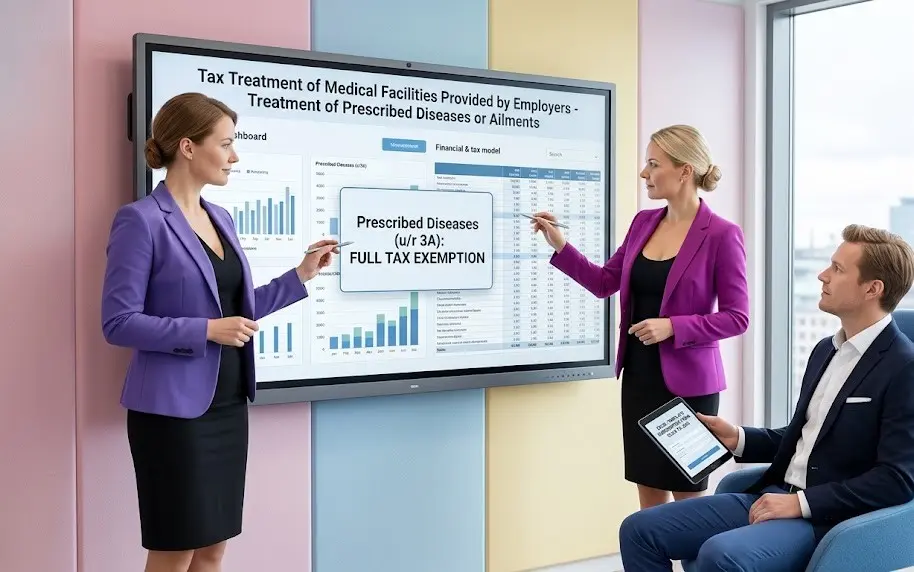
Medical expenditure actually incurred by the employee and paid by the employer may also be excluded where the treatment is for prescribed diseases or ailments in a hospital approved by the Principal Chief Commissioner or Chief Commissioner, having regard to the prescribed guidelines.
The disease or ailment must fall within the prescribed categories under Rule 18, and the hospital must satisfy the applicable approval requirements. The fact that treatment is serious, costly or prolonged does not by itself bring the expenditure within the exclusion.
Where the exclusion relates to prescribed diseases or ailments, the employee must attach with the return of income a certificate from the hospital specifying the disease or ailment for which medical treatment was required, together with the receipt for the amount paid to the hospital.
The prescribed diseases and ailments, and the approval requirements for the hospital, are governed by the applicable provisions of the Income-tax Rules, including Rule 18.
COVID-19 Treatment
Any sum paid by the employer in respect of expenditure actually incurred by the employee on medical treatment for an illness relating to COVID-19 is covered by a specific exclusion under Section 17(2), subject to the conditions that may be specified by the Central Government through notification in the Official Gazette.
The exclusion is therefore conditional. COVID-19-related reimbursement should not be treated as an unrestricted exclusion without checking the relevant notification and the conditions applicable to the expenditure.
For COVID-19-related reimbursement, retain the medical bills, treatment records, payment proof and any other documents required under the applicable notification or employer policy.
Employer-Paid Health Insurance Premium
The portion of the premium paid by an employer to effect or keep in force health insurance for an employee is excluded from the value of perquisites where the insurance is under a scheme approved by the Central Government or the Insurance Regulatory and Development Authority of India for the purposes specified in the relevant statutory provision.
The exclusion applies only where the insurance is under a qualifying approved scheme. The nature of the premium, the person insured and the applicable scheme approval must therefore be verified.
The exclusion should not be extended automatically to every insurance-related payment. The precise nature of the premium, the person insured and the statutory conditions must be considered.
Reimbursement of Health Insurance Premium Paid by Employee
A separate exclusion applies where the employer pays an amount in respect of a premium paid by the employee to effect or keep in force health insurance for the employee or a member of the employee’s family.
The insurance scheme must be approved by the Central Government or the Insurance Regulatory and Development Authority of India for the purposes specified in the relevant statutory provision.
This provision concerns an amount paid by the employer in respect of a premium that was paid by the employee. It should be distinguished from an unrestricted medical allowance or a general cash payment.
Medical Treatment Outside India
Section 17(2) also provides an exclusion for expenditure incurred by the employer on specified medical treatment outside India. The provision covers:
- Medical treatment of the employee or a member of the employee’s family outside India.
- Travel and stay abroad of the employee or a member of the employee’s family for medical treatment.
- Travel and stay abroad of one attendant accompanying the patient in connection with the treatment.
The exclusion is subject to specific conditions. Expenditure on medical treatment and stay abroad is excluded only to the extent permitted by the Reserve Bank of India.
Expenditure on travel is excluded only where the employee’s gross total income, computed before including the relevant expenditure, does not exceed the prescribed amount.
The overseas medical exclusion is not unconditional. Expenditure on medical treatment and stay abroad is subject to the limit permitted by the Reserve Bank of India. In addition, the travel exclusion depends on the employee’s gross total income and the prescribed threshold.
The same statutory conditions apply where the employer pays an amount in respect of expenditure actually incurred by the employee for the purposes specified in the overseas-treatment provision.
Meaning of Family, Hospital and Gross Total Income
For the medical-treatment provisions under Section 17(2), the term “family” has the same meaning as assigned under Section 10(5) of the Income-tax Act, 2025.
The term “hospital” includes a dispensary, clinic or nursing home. Therefore, the statutory reference to a hospital may cover qualifying treatment provided through these facilities as well.
The term “gross total income” used in the overseas medical-treatment provision has the meaning assigned to it under Section 80B(5).

Taxability Summary of Medical Benefits
The following table summarises the principal medical exclusions under Section 17(2). The relevant conditions must be verified before applying the exclusion.
| Medical Benefit | General Treatment | Important Condition |
|---|---|---|
| Treatment in a hospital maintained by the employer | Excluded from the value of perquisites. | Treatment must be provided to the employee or a member of the employee’s family in an employer-maintained hospital. |
| Treatment in a hospital maintained by the Government or a local authority | Eligible medical expenditure paid by the employer is excluded. | Expenditure must have been actually incurred by the employee for qualifying treatment. |
| Treatment in another hospital approved by the Government for medical treatment of its employees | Eligible medical expenditure paid by the employer is excluded. | The hospital must be approved by the Government for the specified medical-treatment purpose. |
| Treatment of prescribed diseases or ailments | Eligible expenditure may be excluded. | Treatment must be in an appropriately approved hospital and the prescribed documentation must be furnished. |
| COVID-19 treatment | Eligible expenditure may be excluded. | Subject to conditions specified by the Central Government through notification. |
| Employer-paid health insurance premium | Specified premium is excluded. | The insurance scheme must satisfy the applicable approval requirement. |
| Reimbursement of health insurance premium paid by employee | Specified payment is excluded. | The premium and insurance scheme must satisfy the statutory conditions. |
| Medical treatment outside India | Eligible expenditure may be excluded. | Subject to RBI-permitted limits and the prescribed gross-total-income condition for travel expenditure. |
Employer Compliance and Documentation
Employers should identify the precise medical benefit and record the statutory basis for treating it as excluded from the value of perquisites. The payroll description alone is not sufficient.
Depending on the nature of the benefit, employers should obtain and retain appropriate supporting records for payroll, tax deduction and audit purposes. Where the law specifically requires the employee to attach documents with the return of income, the employee should comply with that requirement separately.
Depending on the nature of the benefit, the employer should retain or obtain the following records:
- Hospital name and address.
- Details of the employee or family member receiving treatment.
- Medical bills, prescriptions and treatment records.
- Reimbursement claim and approval documents.
- Proof of payment to the hospital or insurer.
- Insurance policy and premium details.
- Hospital approval or recognition documents, where relevant.
- Copy of the hospital certificate and receipt required for prescribed diseases or ailments, where relevant and available for payroll records.
- Documents supporting overseas treatment and travel, where applicable.
Payroll should record the relevant statutory exclusion rather than using a broad label such as “medical benefit exempt”. This makes the treatment easier to support during payroll review, tax audit or employee verification.
Illustrative Examples
Example 1: Employer-Maintained Hospital
An employer maintains a hospital and provides medical treatment to an employee. The value of that treatment is covered by the specific exclusion for treatment provided in a hospital maintained by the employer.
Example 2: Government Hospital Reimbursement
An employee incurs medical expenses in a hospital maintained by the Government and the employer reimburses the actual expenditure. The payment may fall within the statutory exclusion, subject to the applicable conditions and supporting records.
Example 3: Prescribed Disease
An employee receives treatment for a prescribed disease in a hospital approved by the competent income-tax authority. The employer reimburses the expenditure actually incurred by the employee. The exclusion is available only if the disease or ailment, hospital approval and prescribed documentation requirements are satisfied.
Example 4: Employer-Paid Health Insurance
An employer pays a premium under a qualifying health insurance scheme for an employee. The specified premium may be excluded from the value of perquisites where the statutory approval conditions are satisfied.
Example 5: Medical Treatment Outside India
An employer pays for medical treatment and related travel outside India for an employee. The exclusion must be examined against the RBI-permitted limit for treatment and stay, as well as the prescribed gross-total-income condition applicable to travel.
Key Takeaways
- Section 17(2) contains specific exclusions for certain medical facilities and medical payments.
- Treatment in a hospital maintained by the employer is specifically excluded from the value of perquisites.
- Certain medical expenses incurred in hospitals maintained by the Government or a local authority, or in hospitals approved by the Government for the specified purpose, may also be excluded.
- Treatment of prescribed diseases or ailments is subject to hospital approval and prescribed documentation.
- COVID-19 treatment is subject to conditions specified by the Central Government.
- Specified employer-paid health insurance premiums and reimbursement of qualifying premiums paid by employees are excluded.
- Medical treatment outside India is subject to RBI limits and specific conditions relating to travel expenditure.
- The employer should maintain appropriate documents supporting the statutory exclusion adopted in payroll.

Frequently Asked Questions
Medical treatment provided in an employer-maintained hospital and qualifying treatment in a hospital maintained by the Government or a local authority, or in a hospital approved by the Government for the medical treatment of its employees, may be excluded from perquisite taxation. Treatment of prescribed diseases or ailments, qualifying COVID-19 treatment, specified health insurance premiums and eligible overseas medical treatment may also be excluded, subject to the conditions specified under Section 17(2) of the Income-tax Act, 2025.
Medical reimbursement is not automatically exempt. Its tax treatment depends on the type of treatment, the hospital, the applicable statutory conditions and the supporting documents required under the law. Reimbursement that does not fall within a specific statutory exclusion may be taxable as a perquisite.
Qualifying health insurance premiums paid by the employer may be excluded from the value of perquisites where the insurance scheme and the payment satisfy the conditions specified under Section 17(2). The exclusion should not be extended automatically to every insurance-related payment.
Sources and Official References
- Section 17 — Income Tax Department — Statutory definition of perquisite and the specific exclusions for medical treatment, medical reimbursement, health insurance premiums and overseas medical treatment.
- Rule 18 of the Income-tax Rules — Prescribed diseases or ailments and the requirements for approval of hospitals for the purposes of the medical-treatment exclusion.
- Income-tax Act, 2025 — Official PDF — Official statutory text and amendments applicable to the relevant tax year.
- Income from Salary — Income Tax Department — Official guidance on salary income, perquisites and related salary-tax provisions.
Note: The availability of an exclusion depends on the exact facts, the applicable statutory provision, prescribed rules, notifications and conditions in force for the relevant tax year.