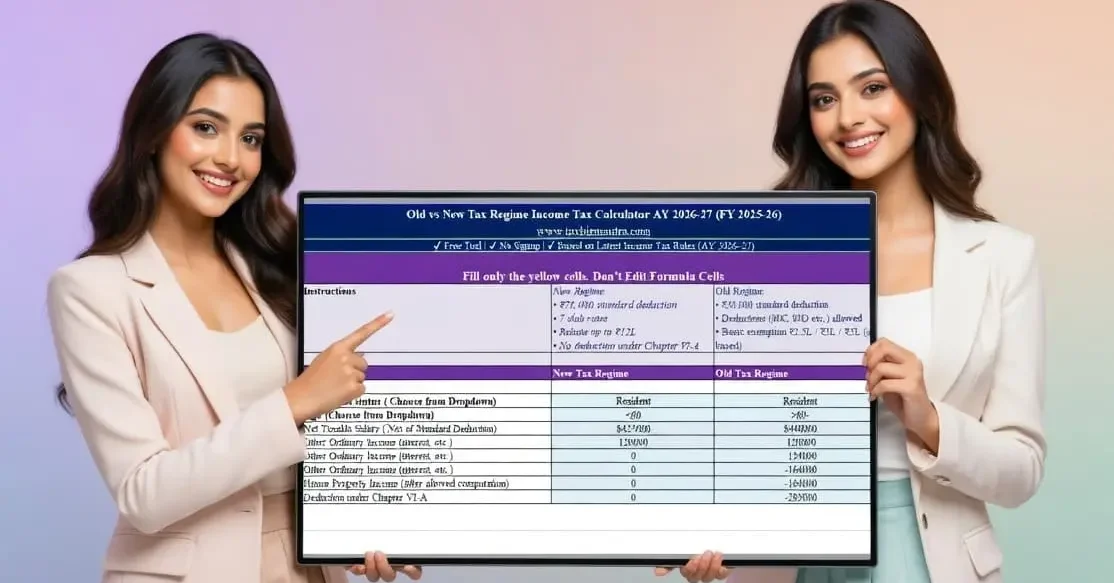
Compare Old vs New Tax Regime Instantly (AY 2026–27)
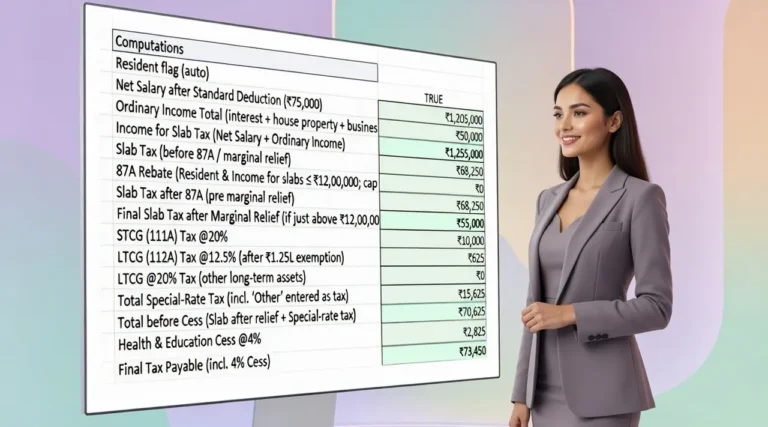
Use our free Old vs New Tax Regime Calculator AY 2026–27 to compare tax under both regimes and find which option saves more tax. The calculator supports salary income, deductions, rebate, surcharge, cess, capital gains, and marginal relief calculations.
✔ Based on latest AY 2026–27 tax rules
✔ Instant side-by-side comparison
✔ Free Excel download + online calculator
✔ Simple and beginner-friendly
Quick Answer – Which Tax Regime Is Better for AY 2026–27?
The new tax regime is generally more beneficial for taxpayers who have low deductions, no home loan interest claim, minimal investments under Sections 80C and 80D, and prefer a simple, hassle-free tax filing process with lower tax slab rates.
The old tax regime may be a better choice for taxpayers who claim HRA exemption, invest regularly in tax-saving instruments, claim deduction for medical insurance under Section 80D, or avail home loan tax benefits that significantly reduce taxable income.
There is no universal winner between the old and new tax regime. The right choice depends on your income structure, deductions, and exemptions. The most accurate way to decide is to compare tax under both regimes using the Old vs New Tax Regime Calculator below and choose the option that results in lower tax liability.
How This Income Tax Calculator can help You
Old vs New Tax Regime Calculator AY 2026–27 helps you compare tax liability under both regimes and identify which option saves more tax based on your income, deductions, and exemptions.
The calculator covers salary income, house property income, capital gains, Section 87A rebate, surcharge, and cess—giving taxpayers a practical side-by-side comparison under the latest rules.
Designed primarily for salaried taxpayers and individuals with non-business income.
100% Free Calculator • No Signup Required • Instant Comparison

Download Free Excel Tax Calculator
Prefer tax planning in Excel? Download the ready-to-use calculator to compare old vs new tax regime tax liability under AY 2026–27 rules.
👉 Download Old vs New Tax Calculator Excel
👉 Prefer only new regime? Use our New Regime Income Tax Calculator
Why You Must Compare Old vs New Tax Regime Before Filing ITR
Choosing between the old vs new tax regime is not just a formality — it directly impacts your final tax liability. Many taxpayers assume the new regime is always better due to lower tax rates, but in reality, the correct choice depends on your income structure, deductions, and investments.
Under the old regime, taxpayers can claim deductions like Section 80C, 80D, HRA, and home loan interest, which can significantly reduce taxable income. On the other hand, the new regime offers lower slab rates but removes most deductions, making it beneficial only when deductions are minimal.
This is why using an old vs new tax regime calculator AY 2026–27 is essential. It helps you compare both regimes side-by-side and ensures that you don’t end up paying higher tax due to wrong selection.

Old vs New Tax Regime AY 2026–27 – Which One Should You Choose?
| Situation / Criteria | Old Tax Regime is Better | New Tax Regime is Better |
|---|---|---|
| Deductions (80C, 80D, etc.) | You claim multiple deductions (PF, LIC, ELSS, medical) | You have low or no deductions |
| HRA Benefit | You receive and claim HRA exemption | HRA not applicable or minimal |
| Home Loan | You claim interest + principal deduction | No home loan or not claiming benefits |
| Investment Style | You actively invest for tax saving | You prefer no investment-linked tax planning |
| Income Structure | Salary with exemptions and deductions | Clean income without exemptions |
| Tax Preference | Comfortable with deductions & documentation | Prefer simple and hassle-free tax system |
| Slab Benefit | Effective tax reduces due to deductions | Benefit from lower slab rates |
| Compliance | Slightly complex (proofs required) | Simple (no proof or deduction tracking) |
🚀 Prefer Instant Calculation Instead of Excel?
👉 Try this online income tax calculator for quick results without downloading Excel:
Income Tax Calculator Online India AY 2026-27 – Old Vs New Regime
✔ No download required
✔ Instant calculation
✔ Mobile-friendly
Key Differences Between Old vs New Tax Regime (AY 2026–27)
Choosing between the old and new tax regime depends on how your income is structured and whether you claim deductions. While the new tax regime offers lower slab rates, the old regime provides multiple deductions and exemptions that can significantly reduce taxable income.
Below is a clear comparison of both regimes based on important tax parameters:
📑 Old vs New Tax Regime – Detailed Comparison
| Feature | Old Tax Regime | New Tax Regime |
|---|---|---|
| Tax Slabs | Higher slab rates | Lower slab rates |
| Standard Deduction | ₹50,000 | ₹75,000 |
| Section 80C Deduction | Allowed (up to ₹1.5 lakh) | Not allowed |
| Section 80D (Medical) | Allowed | Not allowed |
| HRA Exemption | Allowed | Not allowed |
| Home Loan Interest (SOP) | Allowed (up to ₹2 lakh) | Not allowed |
| House Property Loss Set-off | Allowed | Not allowed |
| Capital Gains Tax | Same in both regimes | Same in both regimes |
| Rebate u/s 87A | Up to ₹5 lakh | Up to ₹12 lakh |
| Marginal Relief | Not applicable | Applicable near ₹12 lakh |
| Surcharge | Up to 37% | Capped at 25% |
| Compliance | Higher (proof required) | Lower (simplified) |
The choice between old vs new tax regime depends on your deductions, income structure, and tax-saving investments — use the calculator above to find the exact tax saving.
How to Use Old vs New Tax Regime Calculator (Step-by-Step)
Using the Old vs New Tax Regime Calculator AY 2026–27 (Excel) is simple and helps you accurately compare tax under both regimes. Follow these steps to get the correct tax computation and identify the better regime:

✅ Step 1: Enter Basic Details
Go to the input sheet and fill your residential status, age, and salary income. These are essential for applying correct tax rules and exemption limits.
✅ Step 2: Add Other Income
Include income from interest, dividend, or any other sources. This ensures complete tax calculation under both regimes.
✅ Step 3: Enter House Property Details
Provide details of self-occupied or let-out property, including interest on housing loan. The calculator will apply correct rules for both regimes.
✅ Step 4: Enter Deductions (Old Regime Only)
Add deductions like Section 80C, 80D, and HRA exemption. These are considered only under the old regime.
✅ Step 5: Input Capital Gains (If Any)
Enter STCG and LTCG separately. The calculator applies special tax rates automatically.
✅ Step 6: View Tax Comparison
The calculator will instantly show tax payable under old vs new regime, including rebate, surcharge, and cess.
✅ Step 7: Check Best Regime
Review the section “Which Regime to Select?” to see which option saves more tax and by how much.
💡 Example: When Old Tax Regime Can Be Better
Suppose Rohit earns ₹18 lakh annually and claims multiple deductions and exemptions under the old tax regime.
| Income & Deductions | Amount |
|---|---|
| Salary Income | ₹18,00,000 |
| Standard Deduction | ₹50,000 |
| Section 80C | ₹1,50,000 |
| Home Loan Interest | ₹2,00,000 |
| HRA Exemption | ₹2,50,000 |
| NPS Deduction | ₹50,000 |
| Medical Insurance (80D) | ₹25,000 |
| Regime | Taxable Income | Approx Tax Payable |
|---|---|---|
| New Tax Regime | ₹17.25 lakh | ~ ₹1,50,800 |
| Old Tax Regime | ₹10.75 lakh | ~ ₹1,40,400 |
New Regime
₹1.51L Tax
Old Regime
₹1.40L Tax
Old vs New Tax Regime Calculator Excel (AY 2026–27)
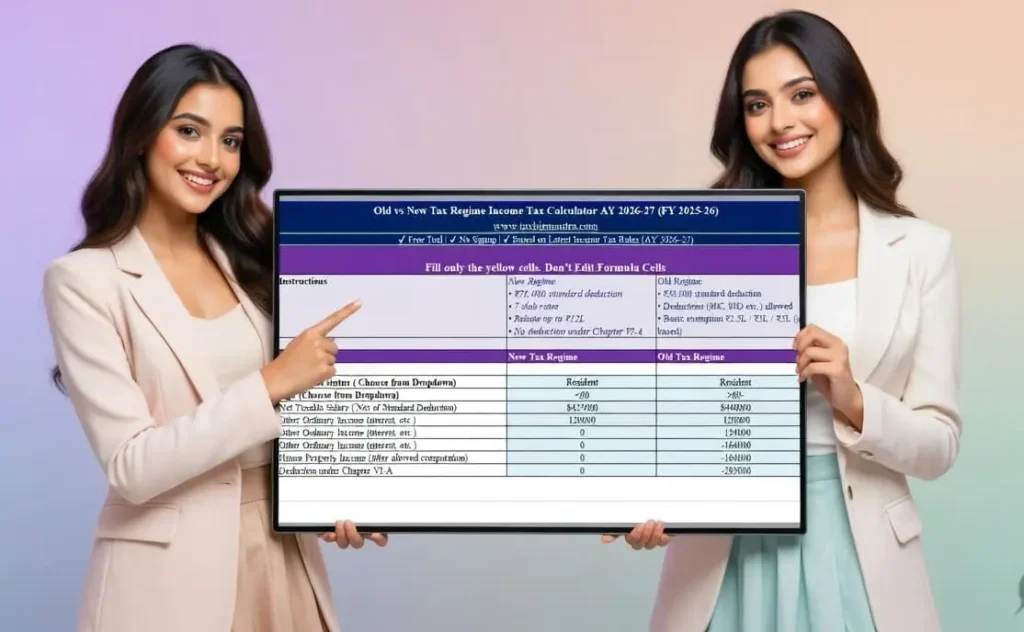
Use the embedded Excel calculator below to estimate your tax under both regimes. Simply fill the highlighted cells to compare tax liability instantly.
✔ Salary, deductions & capital gains support
✔ Automatic tax calculation
✔ Works for AY 2026–27
✔ Free to usesults.
Want Instant Calculation Without Excel?
👉 Try Old vs New Tax Regime Online Calculator– No Download, No Sign-up.
What’s Included in This Excel?
- ✔ Old vs New Tax Regime comparison
- ✔ Salary, house property & other income
- ✔ Capital gains (STCG & LTCG) calculation
- ✔ Section 87A rebate & marginal relief
- ✔ Surcharge and cess computation
- ✔ Automatic regime recommendation
Need Section Reference? Explore Income Tax Act 2025 Section Mapping
Looking for corresponding provisions under the new Income Tax Act 2025? Use TaxBizMantra’s searchable Section Mapping Utility to compare old vs new Income Tax sections, browse chapter-wise mapping, and download the complete Excel reference for professional use..
FAQs – Old vs New Tax Regime AY 2026–27
❓ Which tax regime is better for AY 2026–27?
There is no one-size-fits-all answer. The new tax regime is beneficial if you have low or no deductions, while the old regime is better if you claim deductions like Section 80C, 80D, HRA, and home loan interest. The best way to decide is to compare both using a calculator.
❓ Can I switch between old and new tax regime every year?
Yes, salaried individuals can switch between regimes every year while filing their income tax return. However, business or professional income taxpayers have restrictions on switching.
❓ Is standard deduction allowed in both regimes?
Yes, standard deduction is allowed in both regimes. For AY 2026–27, it is ₹50,000 under the old regime and ₹75,000 under the new regime.
❓ Are deductions under Section 80C allowed in the new regime?
No, deductions under Chapter VI-A such as Section 80C, 80D, and others are not allowed under the new tax regime.
❓ Is HRA exemption available in the new tax regime?
No, HRA exemption is available only under the old tax regime and not under the new regime.
❓ How is rebate under Section 87A different in both regimes?
Under the old regime, rebate is available up to taxable income of ₹5 lakh (maximum ₹12,500). Under the new regime, rebate is available up to ₹12 lakh (maximum ₹60,000), subject to conditions.
❓ Is capital gains tax different in old and new regime?
No, capital gains (STCG and LTCG) are taxed at the same rates in both regimes. However, surcharge and rebate applicability may differ.
❓ Should I choose new regime if my income is below ₹12 lakh?
In many cases, yes — because rebate under Section 87A can reduce tax liability to zero. However, if you have significant deductions, the old regime may still be beneficial.
❓ Do I need to submit proof for deductions in the new regime?
No, the new tax regime does not require investment proofs since most deductions are not allowed.
❓ How do I know which regime saves more tax?
The easiest way is to use an old vs new tax regime calculator, which compares both regimes and shows the exact tax saving instantly.
Can I compare old vs new tax regime in Excel?
Yes. TaxBizMantra provides a downloadable Excel calculator that helps compare tax liability under both regimes instantly using the latest AY 2026–27 rules.
Related Tax Calculators & Utilities
Explore practical tax tools designed to simplify planning, compliance, and quick financial calculations. Use these calculators for instant estimates, tax comparison, and smarter tax decision-making.
HRA Exemption Calculator
Calculate House Rent Allowance exemption quickly based on salary, rent paid, and city classification.
→ Use HRA Calculator
Advance Tax Calculator
Estimate advance tax instalments accurately and plan quarterly tax payments with ease.
→ Use Advance Tax Calculator
Income Tax Calculator India AY 2026–27 (Old vs New Regime)
Compare tax liability instantly under both tax regimes and identify which option results in lower tax.
→ Use Income Tax Calculator
TDS Calculator
Estimate tax deducted at source under different payment categories quickly and accurately.
→ Use TDS Calculator
Gratuity Calculator
Compute gratuity eligibility and estimated payout instantly based on salary and years of service.
→ Use Gratuity Calculator
New Regime Income Tax Calculator
Download a professional Excel utility for offline new tax calculation and planning reference.
→ Download Excel Utility
Disclaimer:
This income tax calculator is provided for general informational purposes only and is based on applicable provisions for AY 2026–27. It is designed for salaried individuals and does not cover business or professional income. While every effort has been made to ensure accuracy, tax laws are subject to change through Finance Acts, CBDT notifications, and judicial interpretations. Users are advised to verify results or consult a qualified tax professional before making any financial decisions. TaxBizMantra is not responsible for any errors or decisions taken based on this tool.