Before You Withdraw Your
NPS Corpus
Understand These Tax Rules
Most people know how NPS saves tax on the way in. Far fewer understand how — and how much — it is taxed on the way out. This guide covers every scenario: normal exit, partial withdrawal, annuity pension, death, and Tier II — with every fact verified against PFRDA’s December 2025 regulations, the official NPS Trust rules, and the Income Tax Act.
Quick Answer — NPS Taxability at a Glance
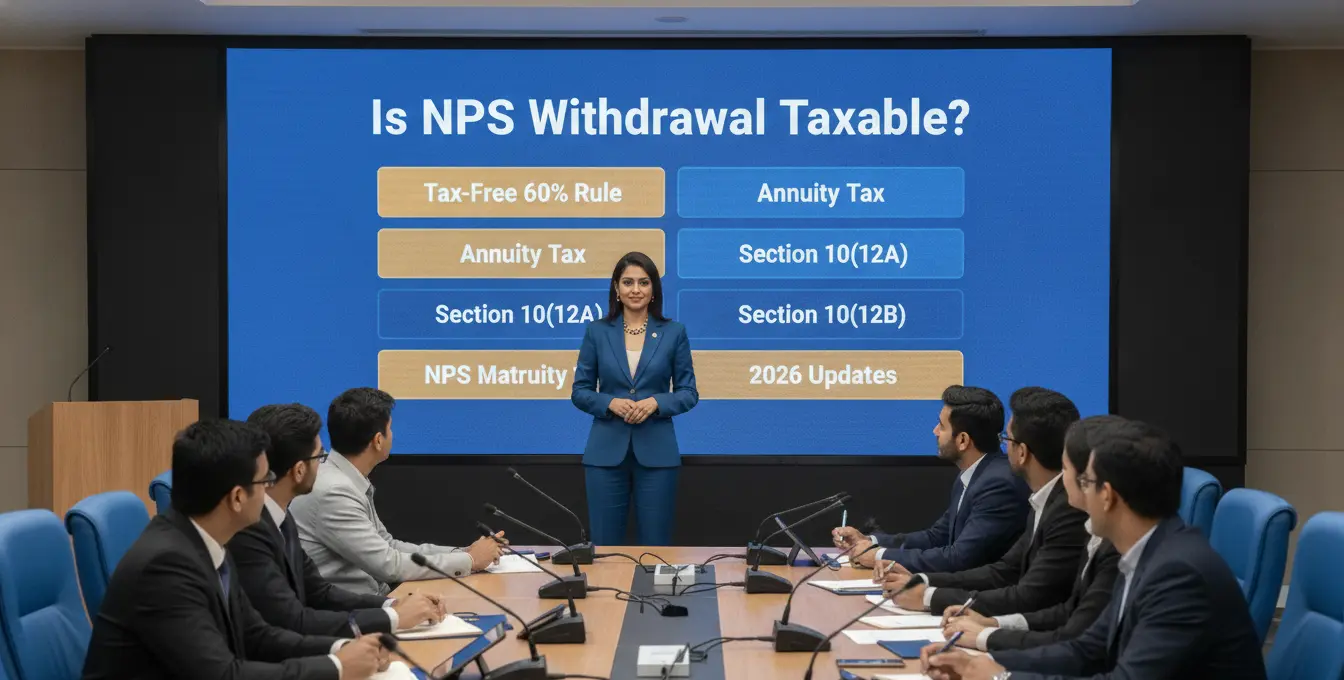
Lump sum at maturity (up to 60%): Fully tax-free under Section 10(12A) — in both old and new tax regimes. | Extra 20% under new 80% rule: Taxable at your slab rate — law not yet amended. | Annuity income: 100% taxable every year under Section 80CCD(3). | Partial withdrawal: Tax-free under Section 10(12B) for employee-subscribers only. | Death benefit: Corpus ≤₹12L fully tax-free to nominee; above ₹12L, 80% locked in compulsory annuity.
Every year, lakhs of Indians contribute to their NPS accounts, claim the deduction, and move on — without ever asking the most important question: when I finally take this money out, how much of it will the taxman claim? The answer is more layered than most subscribers expect. NPS taxability is not one rule — it is a set of provisions that shifts depending on how you exit, at what age, with how much corpus, whether you are employed or self-employed, and which slice of the payout you are receiving. Get any of these wrong and you face a surprise tax bill at the worst possible moment: retirement.
Here is the complete, verified picture of NPS withdrawal tax rules for 2026, updated for PFRDA’s December 2025 amendments and cross-checked against official NPS Trust guidelines.
NPS Tax Rules at a Glance — Master Reference Table (2026)
Every withdrawal scenario across the NPS lifecycle mapped in one place. Cross-verified against the Income Tax Act and PFRDA’s official 2025 amendment regulations.
| Scenario | Tax-Free Portion | Taxable Portion | Section |
|---|---|---|---|
| Normal exit at 60 — corpus ≤ ₹8L (non-govt) | 100% lump sum | Nil | Sec 10(12A) + PFRDA 2025 |
| Normal exit at 60 — corpus ₹8L–₹12L (non-govt) | ₹6L lump sum | Balance via annuity/SUR — pension taxable at slab | Sec 10(12A) / 80CCD(3) |
| Normal exit at 60 — corpus >₹12L (non-govt) | 60% of corpus | Extra 20% if 80% taken — taxable at slab* | Sec 10(12A) |
| Normal exit — government employee (all slabs) | Up to 60% as lump sum; 100% if ≤₹8L | Mandatory 40% annuity above ₹8L; pension taxable | Sec 10(12A) / 80CCD(3) |
| Annuity purchased at exit | Purchase amount — not taxed | Every pension payment — 100% at slab rate | Sec 80CCD(5) / 80CCD(3) |
| Partial withdrawal — employee-subscriber | Up to 25% of self-contributions | Nil if all PFRDA conditions met | Sec 10(12B) |
| Partial withdrawal — self-employed / non-employee | No exemption | Full amount taxable at slab rate | Normal IT provisions |
| Death — corpus ≤ ₹8L (non-govt) | 100% lump sum to nominee | Nil | Sec 10(12A) + NPS Trust |
| Death — corpus ₹8L–₹12L (non-govt) | ₹6L lump sum to nominee | Balance via SUR/annuity — pension/receipts taxable | Sec 10(12A) + NPS Trust |
| Death — corpus >₹12L (non-govt) | 20% lump sum to nominee | 80% compulsory Default Annuity to family; pension taxable at slab | NPS Trust official rules |
| NPS Tier II withdrawal | None | Fully taxable — capital gains or income | Normal IT provisions |
| * The 60% exemption under Section 10(12A) applies in both old and new tax regimes. The extra 20% lump sum (allowed by PFRDA 2025 but not yet exempted by Parliament) is taxable at your applicable slab rate until the Income Tax Act is amended. Deferral option: Non-government subscribers can remain invested until age 85 (non-govt, extended from 70); government subscribers until 85 (extended from 75). | |||

NPS Maturity Tax Rules: Normal Exit at 60 — Three Corpus Slabs Explained
PFRDA’s December 2025 amendments created a three-slab system for normal exit at age 60 (or after completing 15 years of subscription, whichever comes first for non-government subscribers). The tax treatment varies by slab and by subscriber category.
Slab 1 — Corpus ₹8 Lakh or Below (Non-Government)
You may withdraw the entire corpus as a lump sum — 100% — with no annuity requirement. The full amount is tax-free under Section 10(12A). This threshold was raised from ₹5 lakh, bringing real relief to small savers and those who contributed minimally.
Slab 2 — Corpus Between ₹8 Lakh and ₹12 Lakh (Non-Government)
You may withdraw up to ₹6 lakh as a lump sum, which is tax-free under Section 10(12A). The remaining balance must be drawn via Systematic Unit Redemption (SUR) over a minimum of six years, or used to purchase an annuity. Pension income from the annuity is taxable at your slab rate. The tax treatment of SUR receipts on the growth component is still evolving — consult a CA.
Slab 3 — Corpus Above ₹12 Lakh (Non-Government Only)
Non-government subscribers may now take up to 80% as a lump sum with a minimum 20% going to annuity. However, only 60% of the total corpus is tax-exempt under Section 10(12A). The extra 20% you can now withdraw under PFRDA’s new rules is taxable at your applicable income slab rate until Parliament amends the Income Tax Act. Government employees retain the old 60:40 lump sum to annuity rule regardless of corpus size — but also benefit from 100% lump sum for corpus ≤₹8L.
Non-government subscribers can defer exit and remain invested in NPS until age 85 (extended from 70 under PFRDA 2025). Government subscribers can also stay until 85 (extended from 75). This allows your corpus to compound further before triggering withdrawal tax — useful for those in higher slabs expecting lower income in later years.
The 60% Tax-Free Rule — And the Hidden Tax Trap in the New 80% Lump Sum Withdrawal
This is the most consequential aspect of NPS taxability in 2026 — and the one that catches the most subscribers off guard. PFRDA’s December 2025 amendment allows non-government subscribers with a corpus above ₹12 lakh to withdraw up to 80% as a lump sum. A significant improvement. But the Income Tax Act has not yet moved to match it.
Section 10(12A) still exempts only 60% of the total corpus. The extra 20% — the new withdrawal window — is taxable at your income slab rate. This has been confirmed by tax experts including S K Patodia & Associates LLP and is the consistent position taken by PFRDA-affiliated guidance as of June 2026.
On a ₹50 lakh corpus at retirement (non-govt subscriber, corpus >₹12L): 60% = ₹30L is fully tax-free. Extra 20% = ₹10L is taxable — at 30% slab, that is ₹3 lakh in additional tax. The remaining 20% = ₹10L goes to annuity (not taxed at purchase; pension taxable every year). Always calculate the net post-tax position before choosing 80%.

NPS Annuity Taxability: Every Pension Payment Is Fully Taxable
The annuity — the mandatory portion of your corpus converted into a monthly pension — is where most retirees face an unwelcome reality. Many assume NPS’s tax-advantaged status extends to the pension they receive in retirement. It does not.
Under Section 80CCD(3), every rupee of annuity income received is fully taxable in the year of receipt at your applicable slab rate. No threshold. No partial relief. No grandfathering. It is treated exactly like salary or interest income — added to your total income and taxed accordingly. The annuity purchase amount itself is exempt under Section 80CCD(5), but that is a one-time benefit at the point of investment, not on the income stream.
PFRDA-empanelled annuity providers currently offer rates between 4% and 6.5% per year. Younger subscribers receive lower rates because the insurer prices in more years of payouts. On ₹10L annuity at 5.5%: approximately ₹55,000/year before tax — or ₹4,583/month. At the 30% slab: take-home is roughly ₹3,208/month. Seven annuity types are approved by PFRDA, including joint-life and return-of-purchase-price options. Once purchased, the annuity cannot be changed or surrendered.
A structured alternative worth considering: the Systematic Lump Sum Withdrawal (SLW) facility. Rather than buying an annuity, you draw your corpus in installments — monthly, quarterly, half-yearly, or yearly — while the invested balance continues to earn market-linked returns until age 85. Tax treatment on SLW is still being defined by tax authorities; get specific CA advice before choosing this route for large corpora.
NPS Partial Withdrawal Tax Rules — Updated for PFRDA 2025
NPS is significantly more liquid than most subscribers realise. The December 2025 amendments expanded both frequency and permitted reasons — but the tax exemption carries a critical subscriber-type distinction that many overlook.
PFRDA 2025 — What Changed on Partial Withdrawals
- Frequency: Up to 4 partial withdrawals before age 60 (raised from 3), with a minimum 4-year gap between each. After age 60, if you continue your NPS, withdrawals are permitted every 3 years.
- Amount: Up to 25% of your own self-contributions (employer contributions are excluded from the calculation).
- Permitted reasons now include: Higher education of children, marriage of children, home purchase or construction (one-time), medical treatment for self or family, settlement of a loan taken against NPS corpus, and skill development or starting a business.
- Minimum account age: 3 years from date of joining.
The Tax Distinction That Most Articles Miss
Section 10(12B) of the Income Tax Act grants the partial withdrawal tax exemption only to employee-subscribers — those formally employed under Corporate NPS or government NPS. The Finance Act 2017 introduced this exemption specifically for employees.
Self-employed individuals and non-employee All Citizen Model subscribers do not receive this exemption. Their partial withdrawals are treated as taxable income at the applicable slab rate. ICAI formally recommended extending Section 10(12B) to all subscribers in its pre-Budget 2025 memorandum. As of June 2026, no amendment has been enacted.
Your NPS partial withdrawal does not get the Section 10(12B) exemption. The amount withdrawn will be added to your taxable income for the year and taxed at your slab rate. This remains an unresolved disparity in the Income Tax Act. Always verify the current position with a CA before making a partial withdrawal.
Tax on NPS Withdrawal After Death — What the Nominee Actually Receives
The death benefit under NPS is often described simply as “100% tax-free to the nominee.” That is true for smaller corpora — but not for all. The correct rules, sourced directly from the NPS Trust’s official guidelines, depend on corpus size.
| Corpus at Death (Non-Govt Subscriber) | What Nominee Receives | Tax Treatment |
|---|---|---|
| ≤ ₹8 lakh | 100% as lump sum (or SLW/SUR option) | Fully tax-free under Section 10(12A) |
| ₹8L to ₹12L | Up to ₹6L lump sum; balance via SUR (min 6 years) or annuity | Lump sum tax-free; SUR/annuity income taxable at slab |
| Above ₹12L | 20% as lump sum/SLW to nominee; 80% compulsory Default Annuity for family (spouse, then mother, then father) | Lump sum tax-free; annuity pension income fully taxable at slab |
Without a registered nominee, the legal heir must obtain a succession certificate — a court process taking 6–12 months and incurring legal costs. With a registered nominee, the corpus is released swiftly. Verify and update your nomination on the CRA portal: cra.nps-proteantech.in

NPS Tier II Withdrawal — No Tax Exemption, No Special Protection
NPS Tier II is a voluntary, liquid savings account with no lock-in and no exit restrictions. You can withdraw any time. But this liquidity comes at a direct tax cost: Tier II withdrawals receive no tax exemption under any provision of the Income Tax Act.
Gains are taxed as capital gains — short-term if held briefly, long-term if held longer — at applicable rates depending on the fund type (equity or debt). The narrow exception: central government employees contributing to Tier II with a three-year lock-in may claim a Section 80C deduction at contribution stage. This deduction is unavailable under the new tax regime, and the withdrawal remains taxable in all cases.
Treat Tier II as a standard market-linked investment account for tax purposes. Plan withdrawals accordingly — particularly in years when your other income is lower to reduce the overall tax impact.
Frequently Asked Questions — NPS Taxability & Withdrawal Tax Rules