

Twenty years at one company, a farewell card, and a lump sum that finally lands in your account. Before you spend it, the taxman wants to know exactly how that number was worked out.
Retirement and resignation both end with paperwork, and two figures show up on almost every full-and-final settlement: gratuity and leave encashment. Gratuity and leave encashment exemption under the Income Tax Act 2025 is governed by Section 19, “Deductions from Salaries,” a consolidated table of fourteen categories that replaces the old Act’s scattered Section 10(10), 10(10AA), and related provisions. Both exemptions run on statutory formulas, not employer discretion, and both are genuinely worth understanding before the money arrives, not after.
Applicability note: These provisions apply for Tax Year 2026-27 onward. Gratuity sits at Table Sl. No. 6 and leave encashment at Sl. No. 13/14 of Section 19 of Income Tax Act 2025 table. Only Sl. No. 1, professional tax, is excluded from the new tax regime under Section 202(2); gratuity and leave encashment are not on that exclusion list, so both remain available whichever regime you file under.
Gratuity Exemption: The Formula Under Section 19
Gratuity is a reward for staying, formally recognised under the Payment of Gratuity Act, 1972 for anyone who completes five years of continuous service with an establishment employing ten or more people. How much of it actually escapes tax depends on which of three categories you fall into.
| Category | Exemption |
|---|---|
| Government, local authority, or notified institution employee (Central/State Government, local authorities, universities, IITs, and similar notified institutions) | Fully exempt, no ceiling |
| Employee covered by the Payment of Gratuity Act | Least of: actual gratuity received, ₹20 lakh, or (Last drawn Basic + DA) × 15 ÷ 26 × completed years of service |
| Employee not covered by the Act | Least of: actual gratuity received, ₹20 lakh, or (Average salary of last 10 months) × ½ × completed years of service |
The “26” in the covered-employee formula represents working days in a month under the Act’s own convention; the “15” is fifteen days’ wages for each completed year served. For employees outside the Act’s coverage, the calculation instead runs off a half-month’s average salary, averaged over your last ten months of service, and that average includes Basic pay, Dearness Allowance, and any commission calculated as a fixed percentage of turnover. The full exemption isn’t limited to employees on a literal government payroll, either: it extends to employees of local authorities, universities, IITs, and other institutions the government has specifically notified for this purpose, a distinction worth checking if you work for a public-sector or academic institution that doesn’t feel like “government” in the everyday sense of the word.
A separate, narrower category, death-cum-retirement gratuity paid under specified pension rules for central government and similarly-placed employees, sits at its own table entry rather than the general formula above; if this applies to you, it’s worth confirming the specific rule your payout falls under rather than assuming the standard formula.
One rule worth knowing if you’ve changed jobs more than once: where you receive gratuity from more than one employer, whether in the same Tax Year or across different years, the total exemption you can claim over your working life is capped at the notified ceiling, reduced by whatever gratuity exemption you’ve already used up in an earlier year. It’s a lifetime limit, not a limit that resets with every new employer.
Rajesh retires after 21 years and 7 months at a private company covered by the Payment of Gratuity Act, with a last-drawn Basic plus DA of ₹80,000 a month. His completed years of service round to 22. His formula-based figure is ₹80,000 × 15 ÷ 26 × 22, which comes to ₹10,15,385. His employer actually pays him ₹11,00,000. His exemption is the least of ₹11,00,000 (actual), ₹20,00,000 (ceiling), and ₹10,15,385 (formula), so ₹10,15,385 is exempt, and the remaining ₹84,615 is added to his taxable salary for the year.

Leave Encashment Exemption: The Four-Way Test
Unused earned leave converted to cash follows a different mechanism entirely, one genuine four-way comparison rather than a choice between employer categories.
- Actual amount received — whatever your employer actually pays you for the encashment.
- ₹25 lakh — a lifetime ceiling that applies in aggregate across every employer you’ve worked for, not a fresh limit each time you leave a job.
- Ten months’ average salary — calculated on Basic pay plus Dearness Allowance, averaged over the ten months immediately before you leave.
- Cash value of your unused leave balance — your accumulated earned leave, generally capped at 30 days for each completed year of service, valued at your salary rate, and limited to whatever leave balance your employer’s own policy actually lets you carry and encash.
Whichever of these four figures is smallest becomes your exempt amount. Government, local authority, and notified-institution employees are exempt in full, without this four-way test applying to them at all, the same broader category covered under gratuity above. For everyone else, the exemption applies whether you’re retiring, superannuating, or simply resigning, what matters is that employment is ending, not the specific reason it’s ending or what your company calls the exit.
Priya resigns after 20 years, with 300 days of earned leave banked, capped by her employer’s policy at exactly 300 days encashable. Her average Basic plus DA over her last ten months works out to ₹65,000. Her four figures are: actual amount received, ₹6,80,000; the ₹25 lakh ceiling, nowhere close to binding; ten months’ average salary, ₹6,50,000; and her leave balance valued at her daily rate, also around ₹6,50,000. The smallest of the four is ₹6,50,000, which is exempt; the remaining ₹30,000 she actually received gets added to her taxable salary. Notice that the headline ₹25 lakh figure never even enters the picture here, it’s almost always the salary-based limits that bind for a genuinely mid-career exit.
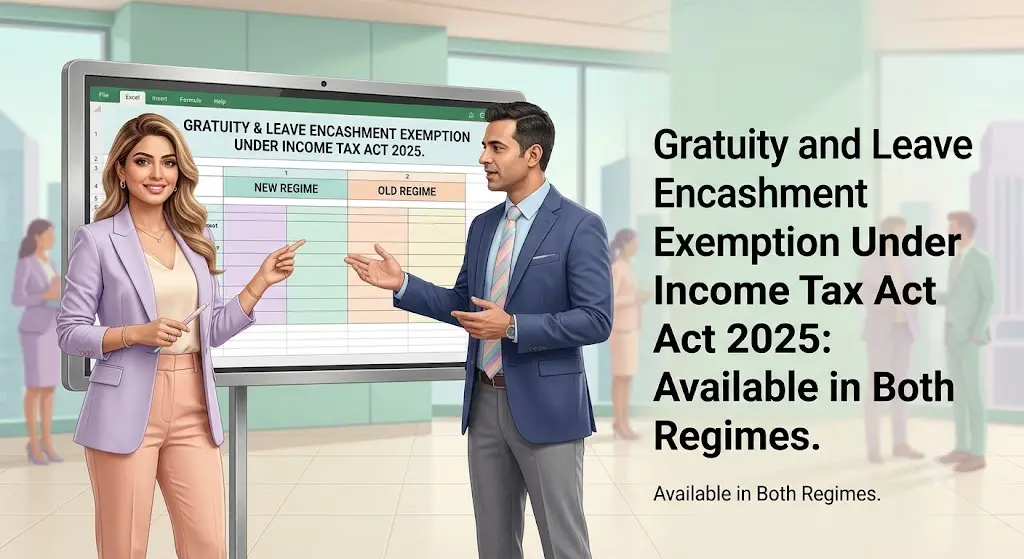
Gratuity and Leave Encashment Exemption Under the Income Tax Act 2025: Available in Both Regimes
Section 19’s table runs to fourteen categories, and Section 202, the provision governing the new tax regime, specifically strips out only one of them, Table Sl. No. 1, professional tax, from new-regime computation. Gratuity sits at Sl. No. 6 and leave encashment at Sl. No. 13/14, neither of which appears anywhere in that exclusion list. In practice, that means both exemptions work exactly the same way whether you’ve opted for the old regime or stayed with the new one, a genuinely reassuring exception to how sharply most salary exemptions in this series have depended on regime choice.
| Section 19 Item | Old Regime | New Regime |
|---|---|---|
| Gratuity (Sl. No. 6) | Exempt, per formula | Exempt, per formula |
| Leave Encashment (Sl. No. 13/14) | Exempt, per formula | Exempt, per formula |
| Standard Deduction (Sl. No. 2) | ₹50,000 | ₹75,000 |
| Professional Tax (Sl. No. 1) | Deductible | Not deductible |
Professional tax is the genuine exception here, and it’s worth knowing precisely because it’s the one item in this group that behaves differently: deductible under the old regime, specifically excluded under the new one. Everything else in this article isn’t affected by which regime you’ve chosen.
- Using gross salary instead of Basic plus DA in either formula — both the gratuity and leave encashment calculations run strictly on Basic pay and Dearness Allowance, excluding HRA, special allowances, and variable pay, which is why the payout often lands lower than a quick mental estimate suggests
- Assuming the ₹25 lakh leave encashment ceiling resets with a new job — it’s a lifetime aggregate across every employer; if you’ve already claimed exemption on an earlier encashment, that amount comes off your remaining limit
- Assuming resignation doesn’t qualify for leave encashment exemption — it does. The exemption applies regardless of whether you’re retiring, superannuating, or resigning
- Assuming either exemption disappears under the new tax regime — neither does. Only professional tax, a much smaller and less consequential deduction, is actually excluded
Frequently Asked Questions
What is the gratuity exemption limit under the Income Tax Act 2025?
For employees covered by the Payment of Gratuity Act, it’s the least of the actual amount received, ₹20 lakh, or 15 days’ salary for each completed year of service, calculated as (last drawn Basic plus DA) × 15 ÷ 26 × years of service. Government employees are exempt in full with no ceiling.
Is leave encashment taxable on resignation, or only on retirement?
The exemption applies in both cases. It’s available whether you’re retiring, superannuating, or resigning, since what matters under Section 19 is that employment is ending, not the specific reason for the exit.
Are gratuity and leave encashment exemptions available under the new tax regime?
Yes. Section 202, which governs the new tax regime, excludes only Table Sl. No. 1 of Section 19, professional tax, from new-regime computation. Gratuity and leave encashment sit at different table entries and are not affected, so both exemptions work the same way under either regime.
What is the leave encashment exemption limit for private sector employees?
The least of four figures: the actual amount received, a ₹25 lakh lifetime ceiling across all employers, ten months’ average salary calculated on Basic plus DA, and the cash value of your accumulated, employer-capped leave balance.
Does the gratuity exemption reset if I claim it at a second employer?
No. Where gratuity is received from more than one employer, across the same or different Tax Years, the aggregate exemption available is the notified ceiling reduced by whatever gratuity exemption has already been claimed in an earlier year. It’s a career-long limit, not a per-employer one.
Do university, IIT, or local authority employees get the full gratuity exemption too?
Yes. The unlimited exemption isn’t restricted to a literal government payroll; it extends to employees of local authorities, universities, IITs, and other institutions specifically notified for this purpose. If you work for a public-sector or academic body that doesn’t feel like “government” in the everyday sense, it’s worth checking whether your employer falls into this notified category.

Income From Salaries — Series Index
Perquisites, Part 1: Accommodation & Conveyance
Rent-free accommodation and company car valuation under Rule 15.
Part 5Perquisites, Part 2: ESOPs, Loans & Other Benefits
Stock options, concessional loans, gifts, and the specified-employee gate.
Gratuity & Leave Encashment: Exemption Rules Explained
The statutory formulas under Section 19, and why regime choice doesn’t touch either one.
Pension, Retrenchment & VRS: The Rest of Section 19
Commuted pension, retrenchment compensation, and voluntary retirement exemptions.
Both exemptions here run on precise statutory arithmetic, not on whatever figure your employer’s HR system happens to print on your settlement letter. Before you assume a payout is fully tax-free, or fully taxable, run the actual formula yourself, particularly if you’re closing in on either the ₹20 lakh gratuity ceiling or the ₹25 lakh lifetime leave-encashment limit across a career with more than one employer.
Sources & References
- Income-tax Act, 2025 [Act No. 30 of 2025] — full text, as amended by Finance Act, 2026Income Tax India, incometaxindia.gov.in
- Section 202 — New Tax Regime for Individuals, HUF and OthersIncome Tax India, incometaxindia.gov.in
Gratuity and leave encashment provisions discussed here sit within Section 19 of the Income-tax Act, 2025, not Section 18, which covers a separate category of termination-related payments. Always cross-check against the official Act text linked above and consult a Chartered Accountant before relying on this for a filing or settlement decision.
Disclaimer: This article is for general informational purposes only and does not constitute tax or legal advice. The Income-tax Act, 2025 and related rules are subject to notifications and amendments by the CBDT. Please consult a qualified Chartered Accountant for advice specific to your situation.