Most salaried Indians think their entire retirement runs through EPF. It doesn’t. A slice of your employer’s provident fund contribution has been quietly building a separate pension you’ll only notice at retirement — and as of June 2026, the scheme behind it just got a complete legal overhaul. Here’s what EPS actually is, exactly how your pension is calculated, and what genuinely changed with the new EPS 2026 framework.
Quick Answer — EPS 2026 at a Glance
The Central Government has notified the Employees’ Pension Scheme, 2026 (EPS 2026), formally replacing the Employees’ Pension Scheme, 1995 (EPS-95) and the Employees’ Family Pension Scheme, 1971. This is the biggest legal overhaul of India’s employer-pension framework in over three decades, introduced under the Code on Social Security, 2020. Existing pensioners continue receiving payments without interruption, and the pension calculation formula, contribution structure, and wage ceiling remain unchanged — but there are real procedural upgrades worth knowing about, covered in this guide.
- What Is EPS and How It Differs From EPF
- What Changed With EPS 2026
- Eligibility & When You Can Claim
- How Your EPS Pension Is Calculated
- Can You Withdraw Your EPS Amount?
- The Higher Pension Option
- Correcting the ₹7,500 Minimum Pension Myth
- Death Benefit & Family Pension
- How to Apply for EPS Pension After Retirement
- FAQ — People Also Ask
Ask a salaried employee what happens to their retirement savings, and most will describe their EPF balance — the number sitting in their EPFO passbook, growing every month with their own and their employer’s contribution. Almost nobody mentions EPS, despite the fact that they’ve been contributing to it, indirectly, for their entire working life. That’s because EPS was designed to be invisible until you need it: no passbook entry, no running balance to check, just a formula-based pension that activates the day you retire.
This guide explains exactly how EPS works, what genuinely changed when it was replaced by EPS 2026 in June 2026, and how to work out roughly what your own monthly pension will be.
What Is EPS and How It Differs From EPF
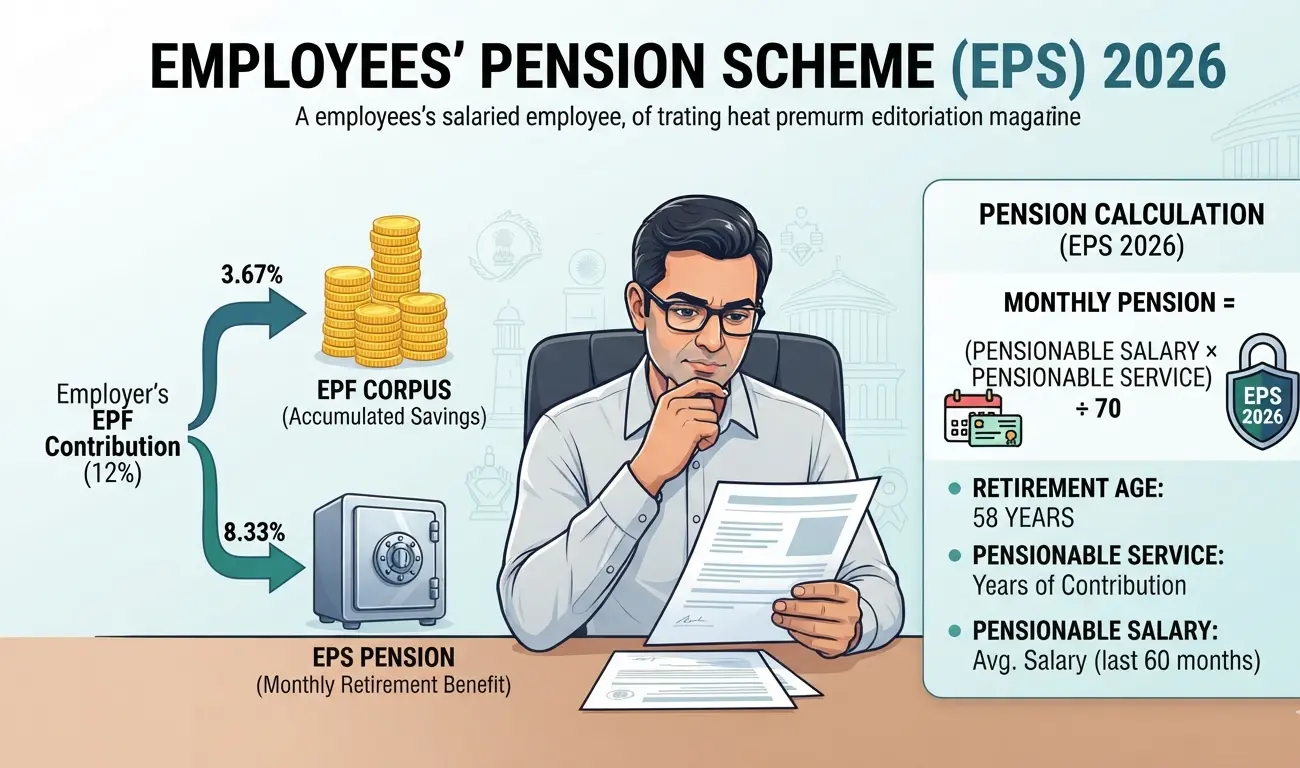
The Employees’ Pension Scheme exists entirely inside your EPF relationship — there is no separate account to open and no separate contribution required from you personally. Here’s the mechanic that surprises most people: every month, your employer contributes 12% of your Basic Salary plus Dearness Allowance toward the EPF system. Your own 12% goes entirely into your EPF account. But your employer’s 12% is split — 8.33% is diverted into EPS, and only 3.67% actually lands in your visible EPF balance.
Critically, this 8.33% is calculated not on your actual salary, but on a statutory wage ceiling of ₹15,000 per month — unchanged since September 2014. Even if your basic salary is ₹80,000, your employer’s EPS contribution is capped at 8.33% of ₹15,000, working out to ₹1,250 a month. The government tops this up with a further 1.16% of wages, also capped at ₹15,000.
Your EPFO passbook shows only your EPF balance — your own 12% plus your employer’s 3.67% share. The remaining 8.33% is tracked separately by EPFO against your UAN (Universal Account Number) and your cumulative years of service — never displayed as a running balance you can check. There’s genuinely nothing to look at until you actually retire and apply for the pension, which is exactly why most employees never give it a second thought.

EPF vs EPS — What’s the Difference?
Although both EPF and EPS are administered by the Employees’ Provident Fund Organisation (EPFO), they serve very different retirement objectives. EPF is a savings scheme that builds a lump-sum retirement corpus with annual interest, whereas EPS is a defined-benefit pension scheme designed to provide a monthly income after retirement. Understanding the distinction helps explain why your EPF passbook shows only part of your employer’s contribution and why you do not see an “EPS balance” despite contributing towards the pension scheme every month.
| Parameter | Employees’ Provident Fund (EPF) | Employees’ Pension Scheme (EPS) |
|---|---|---|
| Primary purpose | Builds a retirement corpus payable as a lump sum. | Provides a monthly pension after retirement. |
| Employee contribution | 12% of Basic Salary + DA. | No direct contribution from the employee. |
| Employer contribution | Generally 3.67% (balance after EPS allocation). | 8.33% of wages, subject to the statutory wage ceiling. |
| Interest earned | Yes, annual interest declared by EPFO. | No interest is credited because EPS is a defined-benefit pension scheme. |
| Visible account balance | Yes, reflected in the EPFO passbook. | No running balance is displayed in the passbook. |
| Benefit received | Lump-sum withdrawal or transfer as per EPF rules. | Monthly pension based on pensionable salary and pensionable service. |
| Withdrawal | Permitted subject to EPF withdrawal rules. | Generally, no lump-sum withdrawal after completing 10 years of pensionable service; eligible members receive monthly pension instead. |
| Nomination benefits | EPF balance is paid to eligible nominees/legal heirs. | Provides family pension to eligible dependants under EPS provisions. |
| While EPF helps build a retirement corpus, EPS is intended to provide a lifelong monthly pension. Together, they form the two pillars of retirement benefits available to eligible employees covered under the EPF framework. | ||
Think of EPF as your retirement savings account and EPS as your retirement pension. One helps you accumulate wealth through contributions and interest, while the other provides a regular monthly income after retirement based on a statutory formula. Both schemes complement each other and are funded through your employer’s contribution.

What Changed With EPS 2026 — And What Didn’t
The rename from EPS-95 to EPS 2026 is not cosmetic — it reflects a genuine legal transition under the new Labour Codes, consolidating both EPS-95 and the older Employees’ Family Pension Scheme, 1971 into a single modern framework. But for the average subscriber, the practical mechanics you actually experience are largely unchanged. Here’s what’s the same and what’s genuinely new.
| Aspect | Status Under EPS 2026 |
|---|---|
| Employer contribution | Unchanged — 8.33% of wages, subject to ₹15,000 wage ceiling |
| Government contribution | Unchanged — 1.16% of wages, subject to the same ceiling |
| Pension calculation formula | Unchanged — same formula as under EPS-95 |
| Minimum monthly pension | Unchanged — remains ₹1,000, in force since Sept 1, 2014 |
| Existing pensioners | Continue receiving pensions without interruption |
| Higher pension option (Nov 2022 SC judgment) | Carried over — those who exercised it under EPS-95 continue under existing provisions |
| Claim settlement timeline | New: EPFO must settle complete pension claims within 20 days |
| Delayed claim penalty | New: 12% annual interest payable if EPFO misses the 20-day deadline without valid reason |
| Digital processing | New: Several pension-related procedures can now be completed fully online |
| Source: Employees’ Pension Scheme, 2026 notification under the Code on Social Security, 2020; verified July 2026. | |
The 20-day settlement window backed by a 12% annual interest penalty is the standout improvement in EPS 2026. Previously, pension claim delays were common with little real recourse for subscribers. Now, if EPFO fails to process your claim within 20 days without valid justification, you’re entitled to 12% annual interest on the delayed amount — a genuine financial consequence that should meaningfully speed up processing times.

EPS Eligibility & When You Can Claim
To be eligible for the EPS pension, you must be an EPFO member — automatic if your employer has 20 or more employees — and have completed a minimum of 10 years of pensionable service. Service across multiple employers is added together for this purpose; every EPS contribution period you’ve accumulated through job changes gets combined at the time of pension calculation, using your UAN as the common thread linking them all.
- Standard pension age: 58
- Early pension (reduced): Available from age 50
- Deferred pension (enhanced): Wait until 60 and receive an additional 4% per year of enhanced pension
- Minimum service required: 10 years of pensionable service, combined across all employers via your UAN
How Your EPS Pension Is Actually Calculated
EPFO uses a specific, publicly documented formula to calculate your monthly pension at retirement — and unlike EPF, which is simply an accumulated balance, EPS is a defined-benefit calculation based on your salary and years of service.
(₹15,000 × 33) ÷ 70 = ₹7,071 per month
Worked example — 12 years of service:
(₹15,000 × 12) ÷ 70 = ₹2,571 per month
Service of 6 months or more is rounded up to a full year; less than 6 months is dropped. Completing 20 or more years of service earns a bonus of 2 additional years added to your pensionable service for calculation purposes — a meaningful boost for long-tenure employees. The minimum monthly pension floor remains ₹1,000 regardless of what the formula produces for shorter service periods.

Can You Withdraw Your EPS Amount Instead of Taking Pension?
One of the most common misconceptions is that the money accumulated under the Employees’ Pension Scheme (EPS) can be withdrawn at any time like an EPF balance. In reality, EPS follows a different set of rules because it is designed to provide a monthly pension rather than a lump-sum retirement corpus. Whether you can withdraw your EPS benefit depends primarily on your total pensionable service.
| Your Pensionable Service | What You Can Do |
|---|---|
| Less than 10 years | You may claim a withdrawal benefit (subject to EPFO rules) by submitting Form 10C, instead of waiting for monthly pension. |
| 10 years or more | Withdrawal is generally not permitted. Your pension entitlement is preserved until you become eligible to receive monthly pension. |
| Age 58 or eligible retirement age | You can apply for monthly pension by submitting Form 10D, subject to eligibility conditions. |
| Death of the member | Eligible family members may receive family pension under the provisions of the Employees’ Pension Scheme. |
| The applicable benefit depends on your completed pensionable service and eligibility under the Employees’ Pension Scheme, 2026. | |
If you are approaching 10 years of pensionable service, understand the implications before opting for settlement. Once you complete 10 years of eligible service, your EPS benefit generally shifts from a withdrawal-based benefit to a pension entitlement payable after reaching the prescribed pension age. If you change employers, your EPS service usually continues through your UAN, so transferring your EPF account helps preserve your pensionable service.

The Higher Pension Option — What Carries Over Into EPS 2026
Historically, EPS contributions were capped regardless of actual salary — first at ₹6,500, then at ₹15,000 from September 2014. Following a Supreme Court judgment in November 2022, eligible employees and existing pensioners were permitted to opt for a higher pension calculated on their actual salary instead of the capped wage ceiling. For those who opted in and were approved, the employer’s EPS contribution rose from 8.33% to 9.49% of actual pay — funded by a corresponding reduction in the employee’s own EPF accumulation.
Under EPS 2026, this is explicitly preserved: employees who exercised the higher pension joint option under the earlier EPS-95 scheme continue to receive benefits under the existing higher pension provisions, which have simply been carried over and incorporated into the new framework. If you already opted in, nothing changes for you procedurally. If you didn’t, it’s worth understanding this was a largely irreversible, individually calculated decision — a materially higher pension in exchange for a smaller lump-sum EPF corpus at retirement — and confirming with EPFO whether the option remains available going forward under the new scheme.
Correcting the ₹7,500 Minimum Pension Myth
This is worth addressing directly, because it’s one of the most persistently circulated pieces of misinformation around EPS right now — including in some articles that have been updated as recently as mid-2026.
Separately, there is also an ongoing proposal — sometimes referred to as part of “EPFO 3.0” reforms — to raise the wage ceiling used for EPS calculations from ₹15,000 to ₹25,000 per month, which would meaningfully increase both contributions and eventual pensions for millions of workers. As of this writing, this too remains under review by the Ministry of Labour and Employment and has not been implemented. Treat both figures as proposals under discussion, not current entitlements, until an official notification confirms otherwise.
Death Benefit & Family Pension Under EPS
If a subscriber passes away — whether before or after starting to receive their pension — EPS provides for a family pension to the spouse and, in defined circumstances, to children. The exact family pension amount depends on the subscriber’s pensionable salary and service, following EPFO’s family pension tables. This structure was previously spread across both EPS-95 and the separate Employees’ Family Pension Scheme, 1971; under EPS 2026, both have been consolidated into a single framework, simplifying what was previously a more fragmented set of rules for surviving family members to navigate.

How to Claim Your EPS Pension Under EPS 2026
Once you become eligible for pension under the Employees’ Pension Scheme (EPS), claiming your pension is a straightforward process, provided your EPFO records are up to date. Before submitting your application, ensure your UAN is active, Aadhaar, PAN and bank account are linked, and your service history has been correctly updated by your employer. Under EPS 2026, complete pension claims are required to be processed within 20 days, offering subscribers faster settlement than under the earlier framework.
| Step | What You Need to Do |
|---|---|
| Step 1 | Complete the minimum eligibility requirements for EPS pension. |
| Step 2 | Ensure your UAN, Aadhaar, PAN, bank account and KYC details are correctly linked with EPFO records. |
| Step 3 | Submit Form 10D through the EPFO portal or the prescribed offline process, as applicable. |
| Step 4 | EPFO verifies your service history and pension eligibility. |
| Step 5 | After approval, EPFO issues a Pension Payment Order (PPO) and your monthly pension starts through the designated bank account. |
| Processing timelines apply only after a complete application with all required details and supporting documents has been submitted. | |
Most delays in pension processing occur because of incomplete KYC, mismatched personal details, multiple UANs, or incorrect service records. Reviewing your EPFO profile and resolving these issues before retirement can help ensure your pension claim is processed smoothly within the timeline prescribed under EPS 2026.

Frequently Asked Questions — EPS 2026

This article has been prepared after reviewing official notifications, legislation and judicial developments relating to the Employees’ Pension Scheme (EPS). Readers seeking the original legal provisions may refer to the following resources:
- Employees’ Provident Fund Organisation (EPFO) – Official Website
- Ministry of Labour & Employment – Government of India
- Gazette Notification – Employees’ Pension Scheme, 2026
- Code on Social Security, 2020
- Supreme Court judgment on the Higher Pension option (November 2022) and subsequent EPFO implementation circulars.
Last reviewed: August 2026. The article will be updated whenever EPFO issues fresh notifications or the Government amends the Employees’ Pension Scheme.