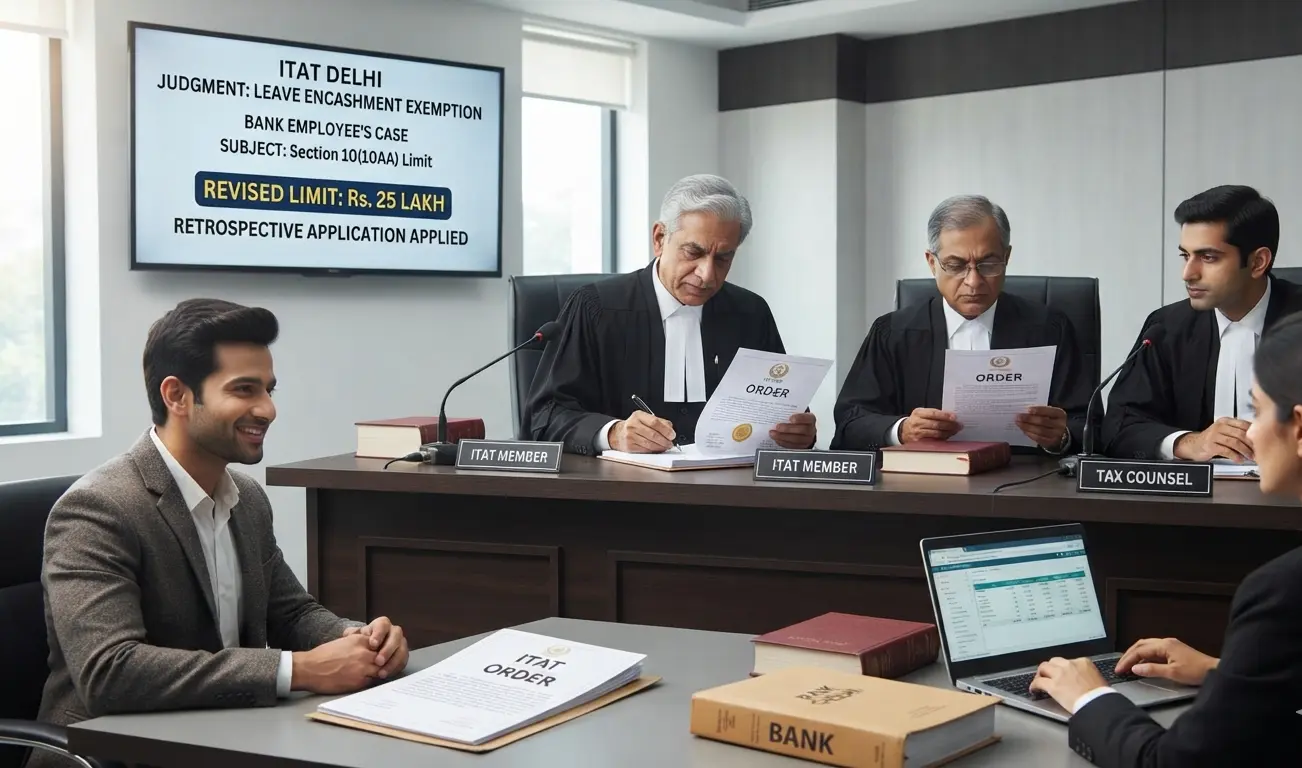
A retired Canara Bank employee claimed Rs.6.97 lakh in leave encashment as exempt under Section 10(10AA). The dispute over leave encashment exemption for bank employees is an old one: the CPC treated her as a non-government employee and capped the exemption at the old Rs.3 lakh limit, enhancing her income by nearly Rs.4 lakh and raising a demand of over Rs.1.18 lakh. Her appeal sat unfiled for 703 days before it finally reached the ITAT Delhi Bench. What the Tribunal did next didn’t settle the long-running question of whether bank employees count as “government employees” for Section 10(10AA) — it sidestepped it entirely, using a 2023 monetary-limit revision instead. Here’s exactly how, and where the limits of that approach lie.
Quick Answer
Can a bank employee claim full Section 10(10AA) leave encashment exemption using the revised Rs.25 lakh limit, even for a retirement before the limit was raised?ITAT Delhi has allowed it in this case — holding that once a leave-encashment claim falls within the CBDT’s revised Rs.25,00,000 exemption ceiling (Notification No.31/2023), it can be allowed in full without deciding whether the employer counts as “government” for the purposes of Section 10(10AA)(i). However, Notification No.31/2023 specifies that the revised limit shall be deemed to have come into force from 1 April 2023. Its application to leave-encashment claims relating to retirements before that date has been debated in appellate proceedings. Several ITAT Benches have applied the higher limit to earlier assessment years, while other authorities have continued to apply the earlier Rs.3 lakh ceiling.
Case Snapshot
| Case Name | Sangita Khanna v. Income Tax Officer, Ward-67(1), Delhi |
| Citation | ITA No. 5072/Del/2026 |
| Court / Bench | Income Tax Appellate Tribunal, Delhi Bench “SMC” (Single Member), New Delhi |
| Coram | Shri Satbeer Singh Godara, Judicial Member |
| Assessment Year | 2021-22 |
| Date of Hearing | 4 August 2026 |
| Date of Order | 4 August 2026 (pronounced); signed 27 August 2026 |
| Key Issue | Denial of full Section 10(10AA) leave encashment exemption to a nationalised bank retiree, treated as a non-government employee subject to the old Rs.3 lakh ceiling |
| Outcome | Appeal allowed — AO directed to allow the full Rs.6,97,100 exemption claim within the revised Rs.25,00,000 limit |
Table of Contents
Legal Issue: Leave Encashment Exemption for Bank Employees Under Section 10(10AA)
Section 10(10AA) of the Income Tax Act, 1961 exempts leave encashment received on retirement. Sub-clause (i) grants Central and State Government employees full, unlimited exemption. Sub-clause (ii) caps the exemption for every other (“non-government”) employee at a monetary ceiling — fixed at Rs.3,00,000 by a notification dating back to 2002, and left unrevised for two decades despite steadily rising salaries. Two questions arose in this case: first, whether a nationalised bank employee should be treated as a “government employee” and get the unlimited exemption; and second — since CBDT revised the non-government ceiling to Rs.25,00,000 with effect from 1 April 2023 — whether that higher limit could apply to a claim relating to an earlier assessment year.
Facts of the Case
The assessee, Sangita Khanna, retired from Canara Bank and claimed Rs.6,97,100 in leave encashment as fully exempt under Section 10(10AA) in her return for AY 2021-22. The CPC processed the return under Section 143(1) (order dated 02.12.2021), restricting the exemption to Rs.3,00,000 on the basis that she was a non-government employee, and disallowing the balance of Rs.3,97,100. This enhanced her assessed income to Rs.11,88,620 and raised a demand of Rs.1,18,280.
She appealed to the CIT(A)/National Faceless Appeal Centre, which upheld the AO’s restriction by order dated 28.02.2024. The CIT(A) relied on the Delhi High Court’s ruling in Kamal Kumar Kalia & Ors. v. Union of India [2020] 268 Taxman 398 (Delhi HC), which held that employees of Public Sector Undertakings and nationalised banks — though treated as “State” under Article 12 of the Constitution for writ jurisdiction purposes — do not thereby become Central or State Government employees for Section 10(10AA), and on the ITAT Bangalore’s ruling in KPTCL Davangere v. ITO [2018] 170 ITD 587, which held that employees of a statutory corporation are similarly not government employees for this exemption.
Aggrieved, the assessee appealed to the ITAT Delhi Bench, with a delay of 703 days in filing. The Tribunal condoned the delay “in larger interest of justice,” citing the Supreme Court’s ruling in Collector, Land Acquisition v. Mst. Katiji & Others (1987) 167 ITR 471 (SC).
Arguments of the Parties
For the Assessee (AR: Sh. Jatin Khanna)
- Canara Bank is regulated by bylaws made by the Central Government, its CMD is appointed by the government, and its management and administration are controlled by the Central Government — so the assessee’s employment should be treated as government, not non-government, employment for full exemption under Section 10(10AA)(i).
- No opportunity of being heard was given before the CPC’s Section 143(1) intimation enhanced her income by disallowing part of the claim.
- The Finance Minister’s Budget speech had indicated an increase in the exemption limit, and a corresponding notification had since been issued; relief should follow on that basis.
For the Revenue (DR: Sh. Manoj Kumar, Sr. DR)
- Relied on the findings of the lower authorities (AO and CIT(A)), but ultimately left the decision to the Bench to grant relief to the assessee as per the notification dated 24.05.2023 — effectively not contesting the outcome once the revised limit was raised in the hearing.
Court/Tribunal’s Decision
The Tribunal allowed the appeal, adopting mutatis mutandis the reasoning of a coordinate Bench in Ram Charan Gupta v. ITO (ITA No.408/JPR/2022, dated 27.06.2023, ITAT Jaipur). It directed the AO to allow the assessee’s Section 10(10AA) exemption claim of Rs.6,97,100 in full, since that amount falls within the CBDT’s revised exemption ceiling of Rs.25,00,000 under Notification No.31/2023.
Reasoning Behind the Decision
The Tribunal did not resolve the underlying question of whether a nationalised bank employee is a “government employee” for the purposes of the unlimited exemption under Section 10(10AA)(i). Instead, following the approach taken by the Jaipur Bench in Ram Charan Gupta, it disposed of the matter on a narrower, monetary basis.
The reasoning traces back to Kamal Kumar Kalia & Ors. v. Union of India (WP(C) 11846/2019, Delhi High Court, dated 08.11.2019), where the Court — while declining to treat PSU and nationalised bank employees as government employees — found prima facie merit in the petitioners’ separate grievance that the Rs.3,00,000 ceiling under Section 10(10AA)(ii), fixed by a 2002 notification, had never been revised despite decades of rising pay scales and inflation. The Court issued notice to the Union of India limited to that point. In response, and following an announcement in the Union Budget 2023 speech, the CBDT issued Notification No.31/2023 dated 24.05.2023, raising the Section 10(10AA)(ii) ceiling to Rs.25,00,000 with effect from 1 April 2023.
In Ram Charan Gupta, the Jaipur Bench applied this revised ceiling to a bank employee’s leave encashment claim that fell below Rs.25,00,000, allowing the claim in full without deciding the government-employee classification question — since the claim was fully covered by the higher ceiling regardless of how the employee was classified. The Delhi Bench here followed the same logic: since Sangita Khanna’s claimed amount of Rs.6,97,100 is well within Rs.25,00,000, her exemption could be allowed in full on the monetary ground alone.
Key Legal Principle
Where a non-government employee’s Section 10(10AA) leave encashment claim falls within the CBDT’s revised Rs.25,00,000 exemption ceiling (Notification No.31/2023), a Tribunal may allow the claim in full on that monetary ground alone — without needing to decide whether the employer qualifies as “government” for the purposes of the unlimited exemption under Section 10(10AA)(i).

Practical Implications
- For bank and PSU retirees with pending disputes: If the claimed leave encashment amount is below Rs.25,00,000, it may be possible to secure the full exemption without having to litigate the government-versus-non-government employee classification question at all.
- Retrospective application is not guaranteed: CBDT’s own Notification No.31/2023 and its Press Release dated 25.05.2023 state the revised Rs.25 lakh limit applies to retirements or resignations on or after 1 April 2023. This Tribunal (following the Jaipur Bench) applied it to an earlier retirement anyway — but this approach is not uniform across authorities, and departmental guidance elsewhere suggests the older Rs.3,00,000 limit continues for pre-April-2023 retirements.
- The classification question remains open and unresolved in the assessee’s favour: This ruling does not establish that bank or PSU employees are “government employees.” For claims exceeding Rs.25,00,000, that unresolved — and currently adverse, per Kamal Kumar Kalia — classification question becomes directly relevant again.
- Long delays can still be condoned: A 703-day delay in filing was condoned here on a justice-oriented reading of Collector, Land Acquisition v. Mst. Katiji, reinforcing that procedural delay alone rarely defeats a case with genuine merit.
Related Judgments and Limitations
| Case | Forum | Relevance |
|---|---|---|
| Ram Charan Gupta v. ITO (ITA No.408/JPR/2022, dated 27.06.2023) | ITAT Jaipur | Directly followed — first applied the revised Rs.25,00,000 ceiling to allow a bank employee’s leave encashment claim in full |
| Kamal Kumar Kalia & Ors. v. Union of India (WP(C) 11846/2019; [2020] 268 Taxman 398) | Delhi High Court | Held PSU/nationalised bank employees are not “government employees” for Section 10(10AA)(i); also flagged the outdated Rs.3 lakh ceiling, prompting CBDT’s eventual revision |
| KPTCL Davangere v. ITO [2018] 170 ITD 587 | ITAT Bangalore | Held employees of a statutory corporation are not government employees for Section 10(10AA) purposes |
| Collector, Land Acquisition v. Mst. Katiji & Others (1987) 167 ITR 471 | Supreme Court | Landmark authority for liberal, justice-oriented condonation of delay — applied here to condone a 703-day delay |
Frequently Asked Questions
Some ITAT Benches, including this Delhi Bench and the Jaipur Bench in Ram Charan Gupta, have applied the revised Rs.25 lakh ceiling to claims relating to earlier assessment years. However, CBDT’s own notification and press release state the revised limit applies to retirements or resignations on or after 1 April 2023, so this point remains contested rather than settled.
No. The Tribunal did not decide that question. It resolved the case only on the monetary ceiling, leaving the Delhi High Court’s finding in Kamal Kumar Kalia — that PSU and bank employees are not government employees — undisturbed.
The monetary-ceiling approach used in this case would not fully resolve such a claim, and the unresolved question of whether the employee counts as a “government employee” for the unlimited exemption under Section 10(10AA)(i) would become directly relevant again.
There’s no fixed cap. Here, a 703-day delay was condoned “in larger interest of justice,” following the Supreme Court’s guidance in Collector, Land Acquisition v. Mst. Katiji that courts should take a justice-oriented, non-pedantic approach to condonation.
No. It is a Single Member Bench ruling of ITAT Delhi and is persuasive rather than binding elsewhere. It follows the reasoning already laid down in Ram Charan Gupta rather than independently establishing a new binding rule.
Final Verdict
Based on the above facts and reasoning, the appeal was allowed. ITAT Delhi (SMC) directed the AO to allow Sangita Khanna’s full Section 10(10AA) leave encashment claim of Rs.6,97,100, holding that since the amount falls within the CBDT’s revised Rs.25,00,000 exemption ceiling under Notification No.31/2023, it is allowable in full — without deciding whether her employer, Canara Bank, qualifies as a government organisation.
Also Read
Corresponding Provisions Under the Income-tax Act, 2025
This case was decided under the Income-tax Act, 1961, as it concerns Assessment Year 2021-22. Under the Income-tax Act, 2025, the general exempt-income framework previously under Section 10 of the 1961 Act has moved to Section 11, read with Schedules II to VII, with certain salary-related exemptions further dealt with under Section 19 of the new Act. The precise corresponding provision for leave encashment specifically (the equivalent of Section 10(10AA)) has not been independently confirmed at the time of writing and should be verified before being relied on for tax years governed by the new Act.

Source Judgment: Sangita Khanna v. Income Tax Officer, Ward-67(1), Delhi, ITA No. 5072/Del/2026, ITAT Delhi Bench “SMC”, order pronounced 4 August 2026. This order can be looked up on the official ITAT judicial search portal using the ITA number above.
Want the full order copy? Download it here.
Legal Disclaimer: This article is for general informational purposes only and analyses a specific Tribunal order under the Income Tax Act, 1961, as it applied to Assessment Year 2021-22. It is not legal or tax advice, and it does not account for developments after the date of publication or for the specific facts of any reader’s case. Readers should verify the applicable current position — including the unresolved retrospective-application question discussed above — and consult a qualified Chartered Accountant or tax professional before acting on this or any similar matter.