

Most NPS subscribers never make this decision consciously — they get defaulted into it on day one and never look back. But the choice between Active and Auto is arguably more consequential than which fund manager you pick, because it decides how much equity risk your retirement corpus carries for the next 20 or 30 years. Here’s how to actually decide.
Open an NPS account today, and unless you actively say otherwise, you are automatically enrolled into the Moderate Life Cycle Fund — a 50% equity, age-based glide path you never explicitly chose. Most subscribers never revisit this decision. They assume the default is fine, or they don’t realise a choice was ever made on their behalf in the first place. That’s a mistake, because NPS Active Choice vs Auto Choice is not a minor settings toggle — it is the single decision that determines how much market risk your retirement corpus carries, and for how long, across the next two or three decades of your working life.
Here is exactly how both options work, what changed with PFRDA’s 2024 and 2025 updates, and how to actually decide between NPS Auto Choice vs Active Choice based on your age, temperament, and how closely you want to manage your own retirement money.
What Active Choice and Auto Choice Actually Are
Every NPS subscriber’s contribution is invested across four possible asset classes: Equity (E), Corporate Bonds (C), Government Securities (G), and Alternative Assets (A) — the last covering instruments like REITs, InvITs, and venture capital funds. How your money is split across these four buckets is where Active and Auto Choice diverge completely.
Active Choice — You Decide the Split
Under Active Choice, you personally set the percentage allocated to each asset class. Most subscribers can allocate up to 75% to Equity, though this cap is lower for central and state government employees (typically capped at 50% or restricted to G-Sec-heavy options). Following PFRDA’s September 2025 Multiple Scheme Framework (MSF), some subscribers can now also access a genuine NPS 100% equity fund — a meaningfully more aggressive option than what was previously available. The critical feature of Active Choice: your allocation does not change automatically with age. If you set 75% equity at 30 and never revisit it, you’re still at 75% equity at 55 unless you manually rebalance.
Auto Choice — The System Decides, Based on Your Age
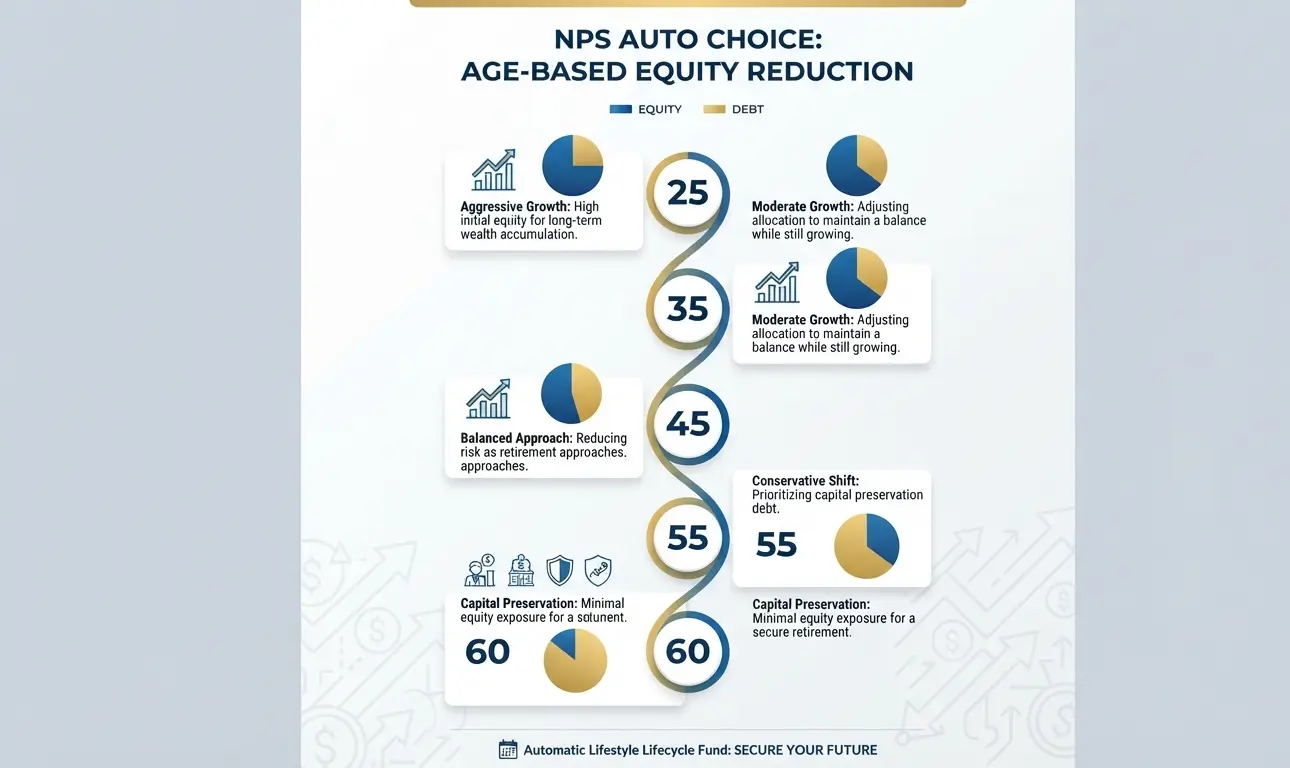
Auto Choice, also called the Lifecycle Fund approach, automatically adjusts your equity exposure as you age — heavier in equity when you’re young and have decades to recover from volatility, progressively shifting toward safer government securities as retirement approaches. You don’t touch a thing; the rebalancing happens on your behalf, once a year, based purely on your date of birth. If you don’t actively select an investment option when opening your NPS account, you are automatically defaulted into Auto Choice — specifically the Moderate Life Cycle Fund (LC50).
Active Choice gives you control but demands discipline — you must remember to rebalance as you age, and many subscribers simply don’t. Auto Choice removes that burden entirely but locks you into a pre-set age-based formula that may not match your personal risk appetite or financial situation.
Choose Active Choice if you want full control over your NPS asset allocation and are willing to review your portfolio regularly. Choose Auto Choice if you prefer a hands-off approach where your equity allocation automatically reduces with age according to the prescribed lifecycle fund.

The Four Lifecycle Funds Under Auto Choice — LC25, LC50, LC75, and BLC
Choosing Auto Choice isn’t the end of the decision — you then pick from four lifecycle fund variants, each with a different equity ceiling and a different age at which tapering begins. Understanding these four funds properly is the real substance of the NPS lifecycle fund LC25 LC50 LC75 decision.
- October 2024: PFRDA introduced the Balanced Life Cycle Fund (BLC), extending 50% equity exposure to age 45 instead of 35 — designed for private sector and All Citizen Model subscribers who want higher equity for longer without going as aggressive as LC75
- September 2025: The Multiple Scheme Framework (MSF) allowed access to pure equity funds under active choice for eligible subscribers — a meaningfully higher-risk option beyond the previous 75% cap
- December 2025: PFRDA introduced two additional lifecycle options specifically for central government pensioners — a high-equity LC75 variant tapering to 15% by 55, and a new Aggressive option offering 50% equity until age 45, tapering to 35% by 55
NPS Active Choice vs Auto Choice — Complete Comparison Table
| Parameter | 🟤 Active Choice | 🔵 Auto Choice |
|---|---|---|
| Who decides allocation | You, manually | Automatic, based on age |
| Maximum equity exposure | Up to 75% (higher via MSF pure equity funds for eligible subscribers) | 25% (LC25), 50% (LC50/BLC), or 75% (LC75), depending on fund chosen |
| Rebalancing | Manual — you must actively rebalance | Automatic — happens once a year based on birthdate |
| Default if no choice made | Not applicable | LC50 (Moderate Life Cycle Fund) is the default |
| Best suited for | Hands-on investors who track markets and rebalance deliberately | Hands-off investors who want a “set it and forget it” glide path |
| Effort required | High — ongoing monitoring and manual adjustment | Low — zero ongoing management needed |
| Risk of over-exposure near retirement | Real — if you forget to de-risk, you stay equity-heavy into your 50s | None — the fund forces de-risking automatically |
| Available to government employees | Yes, with lower caps in most cases | Yes, plus dedicated lifecycle options introduced Dec 2025 |
| Number of asset classes | 4 (E, C, G, A) | 3 (E, C, G) within the lifecycle formula |
| Sources: PFRDA, NPS Trust, LIC Pension Fund, SBI Pension Funds, Business Standard (December 2025). | ||
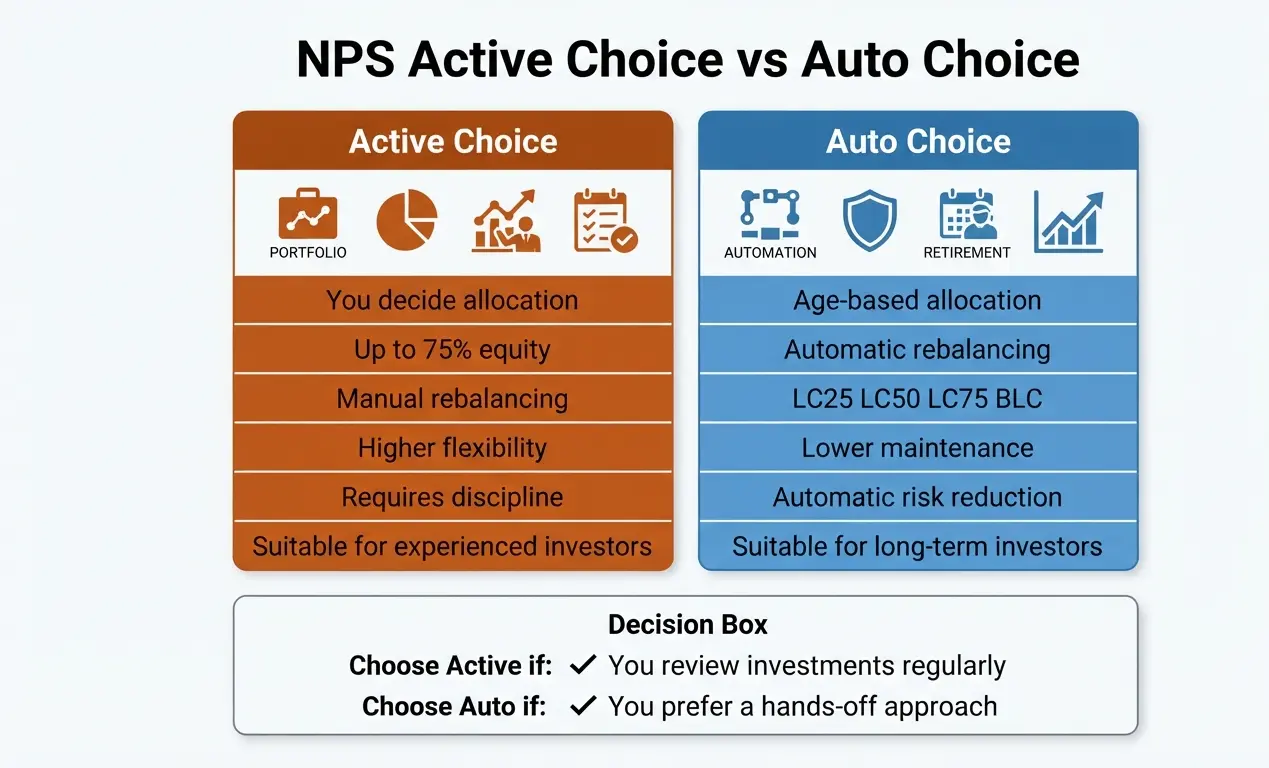
Choosing Active Choice is beneficial only if you review your asset allocation periodically. While it offers greater flexibility, it also requires discipline to rebalance your portfolio as you approach retirement. If you are unlikely to review your investments regularly, Auto Choice may be the better long-term option because it automatically adjusts your equity exposure according to the prescribed lifecycle schedule.
Rahul and Neha are both 29 years old and have similar retirement goals, but they prefer different investing styles.
Rahul actively manages his investments and is comfortable with market volatility. He chooses Active Choice with a 75% equity allocation because he reviews and rebalances his portfolio regularly.
Neha, on the other hand, prefers a hands-off approach. She selects the LC75 Auto Choice lifecycle fund, allowing her NPS portfolio to automatically reduce equity exposure as she gets older without requiring manual intervention.
Key takeaway: Although Rahul and Neha may start with similar equity exposure, their investment management approach is completely different. Active Choice requires periodic review and discipline, while Auto Choice automatically adjusts the portfolio according to the prescribed lifecycle schedule.
- Choosing Active Choice but never reviewing your allocation.
- Assuming the default LC50 is suitable for everyone.
- Ignoring your risk appetite while selecting a lifecycle fund.
- Confusing Pension Fund Manager selection with investment option selection.
What Actually Happens to Your NPS Equity Allocation After Age 35 (or 45)?
Understanding NPS equity allocation by age is the part most subscribers never think through in advance, and it matters enormously. Under LC25, LC50, and LC75, your equity allocation holds steady at its maximum level only until age 35. On your 36th birthday, the fund begins an automatic annual reduction — moving a portion out of equity and into safer debt instruments — continuing every year until age 55, when the glide path flattens out at its final conservative allocation (roughly 5%, 10%, or 15% depending on which lifecycle fund you chose).
The Balanced Life Cycle Fund (BLC) works differently and, for many mid-career professionals, more sensibly: it holds 50% equity all the way to age 45 before tapering begins. If you opened LC50 in your late 20s and are now approaching 35 wondering whether you’re about to be de-risked too early, BLC is worth understanding as an alternative — you get a full extra decade of higher equity exposure before the automatic reduction kicks in.
Active Choice has no equivalent automatic de-risking. If you chose 75% equity at 28 and never revisit your NPS allocation, you could still be sitting at 75% equity at 52 — just eight years from a typical retirement window, with no automatic protection against a market downturn. This is the single most common mistake among Active Choice subscribers: setting an allocation once and never coming back to it for a decade or more.

How to Change Your NPS Investment Option — Frequency & Process
NPS gives you meaningful flexibility to change your mind — but within limits worth knowing precisely. If you’re wondering how many times can I change my NPS scheme in a year, here’s the exact answer.
- Investment option / scheme preference change: Up to 4 times per financial year — this covers switching between Active and Auto Choice, changing your lifecycle fund (e.g. LC50 to BLC), or adjusting your Active Choice percentages
- Pension Fund Manager (PFM) change: Once per financial year, separate from the above
- How to switch: Log in to the CRA portal (cra.nps-proteantech.in) or use your POP; the change applies to future contributions and existing corpus reallocation, depending on the type of switch requested
- No cost or penalty for switching within the permitted frequency — but PFRDA has repeatedly cautioned against treating NPS like a frequently-traded mutual fund; it is designed as a long-term, buy-and-hold retirement vehicle
This 4-times-a-year limit was itself an increase — PFRDA raised it from twice a year in response to subscriber demand, giving you meaningfully more flexibility than existed just a few years ago to correct course if your initial choice no longer fits your situation.

Which One Fits You — By Age and Investing Temperament
- The best NPS investment option for a 30 year old is usually LC75 or Active Choice at 75% equity — decades to recover from volatility
- If uncertain about hands-on management, BLC or LC75 auto-handles it for you
- Revisit your choice every 2–3 years even under Auto Choice
- BLC is genuinely well-suited here — 50% equity held until 45
- Under Active Choice, consciously begin reducing equity if you haven’t already
- Check whether your current lifecycle fund’s taper schedule still matches your retirement timeline
- Auto Choice (any variant) is doing the de-risking for you automatically by now
- Under Active Choice, this is the decade to actively shift toward G-Sec and Corporate Bonds
- Consider switching to Auto Choice if you’re unsure you’ll manage Active allocation carefully from here
- Actively follow markets and are comfortable making allocation decisions
- Want access to pure equity funds under the new MSF framework
- Have a specific asset allocation strategy that differs from age-based defaults
- Are disciplined enough to revisit and rebalance at least annually
- Prefer a “set it and forget it” approach with zero ongoing management
- Are a first-time or new NPS subscriber unsure where to start
- Worry you might forget to de-risk as retirement approaches
- Want the discipline of automatic, age-appropriate rebalancing built in
There is no universally “better” option between Active Choice and Auto Choice. The right decision depends on your willingness to manage your portfolio, your risk tolerance, and your investment horizon. If you can review your asset allocation regularly, Active Choice offers greater flexibility and control. If you prefer a disciplined, hands-off approach, Auto Choice automatically adjusts your equity exposure according to the prescribed lifecycle schedule, helping keep your retirement portfolio aligned as you approach retirement.