

- Why stamp duty and registration charges India catch most homebuyers off-guard — and the circle rate trap that makes the bill bigger than expected.
- Verified 2026 state-wise stamp duty rates for 13 major states — with male, female, and joint ownership columns.
- Real rupee examples: what you pay on a ₹50 lakh, ₹75 lakh, and ₹1 crore property in Maharashtra.
- Four legal, legitimate strategies to reduce your stamp duty bill — including the one that saves couples ₹50,000–₹2 lakh depending on the state.
- How to pay stamp duty online in 2026 — simplified in three steps — and the 4-month deadline you must not miss.
“You’ve paid for the flat. But the government still has one more bill for you — and most buyers discover it only at the registration table.”
Priya and Suresh had saved for six years for their first home in Pune. They negotiated hard, brought the seller down to ₹75 lakh, arranged a home loan, and walked into the Sub-Registrar’s office in October 2025 ready to finalise everything. That is when they discovered that making the flat legally theirs required an additional ₹5.25 lakh — paid that same day, in cash, from personal funds. No loan. No instalment. No flexibility. Just a bill that their entire home-buying journey had never properly accounted for.
This is not an unusual story. Stamp duty and property registration charges are the most consistently underestimated costs in any Indian property transaction. They are mandatory, they are significant — typically adding 5 to 11 percent to your property’s cost depending on the state — and they must be paid upfront before a single document is legally recognised. For first-time home buyers in India especially, this cost blindsides budgets at the worst possible moment. Understanding stamp duty and registration charges across Indian states before you sign anything is not optional. It is essential financial planning.
Stamp duty is a state government tax levied on property transactions under the Indian Stamp Act, 1899. Paying it makes your sale deed legally valid and admissible in court. Without it, you have no enforceable ownership.
Registration charges are separate administrative fees paid to the Sub-Registrar’s office to officially record the property transfer in government records under the Registration Act, 1908. Both are paid together on the day of registration — and neither can be financed through a standard home loan.
How Stamp Duty Is Calculated — and the Circle Rate Trap Most Buyers Walk Into
The formula for stamp duty looks simple. In practice, one variable trips up buyers repeatedly: the circle rate.
The circle rate — known as the ready reckoner rate in Maharashtra, the guidance value in Karnataka, the jantri rate in Gujarat, and the circle rate in Delhi and UP — is the minimum property valuation set by the state government for each locality. It is revised periodically, typically annually. To check circle rate online, visit your state’s official Stamps and Registration portal — most states including Maharashtra (IGR Maharashtra), Karnataka (Kaveri portal), and Delhi (DORIS) now publish locality-wise rates with a searchable interface. Check the current rate for your specific locality before you finalise any deal — not after. NRI buyers should note that stamp duty and registration rates are the same as for resident Indian buyers; there is no separate NRI rate for property registration charges in India.
Underpaying stamp duty — whether by accident or by undervaluing the property — carries serious consequences. The Sub-Registrar can reject the registration on the spot. If somehow registered, the document is inadmissible as evidence in court, banks will refuse home loans against the property, and you cannot legally enforce ownership. Penalties range from 2% per month to 10 times the deficit amount in some states, with criminal proceedings possible in severe cases.
Always calculate stamp duty on the higher of the agreement value or circle rate — never just the price you negotiated.
State-Wise Stamp Duty and Registration Charges India 2026: Quick Reference
Stamp duty rates vary dramatically across India — from 3% in Goa to a combined 11% in Tamil Nadu when stamp duty and registration charges are added together. The table below covers the 13 states where the majority of Indian property transactions take place, with 2026 verified rates.
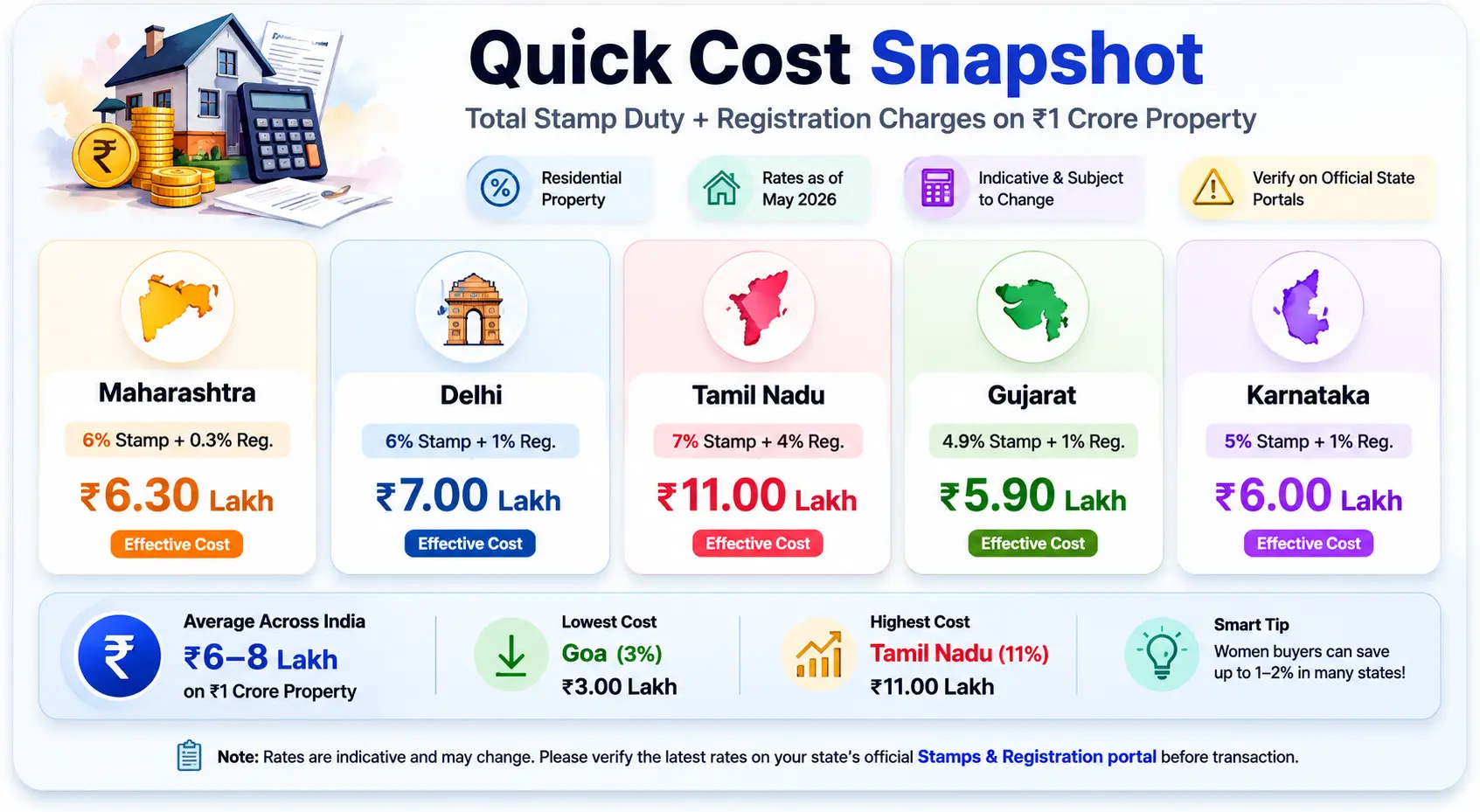
| State | Stamp Duty — Male | Stamp Duty — Female / Joint | Registration Charge | Notable Rule |
|---|---|---|---|---|
| Maharashtra | 6% (municipal corp) 4% (municipal council) 3% (gram panchayat) | 5% / 4% / 2% 1% concession | 1%, capped ₹30,000 | Metro area surcharge applies in Mumbai |
| Delhi | 6% | 4% 2% concession | 1% | DDA/NDMC properties may differ |
| Karnataka | 5% (above ₹45L) 3% (₹21–45L) 2% (below ₹21L) | 5% / 3% / 2% No concession | 2% (revised Aug 2025) | Registration hiked from 1% to 2% w.e.f. Aug 31, 2025 |
| Tamil Nadu | 7% | 7% No concession | 4% | Highest combined rate in India at 11% |
| Uttar Pradesh | 7% | 6% 1% (up to ₹1 cr) | 1% | Max ₹5,000 fee for ancestral property division |
| Gujarat | 4.9% | 4.9% No concession | 1% | Lower rate to attract property investment |
| Rajasthan | 6% | 5% 1% concession | 1% | SC/ST buyers: 1% on property up to ₹20L |
| Haryana | 7% urban / 5% rural | 5% urban / 3% rural 2% concession | 1% | Urban/rural rates differ; joint ownership also qualifies |
| West Bengal | 6% | 6% No concession | 1% | Municipal area surcharges apply |
| Telangana | 4% | 4% No concession | 0.5% registration + 1.5% transfer duty | Total effective cost: ~6% including transfer duty |
| Kerala | 8% | 8% No concession | 2% | Highest stamp duty in table; no gender or first-buyer concession |
| Punjab | 7% | 5% 2% concession | 1% | Rural areas may attract lower rates |
| Goa | 3% | 2% 1% concession | 1% | Lowest stamp duty rate in India |
Most guides only list which states offer women’s stamp duty discounts. Equally important: Karnataka, Tamil Nadu, Gujarat, Telangana, West Bengal, and Kerala do not offer gender-based stamp duty concessions as of 2026. If you are buying in these states, registering solely in a woman’s name will not reduce your stamp duty bill. Plan your ownership structure and budget accordingly.
Additionally, Karnataka raised its property registration charge from 1% to 2% effective August 31, 2025 — making it one of the more expensive states for registration fees. Always verify the latest rates on the Kaveri portal (kaveri.karnataka.gov.in) before proceeding.
Real Numbers: What Stamp Duty Costs on ₹50L, ₹75L, and ₹1 Crore in Maharashtra
Maharashtra is India’s largest property market by transaction volume. Here is exactly what you pay at three price points — and what a woman buyer saves simply by registering in her name.
| Property Value | Male Buyer (6% + 1%) | Female Buyer (5% + 1%) | Saving for Female | Total Outflow |
|---|---|---|---|---|
| ₹50,00,000 | ₹3,00,000 + ₹30,000 | ₹2,50,000 + ₹30,000 | ₹50,000 saved | Male: ₹3,30,000 | Female: ₹2,80,000 |
| ₹75,00,000 | ₹4,50,000 + ₹30,000 | ₹3,75,000 + ₹30,000 | ₹75,000 saved | Male: ₹4,80,000 | Female: ₹4,05,000 |
| ₹1,00,00,000 | ₹6,00,000 + ₹30,000 | ₹5,00,000 + ₹30,000 | ₹1,00,000 saved | Male: ₹6,30,000 | Female: ₹5,30,000 |
Note: Registration charge capped at ₹30,000 in Maharashtra regardless of property value above ₹30 lakh. These figures assume the agreement value equals or exceeds the ready reckoner rate. If the circle rate is higher — common in premium localities — the actual bill increases proportionally.
Most homebuyers plan for the EMI. Very few plan for the ₹4–6 lakh they need in cash on registration day. That single oversight is responsible for more last-minute loan panics than any other factor in Indian property transactions.
5 Factors That Quietly Change What You Pay — Beyond the State Rate
The state rate is just the starting point. Five variables determine what your actual bill looks like on registration day.
4 Legal Strategies to Reduce Your Stamp Duty Bill
The simplest and most universally applicable stamp duty saving strategy in India. In 15+ states, registering solely in a woman’s name — or as joint ownership with the woman listed as the first applicant — qualifies for 1–2% concession. On a ₹1 crore Delhi property, this saves ₹2 lakh in stamp duty. Both sole and joint ownership qualify. The woman does not need to fund the purchase independently — even if the husband is the primary borrower on the home loan, listing the wife as first owner captures the concession in applicable states.
States offering this concession include Maharashtra (1%), Delhi (2%), Haryana (2%), Uttar Pradesh (1%), Rajasthan (1%), Punjab (2%), and Goa (1%). Note: Karnataka, Tamil Nadu, Gujarat, Telangana, West Bengal, and Kerala do not offer this concession — always verify on your state’s official Stamps and Registration portal before the sale deed is drafted.
Before entering any price negotiation, look up the circle rate / ready reckoner rate for that specific locality on your state’s official portal. If the property’s asking price is close to the circle rate, this is actually a signal of fair pricing — your stamp duty will be calculated on the agreed value. If the asking price is significantly above the circle rate, you are paying stamp duty on the market premium. Factoring this into your total budget before negotiation prevents the registration-day shock that caught Priya and Suresh off-guard.
Many homebuyers miss this: stamp duty and registration charges paid on a residential property are eligible for income tax deduction under Section 80C, within the overall ₹1.5 lakh annual limit — but only under the old tax regime. Claim it in the year of actual payment, not the year of possession. At a 30% tax slab, ₹1.5 lakh deduction saves approximately ₹46,800 in income tax (including cess). Under the new tax regime (now the default for most salaried individuals), this Section 80C stamp duty deduction is not available — a factor worth weighing when deciding which tax regime to use for the financial year in which you register the property.
Maharashtra has historically announced temporary stamp duty reductions during real estate slowdowns — it cut rates to 2% in September 2020 and offered a 1% reduction in 2023. Other states have done the same during festive seasons or post-Budget periods. Monitoring your state’s annual Budget announcements and festive season property schemes can save you 1–3% on stamp duty if your purchase timing is flexible. Subscribe to your state’s IGR portal notifications or speak to a local property lawyer in Q4 each year.
How to Pay Stamp Duty Online in 2026 — 3 Simple Steps
The process of paying stamp duty has been significantly digitised across most Indian states. Physical stamp papers are increasingly rare. Here is the simplified 2026 process.
Once stamp duty is paid on a document, that document must be presented for registration at the Sub-Registrar’s office within 4 months. Missing this window means the stamp paper lapses, registration is refused, and you must restart the stamping process — paying again. On high-value properties, this is a costly and avoidable mistake. Book your Sub-Registrar appointment immediately after stamp duty payment.

Frequently Asked Questions — Stamp Duty and Registration Charges India 2026
Stamp duty and registration charges are not a footnote in your property budget. They are a mandatory, upfront, non-negotiable cost that will add ₹3–11 lakh to the price of most homes in India — depending on the state, the property value, and the ownership structure you choose. Most buyers discover this too late, scrambling for cash on the day of registration.
Three actions will prevent that from happening to you. First, check the circle rate for your specific locality before you negotiate the purchase price — not after. Second, if buying in a state that offers the women’s concession, factor the ownership structure into your planning before the sale deed is drafted. Third, budget for stamp duty and registration charges as a separate, fixed cash requirement — equal to 5–8% of property value in most states — that must be available on registration day, independent of your home loan.
The keys to your home come after the paperwork. And the paperwork costs money the bank will not lend you. Plan for it now.

Disclaimer
Stamp duty and registration charges vary across Indian states and may change based on government notifications, property type, ownership category, municipal jurisdiction, and transaction value. The information provided in this article is for educational and informational purposes only and should not be treated as legal, tax, or financial advice.
Readers are advised to verify the latest rates, circle values, concessions, and registration rules from their respective state registration departments or consult a qualified legal or financial professional before making any property transaction decisions.

Similar Posts
NPS Tier I vs Tier II: Key Differences, Tax Benefits & Which One You Need
NPS Tier I vs Tier II: Key Differences & Tax Benefits 2026 | TaxBizMantra NPS Series · Part 4 · Account Structures Tier I is your pension vault — locked, tax-privileged, built for retirement. Tier II is your flexible investment account — open, market-linked, and taxed…
Term Insurance vs Health Insurance vs ULIP: Which One Should You Buy First?
Confused between term insurance, health insurance and ULIP? Understand their purpose, coverage, GST treatment, tax rules, costs and limitations—and learn which insurance protection you should generally prioritise first.
NPS Active Choice vs Auto Choice: Which Should You Pick?
Confused between NPS Active Choice and Auto Choice? Learn the key differences, latest PFRDA rules, equity limits, lifecycle funds, and which option can potentially build a larger retirement corpus.
Term Plan vs Endowment vs ULIP: Why Insurance Should Never Be an investment
A full breakdown of term plans, endowment policies and ULIPs — with a 20-year worked example showing why combining insurance with investment quietly costs you on both sides, and the rare case when it doesn’t.
Atal Pension Yojana (APY) Explained: Eligibility, Chart & Tax Benefits 2026
Planning for retirement? Explore Atal Pension Yojana (APY) eligibility, monthly contribution chart, pension benefits, tax provisions, withdrawal rules, and how APY compares with NPS.
How Much Term Insurance Do You Need? Calculate Your Ideal Cover & Premium Factors
How much term insurance do you really need? Learn three practical methods to calculate your ideal term insurance cover, including income replacement, expense and liability replacement, and Human Life Value. This guide also explains premium factors, riders, Return of Premium plans and how to read claim settlement ratios.