Health insurance is the one old-regime deduction most families need for its own sake. Under the Income-tax Act, 2025 it has a new number, Section 126 — and one sentence in it now reads more widely than the old 80D ever did.
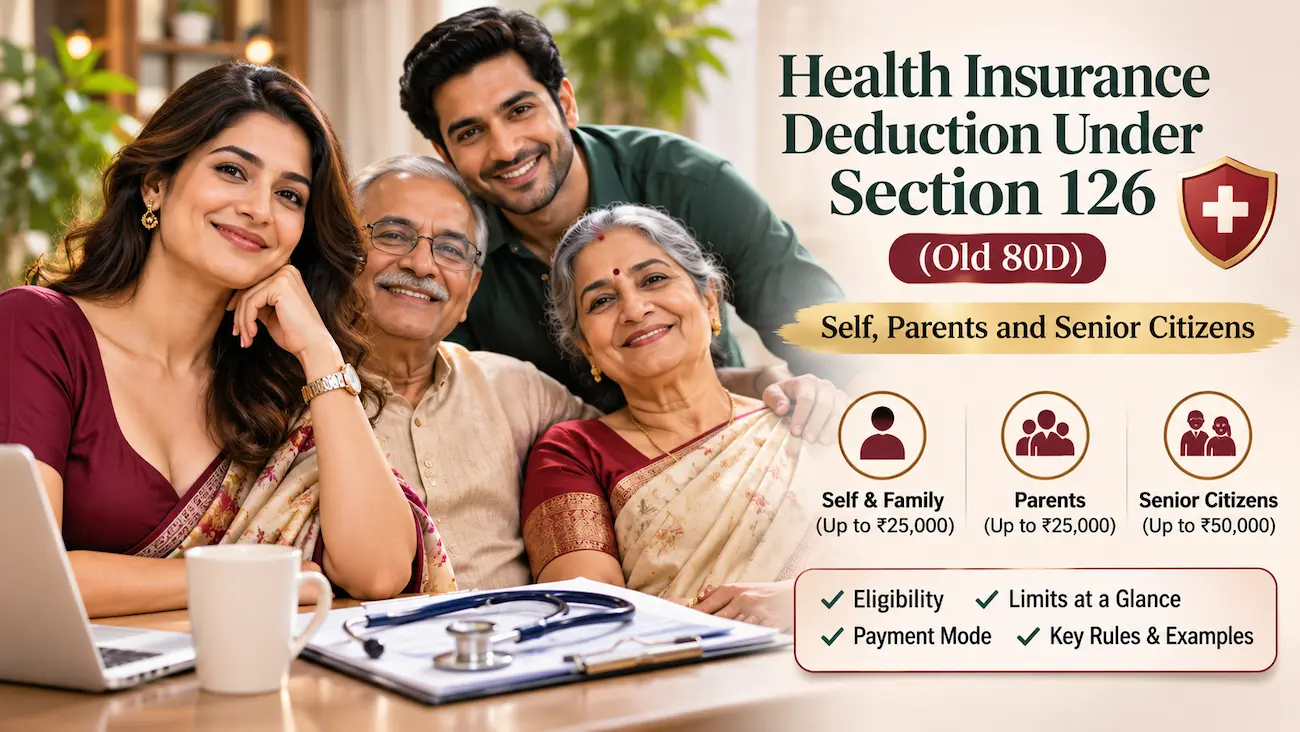
The Section 126 health insurance deduction is the successor to Section 80D of the 1961 Act. It allows a deduction for premium paid on health insurance, for contributions to the Central Government Health Scheme and other notified schemes, for preventive health check-ups and, within limits, for medical expenditure. The limits are familiar — ₹25,000 for one’s own family, ₹25,000 for parents, ₹50,000 wherever a senior citizen is covered — but the section is now arranged in eleven sub-sections, each dealing with one rule.
This chapter takes those rules one at a time and illustrates each with figures. It is written for the employee buying a family floater, the son or daughter paying a parent’s premium, the retired couple managing their own cover, and the professional who prepares all their returns. It also explains, in a separate section, a change in wording on medical expenditure that every reader should understand before claiming it.
- 80D is now Section 126. Old regime only; individuals and HUFs.
- Two groups: self, spouse and dependent children; and parents. ₹25,000 each.
- ₹50,000 for a group where the insured person is a resident senior citizen.
- Preventive check-up: up to ₹5,000 in aggregate, inside the group limits; the only item payable in cash.
- Combined cap: premium, check-up and medical expenditure together cannot exceed ₹50,000 per group.
- Medical expenditure for an uninsured senior is allowed; for others, the wording is wider than 80D but the safe course is not to claim it yet.
See what your health insurance actually saves under each regime. Free Old Regime Deductions Planner (Excel) ↓
Section 126 Income Tax Act 2025: The Rule and the Two Groups
Section 126(1) allows an individual or a Hindu undivided family to deduct, from income chargeable to tax for the tax year, the amounts specified in the section, provided they are paid by a permitted mode. For an individual, sub-section (2) recognises two groups:
Group 1 — self and family
The taxpayer, spouse and dependent children. “Family” is defined in Section 126(10)(b) as the spouse and dependent children.
Group 2 — parents
Either or both parents of the taxpayer. There is no requirement that the parents be dependent.
Each group has its own limits, and the two never borrow from each other: unused room for one’s own family cannot be used for parents, or the other way round. A Hindu undivided family has a single group covering its members, dealt with in section 07 below.
Mapping other provisions from the old Act
80D is only one of several hundred provisions that have moved. Where a Form 16, a notice or an older article refers to a 1961 Act section, rule, form or schedule, our free mapping tools give its Income-tax Act, 2025 equivalent in seconds.
Law Mapping Hub
One reference page for sections, rules, forms and schedules, old Act to new.
Section Mapping
Every 1961 Act section matched to its 2025 Act equivalent, e.g. 80D to 126.
Forms Mapping
Old form numbers to their 2026 replacements, for returns, certificates and declarations.
Section 126 Health Insurance Deduction: Limits at a Glance
| Item | Self and family | Parents |
|---|---|---|
| Premium, CGHS or notified scheme, check-up | ₹25,000 ₹50,000 if a senior citizen is insured | ₹25,000 ₹50,000 if a senior citizen is insured |
| Preventive check-up (within the above) | ₹5,000 in aggregate for both groups together | |
| Medical expenditure | Up to ₹50,000 | Up to ₹50,000 |
| Combined cap per group | ₹50,000 | ₹50,000 |
The highest deduction available is therefore ₹1,00,000: ₹50,000 for one’s own family and ₹50,000 for parents. At the 30% slab, including cess, that saves ₹31,200 in tax; the more common claim of ₹25,000 for a young family saves between ₹1,300 and ₹7,800, depending on the slab.
Know your limits? See what they are worth on your own salary. Free Old Regime Deductions Planner ↓
What Qualifies Under Section 126
- Health insurance premium on a policy under a scheme of the General Insurance Corporation approved by the Central Government, or of any other insurer approved by IRDAI (Section 126(11)). Family floater, individual, top-up and super top-up policies all qualify if they meet this test.
- Contribution to the Central Government Health Scheme or another scheme notified by the Central Government. This is allowed only in the self-and-family group, not for parents.
- Preventive health check-up, up to ₹5,000 in aggregate across both groups (Section 126(3)).
- Medical expenditure on the health of the taxpayer, family members or parents, up to ₹50,000 per group, subject to the conditions discussed in sections 05 and 06.
A premium borne by an employer under a group policy is not paid by the employee and is not deductible by him. Where, however, the employer recovers the premium from the employee’s salary — as is common for parents’ cover and voluntary top-ups — the employee has paid it and may claim it. A personal top-up bought by the employee is equally deductible.
Health Insurance Deduction for Parents
The parents group is where most taxpayers lose money, usually because of one of three misunderstandings. First, dependency is not required: a parent with his own pension still counts. Second, the payment must be made by the taxpayer — a premium paid by the parent from his own account is the parent’s deduction, not the child’s. Third, the ₹50,000 limit applies only if the insured parent is a senior citizen, meaning, in the Department’s description, a resident individual aged 60 or above at any time during the tax year.
The residence condition matters to families with parents abroad. A parent aged 65 who is not resident in India is not a senior citizen for this purpose, so premium paid for that parent is limited to ₹25,000, not ₹50,000.
Where both parents are covered and one is a senior citizen, the ₹50,000 limit applies to the group. In practice, where siblings share a parent’s premium, each claims the part he or she actually pays, within his or her own parents-group limit; the premium receipt or bank record should show who paid what.
Paying your parents’ premium this year? Model the parents group in the free planner ↓
Senior Citizens: Higher Limits and Medical Expenditure
Two provisions give senior citizens additional relief. Section 126(8)(a) raises the ₹25,000 limit to ₹50,000 where the insured person is a senior citizen. And Section 126(7) allows medical expenditure on the health of a senior citizen — hospital bills, consultations, medicines — provided no premium has been paid to keep that person’s health insurance in force.
The condition in sub-section (7) is personal: it looks at whether that person is insured. Where a father is insured and a mother is not, premium for the father and medical expenditure for the mother can both be claimed, together limited to ₹50,000 for the parents group under Section 126(4).
Suresh, 42, pays a premium of ₹40,000 for his father, aged 72 and insured, and ₹30,000 for the medical treatment of his mother, aged 67 and uninsured. Both qualify, but the parents group is capped at ₹50,000. His deduction for parents is ₹50,000.
The Wording Change on Medical Expenditure: Read Before Claiming
Under Section 80D of the 1961 Act, a proviso allowed medical expenditure only where it was paid in respect of a senior citizen who had no health insurance. Medical bills of a younger person were never deductible.
Section 126 is worded differently. Clauses (2)(c) and (2)(d) allow medical expenditure on the health of the taxpayer, family members or parents, up to ₹50,000, without any reference to age. Sub-section (7) then says that where the expenditure is on the health of a senior citizen, it is allowed only if that person is uninsured. Read literally, the restriction to senior citizens has gone: medical expenditure on a person below 60 appears deductible, insured or not, within the ₹50,000 combined cap. The two provisions can be compared side by side in our Section Mapping tool.
- The Income-tax Act, 2025 was presented as a simplification of the 1961 Act rather than a change of policy, and much of the commentary we reviewed continues to read Section 126 as allowing medical expenditure only for uninsured senior citizens.
- We have found no circular or clarification on the point. Until there is one, claim medical expenditure only for senior citizens without health insurance, as under 80D.
- A taxpayer who wishes to rely on the literal reading for a person below 60 should keep full bills and payment records, and should expect the claim to be examined.
Our free planner follows the conservative reading, and applies it per group: if any premium is entered for a group, it ignores medical expenditure in that group. In a mixed case such as Suresh’s, the planner will therefore show less than the law allows, and the medical expenditure for the uninsured parent should be added by hand.
Payment Mode, Multi-Year Premium and HUFs
Mode of payment — Section 126(9)
Cash is permitted only for preventive health check-ups. Premium, scheme contributions and medical expenditure must be paid by any mode other than cash. A premium paid in cash at an insurer’s branch, however genuine, earns no deduction.
Multi-year premium — Section 126(8)(b)
Where premium covering more than one year is paid in a single tax year, the deduction is spread equally over the years for which the policy remains in force. A two-year premium of ₹40,000 paid in Tax Year 2026-27 gives a deduction of ₹20,000 in each of Tax Years 2026-27 and 2027-28, each within that year’s limit.
Hindu undivided family — Section 126(5) and (6)
An HUF may deduct premium on the health of any member up to ₹25,000 (₹50,000 if the insured member is a senior citizen), and medical expenditure on any member up to ₹50,000, together capped at ₹50,000. There is no separate parents group for an HUF, and no deduction for CGHS contributions or preventive check-ups.
Illustrations: Section 126 for Different Taxpayers
Illustration 1 — The young salaried family
Neha, 32, pays ₹18,000 by UPI for a family floater covering herself, her husband and their daughter, and ₹4,000 in cash for their annual check-ups. For her parents, both 58 and resident, she pays a premium of ₹22,000 and ₹3,000 for their check-ups.
| Group | Paid | Allowed | Reason |
|---|---|---|---|
| Self and family | ₹18,000 + ₹4,000 | ₹22,000 | Within ₹25,000; check-up uses ₹4,000 of the ₹5,000 |
| Parents | ₹22,000 + ₹3,000 | ₹23,000 | Only ₹1,000 of check-up room remains |
| Total | ₹47,000 | ₹45,000 | ₹2,000 of check-up cost is lost |
Illustration 2 — Uninsured senior parents
Rohit, 40, has a ₹20,000 policy for his own family. His parents, aged 68 and 64 and resident, have no health insurance; he pays ₹70,000 for his father’s hospital treatment and ₹15,000 for his mother’s medicines, by bank transfer. Medical expenditure of ₹85,000 for the parents is capped at ₹50,000. His total deduction is ₹70,000: ₹20,000 for his family and ₹50,000 for his parents.
Illustration 3 — The retired couple
Mr Iyer, 70, and his wife, 66, both resident, pay a premium of ₹45,000 for a senior-citizen policy and ₹5,000 in cash for check-ups. Because the insured persons are senior citizens, the limit is ₹50,000, and the full ₹50,000 is deductible. Had either of them been uninsured, medical expenditure on that person could have been claimed within the same ₹50,000.
Illustration 4 — The three-year policy
Anita pays ₹60,000 in Tax Year 2026-27 for a three-year policy covering her parents, both below 60. Under Section 126(8)(b) she deducts one-third, ₹20,000, in each of Tax Years 2026-27, 2027-28 and 2028-29, each within the ₹25,000 limit. Claiming ₹25,000 in the first year and losing the rest would be an error.
Illustration 5 — The Hindu undivided family
The Gupta HUF pays ₹32,000 by cheque for a policy covering three members, one of whom, aged 63 and resident, is a senior citizen. The insured group includes a senior citizen, so the limit is ₹50,000, and the full ₹32,000 is deductible to the HUF.
Section 126 is generous only to the taxpayer who keeps the two groups apart, pays by a traceable mode, spreads multi-year premiums correctly, and knows which parents are senior citizens in the tax sense. Each of these points decides real money.
Run your own family’s figures the same way. Free Old Regime Deductions Planner ↓
Common Errors in Claiming the Section 126 Deduction
- Paying premium in cash. Only the preventive check-up may be paid in cash.
- Treating the ₹5,000 check-up as an additional deduction, or claiming it separately for each group.
- Claiming ₹50,000 for parents who are below 60, or who are not resident in India.
- Claiming a multi-year premium entirely in the year of payment.
- Claiming premium paid by the employer under a group policy, or by the parent from his own account.
- Claiming medical expenditure for an insured senior citizen, or exceeding the ₹50,000 combined cap.
- Claiming the deduction under the new regime, where Section 126 is not available.
What the Tribunals Have Held
Reported disputes under Section 80D seldom turn on the law; they turn on evidence — the premium receipt, the mode of payment and, for medical expenditure, the bills. The following rulings remain relevant under Section 126.
| Case | Issue | Held |
|---|---|---|
| Abhishek Rajeshbhai Karia v. ITO (ITAT Ahmedabad, 2026), ITA No. 2327/Ahd/2025, AY 2019-20, order dated 15 May 2026 | Section 80D, now Section 126: medical expenditure on parents | Disallowance deleted; medical expenditure incurred for the assessee’s parents held allowable on the facts. The connected 80DDB claim was remitted for verification of documents. |
| Goetze (India) Ltd. v. CIT (Supreme Court, 2006), (2006) 284 ITR 323 | A deduction not claimed in the return | The Assessing Officer cannot allow a fresh claim except through a revised return; the powers of appellate authorities are not curtailed. |
Free Planner: Section 126 Alongside Every Other Deduction
Our free Excel planner applies the Section 126 group limits, the ₹5,000 aggregate check-up rule and the ₹50,000 combined caps, together with Sections 123, 124, 129 and 153, and compares your tax under the old and new regimes. It follows the conservative reading on medical expenditure explained above.
Old Regime Deductions Planner — Tax Year 2026-27
Sections 123, 124, 126, 129 and 153 · both regimes · unused room · no macros.
Old Regime Deductions — the full guide
Every Chapter VIII deduction under its new section, and the break-even against the new regime.
Section 126 Health Insurance Deduction: Frequently Asked Questions
What is the Section 126 health insurance deduction?
Section 126 of the Income-tax Act, 2025 replaces Section 80D of the 1961 Act. It allows an individual or a Hindu undivided family a deduction for health insurance premium, contributions to the Central Government Health Scheme or another notified scheme, preventive health check-ups and, within limits, medical expenditure. It is available only under the old regime.
How much can I claim under Section 126 for myself and my parents?
Up to ₹25,000 a year for self, spouse and dependent children, and a further ₹25,000 for parents. Each limit rises to ₹50,000 where the insured person is a senior citizen. The highest total, for a taxpayer whose own family and whose parents both include senior citizens, is ₹1,00,000.
Is the preventive health check-up an extra ₹5,000?
No. Up to ₹5,000 of preventive health check-up costs can be claimed, but the amount falls within the ₹25,000 or ₹50,000 group limits, and the ₹5,000 is an aggregate figure for the taxpayer’s family and parents together. It is the only Section 126 payment that may be made in cash.
Can I claim health insurance premium paid in cash?
No. Section 126(9) allows cash only for preventive health check-ups. Premium, contributions to notified health schemes and medical expenditure must be paid by a non-cash mode such as a bank transfer, UPI, card or cheque; a cash payment, however genuine, earns no deduction.
Do my parents need to be dependent on me to claim the deduction?
No. Section 126 sets no dependency test for parents. A son or daughter who pays the premium for a parent’s health insurance can claim it even if the parent has his or her own income. The family group, by contrast, is defined as the spouse and dependent children.
My parents live abroad. Do they get the senior-citizen limit?
Generally not. The Income Tax Department describes a senior citizen as a resident individual aged 60 or more at any time during the tax year. A parent who is not resident in India is therefore not a senior citizen for this purpose, and the limit for premium paid for that parent remains ₹25,000.
Can I claim medical bills if I have no health insurance?
For a senior citizen, yes: Section 126(7) allows medical expenditure of up to ₹50,000 per group where no premium is paid for that person’s health insurance. For a person below 60, the 1961 Act did not allow it, and although the wording of Section 126 is wider, we recommend not claiming it until the position is clarified.
Is the Section 126 deduction available in the new regime?
No. Section 126 is not available under the new regime of Section 202. A taxpayer in the new regime can still buy health insurance, and should, but receives no deduction for the premium.
Before you renew this year’s policy: Check the deduction in the free planner ↓
Deductions under the Income-tax Act, 2025
Old Regime Deductions Under the Income-tax Act, 2025
80C, 80D, 80CCD(1B), 80E and 80TTA under their new sections, with the break-even.
Free TemplateOld Regime Deductions Planner Excel
Apply every limit and compare both regimes on your own figures.
Guide80C Is Now Section 123: Full Schedule XV List
Every eligible investment and the conditions attached to it.
NPS ₹50,000 Deduction Under Section 124(3): Still Worth It?
The extra NPS deduction against the new regime.
Investment Proof Submission: Old Regime Checklist
What your employer will ask for, and by when.
Income Tax Law Mapping: Old Act vs New Act
Sections, rules, forms and schedules of the 1961 Act mapped to the 2025 Act.
ToolIncome Tax Forms 2026 Mapping Tool
Find the new number of any familiar old form.
CalculatorOld vs New Tax Regime Calculator
Compare the two regimes on your income in a minute.
Section 126 carries forward the 80D limits almost unchanged: ₹25,000 per group, ₹50,000 where a resident senior citizen is insured, ₹5,000 for check-ups within those limits, and a ₹50,000 combined cap per group. Its new wording on medical expenditure reads more widely than 80D, but until the Board clarifies it, the prudent course is to claim medical bills only for uninsured senior citizens. Pay every premium by a traceable mode, keep the receipts, and claim the parents group in full — it is the part of this deduction most often left unclaimed.
Sources & References
- Section 126 — Income-tax Act, 2025Income Tax Department. Sub-sections (1) to (11): groups, limits, check-up, combined caps, HUF, senior citizens, multi-year premium, payment mode, definitions, approved insurers.
- FAQs for Senior CitizensIncome Tax Department. A senior citizen is a resident individual aged 60 or above during the tax year.
- Income-tax Act, 1961 — Section 80D(2) and its provisoEarlier position: medical expenditure only for an uninsured senior citizen.
- Goetze (India) Ltd. v. CIT, (2006) 284 ITR 323 (SC)Fresh claim of deduction outside the return.
- Income Tax Law Mapping: Old Act vs New Acttaxbizmantra.com. Section-wise comparison of the 1961 and 2025 Acts.
Disclaimer: This article is for general information and education only and is not tax advice. It reflects Section 126 of the Income-tax Act, 2025 as published by the Income Tax Department, for Tax Year 2026-27, as we read it in November 2026. The scope of the medical-expenditure deduction for persons below 60 has not been clarified, and the recommendation above is a conservative position. Verify against the Act and any subsequent clarification, and consult a Chartered Accountant on your specific facts.