
Case at a glance
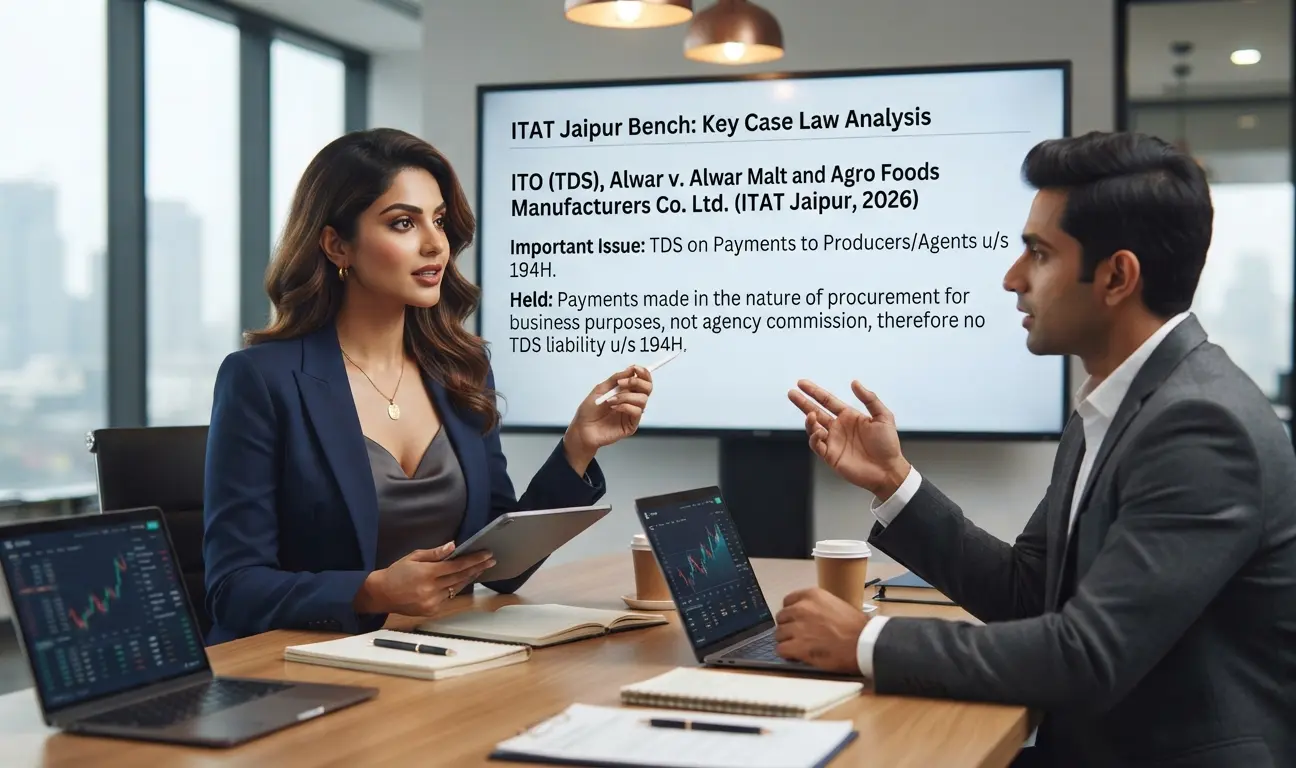
Case Name: ITO (TDS), Alwar v. Alwar Malt and Agro Foods Manufacturers Co. Ltd. (ITAT Jaipur, 2026)
- Subject
- TDS on franchise expenses: whether profit transferred by a liquor bottling unit to IMFL brand owners under tie-up agreements is a fee for technical services under Section 194J
- Issue
- Was the assessee in default under Section 201 for not deducting tax at 10% under Section 194J on Rs.13.04 crore booked as “Franchise Expenses” and paid to United Spirits Ltd., Saraya Distilleries Ltd. and May Fair Enterprises, leading to a demand of Rs.2.48 crore with interest?
- Appeal no.
- ITA No. 1190/JPR/2025 (Revenue’s appeal), order pronounced on 29 October 2026
- Forum
- ITAT Jaipur, “B” Bench (Smt. Annapurna Gupta, Accountant Member, and Shri T.R. Senthil Kumar, Judicial Member); order authored by Smt. Annapurna Gupta
- Assessment year
- 2016-17 (FY 2015-16)
- Provisions
- Sections 194J, 201(1), 201(1A) and 9(1)(vii), Income-tax Act 1961 (Sections 393 and 398 of the Income-tax Act 2025)
- Outcome
- In favour of assessee
- Order copy
- Download the full order
Background
Facts of the Case
- The assessee is an Alwar-based company. Under agreements dated 6 March 2009, 31 March 2011 and 1 July 2011, it manufactured and bottled IMFL for three brand owners: Saraya Distilleries Ltd. (a unit of Saraya Industries), May Fair Enterprises and United Spirits Ltd.
- Under this tie-up bottling arrangement, the brand owners controlled raw material purchases, production, quality and sales. The assessee received fixed bottling charges, on which the brand owners deducted TDS, and kept a separate trading and profit and loss account for each brand owner. The profit left after production expenses was transferred to that brand owner; the assessee argued that this profit transferred to brand owners was not a fee for any service.
- For FY 2015-16, the profit transferred came to Rs.13,04,37,540, shown as “Franchise Expenses” in the audited accounts. A TDS survey under Section 133A(2A) was conducted at the premises on 26 February 2016.
- The Assessing Officer held that the payments were fixed franchise fees for bottling the brand owners’ brands, for sharing know-how and technical assistance, and attracted TDS at 10% under Section 194J. By order dated 14 March 2023 under Sections 201 and 201(1A), he raised a demand of Rs.2,47,83,130.
- The CIT(A), Jaipur-4 deleted the demand on 23 July 2025, following the CIT(A) orders for AY 2009-10 to AY 2015-16 on the same issue, passed by the CIT(A), Alwar for the earlier years and the CIT(A), Jaipur-4 for the later ones. The Revenue appealed to the Tribunal.
The numbers
How the Rs.2.48 Crore TDS Demand Was Raised
- United Spirits Ltd.
- Rs.13,01,91,677.79 profit transferred
- Saraya Distilleries
- Rs.5,92,170.44 profit transferred
- May Fair Enterprises
- (−) Rs.3,46,308.51, a loss on this brand owner’s account
- Total
- Rs.13,04,37,540 booked as “Franchise Expenses”
- Demand
- Rs.1,30,43,753 TDS at 10% under Section 201(1) plus Rs.1,17,39,378 interest under Section 201(1A), totalling Rs.2,47,83,130: deleted
Our own working, not set out in the order: the three figures add up to Rs.13,04,37,540 only if the May Fair Enterprises figure is negative, as the CIT(A)’s findings quoted in the order show it. The order’s own summary of facts drops the minus sign. Ten per cent of the total gives the TDS figure of Rs.1,30,43,753 to within a rupee.
The ruling
Summary of Decision: What the Tribunal Held
Short answer: under this ruling, no TDS on franchise expenses is required under Section 194J where the “franchise expense” is really the profit a bottling unit transfers to brand owners under a tie-up agreement. Such a transfer is a business transaction, not a fee for professional or technical services.
Dismissing the Revenue’s appeal, the Tribunal held:
- That the issue was squarely covered by the Tribunal’s own order in the assessee’s case for AY 2013-14 to AY 2015-16 (ITA Nos. 79 to 81/JPR/2025, dated 6 August 2025), which confirmed the CIT(A)’s deletion of the TDS demands. [Para 5 of the order]
- That the Departmental Representative could not controvert that the identical issue had arisen from AY 2009-10 to AY 2015-16, nor distinguish the Tribunal’s earlier order. [Para 6 of the order]
- That there was no reason to interfere with the CIT(A)’s order deleting the demand of Rs.2,47,83,130. [Paras 7 and 8 of the order]
Why
Reasoning Behind the Decision
- Profit transfer is not a fee for technical services. In the earlier order it followed, the Tribunal tested whether the payments were fees for technical services under Section 194J, reading the section with the definition of “fees for technical services” in Explanation 2 to Section 9(1)(vii), which covers consideration for managerial, technical or consultancy services. Because the assessee kept a separate profit and loss account and transferred the profit under the agreement, the amount debited as franchise fees was a business transaction under the agreement, not a fee for such services. [Para 5 of the order, quoting ITA No. 79/JPR/2025]
- The Assessing Officer had accepted the claim in regular assessments. In scrutiny assessments for AY 2013-14 (order dated 30 March 2016) and AY 2014-15 (order under Section 143(3) dated 13 December 2016), the Assessing Officer examined the franchise expenses and did not disallow them. The Revenue placed nothing to the contrary on record. [Para 5 of the order, quoting ITA No. 79/JPR/2025]
- Settled issues should not be reopened year after year. The Revenue had accepted the CIT(A)’s orders for AY 2009-10 to AY 2011-12 without further appeal, as the tax effect was below the monetary limit. Relying on Parashuram Pottery Works Co. Ltd. v. ITO (1977) 106 ITR 1 (SC), the earlier Tribunal order held that there must be finality and certainty in litigation. [Para 4 of the order, and para 5 quoting ITA No. 79/JPR/2025]
- The Revenue had nothing new. Before the Tribunal in this year, the Departmental Representative could neither dispute that the facts were identical nor distinguish the earlier order, so the CIT(A)’s order was upheld. [Paras 6 and 7 of the order]
Practice point
Key Takeaway: TDS on Franchise Expenses Under Section 194J
- The label invited the notice. Booking a profit transfer as “Franchise Expenses” made it look like franchise fees under Section 194J. If your payments are really a profit share under a tie-up, describe them that way in the accounts and the tax audit report.
- Keep a separate account for each brand owner. The separate trading and profit and loss accounts were central to showing that the amount was profit transferred, not a fee for services. Keep them with the agreements and the bottling-charge invoices.
- Use the history of earlier years. Earlier CIT(A) orders, the Revenue’s decision not to appeal them, and scrutiny assessments accepting the claim together made the Revenue’s case very difficult. Collect these for every later year.
- Winning on TDS is not winning on deduction. The Karnataka High Court in Chamundi Winery held that such a surplus is an application of the bottler’s income and not deductible. If the profit transfer is not a payment for services, the Revenue may argue that it is not an expense either. The Rajasthan High Court has not ruled on this.
- Watch the rate for later years. For FY 2015-16, Section 194J applied at 10%. From FY 2020-21, fees for technical services other than professional services attract 2%. Under the Income-tax Act 2025, Section 194J corresponds to Section 393, and Section 201 to Section 398.
- Note the drafting slips. The order’s summary of facts shows the May Fair Enterprises figure as positive, although only a negative figure reconciles to the total; gives the United Spirits figure as both Rs.13,01,91,677.69 and Rs.13,01,91,677.79; says “all the grounds raised by the assessee are dismissed” although the appeal was the Revenue’s; the earlier order it quotes describes ITA No. 79/JPR/2025 as both AY 2013-14 and AY 2016-17; and para 7 says the CIT(A) followed the Tribunal’s earlier decision, although the CIT(A)’s order of 23 July 2025 predates that decision of 6 August 2025 and followed earlier CIT(A) orders. None affects the result.
Read the full Tribunal order
Download the complete order copy as a PDF.
Download order
Keep reading