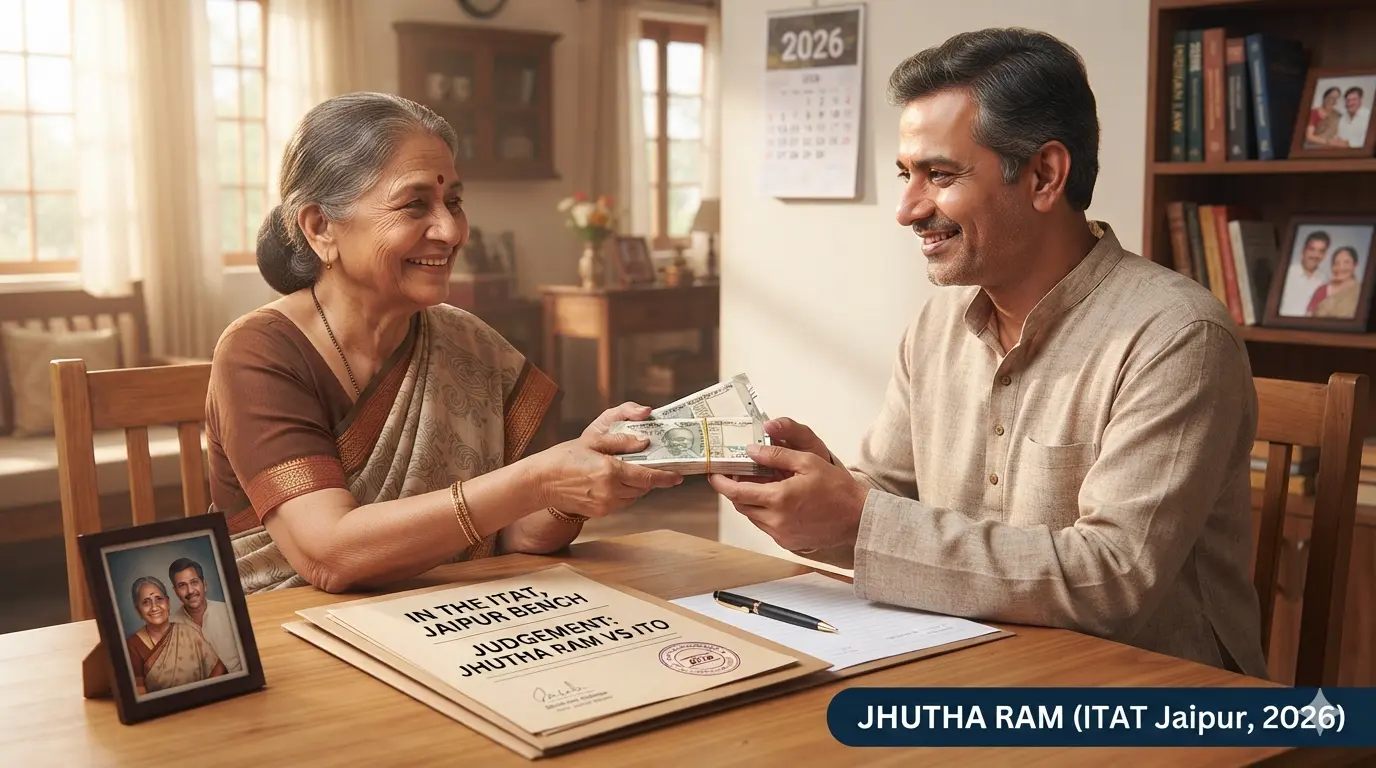
Case at a glance
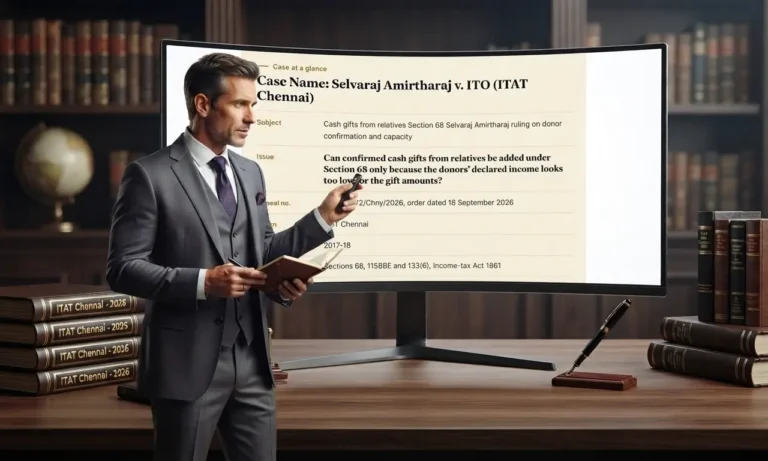
Case Name: Jhutha Ram v. ITO, Ward 1(2), Jaipur (ITAT Jaipur, 2026)
- Subject
- Cash gift from mother: whether cash deposits explained as a gift from the assessee’s mother, funded by the sale of her old jewellery, could be added to his income as unexplained cash deposits
- Issue
- Where the assessee produced a notarised gift deed signed by two witnesses, the jewellery sale invoice and a registered valuer’s report on his mother’s jewellery, could the Assessing Officer reject the gift because the invoice gave only the total weight and the mother had not banked the sale proceeds?
- Appeal no.
- ITA No. 1365/JPR/2025, order pronounced on 6 October 2026
- Forum
- ITAT Jaipur (Smt. Annapurna Gupta, Accountant Member, and Shri T.R. Senthil Kumar, Judicial Member); order authored by Shri T.R. Senthil Kumar
- Assessment year
- 2012-13
- Provisions
- Sections 2(41), 143(3), 147 and 148, Income-tax Act 1961 (Sections 147 and 148 correspond to Sections 279 and 280 of the Income-tax Act 2025)
- Outcome
- In favour of assessee
- Order copy
- Download the full order
Background
Facts of the Case
- The assessee, an individual from Jaipur, had not filed a return of income for AY 2012-13.
- The department received information that during that year he had invested Rs.20,23,778 in immovable property, including stamp duty and registration charges, and had deposited Rs.13,04,900 in cash in his bank account.
- The Assessing Officer reopened the assessment by issuing a notice under Section 148 on 29 March 2019. The assessee filed a return on 3 December 2019, declaring income of Rs.2,14,997.
- In the reassessment under Section 143(3) read with Section 147, the Assessing Officer added both amounts: Rs.20,23,778 as unexplained investment in property and Rs.13,04,900 as unexplained cash deposits.
- The CIT(A), NFAC, deleted the addition for the property investment. After calling for a remand report from the Assessing Officer, he confirmed the addition of Rs.13,04,900 for the cash deposits in his order dated 30 July 2025.
- The assessee explained that the cash came from a gift of Rs.16,00,000 made by his mother on 2 February 2012, which she had funded by selling her old gold jewellery. He appealed to the Tribunal against the remaining addition.
The money trail
From the Mother’s Jewellery to the Assessee’s Bank Account
- Valuation
- The mother’s jewellery valued at Rs.18,36,230 as on 31 March 2011 by a registered valuer
- Sale
- 642.300 grams of old gold jewellery sold for Rs.16,10,567 (the order does not state the date of sale)
- Gift
- Rs.16,00,000 gifted in cash to the assessee on 2 February 2012, under a notarised gift deed signed by two witnesses
- Deposits
- Rs.16,05,000 deposited by the assessee in his bank account between 4 February 2012 and 31 March 2012, as recorded by the Tribunal
- Addition
- Rs.13,04,900 added as unexplained cash deposits and confirmed by the CIT(A)
The order does not explain the difference between the deposits of Rs.16,05,000 recorded by the Tribunal and the addition of Rs.13,04,900. Nor does it name the section under which the addition was made.
The ruling
Summary of Decision: What the Tribunal Held
Allowing the assessee’s appeal and deleting the addition of Rs.13,04,900, the Tribunal held:
- That the gift deed on record showed a gift made to the assessee on 2 February 2012, and the assessee deposited Rs.16,05,000 in his bank account between 4 February 2012 and 31 March 2012. [Para 7 of the order]
- That the gift was from the assessee’s mother, who is a relative as defined in Section 2(41). [Para 7 of the order]
- That a gift made by the mother in her old age out of the proceeds of selling her gold jewellery could not be doubted, since it was supported by a valid notarised gift deed with two witnesses and the value of the jewellery had been determined by a registered valuer. [Para 7 of the order]
Why
Reasoning Behind the Decision
- The Assessing Officer’s objections. The Assessing Officer disbelieved the cash gift from mother on two grounds: the sale invoice for 642 grams of gold worth Rs.16,10,567 did not list the jewellery item by item, and the cash from the sale was not deposited in a bank account. He also contended that the weight of the jewellery sold was much less than the total weight in the valuation report. In his remand report, he asked for the addition to be confirmed. The CIT(A) accepted the remand report and confirmed the addition. [Para 5 of the order]
- The assessee’s answers. Counsel explained that, in the jewellery trade, an invoice for old jewellery usually records only the total weight and does not list individual items. On the weight, counsel submitted that the mother had sold only part of her jewellery, 642.300 grams, and gave Rs.16,00,000 of the proceeds to her son, which is why the weight sold was less than the weight valued. [Para 5 of the order]
- The documents proved the source. The Tribunal examined the paper book filed by the assessee. It found a gift deed dated 2 February 2012 that was notarised and signed by two witnesses, a registered valuer’s report on the mother’s jewellery, and bank deposits that began two days after the gift. The Tribunal relied on these documents in accepting the gift. [Para 7 of the order]
- The donor was a close relative. The Tribunal noted that the gift came from the assessee’s mother, who is a relative under Section 2(41). It held that a cash gift from mother to son, made in her old age out of the sale of her own gold jewellery and backed by a notarised deed and a valuer’s report, could not be doubted. [Para 7 of the order]
- The Revenue relied only on the lower orders. The Departmental Representative’s only submission was that the orders of the Assessing Officer and the CIT(A) should be upheld. The order records no material from the Revenue questioning the gift deed, the valuation report or the sale invoice. [Paras 6 and 7 of the order]
- The legal ground was not reached. The assessee had also challenged the reassessment itself as being without jurisdiction. The Tribunal deleted the addition on merits and did not give a separate finding on that ground. [Paras 4, 7 and 8 of the order]

Practice point
Key Takeaway: How to Prove a Cash Gift From Mother
- Prove the source, not only the relationship. A cash gift from mother is not taxed as income in the son’s hands, because she is a relative, but the Assessing Officer can still ask where the cash came from. Here the assessee won because he showed the mother’s own source: her jewellery, its valuation and its sale.
- Make a proper gift deed. A notarised gift deed with the date, the amount and two witnesses carried real weight with the Tribunal. Execute it on the date the gift is made, not later.
- Keep the donor’s evidence. Preserve the jewellery sale invoice, any valuation report and the donor’s bank or wealth records. Here, an invoice showing only the total weight did not defeat the claim, once the gift deed and the valuation report supported it.
- Link the dates. The deposits here began two days after the gift deed. A short, clear gap between the gift and the deposits makes the explanation far more credible.
- Large cash gifts now carry a separate risk. This case concerns AY 2012-13. From 1 April 2017, Section 269ST bars receiving Rs.2 lakh or more in cash from one person in a day, in a single transaction, or for one event or occasion, even from a relative, and Section 271DA imposes a penalty equal to the amount received. Today, a gift of this size should be made by bank transfer.
- The order has drafting slips. It is headed “SMC” Bench although two Members heard it, and it does not state the section under which the addition was made. Neither affects the result.
Read the full Tribunal order
Download the complete order copy as a PDF.
Download order
Keep reading