Case at a glance
Case Name: Venkateshan R.V. v. Sanjay @ Sanjay Sait & Ors.
- Subject
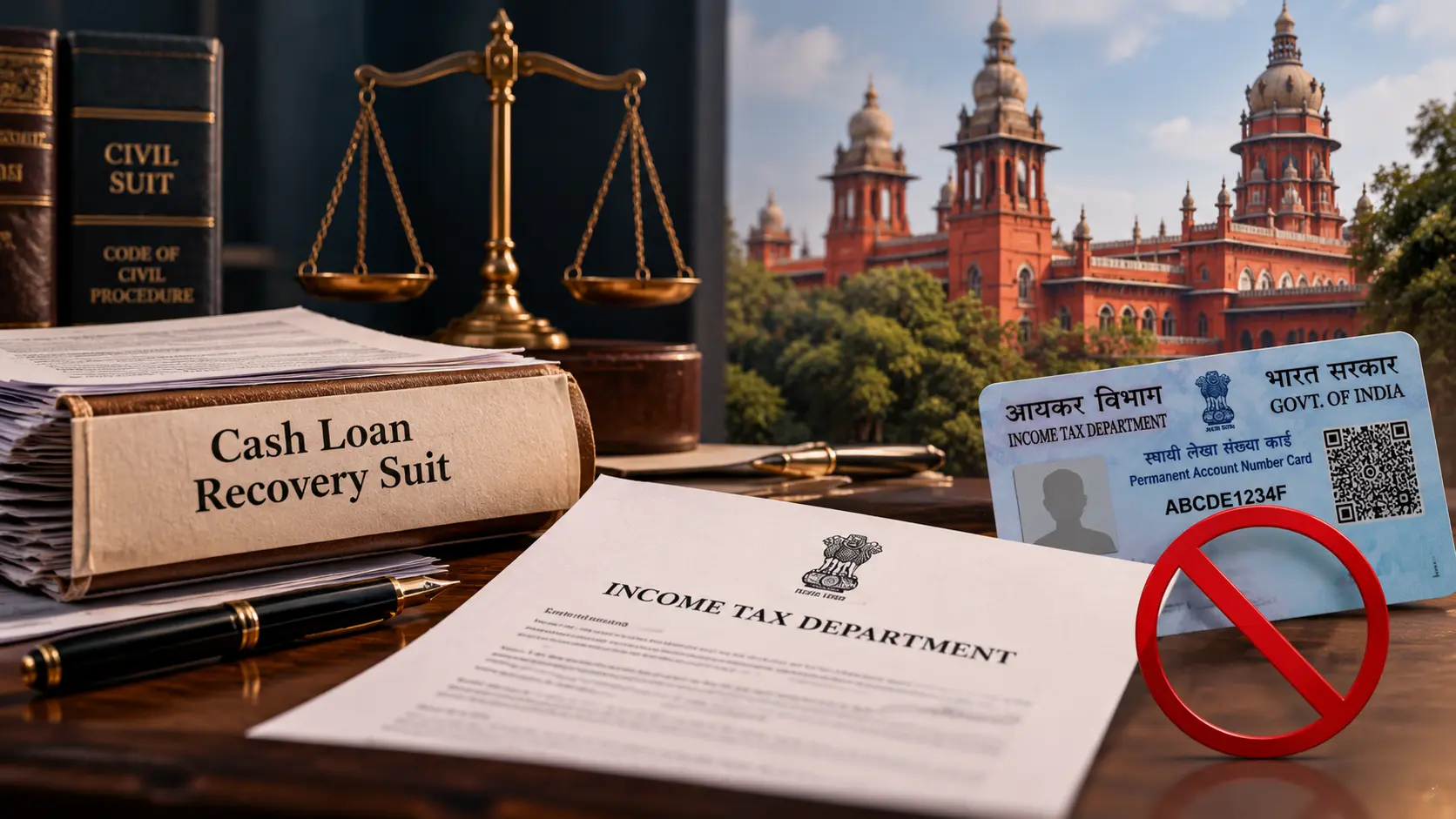
- Cash loan recovery suit: reporting to the Income Tax Department and PAN disclosure
- Issue
- In a suit to recover a Rs 80 lakh cash loan given before Section 269ST existed, can the court (a) send the suit records to the Income Tax Department, and (b) compel the lender to disclose his PAN to the borrowers?
- Citation
- (2026) 349 CTR 105; 182 taxmann.com 845 (Mad)
- Court
- Madras High Court (civil revision)
- Provisions
- Section 269ST, Income-tax Act 1961; Supreme Court guidelines in RBANMS Educational Institution v. B. Gunashekar
- Outcome
- Partly in favour of assessee
Background
Facts of the Case
- The assessee filed a civil suit to recover Rs 80 lakh, allegedly lent in cash on 21 June 2016 against a promissory note.
- While the suit was pending, the borrowers applied for a direction requiring the assessee to disclose his PAN and for the suit records to be sent to the Income Tax Department, alleging a breach of Section 269ST.
- The trial court allowed the application on both counts.
- The assessee challenged that order before the Madras High Court in a civil revision petition.
The ruling
Summary of Decision: What the High Court Held
- In RBANMS Educational Institution v. B. Gunashekar, the Supreme Court issued general guidelines asking courts across India to inform the jurisdictional income tax authorities of large cash transactions, to curb black money.
- The loan was given before Section 269ST was introduced. Even so, a cash transaction of this size deserves examination by the Income Tax Department, so the High Court did not interfere with the order to report the cash loan recovery suit to the Department.
- However, the assessee cannot be compelled to disclose his PAN to the borrowers. The trial court’s direction on PAN disclosure therefore could not stand.
Practice point
Key Takeaway for Any Cash Loan Recovery Suit
- Filing a suit to recover a large cash loan can lead the court to report the transaction to the Income Tax Department.
- This can happen even for loans given before Section 269ST took effect, because the reporting rests on the Supreme Court’s guidelines, not on Section 269ST itself.
- A borrower cannot use the suit to force the lender to disclose his PAN to them.
- Before suing on a large cash loan, check that the lender’s books and returns can explain the source of the cash.
Keep reading