
A home loan EMI has two parts, principal and interest, and the taxman treats them completely differently. Get the interest deduction wrong, and you either leave money on the table or claim more than the law allows.
Parts 1 and 2 got you to the Net Annual Value of a house, whether it is self-occupied, let out, or deemed let out. This part covers what happens next: the home loan interest deduction and the standard deduction under Section 22 of the Income Tax Act 2025, the two rules that turn Net Annual Value into the actual taxable figure. The home loan interest deduction in particular has real limits, real conditions, and one number that catches almost everyone who owns two self-occupied houses off guard.
Applicability note: Section 22 (corresponding broadly to Section 24 of the Income-tax Act, 1961) applies for Tax Year 2026-27 onward. The core deductions are unchanged from the 1961 Act; this article follows the statutory text of Section 22(1) to (6) as reported by legal databases reproducing the Act.
The 30% Standard Deduction
The first deduction needs no explanation beyond its size: 30% of the Net Annual Value is deducted automatically, with no bills, no receipts, and no questions about what you actually spent on maintenance or repairs that year. It applies to every let-out and deemed let-out property. A self-occupied house with a Nil annual value has nothing to apply 30% to, so this deduction is effectively zero for those two houses.
Home Loan Interest Deduction: The Basic Rule
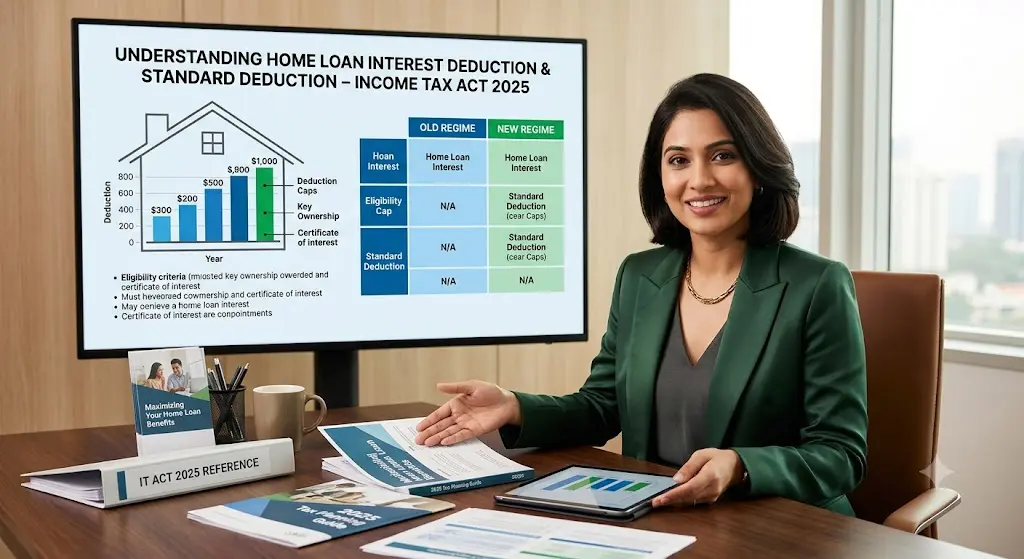
The second deduction is interest on money you borrowed for the property, and the law is generous about what counts. Interest qualifies if the borrowed capital was used to acquire, construct, repair, renew, or reconstruct the property. That is a wider list than most people expect; a loan for renovation qualifies just as much as the original loan to buy the flat, though as you will see below, the two are not treated identically once a ceiling applies.
The ₹2 Lakh Cap for Self-Occupied Houses
For houses covered by Section 21(6), your self-occupied houses, the otherwise unlimited interest deduction is restricted. The cap depends on whether two conditions are both met:
- Completion within five years — the property must have been acquired or constructed with the borrowed capital, and that acquisition or construction completed within five years from the end of the tax year in which the capital was borrowed.
- A lender’s certificate — you must be able to furnish a certificate from the person to whom the interest is payable, confirming the amount.
Meet both conditions, and the deduction is capped at ₹2,00,000. Miss either one, whether the property took longer than five years to complete, or the loan was for repair or renovation rather than acquisition or construction, and the cap drops to ₹30,000.
Self-Occupied
₹2,00,000 if both conditions are met, ₹30,000 otherwise
Let-Out or Deemed Let-Out
No ceiling at all, the full interest amount is deductible
The detail that catches people out is Section 22(5). It does not give you a ₹2,00,000 deduction for each self-occupied house. It caps the aggregate deduction across all properties covered by Section 21(6), which is at most two houses, at a combined ₹2,00,000. If you have a home loan running on both of your self-occupied houses, you are not adding two separate ₹2,00,000 limits together; you are sharing one ₹2,00,000 limit between them.
Meera treats two flats as self-occupied. Both loans meet the five-year completion condition and she has certificates for each. She pays ₹1,40,000 in interest on the first flat and ₹1,60,000 on the second, ₹3,00,000 in total. Because Section 22(5) caps the combined deduction across both self-occupied houses at ₹2,00,000, she cannot deduct the full ₹3,00,000. She can allocate the ₹2,00,000 between the two properties in whatever way benefits her most, but the total she claims across both houses cannot exceed ₹2,00,000, leaving ₹1,00,000 of interest with no deduction available at all.
If she is a co-owner and co-borrower on either loan, jointly owning the property and jointly repaying the loan with someone else, each co-owner can independently claim their own share up to ₹2,00,000, so a jointly owned, jointly financed self-occupied house can genuinely double the household’s usable deduction. Being named only as a co-borrower without co-ownership does not qualify; both conditions, ownership and borrowing, need to be met by the same person.
Pre-Construction Interest: Five Equal Instalments
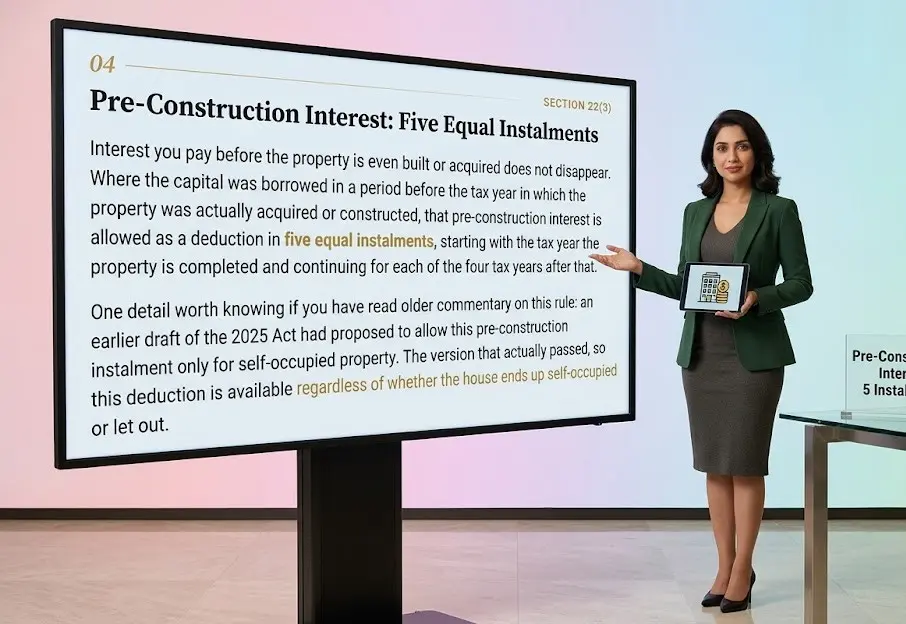
Interest you pay before the property is even built or acquired does not disappear. Where the capital was borrowed in a period before the tax year in which the property was actually acquired or constructed, that pre-construction interest is allowed as a deduction in five equal instalments, starting with the tax year the property is completed and continuing for each of the four tax years after that.
One detail worth knowing if you have read older commentary on this rule: an earlier draft of the 2025 Act had proposed to allow this pre-construction instalment only for self-occupied property. The version that actually passed restored it for let-out property as well, matching the older 1961 Act’s position, so this deduction is available regardless of whether the house ends up self-occupied or let out.
The New Tax Regime Restriction
Part 2 flagged this briefly; here is the fuller picture. Under the tax regime governed by Section 202, the computation does not allow the deduction under Section 22(1)(b) for properties covered by Section 21(6), your self-occupied houses, and a loss under the head Income from House Property cannot be set off against income under another head.
In practice, this means the ₹2,00,000 or ₹30,000 interest deduction discussed above is an old tax regime benefit for self-occupied houses. If you file under the new regime, that deduction is not available for a self-occupied property, whatever the actual interest paid. Interest on a let-out property is a different matter, since it is not a Section 21(6) property; the deduction there is not removed the same way, though the general restriction on setting off a house property loss against other income still applies under the new regime.
Interest Paid to a Lender Outside India
One narrower situation worth flagging: if your home loan is from a lender outside India, the interest is not deductible at all unless one of two things is true. Either tax has been paid or deducted on that interest under the Act’s TDS provisions, or there is an agent in India for that lender who can be treated as the recipient for tax purposes. Miss both, and the deduction is denied entirely, however genuine the loan and however carefully you have tracked the interest paid.
- Assuming ₹2,00,000 applies per self-occupied house — Section 22(5) caps the combined deduction across both self-occupied houses at ₹2,00,000, not ₹2,00,000 each
- Forgetting the five-year completion condition — a self-occupied house that takes longer than five years to complete drops to the ₹30,000 cap, even with a genuine home loan and certificate
- Assuming a co-borrower can claim the deduction without being a co-owner — both ownership and loan repayment need to sit with the same person for that person to claim their own ₹2,00,000
- Expecting the self-occupied interest deduction under the new tax regime — it is not available there at all for Section 21(6) properties, regardless of how much interest was actually paid
Frequently Asked Questions
What is the maximum home loan interest deduction for a self-occupied property?
₹2,00,000 a year, provided the property was acquired or constructed with the borrowed capital and completed within five years from the end of the tax year the loan was taken, and a certificate from the lender is available. If either condition is not met, the cap drops to ₹30,000.
Is the ₹2 lakh interest deduction available for each self-occupied house separately?
No. Section 22(5) caps the aggregate interest deduction across all properties treated as self-occupied at a combined ₹2,00,000, not ₹2,00,000 per house. If you own two self-occupied houses with home loans, the ₹2,00,000 limit is shared between them.
Is there a limit on interest deduction for a let-out property?
No. The ₹2,00,000 and ₹30,000 caps apply only to properties covered by Section 21(6), self-occupied houses. A let-out or deemed let-out property has no ceiling on the interest deduction under Section 22(1)(b).
How is pre-construction interest on a home loan claimed?
Interest paid before the property is acquired or constructed is claimed in five equal instalments, starting from the tax year the property is completed and continuing for each of the next four tax years. This applies to both self-occupied and let-out property.
Can both spouses claim home loan interest deduction on a jointly owned house?
Yes, provided both are co-owners of the property and co-borrowers on the loan. Each can then independently claim up to ₹2,00,000 for a self-occupied property, effectively doubling the household’s usable deduction. Being only a co-borrower without co-ownership does not qualify.
Is home loan interest on a self-occupied house deductible under the new tax regime?
No. Under the tax regime governed by Section 202, the interest deduction under Section 22(1)(b) is not allowed for properties covered by Section 21(6), self-occupied houses. This deduction is available only under the old tax regime.
Can I claim interest deduction on a home loan from a foreign lender?
Only if tax has been paid or deducted on that interest under the Act’s TDS rules, or there is an agent in India for the lender. If neither condition is met, the interest is not deductible at all, regardless of how much was actually paid.
Income From House Property — Series Index
Chargeability & Annual Value: How House Property Income Is Computed
The Section 20/21 framework this article builds on.
Part 2Deemed Let Out Property: The Two-House Rule
Which houses get a Nil value, and which are taxed on notional rent.
Deductions: The 30% Standard Deduction & Home Loan Interest
Turning Net Annual Value into taxable income, and the ₹2 lakh cap most people get wrong.
Co-Ownership & Deemed Ownership: Who Actually Pays Tax
Section 24 and 25 — jointly owned property and the deemed-owner rules.
Two deductions, one flat and automatic, one capped and conditional. The 30% standard deduction takes care of itself. The interest deduction rewards planning: check whether your self-occupied houses will complete construction within five years, keep your lender certificates ready, and remember that owning two self-occupied houses does not give you two separate ₹2,00,000 limits. If you are choosing which two houses to treat as self-occupied, as covered in Part 2, factor the interest cap into that decision too, not just the expected rent.
Sources & References
- Income-tax Act, 2025 [Act No. 30 of 2025] — full text, as amended by Finance Act, 2026Income Tax India, incometaxindia.gov.in
- Section 202 — New Tax Regime for Individuals, HUF and OthersIncome Tax India, incometaxindia.gov.in
Section 22(1) to (6) discussed here are summarised for reader convenience from the statutory text as reproduced by legal databases. Always cross-check against the official Act text linked above and consult a Chartered Accountant before relying on this for a filing decision.
Disclaimer: This article is for general informational purposes only and does not constitute tax or legal advice. The Income-tax Act, 2025 and related rules are subject to notifications and amendments by the CBDT. Please consult a qualified Chartered Accountant for advice specific to your situation.