

Whether or not you’ve actually collected a single rupee in rent this year, the taxman still wants to know what your house is “worth” to you. That number has a name, and it decides your entire tax bill on the property.
This is where a brand-new head of income begins: Income from House Property. If you own a flat, a shop, or a piece of land with a building on it, this is the head that taxes it, whether you’ve rented it out, left it empty, or are living in it yourself. The whole computation rests on one idea: the annual value of house property, defined under Sections 20 and 21 of the Income Tax Act 2025. Get this one concept right, and the rest of the head, deductions, self-occupied rules, co-ownership, all becomes far easier to follow.
Applicability note: Section 20 (corresponding to Section 22 of the Income-tax Act, 1961) and Section 21 of Income Tax Act 2025(corresponding to old Section 23) apply for Tax Year 2026-27 onward. The stock-in-trade relief for builders sits at Section 21(5), corresponding to old Section 23(5). The underlying calculation is unchanged from the 1961 Act; only the section numbers have moved.
Chargeability of House Property Income: What Actually Counts (Section 22 of the Income-tax Act, 1961)
Section 20 keeps this simple in principle: if you own a building, or land attached to a building, its annual value is taxable under this head. It doesn’t matter whether you’ve actually let it out. Ownership alone is enough to trigger the computation, which is exactly why an empty flat can still generate a tax liability even with zero rent in your bank account.
Taxed Under This Head
Residential houses, flats, commercial shops, offices, and land forming part of a building you own
Not Taxed Under This Head
Property used for your own business or profession, and income from sub-letting a property you don’t own
Two details are easy to miss. First, this head covers property you own anywhere in the world, not just in India, though a Double Taxation Avoidance Agreement may affect how it’s actually taxed if you’re paying tax on the same property elsewhere. Second, if you sub-let a property, renting out something you yourself rent from someone else, that income isn’t house property income at all; it’s taxed under Other Sources or Business Income instead, since sub-letting income belongs to the person renting it out, not the actual owner.
Annual Value of House Property: The Formula (Section 23 of the 1961 Act)
This is the single most important calculation in the entire house property head, so it’s worth working through slowly. Four terms feed into it, and it helps to know each one before combining them.
- Municipal value — the value your local municipal authority has assigned to the property for charging property tax.
- Fair rent — what a similar property in the same area would reasonably fetch as rent.
- Standard rent — the maximum rent legally recoverable under your state’s Rent Control Act, where one applies. This acts as a hard ceiling.
- Actual rent — what you actually received or were entitled to receive from your tenant during the year.
Putting these together: expected rent is the higher of municipal value and fair rent, but capped at standard rent if rent control applies to your property. The Gross Annual Value (GAV) is then the higher of expected rent and actual rent, unless genuine vacancy specifically caused your actual rent to fall below the expected figure, in which case the actual rent alone becomes the GAV. This vacancy relief exists precisely so a landlord who genuinely couldn’t find a tenant isn’t taxed as if the property had earned full expected rent anyway.
Suresh’s flat has a municipal value of ₹8,40,000 a year and a fair rent of ₹9,60,000. His area falls under a Rent Control Act, with standard rent fixed at ₹7,20,000. His expected rent is therefore the higher of municipal value and fair rent, ₹9,60,000, capped at the standard rent, so his expected rent works out to ₹7,20,000. He actually let the flat out for seven months at ₹90,000 a month before moving back in himself for the remaining five, giving him actual rent of ₹6,30,000 for the let-out period. Since ₹6,30,000 is lower than the ₹7,20,000 expected rent, and this happened because of a lease arrangement rather than vacancy specifically depressing the rent, his GAV is the higher figure, ₹7,20,000. Had the shortfall instead been caused by the flat sitting empty and unrented for part of the year despite being available, the lower, actual rent figure would have applied.

Special Case: Builders Holding Unsold Flats as Stock-in-Trade
If you’re a builder or developer, and the property you own is held as stock-in-trade rather than as an investment, a separate relief applies. Where such a property, or part of it, hasn’t been let out at any point during the Tax Year, its annual value is treated as Nil for up to two years from the end of the financial year in which the completion certificate was obtained. Once that two-year window ends, if the unit is still unsold and unrented, it drops back into the ordinary annual value calculation described above, and notional rent can become taxable even without a single rupee actually changing hands.
From Gross to Net: Deducting Municipal Taxes
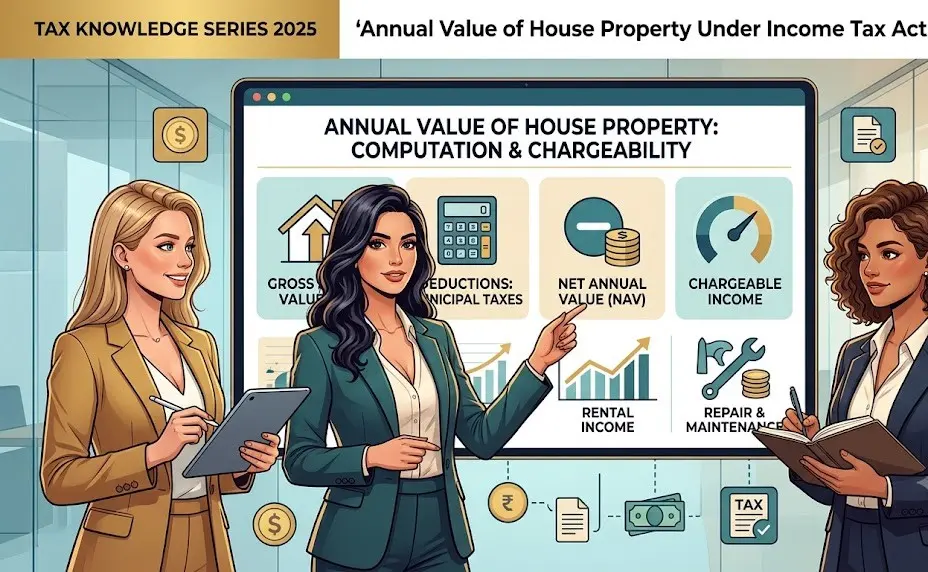
Once you have the Gross Annual Value, one more step gets you to the Net Annual Value (NAV), the figure Part 3 of this series will actually apply deductions to. Subtract the municipal taxes you personally paid during the year, regardless of which year those taxes were originally levied for.
Three conditions matter here, and missing any one of them means no deduction: the taxes must have been actually paid, not merely due; they must have been paid by you as the owner, not by your tenant; and they have to genuinely be municipal or local authority taxes, not society maintenance charges, repair costs, insurance, or brokerage, which don’t qualify no matter how the bill is worded.
Self-Occupied Properties: The Nil Value Rule (Section 23(4) of the Income-tax Act, 1961)
If you live in your own house rather than renting it out, Section 21 gives you a specific concession: its annual value is treated as Nil, entirely outside this whole expected-rent-versus-actual-rent calculation. You’re allowed to claim this Nil treatment for up to two houses, your choice of which ones, even if you own more than two properties in total.
Anything beyond your chosen two is treated as deemed to be let out, even if nobody actually lives there and you’re not charging anyone rent. A deemed let-out property still goes through the full expected-rent calculation above, exactly as if you had genuinely rented it to a tenant, which means owning three empty flats and calling all of them “vacant” doesn’t avoid the annual value computation for the third one.
- Assuming an empty flat has zero tax consequence — ownership itself is enough to trigger the annual value calculation; whether or not you found a tenant doesn’t exempt you from it
- Deducting municipal taxes that are merely due, not paid — only taxes actually paid during the year count, regardless of which year they were originally billed for
- Assuming vacancy relief applies automatically whenever actual rent is lower than expected rent — it applies only where the shortfall is genuinely caused by the property standing vacant, not by a lower negotiated rent or a part-year letting arrangement
- Trying to claim more than two houses as self-occupied — the Nil-value concession is capped at two properties; every additional one is deemed let-out and taxed on its expected rent regardless of actual use

Frequently Asked Questions
How is the annual value of house property calculated under the Income Tax Act 2025?
Annual value is generally the higher of expected rent, the higher of municipal value and fair rent, capped at standard rent if applicable, and actual rent received or receivable. Where genuine vacancy has caused actual rent to fall below expected rent, the lower, actual figure is used instead.
Is an empty, unrented house taxed under Income from House Property?
Yes, unless it qualifies as one of your two permitted self-occupied properties. Ownership alone triggers the annual value calculation under Section 20; an empty house beyond your two self-occupied choices is treated as deemed let-out and taxed on its expected rent.
How many houses can I treat as self-occupied for tax purposes?
Up to two, your own choice of which ones, regardless of how many properties you actually own. Both get a Nil annual value. Any additional house is deemed to be let out and taxed on its expected rent, even if no one is living there.
Can I deduct municipal taxes that are due but not yet paid?
No. Only municipal taxes actually paid by you as the owner during the Tax Year are deductible, regardless of which year they relate to. Taxes that are merely due, or that were paid by your tenant rather than you, don’t qualify.
Is income from sub-letting taxed as house property income?
No. Sub-letting income belongs to whoever is renting the property out, not the actual owner, so it’s taxed under Income from Other Sources or Business Income instead, depending on the circumstances.
Do builders pay tax on unsold flats held as stock-in-trade?
Not immediately. Where an unsold unit is held as stock-in-trade and hasn’t been let out, its annual value is Nil for up to two years from the end of the financial year in which the completion certificate was obtained. After that window, if the unit remains unsold and unrented, it falls back into the ordinary annual value calculation.
Income From House Property — Series Index
Chargeability & Annual Value: How House Property Income Is Computed
The Section 20/21 framework every other part of this series builds on.
Self-Occupied vs. Let-Out vs. Deemed Let-Out: The Two-House Rule
A closer look at how the Nil-value choice actually plays out with three or more properties.
Deductions: The 30% Standard Deduction & Home Loan Interest
Turning Net Annual Value into your actual taxable income from the property.
Every other rule in this head of income, deductions, self-occupied treatment, co-ownership, sits on top of the annual value figure covered here. Before you look up a deduction or wonder whether your second flat qualifies for Nil treatment, make sure you’ve actually worked out the right annual value first, expected rent versus actual rent, vacancy relief where it genuinely applies, and municipal taxes properly subtracted. Get this number wrong, and everything computed afterward is wrong along with it.
Sources & References
- Income-tax Act, 2025 [Act No. 30 of 2025] — full text, as amended by Finance Act, 2026Income Tax India, incometaxindia.gov.in
- Income Tax India — Let Out House Property (official reference)Income Tax India, incometaxindia.gov.in
Sections 20 and 21 discussed here are summarised for reader convenience. Always cross-check against the official Act text linked above and consult a Chartered Accountant before relying on this for a filing decision.
Disclaimer: This article is for general informational purposes only and does not constitute tax or legal advice. The Income-tax Act, 2025 and related rules are subject to notifications and amendments by the CBDT. Please consult a qualified Chartered Accountant for advice specific to your situation.