
The credit card and CIBIL score relationship works in both directions: a card used well is one of the easiest ways to build a strong score, and a card used carelessly is one of the quickest ways to wreck it. The good news is that the habits that matter are few and learnable. This guide explains what actually moves your score, what doesn’t, and a 90-day plan to put it right.
- Credit Card and CIBIL Score: How They Connect
- CIBIL Score Range and What Builds It
- Credit Utilisation: The Habit You Control Monthly
- Closing, Opening and Applying for Cards
- How to Improve Your CIBIL Score: A 90-Day Plan
- Free Report, Errors and Your Rights
- Building Credit With the Right Card
- FAQ — People Also Ask
Nobody checks their CIBIL score for fun. It usually happens the day a home loan officer frowns, or a card application gets declined with a polite email that explains nothing. By then the damage is months old. The score is less a verdict on you than a running memory of how you handled borrowed money, and a credit card, with its monthly bills and visible limit, is the clearest signal you send. Here is how that signal works, and how to make it work for you.
Credit Card and CIBIL Score: How They Connect
Each month your card issuer reports your account to the credit bureaus: your limit, your balance, your payments and any days past due. The bureaus turn that history into a three-digit number. TransUnion CIBIL is the best known, but India has four credit bureaus, and each keeps its own record and score.
Reporting has also become quicker. Since July 1, 2026, lenders send updates weekly, so on-time payments and missed ones reach the bureaus faster than before. We explain that in our guide to the RBI credit card rules 2026. And from April 1, 2027, an account will be reported as “past due” only once it is more than three days overdue. Until then, treat the due date as the deadline.
If you want the basics of billing cycles and minimum due first, start with how credit cards work in India.
CIBIL Score Range and What Builds It
The CIBIL score range runs from 300 to 900. There is no official pass mark, but lenders look hard at the higher end. CIBIL’s own website notes that 79% of loans are sanctioned to consumers with a score above 750, so 750 is the figure most people treat as a good score.
CIBIL doesn’t publish exact weightings, so be wary of any article quoting precise percentages. What it does say is that the score comes from a proprietary algorithm and rests on a few factors:
| Factor | What it looks at | What helps |
|---|---|---|
| Payment history | Whether you pay on time, and any defaults or days past due | Autopay for the total due, plus a reminder |
| Credit utilisation | How much of your limit you are using | Keeping balances well below the limit |
| Credit history length | How long your accounts have been open | Keeping older fee-free accounts open |
| Credit enquiries | How many times lenders have checked your credit when you applied | Applying only when you need to |
| Credit mix | A balance of secured loans (home, car) and unsecured ones (cards, personal loans) | Not borrowing just to improve mix |
| CIBIL names payment history, credit mix, enquiries and utilisation; credit history length is also widely cited by lenders. Weightages are not public, and CIBIL says payment behaviour is among the most important elements. | ||
For most people with cards, two of these do nearly all the work: paying on time and keeping utilisation low. Get those right and the rest tends to follow.
Credit Utilisation: The Habit You Control Monthly
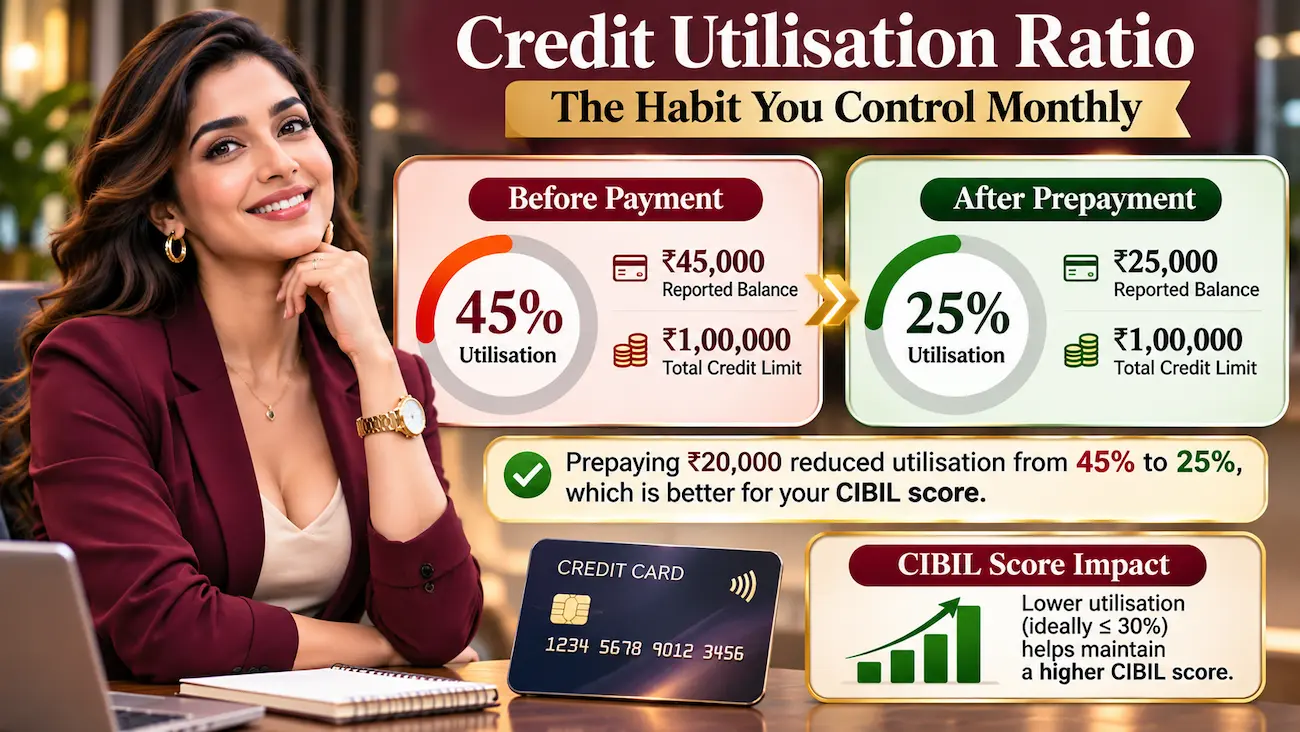
Your credit utilisation ratio is the balance you carry divided by your total credit limit. Lenders read a high ratio as a sign you’re leaning on credit to get by. A commonly quoted rule of thumb is to stay under about 30%. That figure is a guideline from credit-education sources, not an official CIBIL cut-off, but it’s a sensible target.
Issuers commonly report the balance as of the statement date, so paying part of your bill before it can lower the number the bureaus see, even if you pay in full later. That’s why paying twice a month can help if you spend heavily, though how and when each bank reports varies.
Paying only the minimum amount due keeps the account from being marked past due. But the balance you carry can leave your utilisation high, and the interest on it, often around 3.5% a month, costs you far more than any rewards earn. It protects you from a late mark, not from a high ratio.
Closing, Opening and Applying for Cards
Should You Close an Old Card?
Usually not, if it’s free. Closing a card removes its limit from your total, which pushes your utilisation up on the same spending. In the example above, closing the ₹40,000 card while carrying ₹25,000 on the other takes you from 25% to about 42%. It can also shorten your reported history over time. If a card charges an annual fee you can’t justify, ask the bank to convert it to a free one before you close it.
If you do want to close one, RBI’s Directions require the issuer to complete it within seven working days of your request once dues are cleared, with ₹500 a day penalty for delay. Don’t just stop using it and ignore the bills.
What a Hard Enquiry Does
When you apply for a card or loan, the lender checks your report. That is a hard enquiry, and several in a short window can pull your score down, because it can look like you’re hunting for credit. Checking your own report or score is different: it’s treated as a soft enquiry and doesn’t lower it. So check as often as you like, and apply only when you mean to.
Limit Increases
Your bank can’t raise your limit or upgrade your card without your explicit consent under RBI’s Directions. A higher limit can lower your utilisation if your spending stays the same, but it’s also a bigger temptation. Say yes only if you’ll keep spending where it is.
How to Improve Your CIBIL Score: A 90-Day Plan
Nobody can promise you a score by a date, and anyone who does is selling something. What you can do is give the bureaus three clean months to report. Here’s a plan that does that.
- Pull your free report and look for errors or accounts you don’t recognise
- Clear any overdue amounts first
- Switch on autopay for the total due on every card
- Be wary of settling a card for less than you owe, since it can show as “settled” and lenders may view that negatively
- Pay part of the bill before the statement date
- Aim for balances well under 30% of each limit
- Don’t apply for new credit
- Keep paying on time, every time
- Check the report again and note the change
- Dispute anything still wrong
Weekly reporting means progress can show up faster than it used to, but a score that took years to dent won’t recover overnight. Consistency over several months is what moves it.
Free Report, Errors and Your Rights
Checking is free and safe. RBI’s rules entitle you to one free full credit report a year from each credit bureau, and CIBIL provides its free report once a calendar year, January to December, on its website. Use that free report as your yearly health check.
- Raise it with the bureau. CIBIL accepts complaints through its website form, helpline and email. You can escalate to its nodal officer if you’re not satisfied.
- The clock is 30 days. Under RBI’s credit information Directions, a complaint should be resolved within 30 days. The lender has 21 days to send corrected data and the bureau has the other nine.
- Delay earns compensation. If it isn’t resolved in 30 calendar days, you’re entitled to ₹100 per day, shared among the institutions responsible.
- You should get alerts. Lenders must send an SMS or email when they report a default or days past due, where they hold your number or email.
Keep screenshots and reference numbers. If the lender or bureau doesn’t act, you can escalate to the RBI Ombudsman.

Building Credit With the Right Card
If you’re new to credit or rebuilding, a no-fee card you can pay in full each month is the easiest tool. The aim isn’t rewards; it’s a clean record. Spend a small, regular amount, pay the full bill, and let months pass. If you’ve missed payments recently, fix those first before taking on anything new, and remember approval is the bank’s decision.
Check fees, eligibility and reward terms on the bank’s page before applying. Applying triggers a hard enquiry, so apply only to cards you’re likely to qualify for.
Disclosure: some links on this page are affiliate links. If you apply through them we may earn a commission, at no extra cost to you. Commission doesn’t decide which cards we write about.
Frequently Asked Questions — Credit Card and CIBIL Score
- TransUnion CIBIL, score range and factors: cibil.com
- TransUnion CIBIL Consumer Grievance Redressal Policy 3.0 (2026): free report and complaint timelines: cibil.com policy PDF
- RBI Master Direction on reporting of credit information (complaint timelines and compensation, paragraphs 34–35): rbi.org.in
- RBI Credit Cards and Debit Cards Directions, 2025 (consent and closure rules): rbi.org.in
- The 30% utilisation figure, the soft-enquiry point and statement-date reporting reflect widely published bank and credit-education guidance rather than a CIBIL rule, and practice varies by lender. Example numbers are illustrations.