
A credit card is the only loan most of us take every month without noticing. Pay the full bill on time and it costs you nothing; slip once and the interest can run close to 40% a year. Understanding how credit cards work in India comes down to four things: the billing cycle, the interest-free period, the minimum due and the charges that sit around them. This guide explains each one in plain language, with dates and rupee examples.
Most people learn about credit cards the way they learn about speed breakers: by hitting one. A friend says “use it, get cashback”, the bank sends a welcome kit, and three months later there is a ₹1,200 interest line on a bill you thought you had paid. None of it is hidden, exactly. It is just spread across a long statement and a longer terms sheet. So let’s lay it out the way you would explain it to a younger sibling getting their first card, with real numbers and no jargon you can’t use at the dinner table.
How Credit Cards Work in India: The Short Version
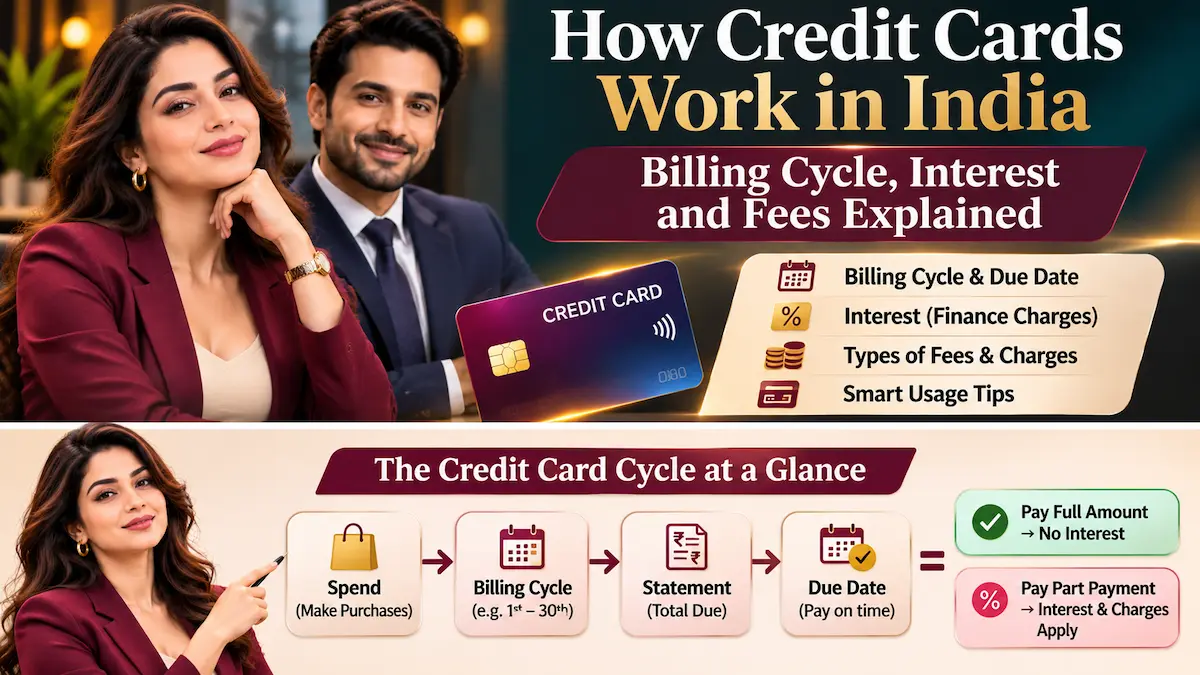
A credit card is a revolving line of credit. The bank fixes a credit limit, say ₹1,00,000. You spend against it through the month. The bank pays the merchants and sends you one statement. You then choose between two paths.
- Pay the total amount due by the due date. No interest on your purchases. The bank earns from merchant fees and annual fees, not from you.
- Pay less than the total. The unpaid part becomes a loan at the card’s interest rate, and the free credit period you would have had is lost.
That’s the whole machine. Everything else, from rewards to lounge access, is built on top of it. The card works for you when you pay in full and against you when you don’t, which is why the first rule of using one is simple: never spend on a card what you can’t pay on the due date.

Billing Cycle and Interest-Free Period
Your credit card billing cycle is the roughly 30-day window the bank uses to add up your spends. On the last day of the cycle, the statement date, the bank prepares your credit card statement. The payment due date is usually about 15 to 20 days after that. Under RBI’s Directions, the bank must give you at least a fortnight between sending the bill and charging interest, and you can ask to change your billing cycle at least once.
The interest-free period is the stretch from the day you make a purchase to the due date, provided you pay the full outstanding amount by then. It depends heavily on when in the cycle you swipe.
So “up to 50 days” is the best case, not the promise. It only applies to purchases made right after your statement date, and only if you clear the whole bill.
If you don’t pay the full amount, the interest-free period is gone for that bill, and under RBI’s Directions the bank can charge interest from the transaction date on the unpaid amount. It can also be suspended for new purchases while any of last month’s bill is outstanding. Your card’s terms (the MITC) spell out how.
The Minimum Amount Due Trap
Every statement shows two numbers. The total amount due is everything you owe. The minimum amount due is the smallest payment that keeps your account in good standing, commonly around 5% of the bill, though it varies by issuer. Paying it avoids the late fee. It does not avoid interest, and it does not stop the loan from growing.
That’s before counting interest from the original purchase dates, which can make the bill higher still. RBI requires every statement to carry a prominent warning that paying only the minimum will stretch repayment over months or years with compounding interest. It also bars banks from setting a minimum due so low that your balance keeps growing (no “negative amortisation”). That helps, but it doesn’t make the minimum a good habit.
Interest Rate, Fees and Charges
Here’s where the real cost of a card sits. The headline credit card interest rate in India is usually quoted per month, and for most issuers it falls somewhere around 3.3% to 3.75% a month, which is roughly 40% to 45% a year. Check your own card’s MITC, since this varies by bank and card. Rates must be published on the issuer’s website, and the annual percentage rate (APR) must be shown alongside the annual fee with equal prominence.
| Charge | What it is | Watch for |
|---|---|---|
| Interest (finance charge) | Charged on unpaid balances, quoted monthly and as an APR | Starts from the transaction date once the interest-free period is lost |
| Late payment charge | Fee for missing the due date, usually in slabs by amount due | From April 1, 2027, charged only after more than 3 days past due and on the outstanding amount (see our RBI rules guide) |
| Cash advance fee | A fee for withdrawing cash on the card, commonly around 2.5% with a minimum amount | Interest usually runs from the withdrawal day, with no free period. APR for cash advances may differ |
| Annual or joining fee | Fixed fee for the card, often waived if you spend above a threshold | Lifetime-free cards have none. The RBI bars hidden charges on them |
| Foreign currency markup | Extra percentage on overseas or foreign-currency spends | Often a few percent. Compare before travelling |
| GST | 18% on interest and fees | Added on top, so the true cost is higher than the quoted rate |
| Typical ranges are indicative. Your card’s Most Important Terms and Conditions (MITC) has the exact figures. | ||
Is There a Cap on Credit Card Interest?
You may have read that interest above 30% is illegal. It isn’t. In 2008 the consumer commission NCDRC capped credit card interest at 30%, but on December 20, 2024 the Supreme Court set that order aside in HSBC v. Awaz. The Court said interest rate policy is for the RBI to regulate, not consumer forums. RBI’s Directions now say issuers must justify rates by cost and expected returns and, as the text stands, set a ceiling in line with other unsecured loans. They don’t name a number. So the practical protection is disclosure and a month’s notice before changes, not a cap you can point to.
Credit Limit, Utilisation and Your Score
Your credit limit is the most you can have outstanding. Your credit utilisation is the share of that limit you’re using. Spend ₹30,000 on a ₹1,00,000 limit and utilisation is 30%.
Why care? Credit bureaus such as CIBIL look at utilisation and payment history when they calculate your score. Lenders generally prefer to see you using a modest share of your limit, with a common rule of thumb being to stay under about 30%, and to see every bill paid on time. A missed or late payment can do real damage to your score, so on-time payment matters more than any other habit here.
- Pay before the statement date if you spend heavily. Issuers commonly report the balance as of the statement date, so a smaller number there can look better on your report.
- Don’t chase new cards for the signup gift. Each application can trigger a hard enquiry on your report.
- Keep old, fee-free cards open if you don’t need to close them. A longer history helps.
Your bank also can’t raise your limit or upgrade your card without your consent. A bigger limit isn’t a gift. It’s a larger loan offer.
Your Rights as a Cardholder
The consolidated RBI Credit Cards and Debit Cards Directions, 2025 give you more protection than most holders realise. The ones worth knowing:
- Key terms upfront. Fees and charges must be disclosed when the card is marketed, in a key fact statement at application, and in the full MITC in your welcome kit. The MITC should be provided in English, Hindi and the local language where possible.
- Changes need notice. Interest-rate changes apply from then on, with at least a month’s prior notice. If you surrender the card because of an adverse change, no extra closure charge applies.
- Billing disputes. If you dispute a bill, the issuer must explain it and give supporting documents within 30 days of your complaint. Transactions disputed as fraud can’t be charged to you until the dispute is resolved. If the bank doesn’t respond within 30 days, you can go to the RBI Ombudsman.
- Closing the card. Once dues are cleared, closure must be done within seven working days of your request, with ₹500 a day penalty for delay.
- Consent. No limit increase or upgrade without your explicit consent, and no card you didn’t ask for.
RBI has also changed the rules on late fees and credit reporting starting April 2027. We’ve covered that separately in our guide to the RBI credit card rules 2026.
Picking a Card That Fits You
Rewards matter far less than fit. A card that earns 5% back but charges ₹2,500 a year only wins if you actually spend enough to cover the fee and then some. Start with how you spend, then match the card.
- A lifetime free credit card has no annual fee to recover
- Set autopay for the total due
- Flat cashback on online spends keeps tracking easy
- Check the monthly cap and the exclusions
- Look at lounge access and travel rewards
- Compare the fee against what you’d really use
If you’re ready to compare, these are good places to start. Check the fees, reward terms and eligibility on the bank’s page before you apply. Approval is the bank’s decision and isn’t guaranteed.
Disclosure: some links on this page are affiliate links. If you apply through them we may earn a commission, at no extra cost to you. Commission doesn’t decide which cards we write about.
Frequently Asked Questions — How Credit Cards Work in India
- RBI (Commercial Banks – Credit Cards and Debit Cards: Issuance and Conduct) Directions, 2025: rbi.org.in
- Hongkong and Shanghai Banking Corp. Ltd. v. Awaz (Supreme Court, December 20, 2024): LiveLaw report
- Rates, fees and thresholds quoted as typical ranges come from common issuer practice and vary. Always use your card’s own MITC.