
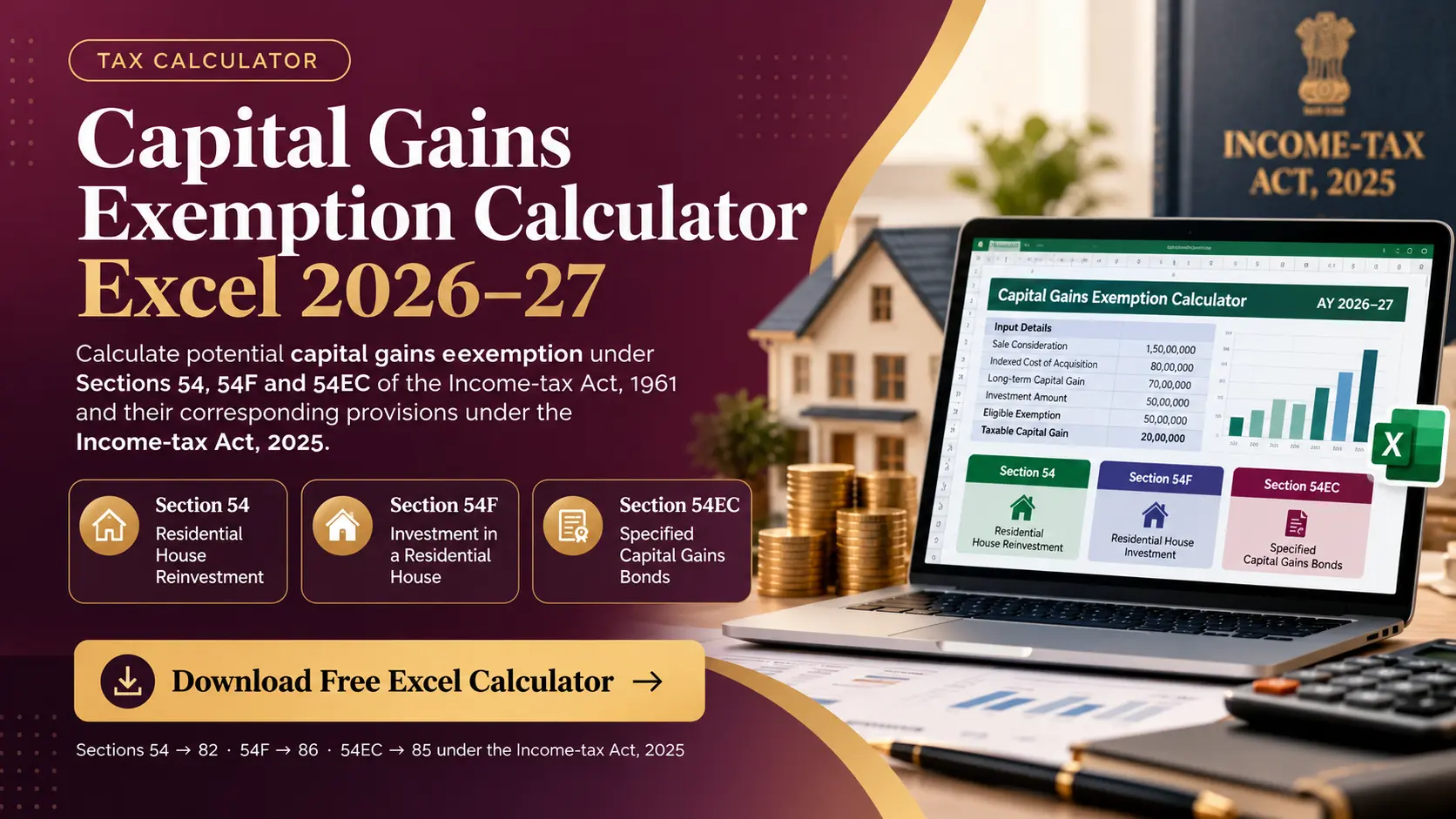
Calculate potential capital gains exemption under Sections 54, 54F and 54EC of the Income-tax Act, 1961 and their corresponding provisions under the Income-tax Act, 2025. This free Capital Gains Exemption Calculator Excel helps estimate exemption for residential-house reinvestment, investment in a new residential house and specified capital gains bonds.
Download Free Excel CalculatorHow the Capital Gains Exemption Calculator Template Works
This Capital Gains Exemption Calculator Excel Template 2026–27 is a free Excel-based tax utility for estimating potential exemption on qualifying long-term capital gains. The workbook covers the familiar Sections 54, 54F and 54EC of the Income-tax Act, 1961 and identifies their corresponding provisions under the Income-tax Act, 2025.
The calculator is designed to help taxpayers, Chartered Accountants, tax professionals and finance teams understand how the amount reinvested in a qualifying asset may affect the capital gains exemption. It can be used as a working tool for analysing residential-house reinvestment, eligible residential-house investment under Section 54F and investment in specified bonds under Section 54EC.
From 1 April 2026, the Income-tax Act, 2025 applies to tax years beginning on or after that date. The statutory correspondence identifies Section 54 of the Income-tax Act, 1961 with Section 82 of the Income-tax Act, 2025; Section 54F with Section 86; and Section 54EC with Section 85.
Which Capital Gains Exemption Sections Does the Calculator Cover?
The Excel calculator focuses on three commonly used capital gains exemption provisions: Section 54 for qualifying residential-house reinvestment, Section 54F for specified long-term capital assets other than a residential house, and Section 54EC for investment of eligible long-term capital gains in specified bonds.
For transactions governed by the Income-tax Act, 2025, the corresponding provisions are Section 82, Section 86 and Section 85, respectively.
Table of Contents
- Capital Gains Exemption Calculator Overview
- Section 54, 54F and 54EC – New Act Mapping
- Section 54 / Section 82 Exemption
- Section 54F / Section 86 Exemption
- Section 54EC / Section 85 Exemption
- Section 54 vs Section 54F
- Capital Gains Account Scheme
- How to Calculate Capital Gains Exemption
- How to Use the Excel Calculator
- Capital Gains Calculator Features
- Important Capital Gains Exemption Rules
- Frequently Asked Questions
- Download Capital Gains Exemption Calculator Excel
- Related Tax Calculators and Excel Templates
- Sources and References
Capital Gains Exemption Calculator for Tax Year 2026–27
A capital gains exemption calculator helps estimate the portion of eligible capital gains that may not be charged to tax when the taxpayer satisfies the conditions of the applicable exemption provision.
The Capital Gains Exemption Calculator Excel provides a structured way to enter the relevant capital gain, investment amount and qualifying asset details and understand the potential exemption before completing the final tax computation.
Section 54 / Section 82
Covers qualifying long-term capital gains arising from transfer of a residential house and reinvestment in another residential house in India, subject to the applicable conditions.
Section 54F / Section 86
Covers eligible long-term capital gains from transfer of a qualifying capital asset other than a residential house where the taxpayer invests in a residential house in India.
Section 54EC / Section 85
Covers eligible long-term capital gains from transfer of land or building where the capital gain is invested in specified long-term bonds within the prescribed period.
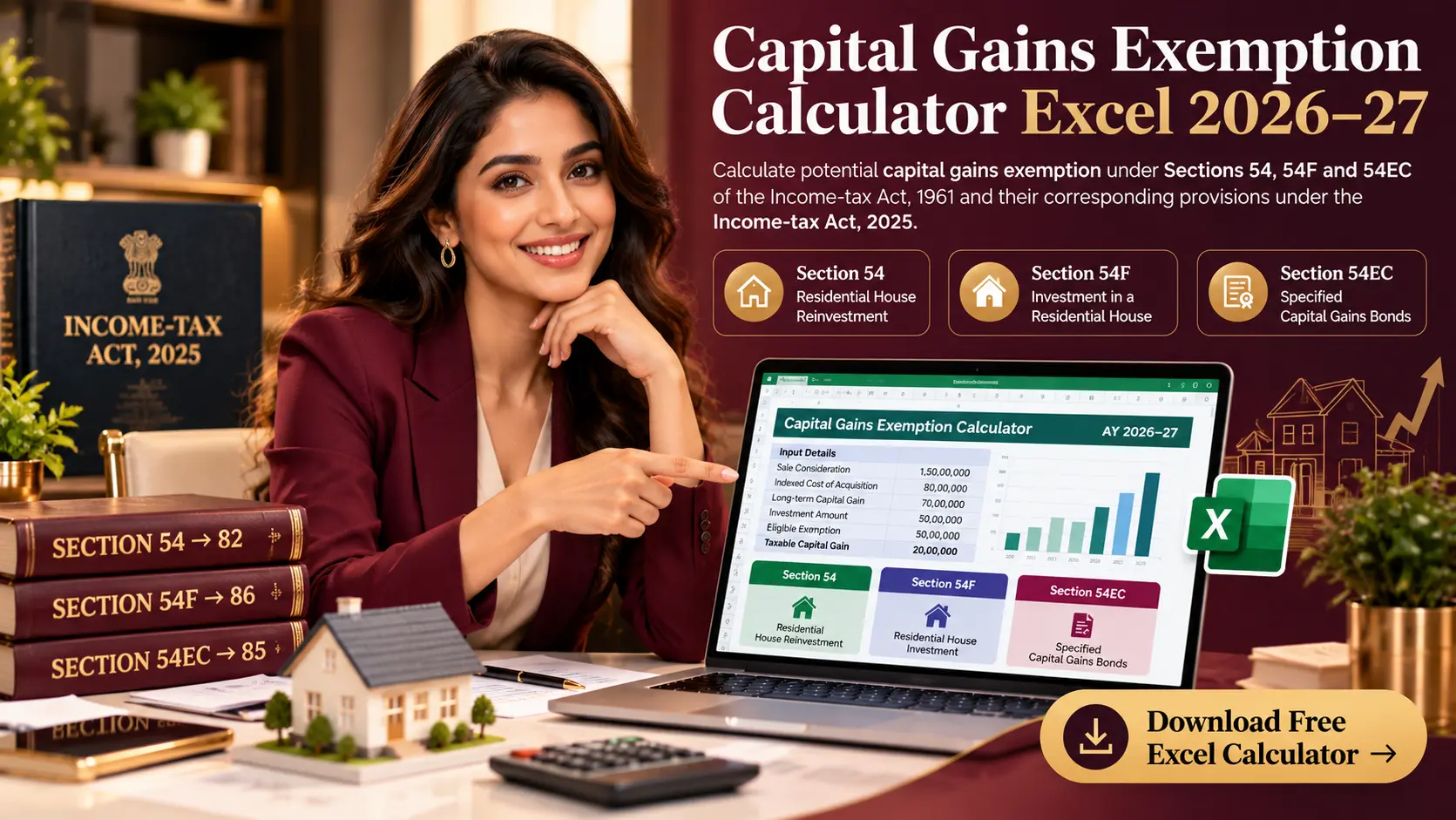
Capital Gains Exemption Section Mapping Under the Income-tax Act, 2025
The Income-tax Act, 2025 replaced the Income-tax Act, 1961 with effect from 1 April 2026. The Income Tax Department’s section-level correspondence maps several capital gains exemption provisions from the old Act to provisions in the new Act.
| Income-tax Act, 1961 | Income-tax Act, 2025 | Broad Subject |
|---|---|---|
| Section 54 | Section 82 | Profit on sale of property used for residence |
| Section 54F | Section 86 | Capital gain on transfer of certain capital assets invested in a residential house |
| Section 54EC | Section 85 | Capital gains invested in specified long-term bonds |
Section correspondence does not mean that every condition is identical. The Income-tax Act, 2025 contains the operative text applicable from 1 April 2026, so the relevant provision should be read before relying on a calculated exemption.
Section 54 / Section 82 Capital Gains Exemption Calculator
Section 54 of the Income-tax Act, 1961 deals with capital gains arising from transfer of a qualifying residential house where the taxpayer purchases or constructs another residential house in India within the prescribed period.
Under the Income-tax Act, 2025, the corresponding provision is Section 82, titled “Profit on sale of property used for residence”.
Section 82 also contains provisions relating to the optional investment in two residential houses where the specified capital gains threshold is satisfied, along with a statutory ₹10 crore limitation for the relevant computation.
The calculator can therefore be used to model the relationship between the capital gain and the amount invested in the qualifying residential property. The final exemption should always be checked against the complete statutory conditions.
Section 54F / Section 86 Exemption on Investment in a Residential House
Section 54F applies where an individual or Hindu undivided family earns capital gains from transfer of a qualifying long-term capital asset other than a residential house and invests in one residential house in India, subject to the conditions of the provision.
Under the Income-tax Act, 2025, Section 54F corresponds to Section 86. The new provision continues the framework for capital gains on certain capital assets where the taxpayer invests in a residential house.
The provision concerns a qualifying long-term capital asset other than a residential house.
The qualifying investment is generally required to be made in one residential house in India within the prescribed period.
Where the qualifying investment is lower than the relevant net consideration, the exemption is calculated using the statutory proportion.
Section 54F contains conditions relating to ownership and purchase or construction of other residential houses. The Excel calculator is intended for estimation and does not replace the detailed eligibility review required under the law.
Section 54EC / Section 85 Capital Gains Bond Exemption
Section 54EC provides an exemption framework for eligible long-term capital gains arising from transfer of land or building where the taxpayer invests the capital gain in specified long-term assets within six months from the date of transfer.
The corresponding provision under the Income-tax Act, 2025 is Section 85. The new provision specifies that the investment in the long-term specified asset cannot exceed ₹50 lakh during a tax year or across the relevant transfer year and subsequent tax year, as prescribed.
Section 54 vs Section 54F vs Section 54EC
Although all three provisions can reduce the taxable capital gain when their conditions are satisfied, they apply to different types of original assets and different forms of reinvestment.
| Provision | Original Asset | Reinvestment | New Act |
|---|---|---|---|
| Section 54 | Qualifying residential house | Residential house in India | Section 82 |
| Section 54F | Qualifying long-term capital asset other than residential house | Residential house in India | Section 86 |
| Section 54EC | Long-term land or building | Specified long-term bonds | Section 85 |
Capital Gains Account Scheme and Unutilised Capital Gains
The Capital Gains Account Scheme can become relevant where the taxpayer has not utilised the qualifying capital gain for the specified reinvestment by the applicable return-filing deadline. Amounts deposited under the scheme are subject to the conditions governing the relevant exemption.
Taxpayers should distinguish between deposits made before 1 April 2026 under the Income-tax Act, 1961 and transactions governed directly by the Income-tax Act, 2025.
The Income Tax Department states that where capital gains were deposited in the Capital Gains Account Scheme before 1 April 2026, the old Act’s conditions continue to govern the deposit. Where the prescribed utilisation period expires after the new Act begins, Section 536(2)(h) provides the relevant transitional framework.
How Capital Gains Exemption Is Estimated
The basic calculation depends on the applicable exemption section, the amount of capital gain, the amount invested and the statutory conditions attached to the reinvestment.
Section 54
The calculator compares the qualifying capital gain with the amount invested in the new residential house, subject to the statutory limits and conditions.
Section 54F
The exemption may be proportionate where the cost of the new residential house is less than the relevant net consideration, subject to the conditions of Section 54F.
Section 54EC
The exemption is linked to investment of eligible capital gains in specified long-term assets within the prescribed six-month period and subject to the applicable investment limit.

How to Use the Capital Gains Exemption Calculator Excel
Enter the relevant capital gains information and identify the exemption provision applicable to the transaction.
Select the applicable Section 54, 54F or 54EC calculation framework.
Enter the amount invested in the qualifying residential property or specified long-term asset, as applicable.
Review the calculated potential exemption and the resulting taxable capital gain for further tax analysis.
Ready to Calculate Your Capital Gains Exemption?
Download the Excel calculator and work through the exemption calculation step by step.
Key Features of the Capital Gains Exemption Excel Template
Structured around the commonly used capital gains exemption provisions covered by Sections 54, 54F and 54EC.
Shows the corresponding Income-tax Act, 2025 provisions: Sections 82, 86 and 85.
Helps compare the capital gain with the qualifying investment amount for exemption estimation.
Useful for preliminary tax planning before finalising a capital gains computation or return of income.
Easy to edit, review and retain as a working-paper style calculation.
Suitable for taxpayers, finance professionals, accountants and Chartered Accountants conducting preliminary exemption analysis.
Important Capital Gains Exemption Rules to Check
Confirm that the capital gain and original asset satisfy the relevant long-term asset requirements of the applicable provision.
Check the applicable purchase, construction or investment period before relying on the exemption.
Section 54 and Section 54F have specific conditions relating to the qualifying residential property.
Check statutory limits, including the applicable limits under Section 82 and Section 85.
Disposal or conversion of the new asset within the applicable statutory period can affect the exemption.
Transactions and exemptions originating under the Income-tax Act, 1961 may require review under the repeal and savings provisions of Section 536 of the Income-tax Act, 2025.
Capital Gains Exemption Calculator FAQs
What is a Capital Gains Exemption Calculator?
A Capital Gains Exemption Calculator is a tax-planning utility that estimates the amount of capital gain that may qualify for exemption when the conditions of an applicable capital gains exemption provision are satisfied.
What is Section 54 under the Income-tax Act?
Section 54 of the Income-tax Act, 1961 provides an exemption framework for qualifying long-term capital gains arising from transfer of a residential house where the prescribed reinvestment conditions are satisfied. Its corresponding provision under the Income-tax Act, 2025 is Section 82.
What is Section 54F and what is its new Act section?
Section 54F applies to qualifying long-term capital gains from transfer of a capital asset other than a residential house where the taxpayer invests in a residential house in India, subject to the statutory conditions. Section 54F corresponds to Section 86 of the Income-tax Act, 2025.
What is Section 54EC and what is Section 85?
Section 54EC provides an exemption framework for eligible long-term capital gains from transfer of land or building invested in specified long-term assets. Its corresponding provision under the Income-tax Act, 2025 is Section 85.
Can I use this calculator for Section 54, 54F and 54EC?
Yes. The workbook is structured to provide preliminary exemption estimates for Sections 54, 54F and 54EC and their corresponding provisions under the Income-tax Act, 2025. The final tax position should be verified against the complete statutory requirements.
What are the corresponding sections under the Income-tax Act, 2025?
Section 54 corresponds to Section 82, Section 54F corresponds to Section 86, and Section 54EC corresponds to Section 85 under the Income-tax Act, 2025.
Does the Income-tax Act, 2025 apply from 1 April 2026?
The Income-tax Act, 2025 came into force from 1 April 2026. The repeal and savings provisions also preserve certain matters arising under the Income-tax Act, 1961, so the relevant transaction date and tax year should be considered before applying a provision.
What happens if an exemption claimed under the old Act is withdrawn after 1 April 2026?
The Income Tax Department states that Section 536(2)(h) of the Income-tax Act, 2025 deals with certain post-repeal violations of conditions attached to exemptions or deductions granted under the repealed Act. For example, where an exemption under Section 54 or 54F was claimed under the old Act and the relevant asset is transferred within the prescribed period after 1 April 2026, the transitional provision may apply.
Is this Excel calculator a substitute for professional tax advice?
No. The calculator is intended for estimation and educational tax-planning purposes. Capital gains exemption depends on the facts of the transaction, dates, asset classification, ownership, reinvestment and other statutory conditions.

Download Capital Gains Exemption Calculator Excel 2026–27
Download the free Excel-based Capital Gains Exemption Calculator to estimate potential exemption under Sections 54, 54F and 54EC and review the corresponding provisions under the Income-tax Act, 2025.
Capital Gains Exemption Calculator Excel Template
A practical Excel workbook for preliminary capital gains exemption analysis covering residential-house reinvestment, Section 54F residential-house investment and Section 54EC specified-bond investment.
Download Free Excel Calculator →Sources & References
The calculator and explanatory content should be read together with the applicable statutory provisions, official Income Tax Department guidance and the relevant tax-year requirements.
- Income Tax Department — Income Tax Act 2025
- Income Tax Department — Income Tax Act 2025 FAQs
- Income Tax Department — Objective and Scope of the New Act
- Income Tax Department — General Questions on the Income Tax Act 2025
- Income Tax Department / Ministry of Finance — Income-tax Rules, 2026
Legislative provisions, rules and tax guidance may be amended from time to time. Always verify the applicable law for the relevant tax year and transaction date before filing a tax return or making a tax claim.
Disclaimer
This Capital Gains Exemption Calculator Excel template is provided for general information, estimation and tax-planning purposes only. It is not a substitute for professional tax, legal or financial advice.
Capital gains exemption depends on the nature of the asset, holding period, date of transfer, amount of capital gain, reinvestment, ownership, statutory limits and other conditions. The Income-tax Act, 2025 also contains repeal and savings provisions that may affect transactions originating under the Income-tax Act, 1961.
Users should verify the applicable provisions and calculations before filing an income-tax return or claiming an exemption.