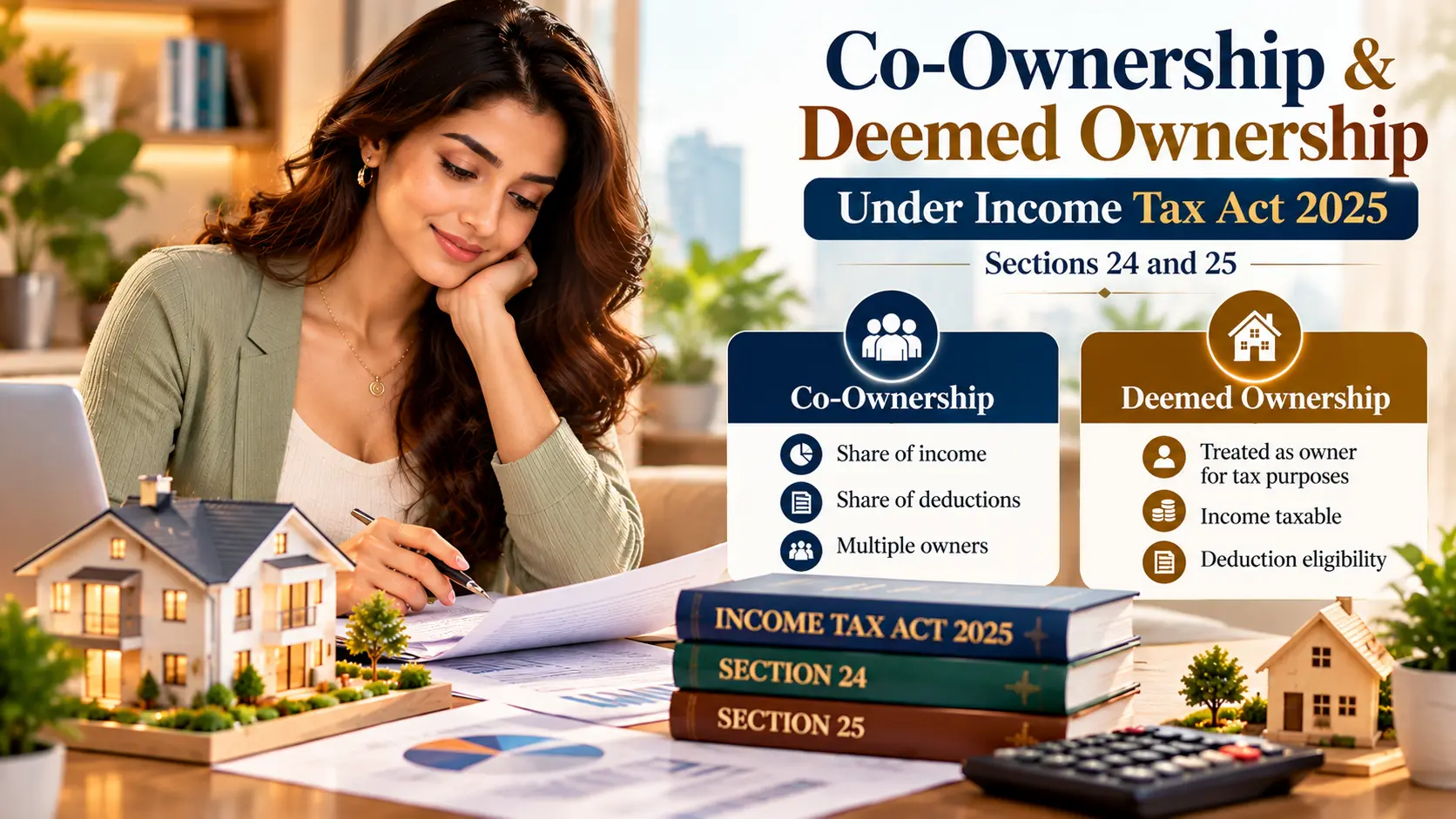
You put the flat in your spouse’s name to keep things simple. The tax department disagrees, and the law says exactly why: on paper it may be theirs, but for tax purposes, it can still be treated as yours.
Every calculation in Parts 1 to 3 assumed one clean fact: you own the house. Real life is messier. A flat might belong to three siblings in unequal shares. A house might sit in a spouse’s name only because of how the paperwork was done. This part covers co-ownership and deemed ownership under Income Tax Act 2025, Sections 24 and 25, the rules that decide who actually reports the income when the answer to “who owns this” is not as simple as a single name on a title deed.
Applicability note: Section 24 (corresponding to Section 26 of the Income-tax Act, 1961) and Section 25 (corresponding to old Section 27) apply for Tax Year 2026-27 onward. Section 25 is now titled “Interpretation” rather than the older, more descriptive heading, but its substance, extending who counts as an “owner,” is unchanged.
Co-Owned Property: Taxed Individually, Not as a Group
When a house is owned by more than one person, and their shares are definite and ascertainable, meaning you can point to a document, usually a sale deed or a partnership agreement, that states each person’s exact share, the law does not lump the co-owners together and tax them as one unit. Each co-owner computes and reports only their own slice of the income.
The same principle carries through to the self-occupied relief you read about in Part 2. If two siblings jointly own a house they both live in, each sibling is entitled to their own Nil annual value on their share, as if each were the sole owner. The relief is not split or halved between them; it applies to each person individually.
Shares Are Definite
Each co-owner reports their own share separately, and can individually claim self-occupied relief
Shares Are Not Defined
Where ownership shares cannot be pinned down, the property may instead be assessed as a single association of persons
That second scenario is worth taking seriously if you are structuring a joint purchase. A vaguely worded family arrangement, with no document specifying who owns what percentage, can push the property out of this favourable individual-share treatment altogether.
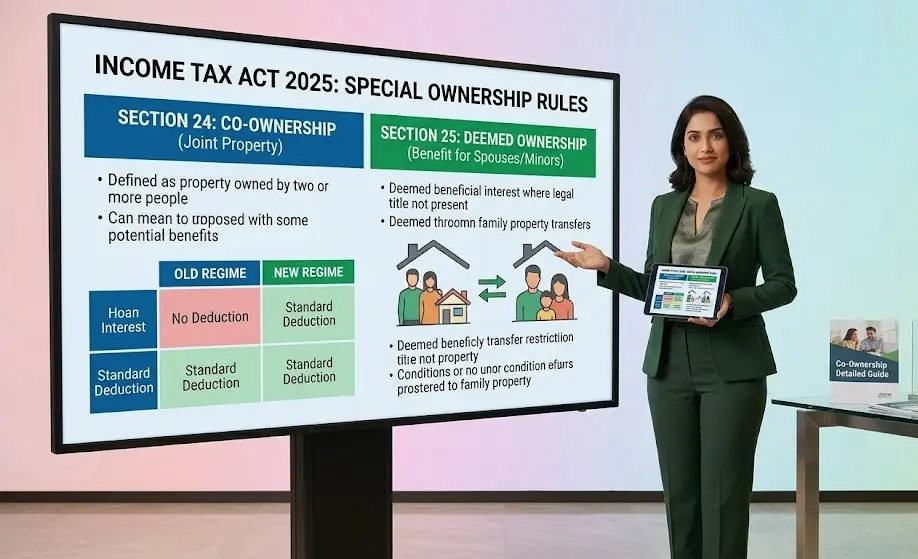
Deemed Ownership Under Income Tax Act 2025
Section 25 exists because “who owns this house” is a question tax law cannot always answer by looking at a registered title deed. It defines “owner”, for the purposes of every provision from Section 20 through Section 24, chargeability, annual value, deductions, arrears, and co-ownership, to include several people who are not the legal titleholder in the ordinary sense.
The practical effect is significant: if you fall into one of these categories, you are treated as the full owner for every purpose in this entire head of income, not just for one narrow rule. Five situations trigger this wider definition.
Transfers to a Spouse or Minor Child
This is the situation most people actually run into, and the one most often misunderstood. If you transfer a house to your spouse or your minor child without adequate consideration, meaning they did not genuinely pay you a fair price for it, you, the person who gave it away, are still treated as the owner for tax purposes. The rental income, or the notional income if it stays vacant, is still taxed in your hands, not theirs.
Two exceptions matter here. The rule does not apply if the transfer to a spouse was made under an agreement to live apart, a genuine separation. And it does not apply to a transfer to a married daughter; the “minor child” carve-out specifically excludes her, so a house given to a married minor daughter is not caught by this provision the way a gift to a son, or to an unmarried daughter, would be.
Anand buys a flat and, purely to simplify his estate planning, registers it in his wife’s name without her paying him anything for it. The flat is let out for ₹40,000 a month. Even though the title deed names his wife as owner, Section 25(a) treats Anand as the owner for tax purposes, because the transfer was made without adequate consideration and does not fall under an agreement to live apart. Anand, not his wife, reports the rental income from this flat in his own return.

The Other Deemed-Owner Situations
The remaining four categories are less commonly relevant to an average reader, but worth knowing if your situation touches any of them.
| Situation | Who is the deemed owner |
|---|---|
| Impartible estate | The holder of the estate, treated as individual owner of everything in it |
| Housing society or company allotment | The member allotted or leased the flat, not the society or company itself |
| Possession under an unregistered agreement | The person in possession, where they have paid or are ready to pay under a written contract, even without a registered sale deed |
| Long-term right of 12 years or more | The person holding that right, through a sale, exchange, or a lease of at least 12 years, or through an arrangement, such as acquiring shares in a company or society, that has the practical effect of letting them enjoy the property, though a month-to-month lease or a lease of one year or less is specifically excluded |
The housing society entry is genuinely common in Indian cities: many buyers live in and pay for a flat for years under a society allotment letter before formal conveyance is completed. Section 25 makes sure the actual occupant, not the society on paper, is the one taxed on it.
The 12-years-or-more category is written broadly on purpose. It does not only cover a formal sale, exchange, or long lease; it also catches an arrangement, such as buying shares in a company or a co-operative society, or any other agreement, that has the practical effect of letting someone enjoy a property, even without a sale, exchange, or lease in the usual sense. What it deliberately leaves out is a short lease: anything on a month-to-month basis, or for a period of one year or less, does not make the occupant a deemed owner.
- Assuming a gift to a spouse or child shifts the tax liability — for a minor child or spouse (outside a genuine separation), it generally does not; the person who gave the property away usually keeps reporting the income
- Assuming this rule applies to a married daughter — it does not; the minor-child provision specifically excludes a married daughter
- Treating a family property arrangement without a clear share document as automatically co-owned — without a definite, ascertainable share, the individual-share treatment in Section 24 may not apply at all
- Assuming a housing society, not the allottee, is taxed on society-allotted flats — the individual member is the deemed owner, not the society or company

Frequently Asked Questions
How is income taxed when a property is jointly owned?
Where each co-owner’s share is definite and ascertainable, they are not taxed as a single group. Each co-owner reports only their own share of the income, and each is separately entitled to the self-occupied Nil-value relief on their share.
If I transfer my house to my wife, who pays tax on the rent?
Generally, you do. Section 25 treats the person who transferred the property without adequate consideration as the deemed owner, so the income continues to be taxed in your hands, not your spouse’s, unless the transfer was made under an agreement to live apart.
Does this rule apply if I give a house to my married daughter?
No. The deemed-ownership rule for transfers to a minor child specifically excludes a married daughter. A house genuinely transferred to a married daughter is not caught by this provision.
Who is taxed on a flat allotted by a housing society before the sale deed is registered?
The member to whom the flat was allotted or leased is treated as the deemed owner, not the housing society or company. This applies even before formal conveyance or registration is completed.
What happens if co-owners’ shares in a property are not clearly defined?
The favourable individual-share treatment under Section 24 depends on shares being definite and ascertainable. Where they are not clearly documented, the property may instead be assessed collectively, which can change how the income is taxed.
Income From House Property — Series Index
Deemed Let Out Property: The Two-House Rule
Which houses get a Nil value, and which are taxed on notional rent.
Part 3Deductions: The 30% Standard Deduction & Home Loan Interest
Turning Net Annual Value into taxable income, and the ₹2 lakh cap most people get wrong.
Co-Ownership & Deemed Ownership: Who Actually Pays Tax
Sections 24 and 25 — jointly owned property and the deemed-owner rules.
Arrears of Rent & Unrealised Rent: The Special Situations
Section 23 — rent recovered late, and rent you never collected at all.
Two lessons sit inside this part of the Act. If you co-own a property with clearly documented shares, you and your co-owners each get taxed, and each get relief, individually, not as a bundle. And if you have moved a property into someone else’s name without them genuinely paying for it, particularly a spouse or minor child, do not assume the tax liability moved with it. In both cases, the paperwork behind the ownership matters as much as the name on the door.
Sources & References
- Income-tax Act, 2025 [Act No. 30 of 2025] — full text, as amended by Finance Act, 2026Income Tax India, incometaxindia.gov.in
- Section 24 — Property Owned by Co-OwnersIncome Tax India, incometaxindia.gov.in
- The Income-tax Act, 2025 — Official Gazette Notification (No. 30 of 2025)The Gazette of India, egazette.gov.in
Section 24 and all five clauses of Section 25 are confirmed against the official Act text, including the Gazette notification. Always cross-check against the official Act text linked above and consult a Chartered Accountant before relying on this for a filing decision.
Disclaimer: This article is for general informational purposes only and does not constitute tax or legal advice. The Income-tax Act, 2025 and related rules are subject to notifications and amendments by the CBDT. Please consult a qualified Chartered Accountant for advice specific to your situation.