
For tens of millions of Indians working outside the formal economy — daily wage earners, drivers, domestic help, small vendors, farmers — retirement has traditionally meant relying entirely on family. Atal Pension Yojana was built to change that with a guaranteed government-backed pension for the price of a few cups of tea a month. Here’s exactly how it works, what it actually costs at every age, and where the fine print catches people out.
Quick Answer — APY at a Glance
Retirement planning is usually framed as an investment decision — which fund, which allocation, which tax bracket. For a huge share of working India, that framing simply doesn’t apply. If you’re paid in cash, move between informal jobs, or run a small shop with no employer contributing to any provident fund on your behalf, the entire conversation around NPS tax slabs and equity allocation is irrelevant. Atal Pension Yojana exists precisely for this gap — a scheme built not around maximising returns, but around guaranteeing that a small, disciplined monthly contribution turns into a fixed income you can actually count on from age 60.
Launched on May 9, 2015 and made operational from June 1, 2015, APY has grown into one of the largest guaranteed-pension programmes anywhere in the world by sheer subscriber count. Here is everything you need to know before enrolling — or before deciding it’s not right for you.
What Is Atal Pension Yojana?
Atal Pension Yojana is a government-backed pension scheme regulated by PFRDA, designed to give unorganised sector workers a guaranteed, fixed monthly pension after age 60. Unlike NPS — where your final payout depends on market performance and fund manager choices — APY offers certainty: you pick a pension amount between ₹1,000 and ₹5,000 a month, and the government guarantees it, topping up the corpus from its own resources if investment returns fall short.
As of April 21, 2026, the scheme had crossed 9 crore total subscribers, with FY 2025–26 recording its highest-ever year for new enrolments — over 1.35 crore new subscribers joined in that single financial year. On January 21, 2026, the Union Cabinet approved continued funding support for APY through FY 2030–31, confirming the scheme’s place as a long-term pillar of India’s social security system rather than a temporary programme.

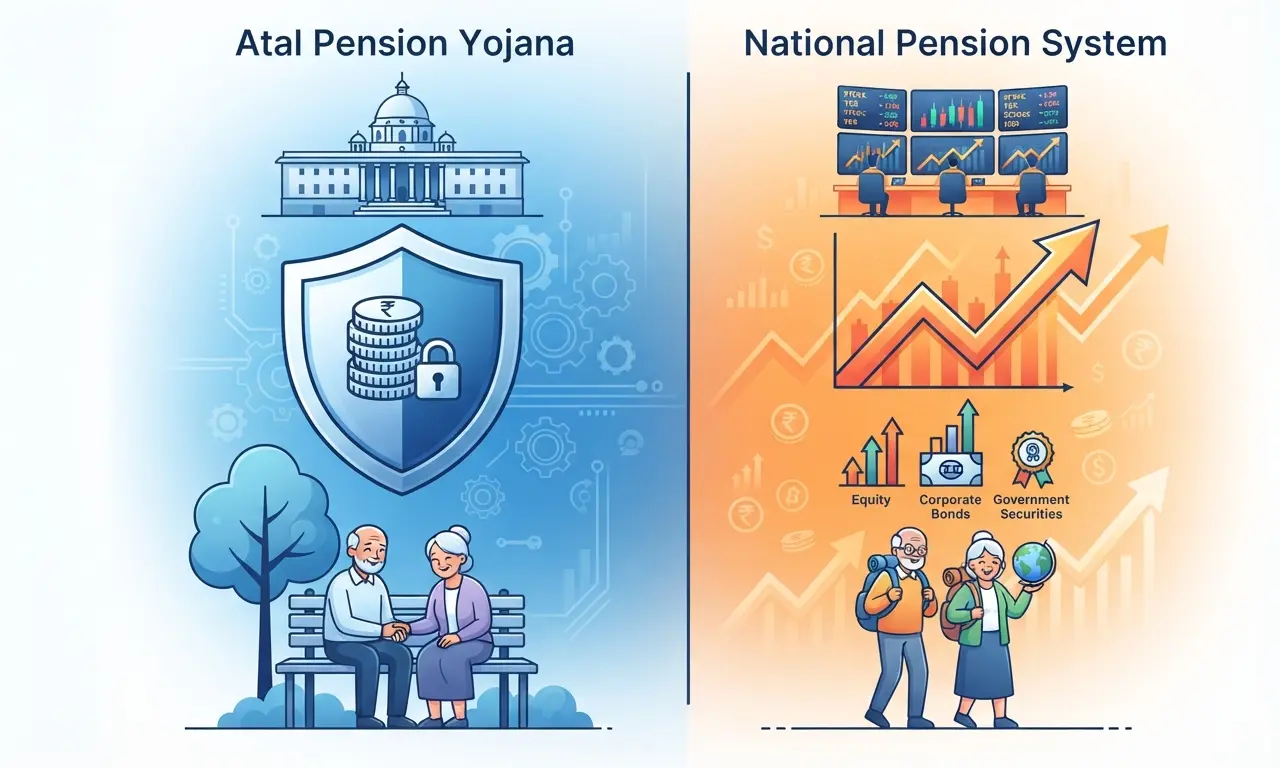
NPS is market-linked — your final corpus depends on how your chosen funds perform over decades, and there’s no guarantee. APY is the opposite: a fixed, government-guaranteed pension amount decided upfront, based purely on your age and contribution. You trade potential upside for absolute certainty — which is exactly the trade-off most APY subscribers are looking for.
Atal Pension Yojana Eligibility — Who Can Join in 2026
- Age: 18 to 40 years at the time of application — enrolment after 40 is not permitted under PFRDA regulations
- Citizenship: Must be a resident Indian citizen; NRIs and OCI cardholders cannot enrol
- Bank account: An active savings account with a bank or post office, linked to Aadhaar and a mobile number, is mandatory for auto-debit of contributions
- Not an income tax payer: Since October 1, 2022, individuals who are income tax payers on the date of application are not eligible to enrol
- New form requirement: From October 1, 2025, all new subscriber registrations must use the revised APY application form, which includes a FATCA/CRS declaration in line with updated PFRDA guidelines — banks and post offices have been directed to accept applications only on this updated form
If someone enrols and is later discovered to be an income tax payer, the account will be closed and only the accumulated savings — not the government’s co-contribution, where applicable — will be returned. It’s worth being certain of your tax status before applying, since this isn’t a minor administrative correction; it results in the account being shut down entirely.
The tax-payer exclusion only applies at the point of a new application. If you enrolled on or before September 30, 2022, you can continue your APY account and contributions regardless of your current tax status. And if a subscriber who joined after that date later starts paying income tax, there is no effect on their existing account — only fresh applications are screened for tax-payer status.

The Complete Atal Pension Yojana Contribution Chart by Age
Your monthly contribution depends on two things: how old you are when you join, and which of the five pension slabs you choose. The earlier you enrol, the less you pay for the same guaranteed pension — because your money has longer to grow before payouts begin at 60.
| Entry Age | ₹1,000 Pension | ₹2,000 Pension | ₹3,000 Pension | ₹4,000 Pension | ₹5,000 Pension |
|---|---|---|---|---|---|
| 18 years | ₹42 | ₹84 | ₹126 | ₹168 | ₹210 |
| 20 years | ₹50 | ₹100 | ₹150 | ₹198 | ₹248 |
| 25 years | ₹76 | ₹151 | ₹226 | ₹301 | ₹376 |
| 30 years | ₹116 | ₹231 | ₹347 | ₹462 | ₹577 |
| 35 years | ₹181 | ₹362 | ₹543 | ₹722 | ₹902 |
| 40 years | ₹291 | ₹582 | ₹873 | ₹1,164 | ₹1,454 |
| Indicative monthly contribution in ₹, based on the standard PFRDA APY chart. Actual amounts are confirmed by your bank or post office at enrolment and may be revised periodically. | |||||
Marketing lines like “secure your retirement for just ₹42 a month” are technically accurate but apply only to an 18-year-old choosing the minimum ₹1,000 pension. A 35-year-old choosing the maximum ₹5,000 pension pays ₹902 a month — over 20 times more. Always check the row that matches your actual age and target pension before assuming the lowest advertised figure applies to you.
Contributions can be made monthly, quarterly, or half-yearly, and are auto-debited from your linked savings account — there’s no need to remember to pay manually each month. Once selected, the pension slab isn’t meant to be changed frequently, so it’s worth choosing deliberately at the outset rather than treating it as a placeholder.
How to Apply for Atal Pension Yojana — Step by Step
Visit your bank branch or post office where you already hold a savings account — APY cannot be opened without one.
Request the updated APY application form — from October 1, 2025, only the revised form with the FATCA/CRS declaration is accepted.
Fill in your details: name, date of birth, Aadhaar number, mobile number, and your chosen pension slab (₹1,000 to ₹5,000).
Provide nominee details — APY requires a nominee to be named, along with spouse details if married, since the scheme includes spousal continuation.
Authorise auto-debit from your savings account for the calculated monthly (or quarterly/half-yearly) contribution.
Submit the form along with your Aadhaar and any other requested KYC documents.
Receive your PRAN (Permanent Retirement Account Number) confirming enrolment, typically communicated via SMS once processed.
APY can also be initiated online through enps.nps-proteantech.in for subscribers comfortable completing KYC and Aadhaar-based e-verification digitally, though many subscribers — particularly first-time applicants in the unorganised sector — still prefer the in-person process at a bank or post office counter.
Tax Benefits Under Atal Pension Yojana
APY contributions may be eligible for deduction under Section 80CCD of the Income Tax Act — the same broad section family that governs NPS deductions — subject to applicable conditions and limits. In practice, this tax benefit matters far less to APY’s core subscriber base than it does to NPS subscribers, simply because most people enrolling in APY already fall below the taxable income threshold. It’s also worth remembering that new enrolments are not permitted for income tax payers from October 1, 2022 onward, so this deduction is largely irrelevant for anyone applying fresh today — the value of APY for most subscribers is the guarantee itself, not a tax write-off.

Exit and Withdrawal Rules — Every Scenario Explained
APY is built as a long-term, locked-in retirement product — it is not designed for early withdrawals, and the rules reflect that deliberately. Here is what happens in each possible scenario.
What Happens If You Miss a Contribution?
Discipline matters in APY, but a missed payment isn’t catastrophic. If there’s insufficient balance in your linked account for the auto-debit, the bank may levy a small penalty, typically scaled to your contribution amount. If payments stop entirely for an extended period, the account is not closed immediately — it remains active as long as the outstanding maintenance charges can still be deducted from whatever balance remains. Prolonged non-payment can eventually lead to account freeze or closure, so it’s worth keeping the linked account funded even during lean months rather than letting the account lapse entirely.
APY vs NPS — Which One Actually Fits You?
| Parameter | Atal Pension Yojana | National Pension System |
|---|---|---|
| Return type | Fixed, government-guaranteed | Market-linked, no guarantee |
| Who it’s for | Unorganised sector, non-taxpayers, 18–40 | Any citizen 18–70; mandatory for govt employees |
| Pension amount | You choose: ₹1,000–₹5,000/month | Depends on final corpus and annuity rate |
| Income tax payer eligible? | No — excluded since Oct 2022 | Yes |
| Withdrawal at exit | No lump sum — pension only | Partial lump sum + annuity, per PFRDA rules |
If you’re reading this and you’re actually eligible for NPS instead — meaning you pay income tax or have access to employer contributions — our detailed comparison of NPS vs APY vs EPS walks through which pension scheme fits which type of worker in far more depth.
Frequently Asked Questions — Atal Pension Yojana

This article has been prepared after reviewing official Government of India publications, PFRDA regulations, operational guidelines, and publicly available reference material applicable as of August 2026.
- Pension Fund Regulatory and Development Authority (PFRDA) — Official APY regulations, circulars, FAQs, operational guidelines, and subscriber services.
- Protean CRA (National Pension System) — APY registration process, PRAN services, subscriber operations, and account management.
- Department of Financial Services (Ministry of Finance) — Government notifications, pension policy updates, and financial inclusion initiatives.
- Press Information Bureau (PIB) — Official Government press releases, Cabinet decisions, and announcements relating to Atal Pension Yojana.
- Income Tax Department — Reference to applicable provisions under Section 80CCD of the Income-tax Act, 1961.
- Official circulars, notifications, and scheme guidelines issued by the Government of India and PFRDA up to August 2026.