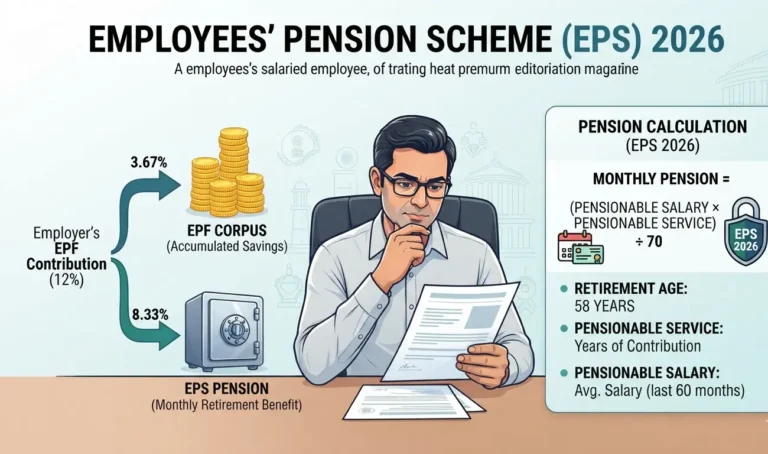

If you’re salaried, EPF is already happening to you — 12% of your basic salary, matched by your employer, going in every month without you lifting a finger. The real question isn’t EPF or NPS. It’s whether the extra money you want to set aside for retirement should top up what you already have, or go somewhere new. Here’s how to actually decide.
Most retirement planning advice starts from a blank slate — as if you’re choosing your very first savings vehicle. For a salaried employee, that’s simply not true. The moment you joined a company with 20 or more employees, EPF started happening to you automatically, and a slice of it has been quietly building an EPS pension too. So when a salaried reader asks “EPF or NPS,” they’re usually really asking a different, more useful question: given that EPF is already running in the background, does it make more sense to add more money to that same pipe, or to open a second one that works differently?
This article is about answering that second question properly — comparing VPF (the way you top up EPF) against voluntary NPS, so you can decide where your next rupee of retirement saving should actually go.

What Every Salaried Employee Already Has
Before deciding where to add more, it helps to be clear about what’s already running. If you’re on a company payroll with EPF coverage, here’s what happens every month without any action from you:
- Your contribution: 12% of Basic Salary + DA goes into your EPF account
- Employer’s contribution: Also 12% of Basic + DA, but split — 3.67% goes into your visible EPF balance, and 8.33% is diverted into EPS (your pension), calculated on a wage ceiling of ₹15,000
- Current EPF interest rate: 8.25% for FY 2025–26, government-backed and unchanged from the previous year
- Tax treatment: Your own EPF contribution qualifies for Section 80C deduction (old regime only); the corpus and interest are tax-free at withdrawal after 5 years of continuous service
If you want the full mechanics of how that 8.33% slice becomes a pension formula at retirement, we’ve covered that in detail in our EPS 2026 explainer. For this article, the key point is simpler: you already have a foundation. The question is what to build on top of it.
VPF — The Simplest Way to Save More
The Voluntary Provident Fund isn’t a separate account or a new scheme — it’s an extension of the EPF account you already have. You tell your employer’s payroll or HR team how much extra you want deducted each month, over and above the mandatory 12%, and it flows into the same EPF account, earning the same interest rate.
- Contribution limit: Up to 100% of your Basic Salary + DA, entirely your choice
- Interest rate: 8.25% for FY 2025–26 — identical to your regular EPF, set annually by EPFO
- Tax status: EEE — contribution, interest, and maturity are all tax-exempt, subject to the ₹2.5 lakh combined threshold explained below
- How to start: A written request to your employer’s payroll team — no new account, no new UAN, no separate paperwork with EPFO
- Withdrawal: Follows the same rules as EPF — tax-free after 5 years of continuous service; earlier withdrawal may attract tax
VPF’s real appeal is how little friction it involves. There’s no fund manager to pick, no asset allocation to think about, and no new portal to learn — just a bigger number flowing into an account that already exists.

NPS — Adding a Genuinely Different Tool
Voluntary NPS is a different proposition entirely. Rather than adding to what you have, you’re opening a new account with its own PRAN, its own fund manager choice, and its own investment mix across equity, corporate bonds, and government securities. In exchange for that added complexity, you get two things VPF cannot offer: exposure to equity markets, and tax benefits that VPF doesn’t have.
- Return type: Market-linked, historically 9–12% in equity-heavy schemes over the long term — but with genuine volatility, unlike VPF’s fixed rate
- Section 80CCD(1B): An additional ₹50,000 deduction, over and above the ₹1.5 lakh Section 80C ceiling — available only under the old tax regime. Note: this provision has been renumbered as Section 123 under the Income Tax Act, 2025, though it is still widely referred to by its familiar old-regime name, 80CCD(1B).
- Section 80CCD(2): If your employer offers Corporate NPS, their contribution — up to 14% of Basic + DA — is deductible in both the old and new tax regimes. This is the single most valuable NPS benefit still standing for salaried employees under the new regime
- Lock-in: Until age 60 or 15 years, with a portion of the corpus going into a compulsory annuity at exit — considerably less liquid than EPF/VPF in the interim

VPF vs NPS — Side by Side
| Parameter | VPF (Top-Up on EPF) | Voluntary NPS |
|---|---|---|
| Return type | Fixed, government-set — 8.25% (FY 2025–26) | Market-linked, no guarantee |
| Setup effort | Minimal — a request to payroll/HR | Moderate — new PRAN, fund manager, allocation choices |
| Contribution limit | Up to 100% of Basic + DA | No fixed ceiling; tax benefit caps apply separately |
| Tax deduction on contribution | Counted within Section 80C ceiling (old regime) | 80CCD(1B) extra ₹50K (old regime); 80CCD(2) employer share (both regimes) |
| Tax on interest/growth | Tax-free up to ₹2.5 lakh combined annual contribution; taxable beyond | Tax-deferred; 60% of corpus tax-free at exit (Section 10(12A)) |
| Liquidity | Tied to EPF withdrawal rules — accessible on job change, specific circumstances | Locked until 60 (or 15 yrs); limited partial withdrawal for approved reasons |
| Equity exposure | None — pure debt instrument | Up to 75% (or more under newer PFRDA fund options) |
| Best suited for | Capital protection, simplicity, shorter horizon to retirement | Long horizon, comfort with market risk, access to employer NPS |
| Sources: EPFO interest rate notification FY 2025–26, Income Tax Act, PFRDA. VPF and EPF share the same declared rate. | ||
The ₹2.5 Lakh Rule Almost Nobody Reads Properly
This is the detail that catches higher earners off guard. Since FY 2021–22, interest earned on your own contributions to EPF and VPF combined — not your employer’s share — becomes taxable once your total annual contribution crosses ₹2.5 lakh. Below that threshold, the entire EEE benefit applies cleanly: contribution, interest, and withdrawal are all tax-free.
If your basic salary is high enough that your mandatory 12% EPF contribution alone approaches or exceeds ₹2.5 lakh a year, adding VPF on top pushes you further into the taxable-interest zone with no additional tax-free benefit. In that specific situation, redirecting new savings into NPS — where the tax treatment works differently and isn’t capped by this same threshold — can be the more tax-efficient move, even though NPS carries market risk that VPF doesn’t.

Who Should Choose What- VPF vs. NPS
- Are within 10–15 years of retirement and want to avoid market risk on new savings
- Want the lowest-effort way to save more — one HR request, nothing else to manage
- Have combined EPF+VPF contributions comfortably under ₹2.5 lakh a year
- Have a long runway to retirement and can tolerate market volatility
- Have an employer offering Corporate NPS with Section 80CCD(2) contributions
- Are already near or above the ₹2.5 lakh VPF threshold and want a different tax lever
- Have room in your budget for meaningful additional retirement saving
- Want VPF as your guaranteed floor and NPS as your growth-and-tax layer
- Can commit to NPS’s longer lock-in without needing that money for near-term goals
For most salaried employees with room to save more, the smartest answer isn’t VPF or NPS — it’s both, used for what each does best. VPF is the easiest, safest way to build a guaranteed floor with money you’re comfortable locking away for the medium term. NPS is where you take on some market risk in exchange for growth potential and tax benefits that VPF simply doesn’t offer — particularly the employer contribution route if it’s available to you. Neither replaces the other; they solve different problems in the same retirement plan.