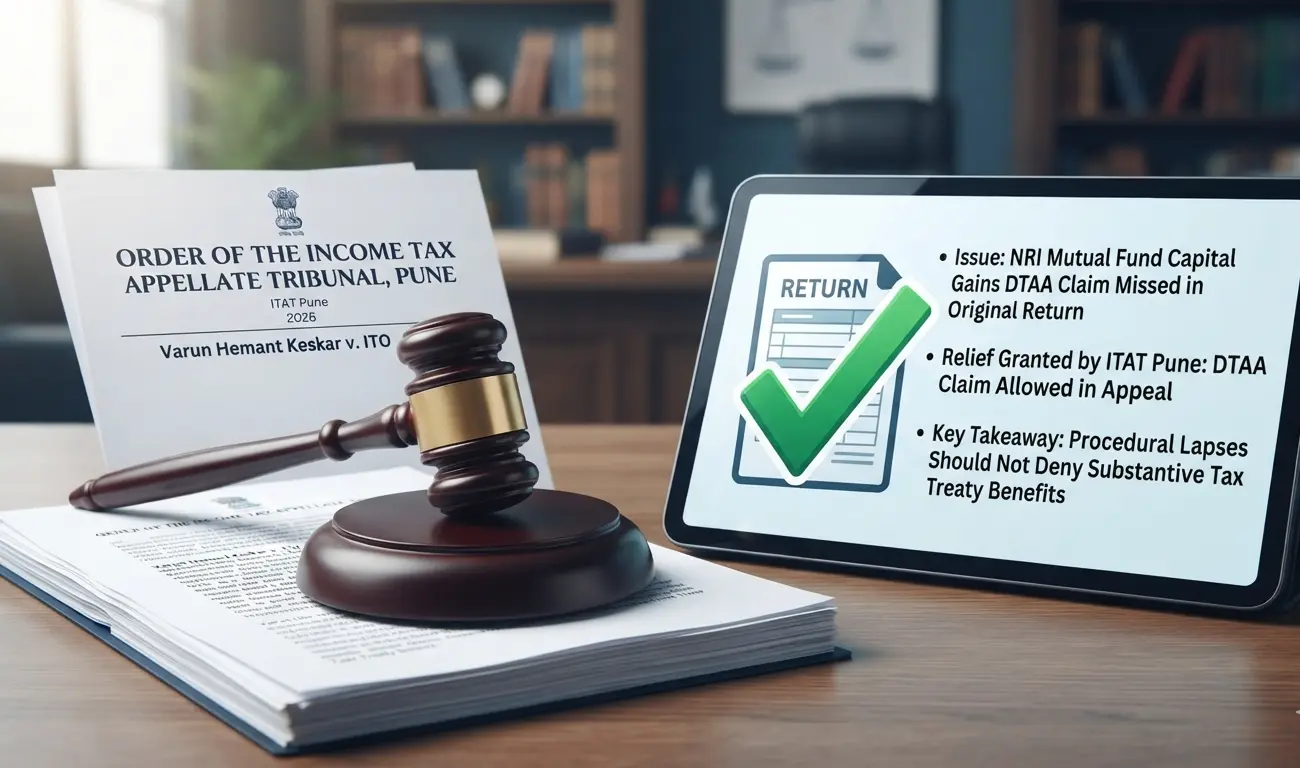
A Singapore-based NRI sold Indian mutual fund units, reported Rs.17.15 lakh of capital gains in his return, and paid Rs.1.70 lakh of tax on it. Nine months later, ITAT Mumbai ruled in another case that such gains are taxable only in Singapore. By then his window to revise the return had closed, and the CIT(A) refused to entertain his appeal, telling him to seek condonation under Section 119(2)(b) instead. ITAT Pune has now set that order aside: an NRI mutual fund capital gains DTAA claim left out of the return can still be raised before the appellate authorities, and the Assessing Officer must recompute the tax and grant any refund.
Quick Answer
Can an NRI claim DTAA exemption on mutual fund capital gains in appeal if the claim was not made in the income tax return?Yes. ITAT Pune held, following the Bombay High Court in CIT v. Pruthvi Brokers & Shareholders, that a claim not made in the return of income can be raised for the first time before the appellate authorities. It set aside the CIT(A)’s order, which had dismissed the appeal as not maintainable and pointed the assessee to Section 119(2)(b), and directed the Assessing Officer to recompute the tax in light of ITAT Mumbai’s ruling in Anushka Sanjay Shah (gains on Indian mutual fund units taxable only in Singapore under Article 13(5) of the India–Singapore DTAA) and to grant any refund after verification.
Case Snapshot
| Case Name | Varun Hemant Keskar v. Income Tax Officer, Ward-2, Pune (ITAT Pune, 2026) |
| Citation | ITA No. 133/PUN/2026 |
| Court / Bench | Income Tax Appellate Tribunal, Pune Bench |
| Coram | Shri Manish Borad (Accountant Member) & Shri Vinay Bhamore (Judicial Member); order authored by Shri Vinay Bhamore |
| Assessment Year | 2024-25 |
| Date of Hearing | 3 August 2026 |
| Date of Order | 12 October 2026 |
| Key Issue | Whether an NRI can claim India–Singapore DTAA exemption on mutual fund capital gains for the first time in appeal, against a Section 143(1) intimation that made no adjustment |
| Outcome | CIT(A)’s order set aside; matter sent to the AO to recompute tax in light of Anushka Sanjay Shah and grant refund, if any; appeal allowed for statistical purposes |
Table of Contents
Legal Issue: Can an NRI Mutual Fund Capital Gains DTAA Claim Be Made in Appeal?
Under Section 90(2), a non-resident can be taxed under the DTAA wherever the treaty is more beneficial than the Income-tax Act. The usual way to claim that benefit is in the return of income, or in a revised return within the time allowed. The question here was what happens when the taxpayer misses that window. Section 246 allows an appeal against a Section 143(1) intimation where the appellant objects to “the making of adjustments”. The CIT(A) read this to mean no appeal lies where CPC accepted the return exactly as filed, so the only remedy was condonation under Section 119(2)(b). The Tribunal had to decide whether the appellate authorities could entertain the treaty claim at all.
Facts of the Case
The assessee, an individual working in Singapore, held a Singapore tax residency certificate. On 26 June 2024 he filed his return for AY 2024-25 as a non-resident, declaring income of Rs.17,73,990, which included capital gains of Rs.17,15,446 from the sale of mutual fund units. CPC processed the return under Section 143(1) by intimation dated 6 September 2024, accepting it as filed. The tax of Rs.1,70,372 on the capital gains was adjusted against TDS credit.
On 26 March 2025, ITAT Mumbai decided Anushka Sanjay Shah v. ITO (IT(IT)A No. 174/Mum/2025, AY 2022-23), holding that gains on Indian mutual fund units are taxable only in Singapore under Article 13(5) of the India–Singapore DTAA. By the assessee’s account, the ruling was published after 31 March 2025, when the time for revising his return had already expired. He appealed against the intimation, claiming the gains were not taxable in India.
| Date | Event |
|---|---|
| 26 June 2024 | Return for AY 2024-25 filed as non-resident; capital gains of Rs.17,15,446 offered to tax |
| 6 September 2024 | Section 143(1) intimation: return accepted as filed; tax of Rs.1,70,372 adjusted against TDS |
| 31 December 2024 | Last date to revise the AY 2024-25 return under Section 139(5) |
| 26 March 2025 | ITAT Mumbai decides Anushka Sanjay Shah: mutual fund gains of a Singapore resident taxable only in Singapore |
| 1 December 2025 | CIT(A) dismisses the appeal as not maintainable |
| 12 October 2026 | ITAT Pune sets aside the CIT(A)’s order and remands the claim to the AO |
The Addl./JCIT(A)-1, Ahmedabad dismissed the appeal on 1 December 2025 as not maintainable. The CIT(A) held that CPC had made no “adjustment”, so no appeal lay under Section 246(1)(a); the grievance arose from the assessee’s own omission; and the proper remedy was a revised return or a condonation application under Section 119(2)(b). The CIT(A) did not examine the DTAA claim on merits.
Arguments of the Parties
For the Assessee (Sh. Rajendra Ranade)
- Section 251 gives the appellate authority wide powers to entertain fresh claims, and these powers are not subordinate to Section 119.
- Section 246 also allows an appeal where the appellant objects to the amount of tax determined; here the tax of Rs.1,70,372 was objected to, as the correct liability was nil.
- The CIT(A)’s hearing notice never raised maintainability, so dismissing the appeal on that ground without notice breached natural justice, and the written submissions were not considered.
- On merits, the gains fall under Article 13(5) of the India–Singapore DTAA and are taxable only in Singapore, as held in Anushka Sanjay Shah. Reliance was placed on CIT v. Pruthvi Brokers & Shareholders (Bombay HC).
For the Revenue (Sh. Sandeep Jumale, virtual)
- The order records that both sides were heard but does not set out any separate submission on behalf of the Revenue.
Court/Tribunal’s Decision
The Tribunal, having heard both sides and perused the paper book, held:
(i) That, following the Bombay High Court in Pruthvi Brokers & Shareholders, a claim not made in the return of income can be raised for the first time before the appellate authorities, and the CIT(A) was not justified in refusing to entertain it. [Paras 6 and 8 of the order]
(ii) That coordinate benches had likewise allowed claims raised for the first time before the CIT(A). [Para 7 of the order]
(iii) That the CIT(A)’s order is set aside, and the Assessing Officer shall recompute the tax on the revised capital gains computation in light of Anushka Sanjay Shah and grant any refund after verification and hearing, with the assessee bound to cooperate without seeking adjournments. [Para 8 of the order]
The appeal was allowed for statistical purposes.
Reasoning Behind the Decision
Appellate authorities can entertain fresh claims. The Tribunal relied on CIT v. Pruthvi Brokers & Shareholders [2012] 23 taxmann.com 23 (Bom). There the Bombay High Court upheld appellate orders allowing a deduction that the assessee had not claimed in its return, holding that the Supreme Court’s decision in Goetze (India) Ltd. v. CIT (2006) 284 ITR 323 (SC) only restricts the Assessing Officer from entertaining a claim without a revised return. It does not curtail the powers of the appellate authorities, which may consider a claim not made before the AO, following National Thermal Power Co. Ltd. v. CIT (1998) 229 ITR 383 (SC) and the Delhi High Court in CIT v. Jai Parabolic Springs Ltd. (2008) 306 ITR 42 (Del).
The same approach has been taken by coordinate benches. The Tribunal noted that Pune benches had allowed Section 10(10B) exemption to BSNL VRS employees where the claim was raised for the first time before the CIT(A), referring to Prathibha Jagadish Unawane v. ITO (ITA Nos. 1117 & 1118/PUN/2026, order dated 29 April 2026) and Makarand Prabhakar Abhyankar v. ADIT, CPC (ITA No. 1497/PUN/2026, order dated 5 October 2026).
The merits go to the Assessing Officer. The Tribunal did not itself decide whether the gains were taxable in India. It directed the jurisdictional AO to recompute the tax “as per fact and law in the light of” Anushka Sanjay Shah and to grant any refund after verifying the documents on the capital gains.
Key Legal Principle
A taxpayer who omits a legitimate claim from the return is not confined to a revised return or a Section 119(2)(b) application. Following Pruthvi Brokers, the appellate authorities have the power to entertain a claim raised for the first time before them, including a DTAA claim against a Section 143(1) intimation, and the CIT(A) should not dismiss such an appeal as not maintainable merely because CPC made no adjustment.
Practical Implications for NRIs With Mutual Fund Gains
- Check whether you paid tax on mutual fund gains you may not owe: NRIs resident in Singapore who sold Indian mutual fund units should review past returns in light of Anushka Sanjay Shah; an NRI mutual fund capital gains DTAA claim can be worth the full tax paid. Whether the same result follows for other countries depends on the wording of each treaty.
- Use the revised return first if time allows: It remains the simplest route. For AY 2024-25 the window closed on 31 December 2024, three months before Anushka Sanjay Shah was decided; this ruling matters where that window has closed.
- Otherwise, appeal against the Section 143(1) intimation: Raise the treaty claim before the CIT(A), cite Pruthvi Brokers and this order, and object to the amount of tax determined, not just to adjustments.
- Keep the treaty paperwork ready: The AO will verify the claim. A Tax Residency Certificate for the relevant year, Form 10F, and capital gains statements from the fund house are the basic documents.
- Respond promptly once the matter is remanded: The Tribunal expressly warned that the AO may pass orders as per law if the assessee seeks adjournments.
Which remedy to use if you missed the claim:
| Remedy | When it works | What to watch |
|---|---|---|
| Revised return | Within the time allowed under Section 139(5) | Simplest route; no longer available once the deadline passes |
| Appeal against the 143(1) intimation | Where the claim was omitted and the revision window has closed | Rely on Pruthvi Brokers and this ruling; expect a remand for verification |
| Condonation under Section 119(2)(b) | Where the taxpayer prefers an administrative route for a belated claim | Discretionary; the CIT(A) here treated it as the only route, which the Tribunal did not accept |

Related Judgments and Limitations
| Case | Forum | Relevance |
|---|---|---|
| CIT v. Pruthvi Brokers & Shareholders, [2012] 23 taxmann.com 23 (Bom) | Bombay High Court | Appellate authorities can entertain a claim not made in the return; Goetze limits only the AO |
| Anushka Sanjay Shah v. ITO, IT(IT)A No. 174/Mum/2025 (order dated 26 March 2025) | ITAT Mumbai | Gains on Indian mutual fund units taxable only in Singapore under Article 13(5) of the India–Singapore DTAA; mutual fund units are not shares |
| Goetze (India) Ltd. v. CIT, (2006) 284 ITR 323 (SC) | Supreme Court | AO cannot entertain a new claim except through a revised return; does not restrict appellate powers |
| Prathibha Jagadish Unawane v. ITO; Makarand Prabhakar Abhyankar v. ADIT, CPC | ITAT Pune | First-time claims before the CIT(A) allowed in BSNL VRS cases |
Frequently Asked Questions
ITAT Mumbai held in Anushka Sanjay Shah that gains on Indian mutual fund units fall under Article 13(5) of the India–Singapore DTAA and are taxable only in Singapore, because mutual fund units are not shares. That is a Tribunal view, and the position for other countries depends on each treaty.
Yes. ITAT Pune held, following the Bombay High Court in Pruthvi Brokers, that a claim not made in the return of income can be raised for the first time before the appellate authorities.
The CIT(A) said no, but ITAT Pune set that order aside and directed the AO to recompute the tax. The Tribunal did not rule on the point in terms, but it treated the appellate authorities as able to entertain the claim.
Not finally. It sent the matter to the Assessing Officer to recompute the tax in light of Anushka Sanjay Shah and grant any refund after verifying the documents.
At a minimum, a Tax Residency Certificate for the relevant year, Form 10F, and capital gains statements from the fund house, so the Assessing Officer can verify the claim.
Final Verdict
Based on the above facts and reasoning, ITAT Pune set aside the CIT(A)’s order dismissing Varun Hemant Keskar’s appeal as not maintainable, and directed the Assessing Officer to recompute his AY 2024-25 tax on Rs.17,15,446 of mutual fund capital gains in light of Anushka Sanjay Shah and grant any refund after verification. In my view, the lasting value of the ruling is procedural: an NRI who missed a DTAA claim in the return, and can no longer revise it, still has an appeal route, not just a Section 119(2)(b) application. The exemption itself is not yet final in this case and will turn on the AO’s verification.
Also Read
Corresponding Provisions Under the Income-tax Act, 2025
This case was decided under the Income-tax Act, 1961, for Assessment Year 2024-25. Under the Income-tax Act, 2025, Section 90 (DTAA relief) corresponds to Section 159 and Section 139 (return of income, including revised returns) to Section 263. Published concordance tables also map Section 143 to Section 270, Section 119 to Section 239, Section 246A (appealable orders) to Section 357 and Section 251 (powers of the appellate authority) to Section 360; confirm these against the bare Act before relying on them. For other sections, see our Income Tax Act 2025 vs 1961 mapping hub.
Source Judgment: Varun Hemant Keskar v. ITO, Ward-2, Pune (ITAT Pune, 2026), ITA No. 133/PUN/2026, order pronounced 12 October 2026. This order can be looked up on the official ITAT judicial search portal using the ITA number above.
Want the full order copy? Download it here.
Legal Disclaimer: This article is for general informational purposes only and analyses a specific Tribunal order under the Income-tax Act, 1961, as it applied to Assessment Year 2024-25. It is not legal or tax advice, and it does not account for developments after the date of publication or for the specific facts of any reader’s case. The DTAA claim in this matter was remanded to the Assessing Officer and not finally decided, as noted above. Readers should verify the applicable current position and consult a qualified Chartered Accountant or tax professional before acting on this or any similar matter.