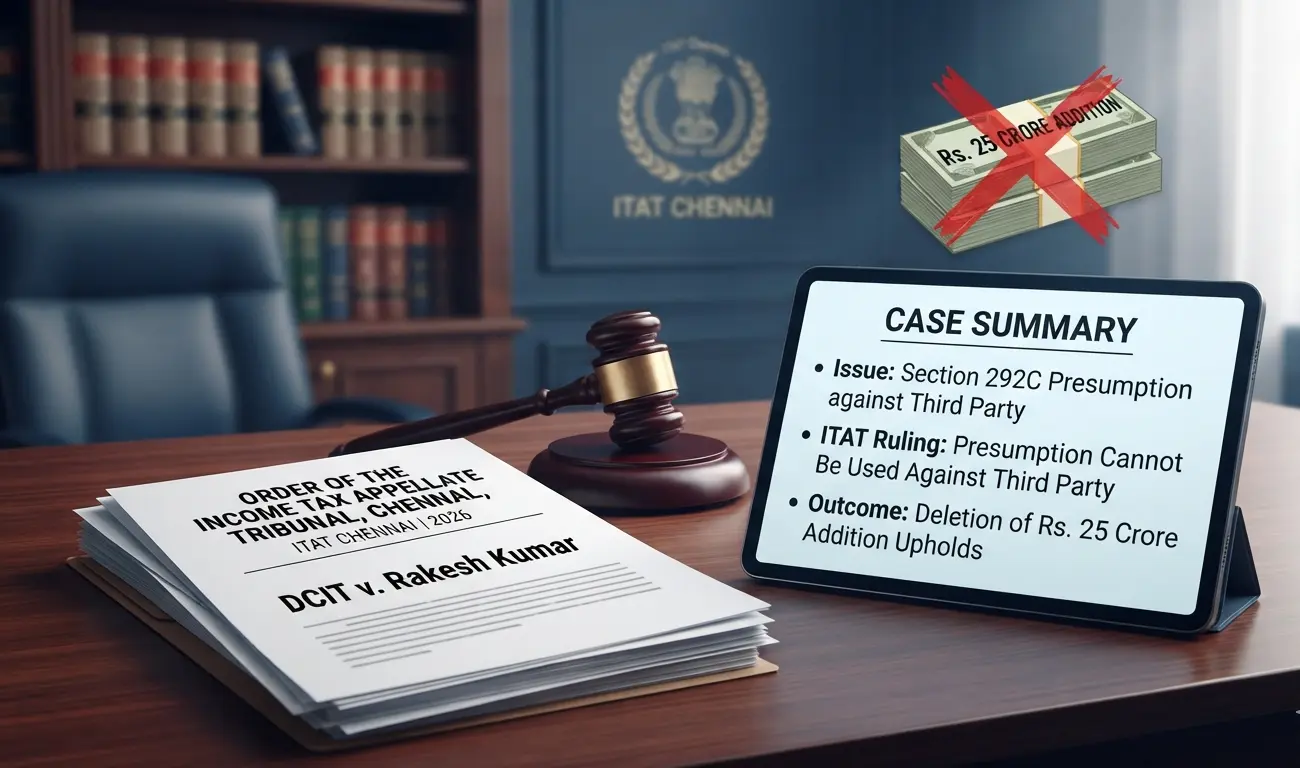
A small notebook seized in the Saravana Stores search carried a short entry: “SLP” and “25”. The group’s AGM said it meant a Rs.25 crore cash loan from Swarna Shilpi; the group’s MD swore the money came from Rakesh Kumar, a partner of that firm. The Assessing Officer added Rs.25 crore to Rakesh Kumar’s income and taxed it at the special rate. ITAT Chennai has now confirmed that the addition cannot stand, because the Section 292C presumption cannot be stretched to a third party: the statutory presumptions about seized documents bind only the person from whom they are seized, not someone named in them who denies the transaction.
Quick Answer
Can a document seized from someone else’s premises be presumed true against a third party under Section 132(4A) or Section 292C?No. ITAT Chennai held that the presumptions under Sections 132(4A) and 292C apply only to the person in whose possession or control the documents are found during a search. They cannot be used to fasten income on a third party named in those documents. A notebook of uncertain authorship that the third party did not prepare cannot, by itself, prove his undisclosed income, particularly where the person who explained it later retracted. The Tribunal upheld the CIT(A)’s deletion of a Rs.25 crore addition under Section 69 and dismissed the Revenue’s appeal.
Case Snapshot
| Case Name | Deputy Commissioner of Income Tax, Central Circle-1(3), Chennai v. Shri Rakesh Kumar (ITAT Chennai, 2026) |
| Citation | ITA No. 3854/Chny/2026 |
| Court / Bench | Income Tax Appellate Tribunal, Chennai Bench “B” |
| Coram | Shri S.S. Viswanethra Ravi (Judicial Member) & Shri Gagan Goyal (Accountant Member); order authored by Shri Gagan Goyal |
| Assessment Year | 2021-22 |
| Date of Hearing | 7 October 2026 |
| Date of Order | 28 October 2026 |
| Key Issue | Whether a Rs.25 crore addition under Section 69 can be made against a third party solely on a notebook seized from another group’s premises and statements of that group’s officers |
| Outcome | Revenue’s appeal dismissed; CIT(A)’s deletion of the Rs.25 crore addition upheld |
Table of Contents
Legal Issue: Does the Section 292C Presumption Apply to a Third Party?
When books, documents or cash are found in a search, Sections 132(4A) and 292C allow the department to presume that they belong to the person in whose possession or control they were found, and that their contents are true. That is a powerful tool against the person searched, who must then rebut the presumption. The question here was whether the same presumption could be turned against someone else: a person named in a seized document, who was not searched, did not write the document, and denied the transaction recorded in it. Put simply, can the department tax a third party on the strength of another person’s notebook and another person’s statement?
Facts of the Case
The assessee, a partner of M/s Swarna Shilpi, declared total income of Rs.7,42,79,050 for AY 2021-22, from his firm, house property, M/s Swarna Shilpi Jewellers Chennai Pvt. Ltd. and capital gains. On 1 December 2021 a search under Section 132 was conducted on the Saravana Stores group (Saravana Store Tex, Saravana Store (Jewellery), Saravana Super LLP and Shri R. Sabapathy) and related entities. The assessee was not among the persons searched.
A small notebook seized in that search (Annexure ANN/SK/SSSLP/B&D/S-2) contained an entry that the group’s AGM, Shri Antony Francis Julian, explained in his statement: “SLP” denoted a loan from M/s Swarna Shilpi and “25” meant Rs.25 crore. The AO read this as a loan taken by Shri Sabapathy from Swarna Shilpi, of which Rs.2 crore had been repaid in cash during the year. Confronted with the notebook, Shri R. Sabapathy, the group’s MD, stated on oath on 4 December 2021 that he had received a Rs.25 crore cash loan from the assessee in December 2020 and used it to pay on-money for a property purchase.
The assessee denied any loan transaction with Shri Sabapathy and denied the contents of the notebook. On 21 March 2022 Shri Sabapathy retracted, stating that the Rs.25 crore was not a loan from the assessee but proceeds of undisclosed sales, of which Rs.17 crore had been parked with the assessee and Rs.8 crore came from other undisclosed sales.
The assessee’s case was selected for compulsory scrutiny, and the AO added Rs.25 crore under Section 69 read with Section 115BBE. The CIT(A), Chennai-18, deleted the addition by order dated 13 April 2026, holding the seized material uncorroborated. The Revenue appealed to the Tribunal.
Arguments of the Parties
For the Assessee (no appearance)
- No one appeared for the assessee before the Tribunal; the appeal was decided on the record.
- Before the AO, the assessee had denied any loan transaction with Shri Sabapathy and the contents of the notebook. The CIT(A) had accepted that the seized material was uncorroborated.
For the Revenue (Sh. C. Sivakumar, CIT-DR)
- The seized notebook was corroborated by the statements under Section 132(4) of Shri R. Sabapathy and Shri Antony Francis Julian.
- Under the jurisdictional High Court’s ruling in A.J. Ramesh Kumar v. DCIT, a retraction does not make a statement unacceptable unless it is backed by strong evidence of duress or coercion.
- The CIT(A) wrongly relied on the Tribunal’s decision in Shri P. Palanichamy (ITA No. 3015/Chny/2024), which the department had not accepted and was challenging before the Madras High Court.
Court/Tribunal’s Decision
The Tribunal, having examined the orders of the AO and the CIT(A), held:
(i) That the presumptions under Sections 132(4A) and 292C apply only to the person in whose possession or control the documents are found during the search, and cannot be applied against a third party. [Paras 6, 7 and 10 of the order]
(ii) That a notebook of uncertain authorship, not prepared by the assessee, cannot by itself constitute conclusive evidence of his undisclosed income. [Para 10 of the order]
(iii) That A.J. Ramesh Kumar, which concerned the person searched, does not apply to a third party, and was wrongly relied upon by the Revenue. [Paras 10 and 11 of the order]
(iv) That the CIT(A)’s order deleting the addition of Rs.25 crore is sustained. [Para 11 of the order]
The Revenue’s appeal was dismissed.
Reasoning Behind the Decision
The presumption follows possession. The Tribunal noted that the Revenue’s entire case rested on two things: the seized notebook and the statements of the group’s AGM and MD. Section 292C presumes that documents found in a person’s possession or control belong to that person and that their contents are true. The key words are “found in the possession or control of any person”. The presumption works against the person from whom the documents were seized, not against anyone named in them.
The Tribunal relied on two High Court rulings. In Dharmraj Prasad Bibhuti v. ITAT [2019] 109 taxmann.com 388 (Patna), cash found at the father-in-law’s residence was presumed to belong to the father-in-law, not to the appellant. In PCIT v. Umesh Ishrani [2019] 108 taxmann.com 437 (Bom), loose papers found with another partner, and not corroborated by independent evidence, could not support additions in the assessee’s hands. Following these, the Tribunal held that the presumptions under Sections 132(4A) and 292C cannot be applied to a third party.
Uncertain authorship and a changed story. The notebook was admittedly not prepared by the assessee but, at best, by someone at the Saravana group’s premises. The Tribunal described the Section 132(4A) presumption as “a limited and rebuttable presumption applicable only in the context of seizure and custody”, which cannot by itself fix tax liability on a third party. It also noted, as the CIT(A) had, that Shri Sabapathy later retracted his statement that the entry recorded a loan from the assessee.
A.J. Ramesh Kumar distinguished. The Revenue relied on A.J. Ramesh Kumar v. DCIT (2022) 441 ITR 495 / [2022] 139 taxmann.com 190 (Mad), where the jurisdictional High Court, applying the Supreme Court’s decision in Bannalal Jat Constructions, held that a retracted Section 132(4) statement remains good evidence unless the retraction is backed by strong evidence. The Tribunal held that the ruling concerned the person searched and his own statement, and so did not help the Revenue against a third party; if anything, it confirmed the Tribunal’s view.
A further observation on regular assessments. The Tribunal also observed that the Section 132(4A) presumption is available in search proceedings and not when framing a regular assessment under Section 143(3), and that seized material can be used as evidence only in the case of the person searched. This observation is discussed in the Limitations section below.
Key Legal Principle
The statutory presumptions about seized documents under Sections 132(4A) and 292C operate against the person from whose possession or control they are seized. They cannot be used to presume that entries in another person’s notebook are true against a third party who did not prepare them and denies them. To tax a third party, the department must bring independent, corroborative evidence linking that person to the alleged transaction; a third party’s notebook and the searched person’s statements are not enough on their own, especially once the statement is retracted.
Practical Implications for Practitioners
- Ask first: whose possession was it found in? If the document was seized from someone else, the department cannot lean on the Section 292C presumption against your client. Make this the opening legal ground.
- Deny promptly and in writing: The assessee here denied both the loan and the notebook’s contents when confronted. An early, clear denial puts the burden back on the department.
- Demand corroboration and cross-examination: Ask for the seized material, the statements relied on, and an opportunity to cross-examine the deponents. Additions built only on a third party’s paper and statements are vulnerable.
- Use the retraction carefully: A retraction by the searched person helps, but read it closely. Here the retraction still said Rs.17 crore of undisclosed sales was “parked” with the assessee, which the department could try to pursue on a different footing.
- Expect A.J. Ramesh Kumar to be cited against you: Distinguish it on the ground that it concerned the person searched and his own statement, as the Tribunal did here.
Related Judgments and Limitations
| Case | Forum | Relevance |
|---|---|---|
| Dharmraj Prasad Bibhuti v. ITAT, [2019] 109 taxmann.com 388 (Patna) | Patna High Court | Cash found at another person’s residence presumed to belong to that person under Sections 132(4A) and 292C, not to the appellant |
| PCIT v. Umesh Ishrani, [2019] 108 taxmann.com 437 (Bom) | Bombay High Court | Loose papers found with another partner and not corroborated by independent evidence cannot support additions; no question of law |
| A.J. Ramesh Kumar v. DCIT, (2022) 441 ITR 495 / [2022] 139 taxmann.com 190 (Mad) | Madras High Court (jurisdictional) | A retracted Section 132(4) statement remains good evidence against the person searched; distinguished as not applying to a third party |
| Shri P. Palanichamy, ITA No. 3015/Chny/2024 (order dated 29 April 2025) | ITAT Chennai | Relied on by the CIT(A); the Revenue says its appeal is pending before the Madras High Court |
1. No one argued for the assessee. He was not represented before the Tribunal, so the Revenue’s arguments went unanswered at the hearing.
2. The delay point is silent. The Revenue’s appeal was 7 days late, but the order does not record any decision on condoning the delay; it simply decides the appeal on merits.
3. One observation goes too far. Para 8 says the Section 132(4A) presumption is not available in a regular assessment under Section 143(3). Section 292C itself allows the presumption “in any proceeding under this Act”, though only against the person in whose possession the material was found. Rely on the third-party point, not this wider remark.
4. The retraction is not a clean exit. Shri Sabapathy’s retraction still said Rs.17 crore of undisclosed sales was parked with the assessee. The Tribunal did not examine this, and the department could pursue it on a different footing.
5. One Revenue ground was not answered. The order does not deal with the Revenue’s point that the Palanichamy ruling is under challenge before the Madras High Court.
6. Drafting slips. The order prints the return-filing date as “31.02.2021”, which is not a valid date.
Frequently Asked Questions
No. ITAT Chennai held that the presumptions under Sections 132(4A) and 292C apply only to the person in whose possession or control the documents are found, and cannot be applied against a third party.
Not on its own. The Tribunal held that a notebook of uncertain authorship, not prepared by the assessee, cannot by itself constitute conclusive evidence of his undisclosed income.
Not according to this ruling. The Tribunal held that A.J. Ramesh Kumar concerned the person searched and his own retracted statement, and does not apply to a third party.
Here the retraction weakened the department’s case, since the MD withdrew his claim that the entry was a loan from the assessee. But the retraction still said Rs.17 crore of undisclosed sales was parked with the assessee, a point the Tribunal did not examine.
It is final at the Tribunal stage, but the Revenue can appeal to the Madras High Court on a question of law, and given the amount involved it may well do so.
Final Verdict
Based on the above facts and reasoning, ITAT Chennai dismissed the Revenue’s appeal and upheld the deletion of the Rs.25 crore addition made against Shri Rakesh Kumar for AY 2021-22. The notebook was seized from the Saravana group, not from him; he did not write it and denied its contents; and the statement linking him to it was later retracted. In my view, the ruling’s core point is sound and widely useful: the presumptions about seized documents bind the person they are seized from, not a third party named in them. Practitioners should rely on that point rather than on the broader remark about regular assessments, and should watch for a Revenue appeal to the Madras High Court.
Also Read
Corresponding Provisions Under the Income-tax Act, 2025
This case was decided under the Income-tax Act, 1961, for Assessment Year 2021-22. Under the Income-tax Act, 2025, Section 132 (search and seizure) corresponds to Section 247, Section 69 (unexplained investments) to Section 103, and Section 115BBE (tax on unexplained income) to Section 195. Published concordance tables also map Section 292C (presumption as to assets and books of account) to Section 524 and Section 143 to Section 270; confirm these against the bare Act before relying on them. For other sections, see our Income Tax Act 2025 vs 1961 mapping hub.
Source Judgment: DCIT, Central Circle-1(3), Chennai v. Shri Rakesh Kumar (ITAT Chennai, 2026), ITA No. 3854/Chny/2026, order pronounced 28 October 2026. This order can be looked up on the official ITAT judicial search portal using the ITA number above.
Want the full order copy? Download it here.
Legal Disclaimer: This article is for general informational purposes only and analyses a specific Tribunal order under the Income-tax Act, 1961, as it applied to Assessment Year 2021-22. It is not legal or tax advice, and it does not account for developments after the date of publication or for the specific facts of any reader’s case. The assessee was not represented before the Tribunal, and the ruling may be challenged before the High Court, as noted above. Readers should verify the applicable current position and consult a qualified Chartered Accountant or tax professional before acting on this or any similar matter.