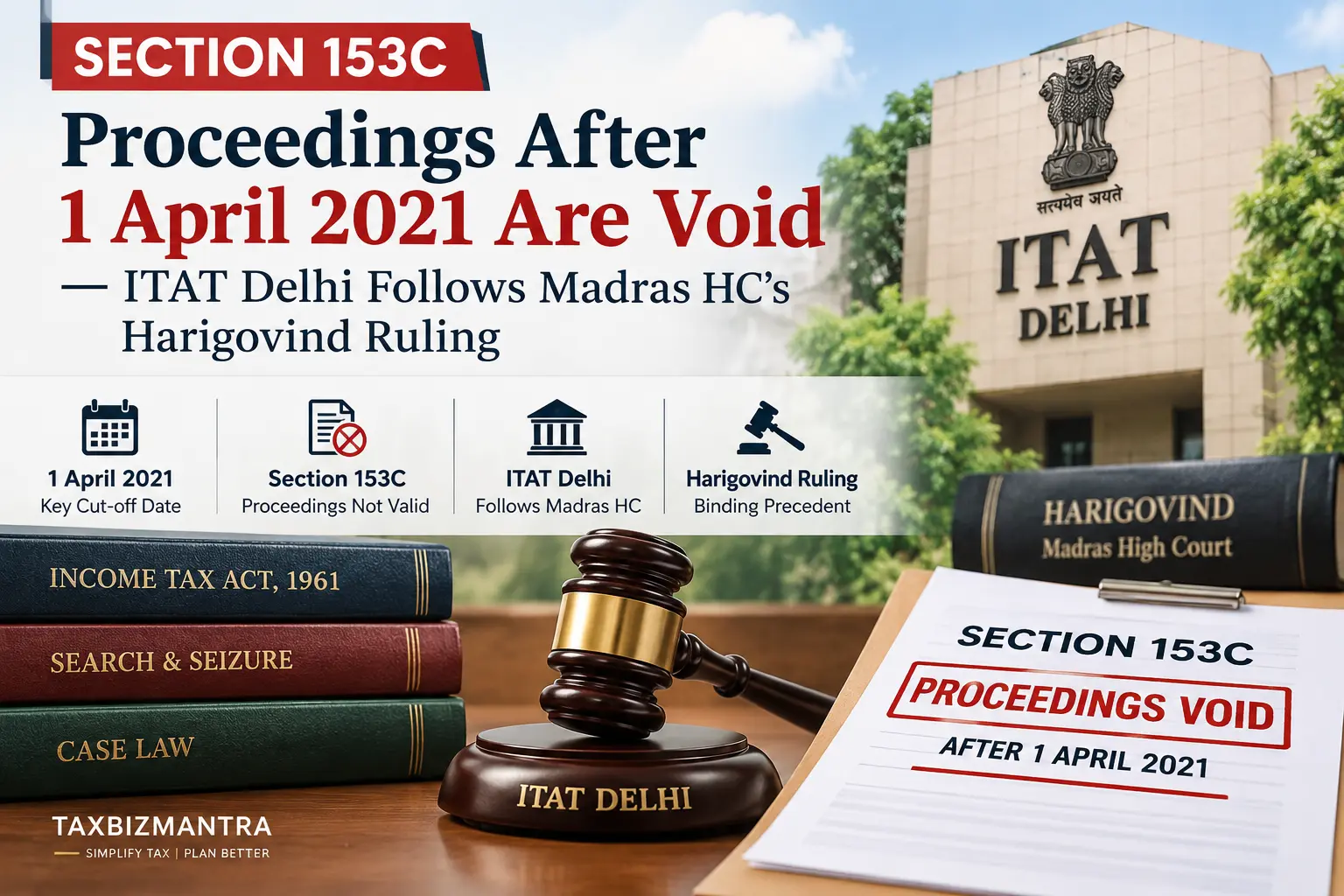
The search happened in October 2019 — well before Parliament shut the door on Section 153C for searches initiated on or after 1 April 2021. But the seized documents relating to this company weren’t actually handed over to its Assessing Officer until February 2022, more than two years later and four months after that cutoff. The Revenue argued this shouldn’t matter: the original search was valid, so the provision should still apply. ITAT Delhi disagreed, and in doing so applied a Madras High Court ruling that’s rapidly becoming one of the most-cited authorities in search-assessment litigation right now. Section 153C proceedings after 1 April 2021 face a jurisdictional problem that goes well beyond a simple limitation technicality — and this case shows exactly why.
Quick Answer
Can Section 153C proceedings be validly initiated against a non-searched person if the seized material reaches their Assessing Officer on or after 1 April 2021, even though the original search happened earlier?No. ITAT Delhi, following the Madras High Court’s ruling in Harigovind v. ACIT, has held that the “deemed date of search” for a person other than the one actually searched — the date their own Assessing Officer receives the seized material and records satisfaction — is treated as the date of initiation of search for that person for all purposes, including Section 153C(3). If that deemed date falls on or after 1 April 2021, Section 153C(3) bars the provision from applying to that person at all, regardless of when the original search took place.
Case Snapshot
| Case Name | I Home and Infrastructure Pvt. Ltd. v. Deputy Commissioner of Income Tax, Central Circle-28, Delhi |
| Citation | ITA Nos. 1913 to 1915/Del/2026 |
| Court / Bench | Income Tax Appellate Tribunal, Delhi Bench “B”, New Delhi |
| Coram | Shri M. Balaganesh (Accountant Member) & Shri Sudhir Kumar (Judicial Member) |
| Assessment Years | 2014-15, 2015-16 & 2016-17 |
| Date of Hearing | 10 August 2026 |
| Date of Order | 19 August 2026 |
| Key Issue | Whether Section 153C proceedings are void where the “deemed date of search” for a non-searched person falls on or after 1 April 2021, even though the original search predated that cutoff |
| Outcome | All three appeals partly allowed — AY 2014-15 and 2015-16 quashed as outside the block period; AY 2016-17 quashed as void ab initio under Section 153C(3) |
Table of Contents
Legal Issue: Section 153C Proceedings After 1 April 2021
Section 153C(3) of the Income Tax Act, 1961 states that the section does not apply to a search initiated under Section 132, or a requisition under Section 132A, on or after 1 April 2021 — proceedings against such searches instead fall under the general reassessment provisions in Sections 147 to 151. Separately, under the first proviso to Section 153C(1), for a person other than the one actually searched, the reference to the “date of search” is deemed to be the date the seized material is received by that person’s own Assessing Officer — a principle already settled by the Supreme Court for computing the six-year block period. This case asked a further question: does that same deemed date also govern whether Section 153C(3) bars the provision from applying at all, where the original search predates 1 April 2021 but the handover to the non-searched person’s Assessing Officer happens after it?
Facts of the Case
A search and seizure action under Section 132 was carried out on the Alankit group on 18 October 2019 — before the 1 April 2021 cutoff. During that search, documents relating to I Home and Infrastructure Pvt. Ltd., a person other than the one searched, were found. The Assessing Officer of the searched person handed over the material, and the assessee’s own Assessing Officer recorded a satisfaction note under Section 153C on 14 February 2022 — falling within Assessment Year 2022-23. Section 153C proceedings were initiated for Assessment Years 2014-15, 2015-16, and 2016-17, and assessment orders were passed on 31 March 2023. The CIT(A) upheld all three assessments by a common order dated 12 December 2025.
For Assessment Years 2014-15 and 2015-16 (ITA Nos. 1913 and 1914/Del/2026), the preliminary issue was whether these years fell within the permissible six-year block period, computed from the deemed date of search (14 February 2022, in AY 2022-23) rather than the original search date. Counting six years back from AY 2022-23 places the block at AY 2016-17 to AY 2021-22 — meaning AY 2014-15 and 2015-16 fall entirely outside it.
For Assessment Year 2016-17 (ITA No. 1915/Del/2026 — the order’s own heading for this appeal states “Assessment Year 2015-16,” which appears to be a typographical error, since every substantive paragraph in this section of the order, and the case’s own combined heading of “Assessment Years 2014-15 to 2016-17,” consistently refer to AY 2016-17), a different and more fundamental question arose. Because AY 2016-17 falls within the six-year block computed from the deemed search date, the limitation argument used for the other two years did not apply here. Instead, the assessee argued that since the deemed date of search for it (14 February 2022) fell after 1 April 2021, Section 153C(3) barred the provision from applying to it at all — meaning the notice issued under Section 153C on 18 February 2022, and the consequent assessment, were void for want of jurisdiction, not merely time-barred for one year.
Arguments of the Parties
For the Assessee (AR: Sh. Rajat Jain & Sh. Akshat Jain, C.A.s)
- For AY 2014-15 and 2015-16: relied on the Supreme Court’s ruling in Jasjit Singh, (2023) 458 ITR 437 (SC), and the jurisdictional Delhi High Court’s ruling in PCIT v. Ojjus Medicare Pvt. Ltd., 161 taxmann.com 160 (Del HC), that the block period for a non-searched person runs from the date material is handed over to their own Assessing Officer, placing these two years outside the permissible six-year window.
- For AY 2016-17: since the deemed date of search (14 February 2022) fell after 1 April 2021, Section 153C(3) meant the provision no longer applied to the assessee at all — if any proceedings were warranted, they could only have been initiated under the reassessment provisions in Sections 147 to 151, not Section 153C.
- Relied on the Madras High Court’s ruling in Harigovind v. ACIT, 485 ITR 509 (Mad), which held there cannot be two different dates of initiation of search for a non-searched person — the same deemed date governs both the block-period computation and whether Section 153C(3) bars the provision from applying at all.
For the Revenue (DR: Ms. Sugandha Sharma, CIT(DR))
- The applicability of the search-assessment provisions is governed by the actual date of initiation of search under Section 132 — here, 18 October 2019 — not by the subsequent date of recording satisfaction or transmitting seized material to the jurisdictional Assessing Officer.
- The legal fiction in the first proviso to Section 153C(1) is enacted only for determining the block of assessment years and the applicability of abatement — it cannot be stretched to extinguish jurisdiction that validly arose from a search initiated before 1 April 2021.
- Since the parent search (18 October 2019) predates 1 April 2021, the AO rightly invoked Section 153C rather than the reassessment provisions.
- Accepting the assessee’s interpretation would create an anomalous result: a valid search yielding genuine incriminating evidence, with the Revenue left remediless merely because the documents reached the jurisdictional AO after 1 April 2021 — defeating the legislature’s intent.
- The judicial decisions relied on by the assessee deal only with computing the assessment block and limitation; they do not hold that Section 153C proceedings become invalid merely because satisfaction was recorded after 1 April 2021.
Court/Tribunal’s Decision
The Tribunal partly allowed all three appeals. For AY 2014-15 and 2015-16, it quashed the assessments as falling outside the permissible six-year block period. For AY 2016-17, it went further, quashing the initiation of Section 153C proceedings themselves as illegal and void ab initio, holding that Section 153C could not have been invoked against the assessee at all once the deemed date of search fell after 1 April 2021.
Reasoning Behind the Decision
For AY 2014-15 and 2015-16, the Tribunal applied the now well-settled principle from Jasjit Singh (SC) and Ojjus Medicare (Delhi HC): the deemed date of search for a non-searched person is the date their own Assessing Officer receives the seized material, not the date of the original search. Since that date (14 February 2022) fell in AY 2022-23, the six preceding years run from AY 2016-17 to AY 2021-22 — placing both AY 2014-15 and 2015-16 outside the block and rendering those assessments time-barred.
For AY 2016-17, the Tribunal accepted the assessee’s reliance on Harigovind v. ACIT. The Madras High Court in that case had held that there cannot be two different dates of initiation of search for a non-searched person — one date for computing the six-year block, and a separate, earlier date for determining whether Section 153C(3) bars the provision from applying at all. The same deemed date must govern both questions. The Madras High Court reasoned that this followed directly from the Supreme Court’s rejection, in Jasjit Singh, of the Revenue’s argument that the first proviso to Section 153C(1) is “confined… to the question of abatement” — since the Supreme Court held the proviso also governs the date from which the six-year period is reckoned, the same logic extends to Section 153C(3): the deemed date is the date of initiation of search for the non-searched person “for all purposes,” not a selectively-applied fiction. Since the assessee’s deemed date of search (14 February 2022) fell after 1 April 2021, Section 153C(3) meant the section could not be invoked against it at all — not merely that this particular year fell outside a block period, but that the entire proceeding lacked jurisdiction from the outset.
Key Legal Principle
For a person other than the one actually searched, there is only one deemed date of initiation of search — the date their own Assessing Officer receives the seized material and records satisfaction — and that single date governs both the computation of the six-year block period under Section 153C(1) and the applicability bar under Section 153C(3). If that deemed date falls on or after 1 April 2021, Section 153C cannot be invoked against that person at all, even where the original search of the searched person predates that cutoff.
Practical Implications for Practitioners
- Check the deemed date of search against 1 April 2021 as a threshold question: Before analysing block-period limitation year by year, first ask whether the assessee’s own deemed date of search falls on or after 1 April 2021 — if so, the entire Section 153C proceeding may be without jurisdiction, regardless of which assessment years are involved.
- This argument works even for years that would otherwise fall inside the block period: Unlike a pure limitation challenge, the Section 153C(3) argument doesn’t depend on whether a specific year falls within six years of the deemed search date — it challenges whether the provision applies to the assessee at all.
- Watch for the Revenue’s “actual search date” counter-argument: The Revenue’s position here — that the actual, original search date under Section 132 should govern jurisdiction even where the deemed date is later — is a serious, sophisticated argument that has now been rejected at multiple Tribunal benches, but it is not yet settled by the jurisdictional Delhi High Court or the Supreme Court on this specific point.
- Track this line of authority closely — it is developing rapidly: Multiple ITAT benches have applied the Harigovind principle in the weeks around this order; this is an active, fast-moving area of litigation rather than settled law.

Related Judgments and Limitations
| Case | Forum | Relevance |
|---|---|---|
| Harigovind v. ACIT, 485 ITR 509 (Mad) / [2025] 180 taxmann.com 197 (Mad) | Madras High Court | Directly relied on for AY 2016-17 — holds there is only one deemed date of search for a non-searched person, governing both block-period computation and Section 153C(3) applicability |
| CIT v. Jasjit Singh, (2023) 458 ITR 437 (SC) | Supreme Court | Foundational authority — the first proviso to Section 153C(1) governs the date from which the six-year period is reckoned, not merely abatement; relied on directly for AY 2014-15/2015-16, and as the doctrinal basis for Harigovind’s extension to Section 153C(3) |
| PCIT v. Ojjus Medicare Pvt. Ltd., 161 taxmann.com 160 (Del HC) | Delhi High Court (jurisdictional) | Directly relied on for AY 2014-15/2015-16 — confirms the deemed-date principle within this Tribunal’s own jurisdiction |
Frequently Asked Questions
Per this ITAT Delhi ruling, following the Madras High Court’s decision in Harigovind v. ACIT, no. The deemed date of search for a non-searched person — the date their own AO receives the material — is treated as the date of initiation of search “for all purposes,” including Section 153C(3). If that date falls on or after 1 April 2021, Section 153C cannot be invoked against that person at all.
Yes. A limitation argument only helps for specific years that fall outside the six-year block computed from the deemed search date. The Section 153C(3) argument is broader — it challenges whether the provision applies to the taxpayer at all, and can succeed even for a year that would otherwise fall inside the block period, as it did here for AY 2016-17.
The assessee argued, and the reasoning in this line of cases supports, that if any proceedings were warranted, they could only have been initiated under the general reassessment provisions in Sections 147 to 151 of the Act, not Section 153C.
Not fully. It rests on a Madras High Court ruling that has been followed by several ITAT Delhi benches, but it has not yet been tested before the jurisdictional Delhi High Court or the Supreme Court on this specific Section 153C(3) point, and the Revenue’s counter-argument is a serious one that could succeed on further appeal.
No. It is a Division Bench ruling of ITAT Delhi and is persuasive rather than binding elsewhere, though it follows a rapidly growing line of Tribunal decisions applying the same Madras High Court precedent.
Final Verdict
Based on the above facts and reasoning, all three appeals were partly allowed. ITAT Delhi quashed the Section 153C assessments for AY 2014-15 and 2015-16 as falling outside the permissible six-year block period, and separately held the AY 2016-17 proceedings void ab initio, since the assessee’s deemed date of search fell after 1 April 2021, meaning Section 153C could not be invoked against it at all under Section 153C(3).
Also Read
- Section 153C Limitation Period Runs From the Satisfaction Note, Not the Search Date — ITAT Delhi Quashes Rs.12.62 Crore Additions
- Section 153C vs Reassessment Under Section 147: Which Applies When the Deemed Search Date Falls After 1 April 2021
- Understanding the Section 153C(3) Sunset Clause: What Changed From 1 April 2021
- Section 153C Limitation Period Runs From Satisfaction Note
Corresponding Provisions Under the Income-tax Act, 2025
This case was decided under the Income-tax Act, 1961, as it concerns Assessment Years 2014-15 to 2016-17. Under the Income-tax Act, 2025, Section 132 (search and seizure) corresponds to Section 247; Section 153A (assessment of the searched person) corresponds to Section 294; and Section 153C (assessment of a person other than the one searched) corresponds to Section 295. Section 254(1) (orders of the Appellate Tribunal) corresponds to Section 363(1). These mappings were verified against multiple independent sources at the time of writing but should be re-checked against the enacted text before being relied on for tax years governed by the new Act — and readers should note this entire line of case law concerns a sunset clause specific to the Income-tax Act, 1961’s search-assessment regime, which does not carry forward in the same form under the new Act’s restructured provisions.
Source Judgment: I Home and Infrastructure Pvt. Ltd. v. DCIT, Central Circle-28, Delhi, ITA Nos. 1913 to 1915/Del/2026, ITAT Delhi “B” Bench, order pronounced 19 August 2026. This order can be looked up on the official ITAT judicial search portal using the ITA numbers above.
Want the full order copy? Download it here.
 Legal Disclaimer: This article is for general informational purposes only and analyses a specific Tribunal order under the Income Tax Act, 1961, as it applied to Assessment Years 2014-15 to 2016-17. It is not legal or tax advice, and it does not account for developments after the date of publication or for the specific facts of any reader’s case. This is an actively developing area of law that has not yet been settled by the jurisdictional High Court or the Supreme Court on the specific point decided for AY 2016-17. Readers should verify the current position and consult a qualified Chartered Accountant or tax professional before acting on this or any similar matter.