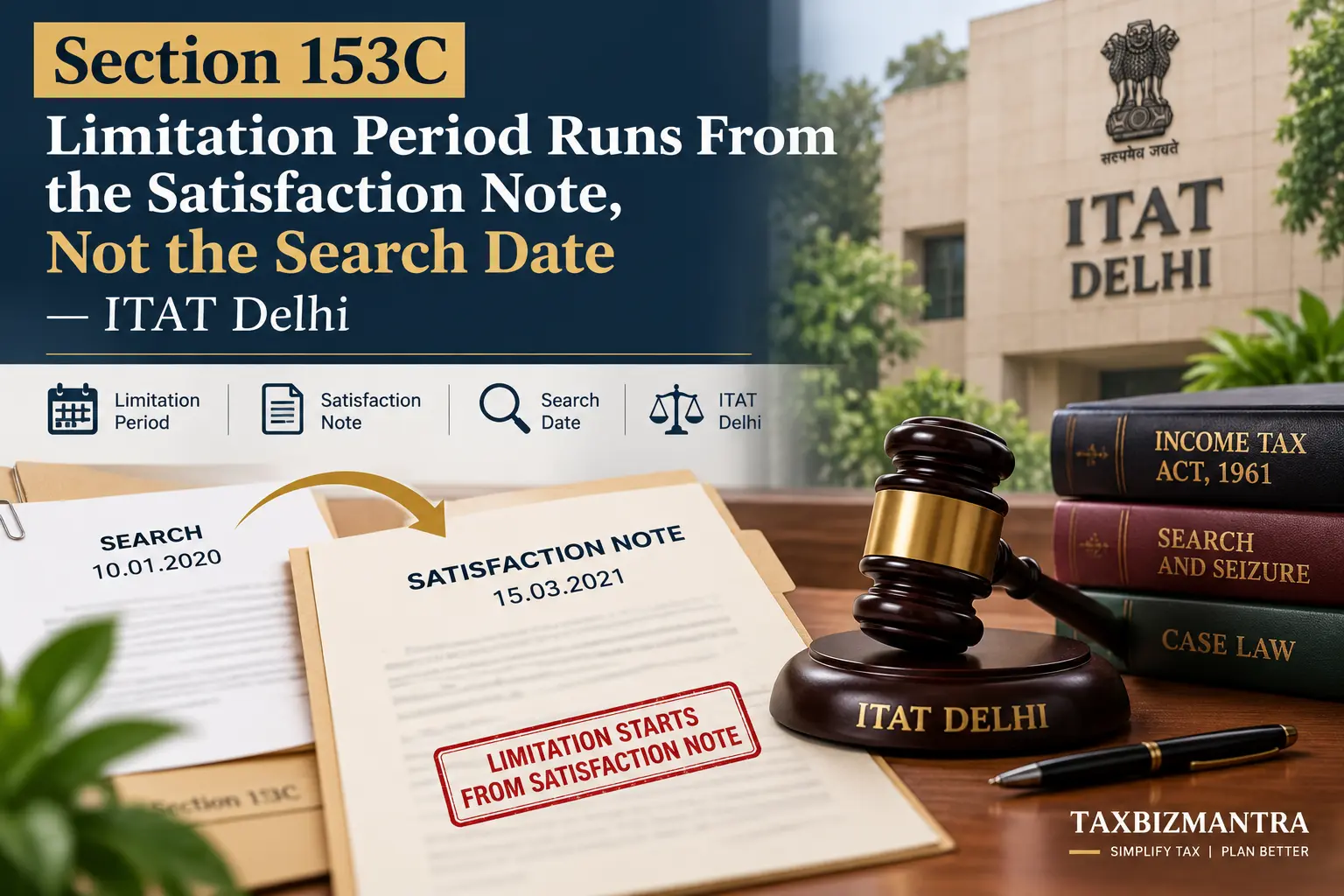
A search in 2017 eventually led to a Rs.12.62 crore addition against a Delhi trading firm — but the notice that actually started the assessment wasn’t issued until August 2021, nearly four years later. ITAT Delhi has now ruled that two of the assessment years the department reached back into, 2012-13 and 2013-14, were legally out of bounds by the time that notice was issued. The Section 153C limitation period for a person other than the one searched doesn’t run from the original search date — it runs from when that person’s own Assessing Officer actually received the seized material and recorded satisfaction. Get that date wrong, and years of assessment work can be quashed on a pure technicality, exactly as happened here.
Quick Answer
From which date is the Section 153C limitation period calculated for a person other than the one searched?ITAT Delhi has confirmed that for a person other than the one actually searched, the six-year (or extended ten-year) Section 153C block period is computed from the date that person’s own Assessing Officer receives the seized material and records satisfaction — not from the date of the original search. Here, that satisfaction was recorded on 10 August 2021, which fell in AY 2022-23, making AY 2012-13 and AY 2013-14 fall entirely outside the permissible six-year window.
Case Snapshot
| Case Name | Blue Water Enterprises v. Deputy Commissioner of Income Tax, Central Circle 16, Delhi |
| Citation | ITA Nos. 829 & 830/Del/2026 |
| Court / Bench | Income Tax Appellate Tribunal, Delhi “A” Bench, New Delhi |
| Coram | Shri Raj Kumar Chauhan (Judicial Member) & Shri Manish Agarwal (Accountant Member) |
| Assessment Years | 2012-13 & 2013-14 |
| Date of Hearing | 19 May 2026 (conclusion of hearing) |
| Date of Order | 7 August 2026 |
| Key Issue | Whether Section 153C proceedings against a person other than the one searched are time-barred when the six-year block period is computed from the searched person’s original search date rather than the other person’s own satisfaction-note date |
| Outcome | Both appeals allowed — Section 153C notices for AY 2012-13 and 2013-14 quashed as time-barred; underlying additions left unadjudicated |
Table of Contents
Legal Issue: Section 153C Limitation Period Computation for a Non-Searched Person
Section 153C of the Income Tax Act, 1961 allows the tax department to assess a person other than the one actually searched, where material seized during a search is found to belong or relate to that other person. Under the first proviso to Section 153C(1), the reference to the “date of search” for computing the standard six-year (or, in limited circumstances, extended ten-year) block period is deemed to be the date on which the seized material is received by the Assessing Officer having jurisdiction over that other person — not the date of the original search itself. The dispute here was whether that principle placed Assessment Years 2012-13 and 2013-14 outside the permissible block period, given that the assessee’s own Assessing Officer did not record satisfaction and receive the seized material until 10 August 2021 — nearly four years after the original search.
Facts of the Case
A search and seizure action under Section 132 was conducted in the case of the Rakesh Jain Group on 2 November 2017, covering Shri Prahlad Kumar Aggarwal. During assessment proceedings in Shri Aggarwal’s case, documents relating to Blue Water Enterprises — a person other than the one searched — were found. The Assessing Officer of the searched person recorded satisfaction and handed over the seized material to the Assessing Officer of Blue Water Enterprises on 10 August 2021. The assessee’s own Assessing Officer then recorded a separate satisfaction note, also dated 10 August 2021, initiating proceedings under Section 153C for AYs 2012-13 to 2018-19. The satisfaction note recorded that seized documents showed cash payments totalling Rs.12,62,00,000 made to a related entity for the purchase of shops from M/s Celebration City Private Limited (in the Red Mall project, Ghaziabad), and the AO treated the source of this cash as unexplained, making an addition under Section 69A.
The assessee appealed to the CIT(A). In the AY 2012-13 matter, the CIT(A) dismissed the appeal ex-parte by order dated 16 June 2025, holding that the assessee company had failed to respond despite 11 opportunities being given — a finding the parties agreed applied identically to the AY 2013-14 appeal. The assessee attributed the lack of response to the ill-health of its Director, who had suffered a heart attack in 2019.
The appeal before the Tribunal was itself filed late, and the order records inconsistent figures for exactly how late: the Bench’s own introductory observation states the delay was 88 days, the assessee’s condonation application (reproduced in full in the order) states the delay was 169 days, and the Tribunal’s final operative finding condoning the delay refers to “59 days.” The application attributed the delay to the appellant being a 72-year-old senior citizen unfamiliar with the e-filing portal, the CIT(A)’s order never having been physically served, and the assessee’s professional only discovering the order in August 2025 while filing a return. The Tribunal condoned the delay, holding that the explanation did not “smack of mala fide” and was not part of a “dilatory strategy.”
On merits, the assessee’s central ground of appeal was that the Section 153C notices for AY 2012-13 and 2013-14 were issued beyond the permissible limitation period.
Arguments of the Parties
For the Assessee (AR: Sh. P.C. Yadav & Sh. R.K. Vashishth, Advocates)
- The satisfaction note for initiating proceedings in the assessee’s own case was recorded on 10 August 2021, which falls within AY 2022-23 — making AY 2022-23 the effective “search year” for limitation purposes as regards the assessee.
- Counting the six preceding assessment years from AY 2022-23 gives a block period running from AY 2016-17 to AY 2021-22; AY 2012-13 and AY 2013-14 fall entirely outside this window.
- Relied on the jurisdictional Delhi High Court’s ruling in PCIT v. Ojjus Medicare Pvt. Ltd. [2024] 161 taxmann.com 160, along with various coordinate-bench Tribunal decisions, in support of excluding AY 2012-13 and 2013-14 from the Section 153C limitation period.
For the Revenue (DR: Sh. Jitender Singh, CIT DR)
- Submitted that the limitation period should be reckoned from the date of the original search itself, not from the date of the satisfaction note.
- In the alternative, argued that even if the satisfaction-note date were treated as the relevant date, the extended ten-year period under the 4th proviso to Section 153A(1) would apply, and both assessment years fell within that extended ten-year window.
Court/Tribunal’s Decision
The Tribunal allowed both appeals. It held that the Section 153C notices issued for AY 2012-13 and AY 2013-14 were beyond the period of limitation and therefore invalid, and quashed the consequent assessment orders. Having allowed the appeals on this pure limitation ground, the Tribunal did not go on to adjudicate the assessee’s remaining grounds — including the challenge to the Section 69A additions themselves — treating them as academic.
Reasoning Behind the Decision
The Tribunal held that, following the Supreme Court’s ruling in Jasjit Singh [2025] 173 taxmann.com 575 (SC) and the jurisdictional Delhi High Court’s ruling in PCIT v. Ojjus Medicare Pvt. Ltd., the relevant date for computing the Section 153C block period in the case of a non-searched person is the date on which the seized material and satisfaction note were received by that person’s own Assessing Officer — here, 10 August 2021, falling within AY 2022-23. Counting six years back from that point placed the permissible block at AY 2016-17 to AY 2021-22, with AY 2022-23 as the year of search. AY 2012-13 and AY 2013-14 fell outside this window entirely. The Bench noted this position had been further affirmed by the Delhi High Court in PCIT v. Annex Infrarealty Pvt. Ltd. (ITA No.386/2025, dated 28 July 2026).
On the Revenue’s alternative argument for the extended ten-year period, the Tribunal held that invoking that extended period requires the Assessing Officer to record a specific satisfaction, under the 4th proviso to Section 153A(1), that the escaped income is likely to be Rs.50 lakh or more for the relevant assessment year or years. No such specific satisfaction had been recorded in this case — the satisfaction note only covered the standard six-year block, AY 2012-13 to AY 2018-19, with no separate finding extending the period to ten years. In the absence of that specific satisfaction, the Tribunal held the Revenue’s extended-period argument had no merit, and confirmed that the notices were time-barred under the standard six-year computation.
Key Legal Principle
For a person other than the one actually searched, the Section 153C limitation period is computed from the date that person’s own Assessing Officer receives the seized material and records satisfaction — not from the date of the original search. Separately, invoking the extended ten-year block period under the 4th proviso to Section 153A(1) requires the Assessing Officer to record a specific satisfaction that escaped income is likely to be Rs.50 lakh or more for the relevant year; a general satisfaction note covering only the standard six-year block cannot be stretched to justify the extended period after the fact.

Practical Implications for Practitioners
- Always check the satisfaction-note date first in a Section 153C matter: The relevant limitation trigger for a non-searched person is the date material was received by their own AO, which can fall years after the original search — and can place assessment years the department is reaching for entirely outside the permissible block.
- Scrutinise whether the extended ten-year period was validly invoked: A Rs.50-lakh-or-more escaped-income satisfaction, specific to the relevant year(s), must actually be recorded in the satisfaction note itself — it cannot be inferred or argued for after the fact if the note is silent on it.
- A pure limitation ground can dispose of a case without reaching the merits: Here, a Rs.12.62 crore addition was never actually tested on its evidentiary merits (dumb documents, third-party statements without cross-examination, alleged double addition) because the limitation ground succeeded first — a reminder to raise jurisdictional/limitation challenges early and squarely.
- Internal inconsistencies in an order are worth flagging, not ignoring: This order itself states three different figures for the same delay in filing (88, 169, and 59 days) — a reminder to read condonation applications and operative findings carefully rather than assuming later paragraphs of an order are fully consistent with earlier ones.
Related Judgments and Limitations
| Case | Forum | Relevance |
|---|---|---|
| Jasjit Singh v. [Revenue] [2025] 173 taxmann.com 575 | Supreme Court | Directly relied on — confirms the satisfaction-note date, not the original search date, governs the Section 153C block period for a non-searched person |
| PCIT v. Ojjus Medicare Pvt. Ltd. [2024] 161 taxmann.com 160 | Delhi High Court (jurisdictional) | Directly relied on — same principle; also addresses the specific Rs.50-lakh satisfaction required for the extended ten-year period |
| PCIT v. Annex Infrarealty Pvt. Ltd. (ITA No.386/2025, dated 28.07.2026) | Delhi High Court (jurisdictional) | Cited as further, recent affirmation of the same limitation principle |
| Collector, Land Acquisition v. Mst. Katiji & Ors., 167 ITR 471 (SC) | Supreme Court | Relied on for condonation of the delay in filing the appeal itself — substantial justice preferred over technical considerations |

Frequently Asked Questions-Section 153C limitation period
For a person other than the one actually searched, the six-year block period is calculated from the date that person’s own Assessing Officer receives the seized material and records satisfaction — not from the date of the original search, which can fall years earlier.
Only if the Assessing Officer records a specific satisfaction, at the time of initiating proceedings, that the escaped income is likely to be Rs.50 lakh or more for the relevant assessment year(s). Without that specific recorded satisfaction, the extended ten-year period cannot be invoked, even if the amounts involved are large.
No. The appeals succeeded on the limitation ground alone, so the Tribunal never examined the merits of the underlying additions. The assessee’s other grounds — including challenges based on unreliable documents and lack of cross-examination — were left unadjudicated as academic.
No. That Supreme Court ruling specifically addresses accessible digital KYC for persons with disabilities. It does not establish a general principle that any taxpayer’s unfamiliarity with an e-filing portal excuses a delay, though it was cited in that broader sense in this assessee’s condonation application.
No. It is a Division Bench ruling of ITAT Delhi and is persuasive rather than binding elsewhere, though it follows a well-established line of Supreme Court and jurisdictional Delhi High Court authority on the same point.
Final Verdict
Based on the above facts and reasoning, both appeals were allowed. ITAT Delhi quashed the Section 153C notices and consequent assessment orders for AY 2012-13 and AY 2013-14 against Blue Water Enterprises, holding that the limitation period runs from the date the assessee’s own Assessing Officer received the seized material and recorded satisfaction — not from the date of the original search — and that both assessment years fell outside the permissible six-year window as a result.
Also Read
- Section 153C vs Section 153A: How the Limitation Period Differs for Searched and Non-Searched Persons
- The Extended Ten-Year Block Period Under Section 153A: When Can the Department Reach Back Further
- Condonation of Delay Before ITAT: What Counts as “Sufficient Cause”
- TDS On Trademark Purchase From A Non-Resident: ITAT Mumbai
Corresponding Provisions Under the Income-tax Act, 2025
This case was decided under the Income-tax Act, 1961, as it concerns Assessment Years 2012-13 and 2013-14. Under the Income-tax Act, 2025, Section 132 (search and seizure) corresponds to Section 247; Section 153A (assessment of the searched person, block assessment) corresponds to Section 294; and Section 153C (assessment of a person other than the one searched) corresponds to Section 295. Section 253 (appeal to the Appellate Tribunal) corresponds to Section 355, and Section 254(1) (orders of the Appellate Tribunal) corresponds to Section 363(1). These mappings were verified against multiple independent sources at the time of writing but should be re-checked against the enacted text before being relied on for tax years governed by the new Act.
Source Judgment: Blue Water Enterprises v. DCIT, Central Circle 16, Delhi, ITA Nos. 829 & 830/Del/2026, ITAT Delhi “A” Bench, order pronounced 7 August 2026. This order can be looked up on the official ITAT judicial search portal using the ITA numbers above.
Want the full order copy? Download it here.
Legal Disclaimer: This article is for general informational purposes only and analyses a specific Tribunal order under the Income Tax Act, 1961, as it applied to Assessment Years 2012-13 and 2013-14. It is not legal or tax advice, and it does not account for developments after the date of publication or for the specific facts of any reader’s case. Readers should verify the applicable current position — including the internal inconsistencies noted above in the source order regarding the delay in filing — and consult a qualified Chartered Accountant or tax professional before acting on this or any similar matter.