Five assessment years, one satisfaction note, and a single missing sentence undid all of it. The tax department had seized tally data from a search on a third party, tabulated specific cash amounts against a timber trader’s name across five financial years, and used that to reopen five of his assessments under Section 153C. The data looked damaging enough. But the satisfaction note never actually said the material would affect the determination of his total income — it only said the material belonged to him. That is the Section 153C bearing on total income test, and ITAT Delhi has now confirmed that failing it is fatal, however incriminating the underlying numbers appear.
Quick Answer
Is it enough for a satisfaction note under Section 153C to say that seized material “belongs to” or “pertains to” the assessee?No. ITAT Delhi, applying the Delhi High Court’s ruling in Saksham Commodities Ltd. v. ITO, has confirmed that the note must go further and separately record that the material is likely to have “a bearing on the determination of the total income” of the assessee for the specific assessment year(s) in question. A note that only asserts the material belongs to or pertains to the assessee — without this further recorded link to income determination — is invalid, and the defect vitiates the entire assumption of jurisdiction.
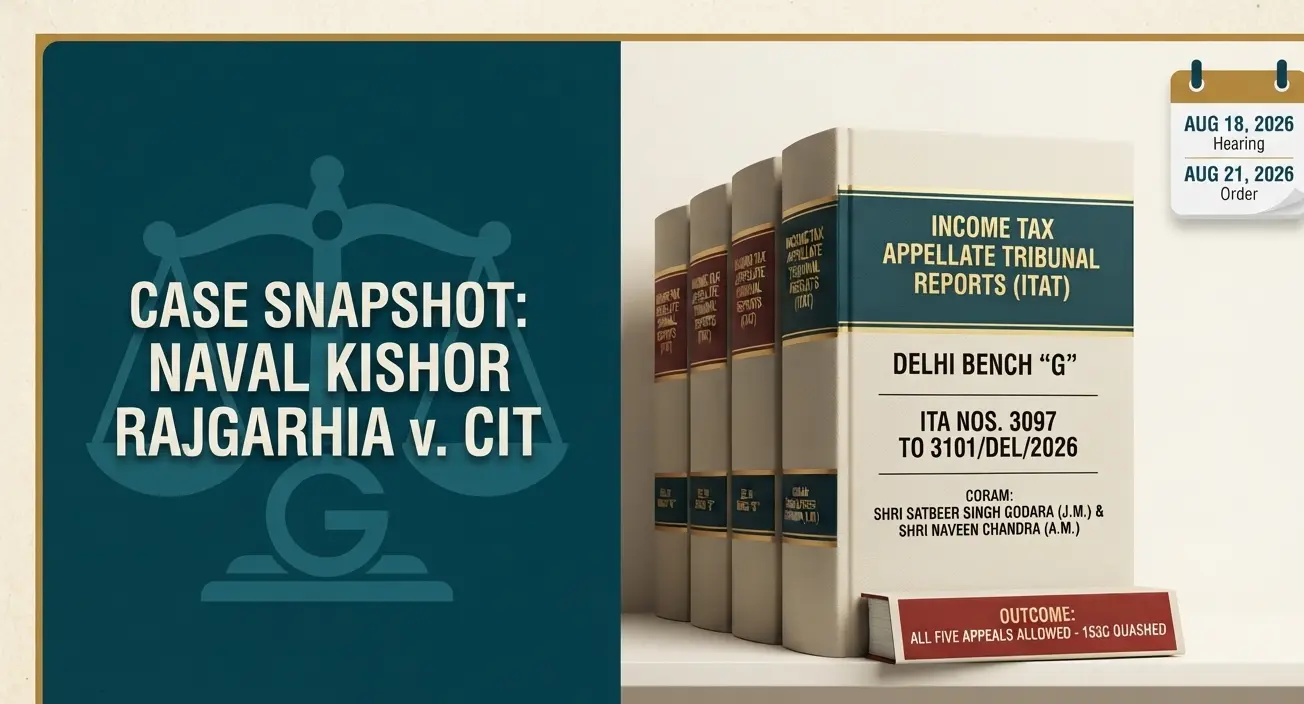
Case Snapshot
| Case Name | Naval Kishor Rajgarhia v. Assistant Commissioner of Income Tax, Central Circle-32, Delhi |
| Citation | ITA Nos. 3097 to 3101/Del/2026 |
| Court / Bench | Income Tax Appellate Tribunal, Delhi Bench “G”, New Delhi |
| Coram | Shri Satbeer Singh Godara (Judicial Member) & Shri Naveen Chandra (Accountant Member) |
| Assessment Years | 2014-15, 2015-16, 2016-17, 2018-19 & 2019-20 |
| Date of Hearing | 18 August 2026 |
| Date of Order | Pronounced 18 August 2026; order dated 21 August 2026 |
| Key Issue | Whether a satisfaction note under Section 153C that identifies seized material as belonging to the assessee, without explaining how it bears on the determination of total income, is sufficient to validly assume jurisdiction |
| Outcome | All five appeals allowed — Section 153C notices and assessment orders quashed for all five years |
Table of Contents
Legal Issue: The Section 153C Bearing on Total Income Test
Section 153C permits assessment of a person other than the one actually searched where seized material is found to belong, pertain, or relate to that other person. But the jurisdictional Delhi High Court has read a further requirement into the provision: the Assessing Officer must separately be satisfied — and record that satisfaction — that the material is likely to have “a bearing on the determination of the total income” of that other person for the relevant assessment year(s). The dispute here was whether a satisfaction note that only records that seized material belongs to the assessee, without any further recorded link to income determination for the specific years in question, meets this statutory threshold.
Facts of the Case
The assessee, a proprietor trading in timber under the name “M/s Rama Krishna Timber” and also engaged in commodity speculation, filed his original return for AY 2014-15 on 30 June 2014, declaring income of Rs.4,30,980. A search under Section 132(1) was carried out on the Alankit Group — a third party — on 18 October 2019, during which documents in the form of tally data were seized and statements of various persons were recorded. The assessee first received a notice dated 28 June 2021 under the pre-2021 (un-amended) version of Section 148, and filed a return in response on 1 July 2021, reaffirming the same income of Rs.4,30,980.
The assessee was then issued a notice under Section 153C dated 10 November 2022, based on a satisfaction note of the same date recorded by the Assessing Officer of the assessee as the non-searched person. Assessment orders dated 31 March 2024 were passed under Section 153C for AY 2014-15, 2015-16, 2016-17, 2018-19 and 2019-20. For the lead year, AY 2014-15, the AO added Rs.9,45,000 under Section 69A (treating an alleged cash receipt as an accommodation entry) and Rs.28,350 under Section 69C (an alleged 3% commission on that entry), assessing total income at Rs.14,04,330. The order records that the grounds for the other four years are identical except for the figures. (The order’s grounds of appeal state the originally returned income as Rs.3,40,930, while the facts narrative twice states it as Rs.4,30,980 — the same digits in different order; this appears to be a drafting transposition rather than a substantive dispute, and is flagged in the Limitations section below.) The CIT(A), Delhi-25 upheld the AO’s order in full by order dated 20 January 2026.
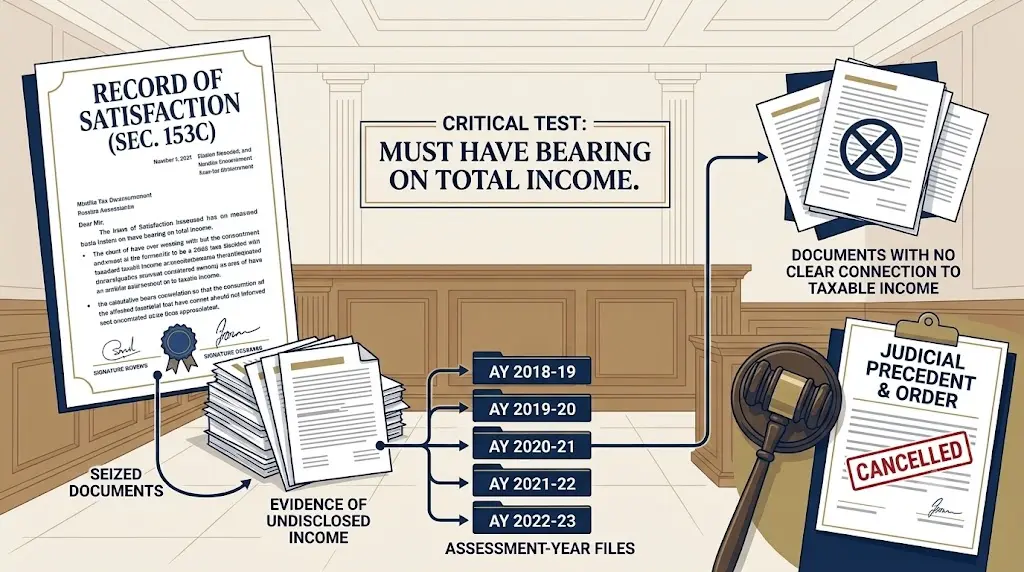
Before the Tribunal, the assessee’s counsel challenged the validity of the satisfaction note itself. The Tribunal reproduced the note dated 10 November 2022 in full. Signed by the Income-tax Officer, Ward-1, Churu, it recorded that ledgers obtained from the laptop of one Sh. Sunil Kumar Gupta, seized from his residence, tabulated unaccounted cash received from and paid to Sh. Alok K. Agarwal against the assessee’s name for FY 2013-14, 2014-15, 2015-16, 2017-18 and 2018-19 (the Rs.9,45,000 figure is the FY 2013-14 entry). It concluded only that the documents “belonging to” the assessee showed the case “belongs to a person other than person searched”, and that this was therefore “a fit case” to initiate Section 153C proceedings for AY 2014-15 to 2020-21.
Arguments of the Parties
For the Assessee (AR: Sh. Gaurav Jain, Adv. & Sh. Tarun Chanana, Adv.)
- The satisfaction note fails to record that the seized material has a bearing on the determination of the assessee’s total income, as mandated by Section 153C.
- The fourteen grounds of appeal also raised (though the order records argument only on the satisfaction note): that the proceedings were time-barred; that a Section 148 notice had already been issued on the same issue, making the later Section 153C initiation an impermissible assumption of jurisdiction; that the Section 153D approval was mechanical; that no incriminating material justified disturbing completed assessments; that the CIT(A) wrongly directed the AO under Section 150(1) to explore remedial action if the assessments failed; and the merits of the Section 69A and 69C additions.
For the Revenue (DR: Sh. Rajesh Chandra, CIT-DR)
- Relied on the orders of the Assessing Officer and the CIT(A).
Court/Tribunal’s Decision
The Tribunal allowed all five appeals, holding the satisfaction note invalid and quashing the Section 153C notices and consequent assessment orders for every assessment year under appeal — AY 2014-15, 2015-16, 2016-17, 2018-19 and 2019-20.
Reasoning Behind the Decision
Examining the satisfaction note on its own terms, the Tribunal found that the Assessing Officer had recorded only that the seized material “belongs to” the assessee and that this made it “a fit case” for Section 153C proceedings — but had not recorded, as a separate and distinct finding, that this material would have a bearing on the determination of the assessee’s total income, as the provision requires.
Applying the Delhi High Court’s ruling in Saksham Commodities Ltd. v. ITO (2024) 464 ITR 1 / 338 CTR 418 / 161 taxmann.com 485 (Delhi), the Tribunal held that Section 153C jurisdiction is not triggered merely because material concerning the assessee was found during a search. The Assessing Officer must go further and form — and record — an opinion that the material is likely to impact the determination of total income for the particular assessment year(s) being proceeded against; the mere existence of jurisdiction-conferring facts under Section 153C does not by itself justify initiating proceedings for every year within the eligible block. Since the note here did not meet this threshold, the Tribunal held it invalid, holding that this defect vitiated the entire assumption of jurisdiction, and quashed the notices and orders for all five years accordingly.
Key Legal Principle
A satisfaction note under Section 153C must do more than identify that seized material belongs to or pertains to a person other than the one searched. The Assessing Officer must separately record a satisfaction that the material is likely to have a bearing on the determination of that person’s total income for the specific assessment year(s) being proceeded against. A note that stops at “belongs to” — without this further recorded link to income determination — is invalid and vitiates the entire proceeding, regardless of how detailed or seemingly incriminating the underlying seized data appears to be.
Practical Implications for Practitioners
- Always obtain and scrutinise the actual text of the satisfaction note itself: The defect here was in what the Assessing Officer failed to say, not in what the underlying seized data showed — this is a defence built entirely on the note’s own wording.
- A note that merely tabulates figures against the assessee’s name is not enough: Even specific, year-wise cash amounts recorded in a satisfaction note cannot substitute for the AO’s own recorded conclusion that the material bears on income determination.
- This is a pure, threshold, jurisdictional challenge: It can succeed without disputing the underlying factual allegations at all — here, the accommodation-entry allegations were never substantively tested, because the proceeding was quashed before reaching that stage.
- Check the satisfaction-note date as well as its wording: Here the search was in October 2019 but the note was recorded in November 2022. Where a note postdates 1 April 2021, consider whether the Section 153C(3) sunset clause and the six-year block, both read from the deemed search date, give you further jurisdictional grounds. Neither was decided in this case.
- Expect the Revenue to look for another route: The CIT(A) had already directed the AO under Section 150(1) to explore remedial action if these assessments did not survive, and a separate Section 148 notice had been issued in June 2021. Winning on the satisfaction note may not be the last word on these additions.
- Don’t treat this order as deciding anything beyond the satisfaction-note point: The assessee’s other grounds — including the dual Section 148/153C initiation argument, the Section 153D approval challenge, and the merits of the Rs.9,45,000 and Rs.28,350 additions — were never examined, since the appeal succeeded entirely on the narrower ground.
Related Judgments and Limitations
| Case | Forum | Relevance |
|---|---|---|
| Saksham Commodities Ltd. v. ITO, (2024) 464 ITR 1 / 338 CTR 418 / 161 taxmann.com 485 (Delhi) | Delhi High Court (jurisdictional) | Sole and directly relied-on authority — establishes that a satisfaction note under Section 153C must separately record a bearing on the determination of total income, not merely that material belongs to or pertains to the assessee |
| ACIT v. Neelkanth Steel and Alloys, (2025) 306 Taxman 100 (SC) | Supreme Court | Not cited in this order, but the Revenue’s SLP applying the same Saksham Commodities principle in a connected matter was dismissed, strengthening (though not conclusively affirming on merits) the underlying line of authority |
Frequently Asked Questions
No. Per this ruling, applying the Delhi High Court’s decision in Saksham Commodities Ltd., the Assessing Officer must go further and separately record that the material is likely to have “a bearing on the determination of the total income” of the assessee for the specific year(s) being proceeded against. A note that stops at “belongs to” is invalid.
No. This is a threshold, jurisdictional challenge to the satisfaction note’s own wording — it can succeed even without examining whether the underlying allegations, such as accommodation entries, are factually true.
No. The assessee raised this as a ground, but since the appeal succeeded entirely on the satisfaction-note-validity point, this and several other grounds were never examined or decided.
Possibly not in the same form. Section 295 of the new Act, the successor to Section 153C, uses the “belongs to or pertains to or relates to” language without Section 153C’s specific “bearing on total income” requirement that this entire line of cases is built on.
The Tribunal ruling itself is persuasive rather than binding elsewhere, but it applies the Delhi High Court’s binding decision in Saksham Commodities Ltd., which is jurisdictional law within Delhi and has already survived a Supreme Court SLP dismissal in a connected matter.
Final Verdict
Based on the above facts and reasoning, all five appeals were allowed. ITAT Delhi quashed the Section 153C notices and assessment orders for AY 2014-15, 2015-16, 2016-17, 2018-19 and 2019-20 against Naval Kishor Rajgarhia, holding that the satisfaction note recorded by the Assessing Officer failed to show how the seized material had a bearing on the determination of the assessee’s total income — as required under Section 153C and the Delhi High Court’s ruling in Saksham Commodities Ltd. v. ITO — rendering the entire assumption of jurisdiction invalid.
Also Read
- Section 153C Limitation Period Runs From the Satisfaction Note, Not the Search Date — ITAT Delhi Quashes Rs.12.62 Crore Additions
- Section 153C Proceedings After 1 April 2021 Are Void — ITAT Delhi Follows Madras HC’s Harigovind Ruling
- What Must a Valid Section 153C Satisfaction Note Actually Say? A Practitioner’s Checklist
Corresponding Provisions Under the Income-tax Act, 2025
This case was decided under the Income-tax Act, 1961, as it concerns Assessment Years 2014-15 through 2019-20. Under the Income-tax Act, 2025, Section 153C corresponds to Section 295. However, the published text of Section 295(1) uses the trigger language “belongs to or pertains to or relates to any person” — the same formula as Section 158BD of the 1961 Act, as substituted with effect from 1 September 2024 — and does not appear to carry forward Section 153C’s specific requirement that the material have “a bearing on the determination of the total income” of that person, which is the textual foundation of the Saksham Commodities line of cases this article discusses. Whether courts will read a similar requirement into Section 295 by interpretation remains an open question at the time of writing, and this should be treated as an important point to track rather than a settled position, for tax years governed by the new Act.
Source Judgment: Naval Kishor Rajgarhia v. ACIT, Central Circle-32, Delhi, ITA Nos. 3097 to 3101/Del/2026, ITAT Delhi “G” Bench, order pronounced 18 August 2026. This order can be looked up on the official ITAT judicial search portal using the ITA numbers above.
Want the full order copy? Download it here.
Legal Disclaimer: This article is for general informational purposes only and analyses a specific Tribunal order under the Income Tax Act, 1961, as it applied to Assessment Years 2014-15 through 2019-20. It is not legal or tax advice, and it does not account for developments after the date of publication or for the specific facts of any reader’s case. Several grounds raised by the assessee in this matter were never argued or decided, as noted above. Readers should verify the applicable current position and consult a qualified Chartered Accountant or tax professional before acting on this or any similar matter.