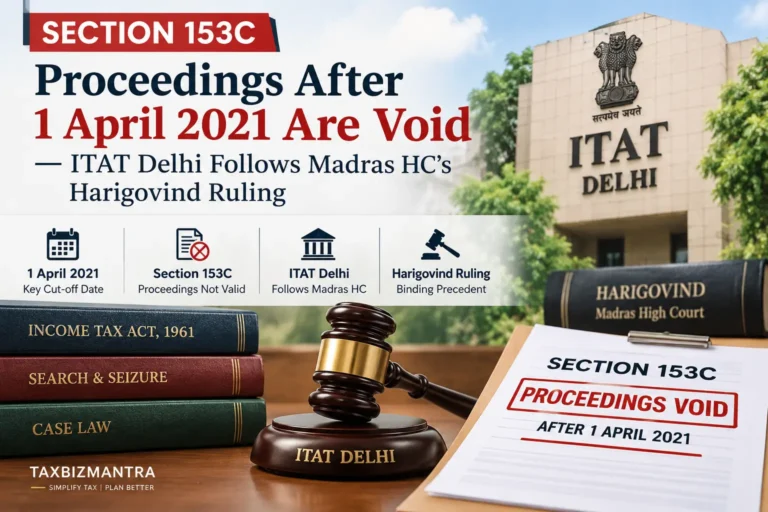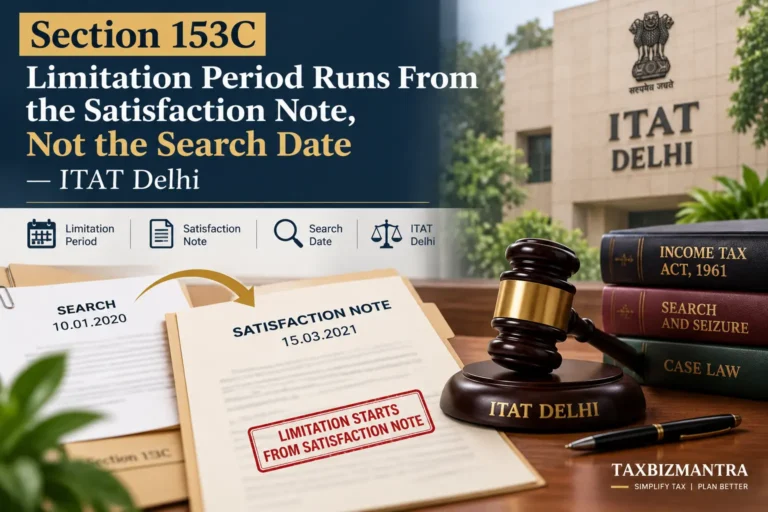

The department had WhatsApp chats, photographed “hisab parchis” and draft agreements pointing to more than Rs.35 crore of cash investments in property — and it still lost all three years. ITAT Delhi did not reach the evidence at all. It held that the Assessing Officer’s single, consolidated satisfaction note under Section 153C covering seven assessment years was invalid, that the note had been recorded 17 months too late, and that Section 153C could not apply in any case because the assessee’s deemed search date fell after 1 April 2021. Any one of those defects was enough to quash the assessments.
Quick Answer
Can one satisfaction note cover several assessment years for Section 153C proceedings?No. ITAT Delhi held that a satisfaction note must be recorded separately for each assessment year, and that a consolidated satisfaction note under Section 153C covering several years vitiates the assumption of jurisdiction. It followed the Karnataka High Court in DCIT v. Sunil Kumar Sharma (Revenue’s SLP dismissed by the Supreme Court) and the Delhi High Court in Saksham Commodities. The Tribunal also held the note invalid because it was recorded 17 months after the searched person’s assessment was completed, contrary to Calcutta Knitwears and CBDT Circular No. 24/2015.
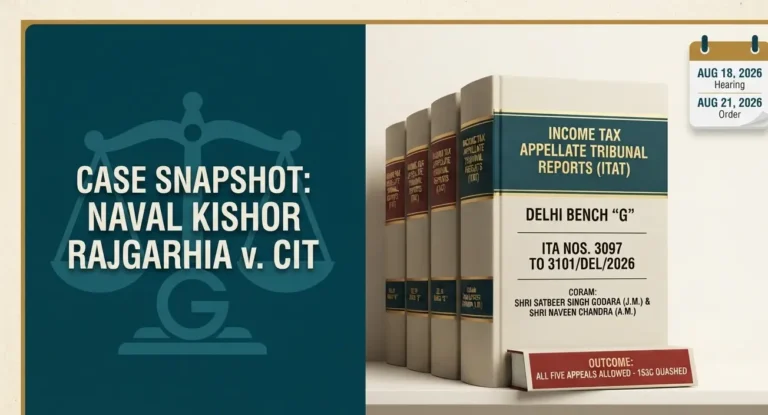
Case Snapshot
| Case Name | Shikhar Kailash Infratech Limited Liability Partnership v. DCIT, Central Circle, Meerut (ITAT Delhi, 2026) |
| Citation | ITA Nos. 6943, 6944 & 6945/Del/2025 |
| Court / Bench | Income Tax Appellate Tribunal, Delhi Bench “B”, New Delhi |
| Coram | Shri M. Balaganesh (Accountant Member) & Shri Sudhir Kumar (Judicial Member); order authored by Shri M. Balaganesh |
| Assessment Years | 2019-20, 2020-21 & 2021-22 (AY 2020-21 taken as the lead case) |
| Date of Hearing | 12 August 2026 |
| Date of Order | 15 October 2026 |
| Key Issue | Whether Section 153C jurisdiction survives a single satisfaction note covering seven assessment years, recorded 17 months after the searched person’s assessment and after 1 April 2021 |
| Outcome | Section 153C assessments for all three years quashed as void ab initio; appeals partly allowed (some grounds not pressed, merits left open) |
Table of Contents
Legal Issue: Is a Consolidated Satisfaction Note Under Section 153C Valid?
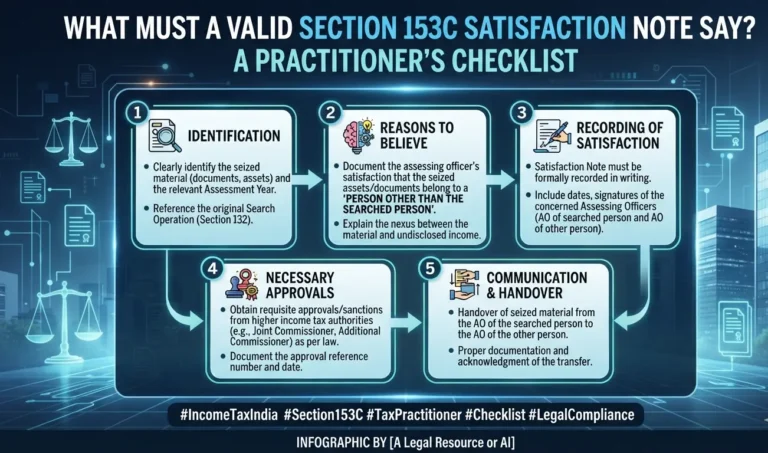
Section 153C lets the department assess a person other than the one searched, once the Assessing Officer is satisfied that seized material belongs or relates to that person and has a bearing on their total income. Because the provision reaches back over a block of years, the satisfaction note is the gateway to every assessment that follows. This appeal raised three questions about that gateway. Can one note cover several assessment years together? How long after the search, and after the searched person’s assessment, can the note be recorded? And does Section 153C apply at all where the search took place before 1 April 2021 but the note was recorded after that date?
Facts of the Case
A search under Section 132 was carried out on 6 January 2021 on Shri Praveen Jain, one of the searched persons of the Hans Group. Cloned data from his mobile phone included WhatsApp chats, images of “hisab parchis” and draft agreements which the department linked to the assessee, a Meerut-based LLP. The searched person’s assessment was completed on 31 March 2022, and the Assessing Officer of the searched person recorded satisfaction on 23 August 2022.
On 1 September 2023, the Assessing Officer of the assessee (DCIT, Central Circle, Meerut) recorded a single satisfaction note covering AY 2015-16 to 2021-22. The note recorded that the digital data belonged to the assessee, alleged unexplained cash investments of Rs.20 crore with interest at 6.65% and of Rs.15.25 crore with interest of Rs.84 lakh, and concluded that the material “has bearing upon the determination of total income” and that it was “a fit case for action u/s 153C” for all seven years together.
A Section 153C notice followed on 26 December 2023. For AY 2020-21, the assessee filed a return declaring Rs.41,41,190 — the same as its original return of 9 October 2020 — and denied making any investment in immovable property, asking for the documents relied on. The AO then issued a show-cause notice enclosing the hisab parchis and made the following additions in the Section 153C assessments:
| Addition | AY 2019-20 | AY 2020-21 | AY 2021-22 |
|---|---|---|---|
| Cash investment in Dwarka Unity | Rs.20,00,00,000 | — | — |
| Interest @ 6.65% on Dwarka Unity | Rs.1,19,16,667 | Rs.1,33,00,000 | Rs.66,50,000 |
| Cash investment in Gulshan Homes | — | Rs.15,25,00,000 | — |
| Interest @ Rs.7 lakh per month | — | Rs.84,00,000 | — |
Together these additions come to about Rs.39.28 crore across the three years. The CIT(A)-3, Noida upheld the assessments by order dated 15 September 2025, and the assessee appealed to the Tribunal.
Arguments of the Parties
For the Assessee (Sh. Rohit Kapoor, Adv.; Sh. Vir Sain Aggarwal, Adv.; Sh. Ayush Garg, CA)
- A single satisfaction note for AY 2015-16 to 2021-22 is not a valid basis for Section 153C jurisdiction; satisfaction must be recorded for each assessment year.
- By additional grounds, admitted as purely legal: the note was recorded 17 months after the searched person’s assessment was completed and 32 months after the search, contrary to Calcutta Knitwears and CBDT Circular No. 24/2015.
- By further additional grounds: the assessee’s deemed search date is the date of its satisfaction note (1 September 2023, falling in AY 2024-25). Since that is after 1 April 2021, Section 153C(3) excludes the provision and only the reassessment route under Sections 147 to 151 was available.
- On merits, the assessee denied making any investment in immovable property.
For the Revenue (Ms. Sugandha Sharma, CIT-DR)
- The Revenue defended the assumption of jurisdiction and the assessments upheld by the CIT(A). The order does not record any separate submission by the DR on the three legal grounds.
Court/Tribunal’s Decision
The Tribunal decided the jurisdictional challenge first, as a pure question of law, and held:
(i) That satisfaction under Section 153C must be recorded separately for each assessment year, and since the Assessing Officer recorded a single consolidated note for assessment years 2015-16 to 2021-22, jurisdiction was invalidly assumed. [Para 9 of the order]
(ii) That the satisfaction note, recorded seventeen months after the searched person’s assessment was completed, was belated and contrary to Calcutta Knitwears and CBDT Circular No. 24/2015, and was therefore fatal to jurisdiction. [Para 11.5 of the order]
(iii) That, since the assessee’s deemed date of search fell after 1 April 2021, Section 153C stood excluded by Section 153C(3), and the proceedings under it were without authority. [Para 13 of the order]
(iv) That the assessments for assessment years 2019-20 to 2021-22 were accordingly void ab initio, and the merits of the additions, being academic, did not call for adjudication. [Paras 14 and 18 of the order]
The appeals were partly allowed.
Reasoning on All Three Grounds
Ground 1 — one note for seven years is fatal. It was undisputed that a single consolidated satisfaction note had been recorded for AY 2015-16 to 2021-22. The Tribunal relied on DCIT v. Sunil Kumar Sharma [2024] 159 taxmann.com 179 (Karnataka), which held that a satisfaction note must be recorded for each assessment year and that a consolidated note vitiates the entire assessment; the Revenue’s SLP against it was dismissed ([2024] 165 taxmann.com 846 (SC)). It also relied on the jurisdictional Delhi High Court in Saksham Commodities Ltd. v. ITO, which requires the AO to be satisfied that the material bears on the total income of each specific year, and noted that the Supreme Court dismissed the Revenue’s SLP in that case too (170 taxmann.com 87 (SC)). Since no individual note was recorded for each year, the assumption of jurisdiction was “totally flawed”.
Ground 2 — the note was recorded too late. Under CIT v. Calcutta Knitwears (362 ITR 673 (SC)) and CBDT Circular No. 24/2015, satisfaction about a third party may be recorded at the start of the searched person’s proceedings, during them, or immediately after they are completed. The Tribunal held that these principles, laid down for the old block-assessment provisions, apply equally to Section 153C. Here the note came 17 months after the searched person’s assessment (31 March 2022) and 32 months after the search — which cannot be called “immediately after”. Following the jurisdictional Delhi High Court in CIT v. Bharat Bhushan Jain (370 ITR 695 (Del)), which held that a delay of ten months to a year and a half is not contemporaneous, the Tribunal held the belated note fatal. It found the same view in Parag Rameshbhai Gathani v. ITO (Gujarat HC; 22-month delay, Covid and faceless-assessment explanations rejected, SLP dismissed), PCIT v. Jitendra H. Modi HUF (Gujarat HC; 9 months) and Clear Channel India P. Ltd. v. DCIT (Bombay HC; 15 months).
Ground 3 — Section 153C(3) bars the proceedings. Section 153C(3) provides that the section does not apply to a search initiated on or after 1 April 2021. Following the Madras High Court in Harigovind v. ACIT (485 ITR 509), which applied the Supreme Court’s reasoning in Jasjit Singh that the non-searched person’s date of search is the date the seized material is handed over to its Assessing Officer, the Tribunal accepted the assessee’s submission that its search fell in FY 2023-24 (AY 2024-25), the year in which its satisfaction note was recorded. The order does not record the exact handover date, but nothing turns on that: the material could only have been handed over after the searched person’s AO recorded satisfaction on 23 August 2022, which is itself well after 1 April 2021. Section 153C therefore could not be invoked, and the initiation of proceedings and the resulting assessments were quashed.
Key Legal Principle
Section 153C jurisdiction depends on a valid satisfaction note, and the note must meet three tests: it must be recorded separately for each assessment year, it must be recorded within a reasonable time — at the latest immediately after the searched person’s assessment is completed — and, on the Madras High Court’s reading followed here, Section 153C cannot apply at all where the non-searched person’s deemed date of search — when the seized material reaches its Assessing Officer — falls after 1 April 2021. Failure on any one test makes the entire search assessment void, however strong the seized material may appear.
Practical Implications for Practitioners
- Check how many years the note covers: If one note lists a range of years (“AY 2015-16 to 2021-22”), the Sunil Kumar Sharma and Saksham line gives you a jurisdictional challenge for every year in that range.
- Build a date chart before anything else: Search date, completion of the searched person’s assessment, the searched person’s AO’s satisfaction, your AO’s satisfaction, and the Section 153C notice. The gaps between those dates decide the delay ground.
- Measure delay from completion of the searched person’s assessment: Delhi HC has treated ten months to a year and a half as too late; other High Courts have struck down delays of 9, 15 and 22 months. Covid-era and faceless-scheme explanations did not save a 22-month delay in Gathani.
- Raise legal grounds even at the Tribunal stage: Both the delay and the Section 153C(3) objections were raised here as additional grounds and admitted because they were purely legal and the facts were on record.
- Remember the merits stay open: The Rs.39 crore of additions was never tested on evidence. A win on jurisdiction does not stop the department from exploring other routes where the law allows.

Related Judgments and Limitations
| Case | Forum | Relevance |
|---|---|---|
| DCIT v. Sunil Kumar Sharma, [2024] 159 taxmann.com 179 (Karnataka); SLP dismissed, 165 taxmann.com 846 (SC) | Karnataka High Court | A satisfaction note must be recorded for each assessment year; a consolidated note vitiates the assessment |
| Saksham Commodities Ltd. v. ITO, (2024) 464 ITR 1 / 161 taxmann.com 485 (Delhi); SLP dismissed, 170 taxmann.com 87 (SC) | Delhi High Court (jurisdictional) | Satisfaction must relate to the bearing of the material on each year’s total income |
| CIT v. Calcutta Knitwears, 362 ITR 673 (SC), with CBDT Circular No. 24/2015 | Supreme Court | Sets the three permissible stages for recording satisfaction about a third party |
| CIT v. Bharat Bhushan Jain, 370 ITR 695 (Del) | Delhi High Court (jurisdictional) | Delay of ten months to one and a half years is not contemporaneous; notice invalid |
| Parag Rameshbhai Gathani v. ITO, 180 taxmann.com 662 (Guj); SLP dismissed, 188 taxmann.com 1030 (SC) | Gujarat High Court | 22-month delay fatal; Covid and faceless-scheme explanations rejected |
| Clear Channel India P. Ltd. v. DCIT, 184 taxmann.com 434 (Bom) | Bombay High Court | 15-month delay after the searched person’s assessment fatal |
| Harigovind v. ACIT, 485 ITR 509 (Mad) | Madras High Court | Deemed search date for the non-searched person is the date the seized material is handed over to its AO; Section 153C(3) bars cases where that date falls on or after 1 April 2021 |
Frequently Asked Questions
Per this ruling, no. ITAT Delhi held that satisfaction must be recorded separately for each assessment year, following the Karnataka High Court in Sunil Kumar Sharma, where the Revenue’s SLP was dismissed. A single note covering several years vitiates the assumption of jurisdiction.
Under Calcutta Knitwears and CBDT Circular No. 24/2015, at the latest immediately after the searched person’s assessment is completed. Here a note recorded 17 months after that assessment was held to be belated and fatal to jurisdiction.
Following the Madras High Court in Harigovind, ITAT Delhi held that it does not, because the non-searched person’s search is deemed to begin when the seized material reaches its Assessing Officer, which here was after 1 April 2021. This point has not yet been decided by the Delhi High Court or the Supreme Court.
No. The Tribunal quashed the assessments on jurisdiction alone and treated the grounds on merits as academic. The allegations based on the WhatsApp chats and hisab parchis were never examined.
Yes. The delay and Section 153C(3) objections were raised here as additional grounds and admitted, because they were purely legal and the facts needed to decide them were already on record.
Final Verdict
Based on the above facts and reasoning, ITAT Delhi quashed the Section 153C assessments of Shikhar Kailash Infratech LLP for AY 2019-20, 2020-21 and 2021-22 as void ab initio. The single satisfaction note covering seven years, recorded 17 months after the searched person’s assessment, failed the tests laid down by the Karnataka, Delhi, Gujarat and Bombay High Courts and the Supreme Court in Calcutta Knitwears; and on the Madras High Court’s reading in Harigovind, Section 153C could not apply at all, because the assessee’s deemed date of search fell after 1 April 2021. In my view, the first two grounds are the ones practitioners can rely on most confidently; the third is a strong additional argument that still awaits a ruling from the Delhi High Court or the Supreme Court.
Also Read
- Naval Kishor Rajgarhia v. ACIT (ITAT Delhi, 2026) — Section 153C satisfaction note must show bearing on total income
- I Home and Infrastructure v. DCIT (ITAT Delhi, 2026) — Section 153C proceedings after 1 April 2021 are void
- Blue Water Enterprises v. DCIT (ITAT Delhi, 2026) — Section 153C limitation runs from the satisfaction note
- All Section 153C rulings on TaxBizMantra
Corresponding Provisions Under the Income-tax Act, 2025
This case was decided under the Income-tax Act, 1961, for Assessment Years 2019-20 to 2021-22. Under the Income-tax Act, 2025, Section 153C corresponds to Section 295, Section 132 (search and seizure) to Section 247, and Sections 147 and 148 (reassessment) to Sections 279 and 280. Section 295 is worded differently from Section 153C, so whether the per-year satisfaction and timing requirements discussed here carry over unchanged is a question to watch for searches governed by the new Act. For other section mappings, see our Income Tax Act 2025 vs 1961 mapping hub.
Source Judgment: Shikhar Kailash Infratech LLP v. DCIT, Central Circle, Meerut (ITAT Delhi, 2026), ITA Nos. 6943 to 6945/Del/2025, ITAT Delhi “B” Bench, order pronounced 15 October 2026. This order can be looked up on the official ITAT judicial search portal using the ITA numbers above.
Want the full order copy? Download it here.
Legal Disclaimer: This article is for general informational purposes only and analyses a specific Tribunal order under the Income-tax Act, 1961, as it applied to Assessment Years 2019-20 to 2021-22. It is not legal or tax advice, and it does not account for developments after the date of publication or for the specific facts of any reader’s case. The merits of the additions in this matter were not decided, as noted above. Readers should verify the applicable current position and consult a qualified Chartered Accountant or tax professional before acting on this or any similar matter.