An assessment can be thrown out without a single rupee of the addition being argued. All it takes is one badly written note that nobody read carefully when it was signed.
A Section 153C satisfaction note is the document that lets the Income Tax Department move from the person who was searched to a third person whose name turned up in the seized material. It is short, it is usually written in a hurry, and tribunals keep quashing assessments because of what it says, or fails to say. This checklist sets out what a valid note must contain, drawn from the Supreme Court and recent Delhi Tribunal rulings, and then explains what replaces Section 153C in the new law.
Applicability note: This article is written under the Income-tax Act, 1961, because Section 153C and the cases discussed here arise under it. Section 153C was available for searches before 1 April 2021. The Income-tax Act, 2025 has a different structure, covered in Section 05 below. For the section-by-section correspondence, use our old vs new Act mapping hub.
What Section 153C Does
When a search and seizure operation is carried out under Section 132, the officer assessing the searched person may find that some of the seized money, valuables, books or documents really concern someone else. Section 153C allows that material to be handed over to the Assessing Officer of that other person, who then proceeds against them in the same way as under Section 153A. The section is headed “Assessment of income of any other person”, and a Section 153C assessment stands or falls on the note that triggers it.
Two features matter for what follows. First, from the 2015 amendment, the material no longer has to belong to the other person: it is enough that it pertains to them, or that information in it relates to them. Second, for the other person the date of the search is treated as the date the seized material reaches their Assessing Officer. That one proviso is why the date on a satisfaction note can decide a whole case.
Searched Person
Assessed under Section 153A; their officer decides whether the material concerns someone else
Satisfaction Note
The written record that makes the handover, and the notice that follows, valid
Other Person
Receives the material and is assessed for the relevant years
The Section 153C Satisfaction Note Checklist
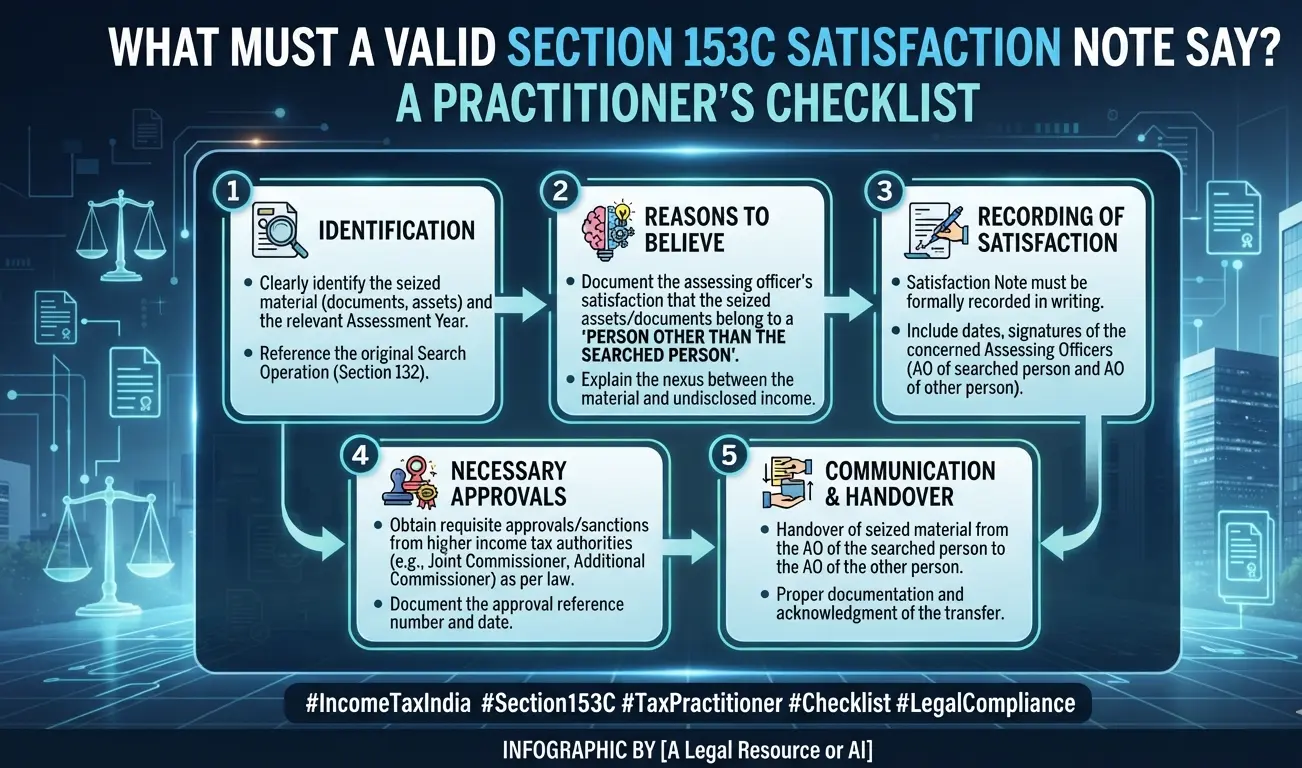
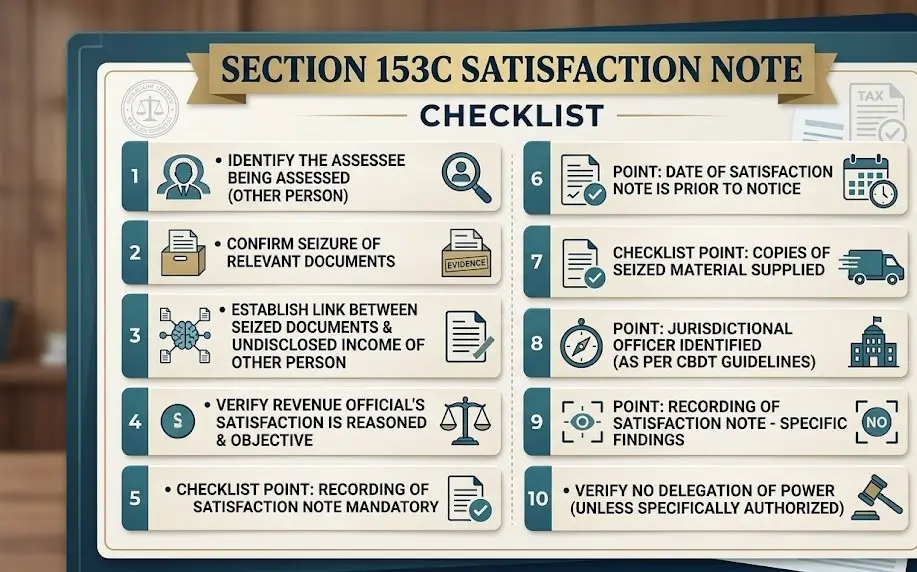
Use these eight tests, whether you are drafting a note, reviewing one in an assessment you are defending, or deciding whether to challenge one. They are drawn from the Supreme Court’s ruling in Super Malls and from the Tribunal decisions summarised in the next section.
- It is in writing and recorded by the right officer. Where the searched person and the other person have different Assessing Officers, the searched person’s officer records it and forwards it with the records. Where one officer handles both, one note can do.
- It identifies the seized material. The note should say what was seized, for example the annexure or panchnama item, so the material can be traced and tested later.
- It says the material belongs to, pertains to, or relates to the other person. For searches on or after 1 June 2015 the test is wider than ownership: the material can also pertain to the other person, or contain information that relates to them.
- It records that the material has a bearing on the other person’s total income. This is the point on which Naval Kishor Rajgarhia turned. A note that does not say so is exposed to being quashed.
- It is tied to the assessment years in question. The Delhi High Court’s Saksham Commodities line, as applied in later cases, expects material to be identified for the specific year it affects, not applied across six years by default.
- It rests on actual material, not surmise. The note should point to the material actually relied on. A conclusion with no material behind it is open to challenge.
- The other person’s Assessing Officer records their own satisfaction. Different officers means two satisfactions. The second should not be a bare copy of the first.
- It is dated, and the date holds up. The date can decide limitation, and it can decide whether Section 153C was available at all.
A search is carried out on a group company. The searched person’s Assessing Officer records that “documents seized at Annexure A-4 are found to pertain to Mr. Verma” and stops there. The note names the material and the person, but it does not say the documents have a bearing on Mr. Verma’s total income, and it does not tie them to particular assessment years. That is the gap on which notes have been quashed in the cases below.
Practical Steps Before You Rely on, or Challenge, a Note
- Get both notes. Where two Assessing Officers are involved, ask for the searched person’s note and the other person’s own note, and read them side by side.
- Build a date line. Write down the search date, the date of the note, the date the material reached the other person’s officer, and the date of the Section 153C notice. Limitation and the 1 April 2021 cut-off both turn on these dates.
- Match the material to the years. Check whether the material the note relies on actually relates to each assessment year in the notice.
- Raise it as a jurisdiction ground. In the cases below, the defect in the note was taken as a ground against the notice and the assessment, not only against the addition.
What the Courts and Tribunals Have Held
| Case | What it held on the satisfaction note |
|---|---|
| Super Malls (P.) Ltd. v. PCIT, (2020) 423 ITR 281 (SC) | Different Assessing Officers: the searched person’s officer records a note and forwards it with the records. Same officer: one note is enough, if it says the material belongs to the other person. |
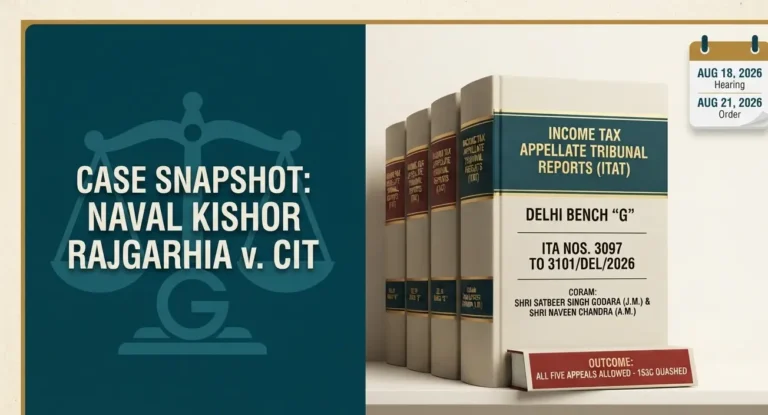
| Naval Kishor Rajgarhia v. ACIT, ITAT Delhi, 18 Aug 2026 (ITA 3097 to 3101/Del/2026) | A note dated 10 November 2022 did not record that the seized material had a bearing on total income. Held invalid; notice and assessment quashed. |
| Mukesh Chandra Agrawal v. DCIT, ITAT Delhi, 8 Dec 2025 (ITA 1787/Del/2025) | Satisfaction was improper because the note did not clarify whether the seized material had a bearing on the assessee’s total income. |
| Saksham Commodities Ltd. v. ITO, Delhi High Court | Action under Section 153C needs material likely to have a bearing on total income, identified for the year it affects. Applied by the Tribunal in Naval Kishor Rajgarhia. |
Earlier rulings point the same way. CIT v. Calcutta Knitwears, [2014] 43 taxmann.com 446 (SC), decided under the old Section 158BD, and Pepsi Foods (P.) Ltd. v. ACIT, [2014] 52 taxmann.com 220 (Delhi), treat a recorded satisfaction as a condition that must be met before the other person is proceeded against, not a formality to be completed afterwards. Because Calcutta Knitwears arose under Section 158BD, it is also the ruling most likely to be argued under Section 295 of the new Act.
- Saying the material “pertains to” the person but never saying it affects their income — the bearing-on-total-income point is what Naval Kishor Rajgarhia and Mukesh Chandra Agrawal turned on
- Treating one note as enough when two Assessing Officers are involved — Super Malls requires the searched person’s officer to record and forward a note
- Applying the material across all six years by default — the Saksham Commodities approach expects year-specific material
- Ignoring the date — a late note can make the whole Section 153C notice one the department had no power to issue
Why the Date of the Note Matters
Because the proviso treats the date of receipt of the material by the other person’s Assessing Officer as the search date, the six-year lookback and the 1 April 2021 cut-off both run from that date, not from the real search. The Supreme Court’s decision in CIT v. Jasjit Singh links the other person’s date to the handover in this way, and the Madras High Court in Harigovind v. ACIT has said Section 153C does not apply to a search initiated on or after 1 April 2021. Three Delhi Tribunal cases show how this plays out.
| Case | Facts and result |
|---|---|
| Blue Water Enterprises v. DCIT, ITAT Delhi (AY 2012-13, 2013-14) | Search on 2 November 2017; satisfaction recorded 10 August 2021, which falls in AY 2022-23. Six years back from that point excludes AY 2012-13 and 2013-14, so the notices were time-barred. |
| B.H. Trading Co. v. DCIT, ITAT Delhi, 14 Aug 2026 (AY 2020-21) | Search on 30 January 2020; satisfaction note on 4 February 2022. Because the relevant date for the other person fell after 1 April 2021, the Section 153C notice was held to be without jurisdiction. |
| Abhisar Estates Pvt. Ltd. v. DCIT, ITAT Delhi (AY 2017-18) | Search began 18 October 2019. With no record of when the material was received, the Tribunal treated the satisfaction date, 10 May 2022, as the relevant date. That fell after 1 April 2021, so the notice and assessment were held invalid. |
The ten-year reach-back has its own condition. In Blue Water Enterprises, the department’s attempt to go back ten years failed because the Assessing Officer had not recorded the specific satisfaction required by the fourth proviso to Section 153A(1) for escaped income of ₹50 lakh or more. So if a note is meant to support the ten-year period, it needs to say so expressly.
Notice that in two of these three cases the real search happened before 1 April 2021 and the assessee still won. The point is the date of the handover, and the note is often the only evidence of when that was. This is why a satisfaction note that is vague about dates is a problem for the department, not only for the taxpayer.
What Changed Under the Income-tax Act, 2025
The law on searching a person and then assessing someone else has been through three phases, and the 2025 Act continues the third.
| Search made | Regime |
|---|---|
| Before 1 April 2021 | Sections 153A to 153D of the 1961 Act; Section 153C for the other person |
| 1 April 2021 to 31 August 2024 | Search cases handled through the reassessment provisions in Sections 147 to 151A, after the Finance Act, 2021 changes |
| On or after 1 September 2024 | Block assessment revived by the Finance (No. 2) Act, 2024; Section 158BD for the other person |
| Under the Income-tax Act, 2025 | Sections 292 to 295: block assessment of undisclosed income; Section 295 for the other person |
The dates in the first column are the dates of the search. For a person assessed as an “other person”, the relevant date can be the later date on which the material reached their Assessing Officer, as Section 04 shows.
Section 295 of the Income-tax Act, 2025 is titled “Undisclosed income of any other person”. If the Assessing Officer is satisfied that undisclosed income relates to a person other than the one searched or requisitioned, the seized material goes to the Assessing Officer with jurisdiction over that other person, who proceeds against them under Section 294. For that other person, the abatement reference date becomes the date the material is received, which mirrors the proviso you have just read in Section 153C.
The Income Tax Department’s published text of Section 158BD of the 1961 Act lines up with Section 295 point by point: the satisfaction that the income belongs to, pertains to or relates to another person, the handover of material to that person’s Assessing Officer, the block period following that of the searched person, and the receipt date as the reference date for abatement. So Section 295 is the corresponding provision in substance, even though it does not carry forward Section 153C by number. Do not confuse it with Section 286, which our mapping tool pairs with old Section 153: Section 286 only sets time limits for completing assessments, reassessments and recomputations. The practical consequence is that the satisfaction-note case law from Section 153C is likely to be cited by analogy, but we have not found a reported ruling under Section 295 yet, so treat that as an expectation, not settled law. Use the Income Tax Act 2025 section mapping to look up related provisions, the Income-tax Rules 2026 mapping tool for the Rules, and the forms mapping tool for any forms.
Frequently Asked Questions
What is a satisfaction note under Section 153C?
It is a written record made by the Assessing Officer that the money, valuables, books or documents seized in a search belong to, pertain to, or contain information relating to a person other than the searched person. Without it, the seized material cannot be handed over and a Section 153C notice cannot validly be issued.
Is one satisfaction note enough, or are two needed?
It depends on who the Assessing Officers are. In Super Malls (P.) Ltd. v. PCIT, (2020) 423 ITR 281 (SC), the Supreme Court held that where the searched person and the other person have different Assessing Officers, the searched person’s officer must record a note and forward it with the records. Where one officer handles both, one note is enough, provided it clearly states that the material belongs to the other person.
Does the satisfaction note have to say that the seized material affects the other person’s total income?
Yes, according to recent Tribunal rulings. In Naval Kishor Rajgarhia v. ACIT (ITAT Delhi, 18 August 2026), the Tribunal held a note invalid because it did not record that the seized material had a bearing on the determination of the assessee’s total income, relying on the Delhi High Court’s decision in Saksham Commodities Ltd. v. ITO. A similar view was taken in Mukesh Chandra Agrawal v. DCIT (ITAT Delhi, 8 December 2025).
Why does the date of the satisfaction note matter?
Under the proviso to Section 153C(1), the search date for the other person is treated as the date the seized material is received by that person’s Assessing Officer. The six-year lookback therefore runs from that date. In Blue Water Enterprises v. DCIT (ITAT Delhi), the material reached the Assessing Officer in AY 2022-23, so AYs 2012-13 and 2013-14 fell outside the six-year window and the notices were time-barred.
Can Section 153C still be used after 1 April 2021?
According to recent Delhi Tribunal rulings, not where the relevant date for the other person falls on or after 1 April 2021. In B.H. Trading Co. v. DCIT (ITAT Delhi, 14 August 2026), the search was on 30 January 2020, but the satisfaction note was recorded on 4 February 2022, and the Tribunal quashed the Section 153C notice as without jurisdiction. Abhisar Estates Pvt. Ltd. v. DCIT (ITAT Delhi) took the same approach.
What replaces Section 153C for searches made on or after 1 September 2024?
The block assessment scheme was revived by the Finance (No. 2) Act, 2024 for searches conducted on or after 1 September 2024, and Section 158BD deals with undisclosed income of any other person. The Income-tax Act, 2025 follows the same structure in Sections 292 to 295.
Which section of the Income-tax Act, 2025 corresponds to Section 153C?
The Income-tax Act, 2025 has no section that carries forward Section 153C by number. Its search chapter is a block assessment scheme in Sections 292 to 295, and Section 295, titled Undisclosed income of any other person, performs the other-person role that Section 158BD performs under the 1961 Act. Section 286 is not the counterpart: it corresponds to old Section 153 and only sets time limits for assessments, reassessments and recomputations.
Everything Linked to This Guide
Section 153C Bearing on Total Income Test.Naval Kishor Rajgarhia v. ACIT (ITAT Delhi)
Satisfaction note silent on bearing on total income held invalid.
Case LawSection 153C Limitation Period Runs From the Satisfaction Note, Not the Search Date (Blue Water Enterprises)
How the date of the note fixes the six-year window.
Case LawSection 153C Proceedings After 1 April 2021 Are Void (I Home and Infrastructure)
Why a late handover can end a Section 153C notice.
Case LawSection 148 Reopening Based On Search Material: ITAT Ruling (Maharashtra Seamless)
When search material supports reopening under Section 148 instead of Section 153C.
Section 148 vs Section 153C: Which Applies After 1 April 2021
The reassessment route, the 153C(3) sunset clause, and the deemed search date.
153A vs 153C: How the Limitation Period Differs for Searched and Non-Searched Persons
Six years from the search, or from the handover.
The Extended Ten-Year Block Period Under Section 153A: When Can the Department Reach Back Further
The ₹50 lakh condition and the satisfaction it needs.
Explanation 2 to Section 148: What Counts as “Information” Suggesting Escaped Income
How a search is deemed to be information for reassessment.
If you are defending an assessment, read the satisfaction note before anything else: who recorded it, what it says about income, which years it covers, and when it was written. If you are on the department’s side, treat the note as the foundation of the case, because a short, dated, year-specific note is far harder to quash than a long assessment order built on a weak one.
Sources & References
- Section 153C — Assessment of income of any other person (Income-tax Act, 1961)Income Tax India, incometaxindia.gov.in. The page reproduces an earlier version of the section, so check the current consolidated Act for the 2015 and later amendments.
- Section 158BD — Undisclosed income of any other person (Income-tax Act, 1961)Income Tax India, incometaxindia.gov.in
- Section 295 — Undisclosed income of any other person (Income-tax Act, 2025)Income Tax India, incometaxindia.gov.in
- Super Malls Private Limited v. Principal Commissioner of Income Tax 8 — Supreme Court of India, 5 March 2020, reported at (2020) 423 ITR 281Judgment text on Indian Kanoon
- Income Tax Appellate Tribunal — Orders (official ITAT website; search by ITA number)Naval Kishor Rajgarhia v. ACIT, ITA Nos. 3097 to 3101/Del/2026 (18 August 2026); Mukesh Chandra Agrawal v. DCIT, ITA No. 1787/Del/2025 (8 December 2025); B.H. Trading Co. v. DCIT, ITA No. 3601/Del/2025 (14 August 2026); Blue Water Enterprises v. DCIT (AY 2012-13 and 2013-14); Abhisar Estates Pvt. Ltd. v. DCIT (AY 2017-18). All ITAT Delhi.
Case details are taken from published reports of the orders; read the full order on the ITAT website or the Supreme Court judgment before relying on any ruling. Section 153C has no direct numbered counterpart in the Income-tax Act, 2025; Section 05 explains the position by function, comparing the Department’s text of Section 158BD with Section 295. Cross-check against the official Act text before relying on it for a filing or a reply to a notice.
Disclaimer: This article is for general informational purposes only and does not constitute tax or legal advice. The Income-tax Act, 2025 and related rules are subject to notifications and amendments by the CBDT. Please consult a qualified Chartered Accountant or tax counsel for advice specific to your situation.