Case at a glance
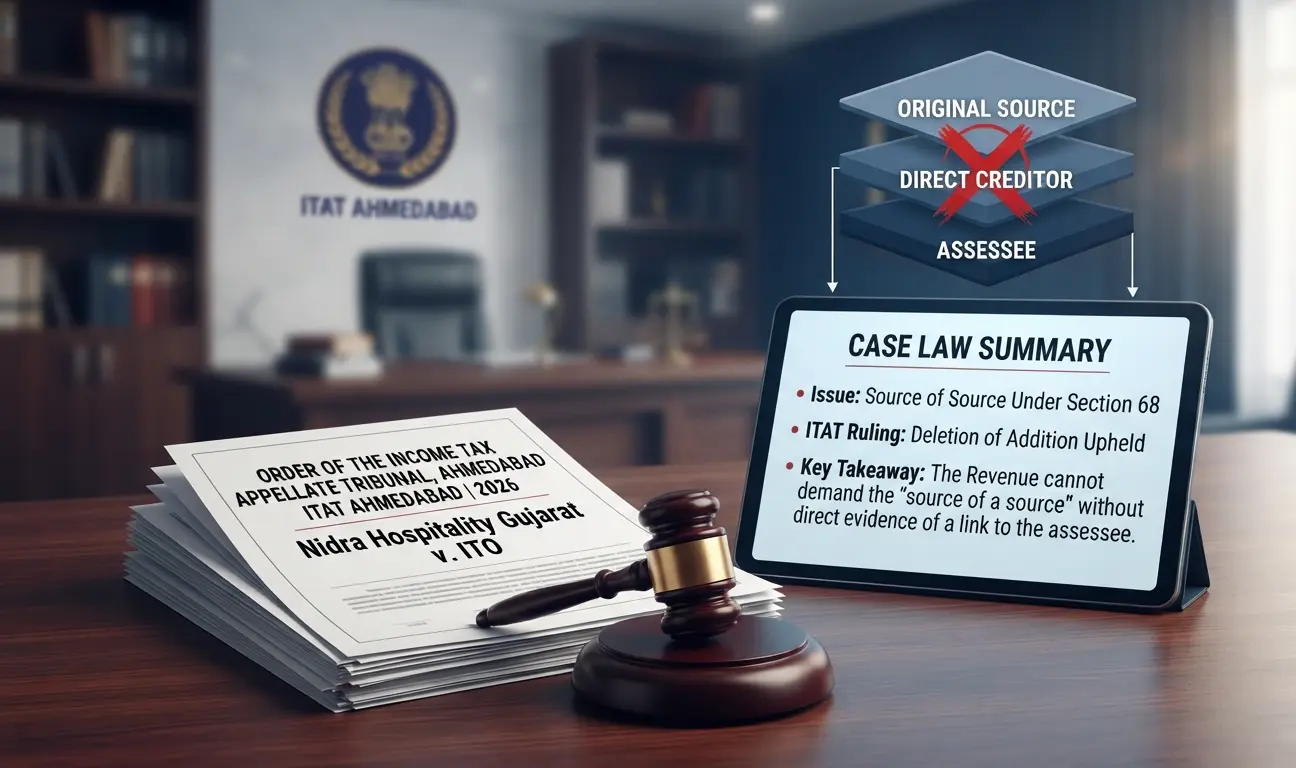
Case Name: Nidra Hospitality Gujarat Pvt. Ltd. v. ACIT, Circle 2(1)(2), Vadodara (ITAT Ahmedabad, 2026)
- Subject
- Source of source under Section 68: whether a Rs.2.67 crore unsecured loan from an NBFC could be added as unexplained cash credit for AY 2017-18
- Issue
- Where the assessee proved the lender’s identity, creditworthiness and the genuineness of the loan with documents, could the Assessing Officer make a Section 68 unsecured loan addition by doubting where the lender itself got the money?
- Appeal no.
- ITA No. 1963/AHD/2026, order pronounced on 1 October 2026
- Forum
- ITAT Ahmedabad “C” Bench (Dr. B.R.R. Kumar, Vice President, and Shri Rahul Chaudhary, Judicial Member)
- Assessment year
- 2017-18
- Provisions
- Sections 68, 69C and 115BBE, Income-tax Act 1961 (Section 68 corresponds to Section 102 of the Income-tax Act 2025)
- Outcome
- In favour of assessee
Background
Facts of the Case
- The assessee, a company based in Vadodara, filed its return for AY 2017-18 declaring a loss of Rs.5,13,57,857.
- In scrutiny, the Assessing Officer noticed an unsecured loan of Rs.2,67,00,000 taken from Carbel Mercantile Ltd., a non-banking finance company (NBFC).
- When asked to explain the loan, the assessee filed the lender’s PAN, a signed loan confirmation, the lender’s ITR acknowledgement, its audited financial statements, HDFC Bank account statements showing the transaction, and proof that interest had been paid after deducting tax at source.
- The Assessing Officer still treated the loan as unexplained cash credit under Section 68 in the assessment order dated 27 December 2019. He relied on two points: the lender had returned a loss for the year, and money had come into the lender’s bank account just before it lent to the assessee.
- As a consequence, the interest of Rs.3,06,832 paid on the loan was also disallowed, and tax was charged at the 60% rate under Section 115BBE on Rs.2,70,06,832.
- The CIT(A), NFAC, partly allowed the appeal on 16 March 2026 but confirmed the Section 68 addition. The assessee then appealed to the Tribunal.
The record
Evidence Filed by the Assessee and the AO’s Doubts
- Identity
- The lender’s PAN and its ITR acknowledgement for AY 2017-18
- Confirmation
- A signed loan confirmation from Carbel Mercantile Ltd.
- Capacity
- The lender’s audited balance sheet and profit and loss account for FY 2016-17
- Bank trail
- HDFC Bank (Safdarjung Branch, New Delhi) account statement showing that the loan moved through banking channels
- Interest
- Interest paid at 11.25%, with tax deducted at source and deposited
- AO’s doubt 1
- The lender had returned a loss for the year, so it could not have had the means to lend
- AO’s doubt 2
- Funds were credited to the lender’s account just before the loan, so the source of the lender’s money was questionable
- AO’s inquiry
- None recorded: the Tribunal found that no independent inquiry was made, and the assessee pointed out that no notice under Section 133(6) or summons under Section 131 was issued
The ruling
Summary of Decision: What the Tribunal Held
Allowing the assessee’s appeal and deleting the addition of Rs.2.67 crore, the Tribunal held:
- That, by filing the lender’s PAN, ITR, loan confirmation, audited accounts and bank statement, the assessee had discharged its primary onus under Section 68 of proving the lender’s identity and creditworthiness and the genuineness of the loan. [Para 9 of the order]
- That the onus then shifted to the Assessing Officer, who made no independent inquiry and brought no material on record to disprove the assessee’s documents. [Para 9 of the order]
- That the requirement to explain the source of source of a loan, inserted in the first proviso to Section 68 by the Finance Act 2022 with effect from 1 April 2023, did not apply to AY 2017-18, so the addition could not rest on doubts about the lender’s own funds. [Para 9 of the order]
- That the consequential disallowance of interest of Rs.3,06,832 was also deleted, and the ground on the 60% tax rate under Section 115BBE was allowed for statistical purposes without any finding on merits. [Paras 9 and 10 of the order]
Why
Reasoning Behind the Decision
- The assessee proved all three ingredients. Section 68 requires the assessee to explain a credit in its books by showing who the lender is, that the lender could afford the loan, and that the transaction is genuine. The Tribunal noted that the assessee had filed every primary document the law expects: PAN, return of income, confirmation, audited financial statements and bank statements. It held that, with these documents on record, the assessee’s initial burden was fully discharged. [Para 9 of the order]
- The burden then moved to the Assessing Officer. Once the primary evidence is filed, the Assessing Officer must verify it and bring cogent material to contradict it before rejecting it. Here, the Assessing Officer issued no notice to the lender under Section 133(6), did not summon it under Section 131, and pointed out no defect in any document. The Tribunal held that, in the absence of any independent inquiry and of any material to controvert the assessee’s evidence, the addition of unexplained cash credit could not be sustained. [Paras 6 and 9 of the order]
- The AO’s real doubt was about the source of source. The Tribunal observed that the Assessing Officer never questioned the assessee’s explanation that the money came from Carbel Mercantile Ltd. What he doubted was how the lender had funded the loan, because money had reached the lender’s account through banking channels just before the loan. That is a doubt about the source of the source, not about the assessee’s own source. [Para 9 of the order]
- The Finance Act 2022 amendment is prospective. The Finance Act 2022 amendment to the first proviso to Section 68 requires an assessee who receives a loan or borrowing to show that the lender also explains the source of the money. The Tribunal held that this requirement applies only from 1 April 2023, that is, from AY 2023-24, and therefore the source of source under Section 68 could not be demanded for a loan taken in FY 2016-17 relevant to AY 2017-18. [Para 9 of the order]
- The lender’s loss was not enough. The Revenue argued that a lender with a returned loss could not have advanced Rs.2.67 crore. The Tribunal did not discuss this argument separately, but it allowed Grounds 1 to 6, which included the assessee’s plea that creditworthiness depends on the funds available in the lender’s bank account and not on its profit. The addition founded on the lender’s loss therefore did not survive. [Paras 7 and 10 of the order]
- The connected issues followed the main addition. As the interest disallowance of Rs.3,06,832 depended entirely on the Section 68 addition, the Tribunal deleted it as consequential. The order describes it as a disallowance “under Section 69C”. The Section 115BBE ground became academic once the addition was deleted, so the Tribunal recorded it as allowed for statistical purposes and gave no ruling on whether the 60% rate applies to AY 2017-18. [Paras 9 and 10 of the order]
Practice point
Key Takeaway: When Does Source of Source Under Section 68 Apply?
- Check the assessment year first. The requirement to prove the source of source under Section 68 for loans and borrowings applies from AY 2023-24 onwards. For loans received in FY 2021-22 or earlier, the assessee need not prove where the lender’s money came from.
- File the full set of primary documents. The assessee in this case won because the record already held the lender’s PAN, ITR, confirmation, audited accounts, bank statement and TDS proof. Missing any of these weakens the claim that the primary onus was discharged.
- Point out the absence of inquiry. In any appeal against a Section 68 unsecured loan addition, check whether the Assessing Officer verified the evidence. If the Assessing Officer did not issue a notice under Section 133(6) or a summons under Section 131 to the lender, say so expressly in the grounds of appeal and in the written submissions. The lack of inquiry was central to the Tribunal’s decision.
- A lender’s returned loss is not enough. Creditworthiness should be shown from the funds available in the lender’s bank account when the loan was given, not from its taxable profit for the year.
- Do not rely on this case for the 60% tax rate. The Tribunal gave no finding on Section 115BBE. On the statute, the amended 60% rate in Section 115BBE applies from AY 2017-18 itself, so a separate argument is needed if that issue survives in your case.
- For later years, the position is stricter. From AY 2023-24, an explanation for a loan is treated as unsatisfactory unless the lender also explains the source of the money and the Assessing Officer accepts it. Collect the lender’s own source documents at the time of borrowing.

Keep reading