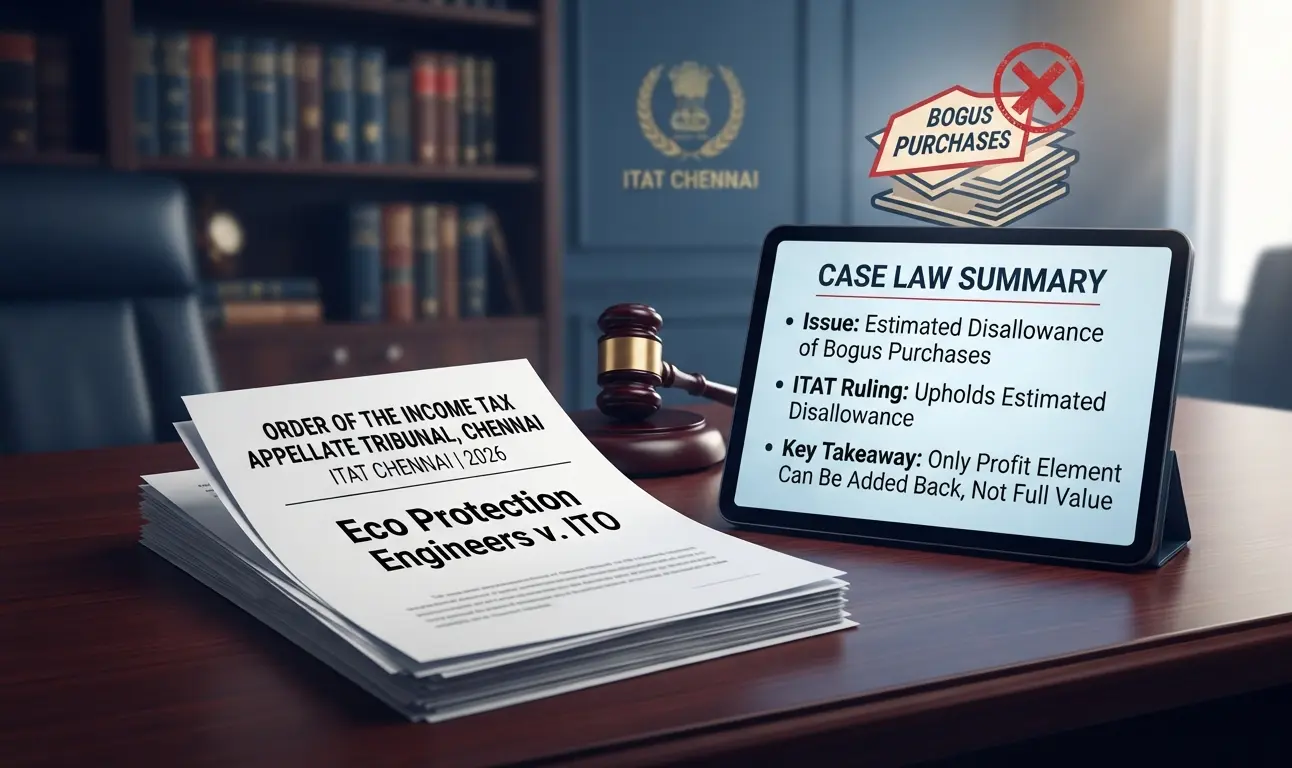
The search found WhatsApp chats about cash coming back from vendors, Excel sheets on the accounts manager’s laptop, and statements recorded on oath. The Assessing Officer responded with a round number: 40% of the purchases and subcontract bills from the identified parties were treated as inflated, year after year. For AY 2020-21 alone that meant Rs.9.12 crore. ITAT Chennai has now confirmed that an estimated disallowance of bogus purchases cannot rest on a flat percentage with no transaction-wise or year-wise basis. A 5% estimate was sustainable, and because the company had already offered more than that as voluntary additional income, the further additions went.
Quick Answer
Can the AO disallow a flat percentage of purchases as bogus on the basis of search material alone?No. ITAT Chennai held that an estimated disallowance of bogus purchases needs a clear basis. Here the AO accepted that most purchases were genuine, did not reject the audited books, and could not name any fake invoice. A flat 40% applied to every year was therefore arbitrary. Seized WhatsApp chats and Excel sheets must be matched to specific invoices before they can justify a figure. The Tribunal upheld a 5% disallowance instead, and since the company had already offered more than 5% as extra income, the further additions were deleted.
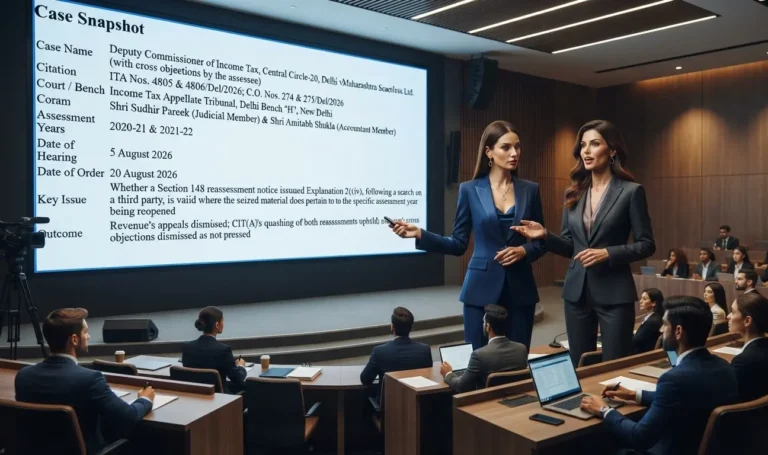
Case Snapshot
| Case Name | Deputy Commissioner of Income Tax, Central Circle-2(4), Chennai v. Eco Protection Engineers Private Limited (ITAT Chennai, 2026) |
| Citation | ITA Nos. 3832 to 3837/Chny/2026 |
| Court / Bench | Income Tax Appellate Tribunal, Chennai Bench “B” |
| Coram | Shri S.S. Viswanethra Ravi (Judicial Member) & Shri Gagan Goyal (Accountant Member); order authored by Shri S.S. Viswanethra Ravi |
| Assessment Years | 2019-20 to 2024-25 (AY 2020-21 taken as the lead case) |
| Date of Hearing | 6 October 2026 |
| Date of Order | 28 October 2026 |
| Key Issue | Whether, after a search, the AO could disallow a uniform 40% of purchases and subcontract expenditure as inflated, on the basis of seized electronic records and statements, without identifying specific bogus transactions |
| Outcome | All six Revenue appeals dismissed; CIT(A)’s restriction of the disallowance to 5% upheld |
Table of Contents
Legal Issue: When Is an Estimated Disallowance of Bogus Purchases Valid?
After a search, the department often suspects that some suppliers issued inflated bills and returned the extra money in cash. It rarely disallows all the purchases. Instead, the AO picks a percentage and treats that share as bogus. This is an estimated disallowance of bogus purchases.
The question here was simple. The AO had himself accepted that most of the purchases were real. Could he still pick 40% and apply it to every vendor and every year?
Facts of the Case
The assessee is a Chennai company that builds water supply, sewerage, wastewater treatment and solid waste projects for government departments. For AY 2020-21, it declared income of Rs.19,05,31,950.
The search. On 5 April 2024, the department searched the company and its director, Shri Chinnasami Chandrasekar. It seized the phone and laptop of Shri T. Devarajulu, the company’s Manager (Accounts and Taxation). The department said WhatsApp chats and Excel sheets on these devices showed that some suppliers and subcontractors had returned money in cash after keeping a commission. Statements were recorded on oath under Section 132(4).
Reassessment and voluntary offer. Notices under Section 148 followed; for AY 2020-21 the notice was dated 6 November 2024. In its fresh returns, the company offered about Rs.16 crore of extra income across the years, saying this was only to avoid litigation and not an admission. For AY 2020-21 it offered Rs.1.5 crore, raising its income to Rs.20,55,31,950.
The AO’s additions. The AO test-checked purchases from 34 vendors worth Rs.53.72 crore and found Rs.13.01 crore without e-way bills or weighment slips. He accepted that genuine purchases had been made, but still treated 40% of the purchases and 40% of the subcontract expenditure with the identified parties as inflated. For AY 2020-21:
- Purchases: 40% of Rs.16,22,85,810 = Rs.6,49,14,324
- Subcontract expenditure: 40% of Rs.6,55,94,250 = Rs.2,62,37,700
- Assessed income: Rs.28,16,83,974 (order dated 30 March 2025)
The subcontract disallowance grew sharply in later years:
| Assessment Year | Subcontract expenditure (Rs.) | AO’s disallowance at 40% (Rs.) |
|---|---|---|
| 2020-21 | 6,55,94,250 | 2,62,37,700 |
| 2021-22 | 8,77,33,816 | 3,50,93,526 |
| 2022-23 | 14,22,64,165 | 5,69,05,666 |
| 2023-24 | 63,12,76,110 | 25,25,10,444 |
| 2024-25 | 66,17,69,785 | 26,47,07,914 |
The CIT(A)’s order. On 3 March 2026, the CIT(A), Chennai-19, held that 40% was excessive and cut the disallowance to 5% under each head. Because the company’s voluntary offers were larger than 5%:
- For AY 2019-20 to 2022-23, the AO was told to accept the income returned under Section 148.
- For AY 2023-24, Rs.3,15,63,806 was sustained and Rs.21,35,57,644 deleted.
- For AY 2024-25, the further subcontract additions were deleted.
The Revenue appealed all six years to the Tribunal.
Arguments of the Parties
For the Assessee (Sh. R. Venkata Raman, CA)
- The AO identified no specific fictitious invoice or work; he accepted genuine purchases and actual execution of subcontract work, and did not reject the audited books.
- A reconciliation of about Rs.118.40 crore of purchases showed e-way bills available or not required for 97.27%, and weighment slips available or not required for 97.67%, of purchases. The AO’s base also wrongly included GST credit that was never debited as expense.
- Subcontract work was certified by government engineers, with running bills, inspection reports and geo-tagged photographs. The Excel sheets related to Shri Devarajulu’s own consultancy clients, as his tax returns showed, and he had retracted his statement.
- No statement admitted 40% inflation. The coordinate bench in Somu Sarvai Ramachandran had upheld a 5% restriction on near-identical facts arising from the same search date.
For the Revenue (Sh. C. Sivakumar, CIT-DR)
- The additions rested on the cumulative effect of seized electronic records, sworn statements and post-search enquiries, not on suspicion.
- Statements recorded under Section 132(4) are substantive evidence, relying on B. Kishore Kumar v. DCIT (SC) from the Madras High Court’s jurisdiction.
- Reliance was placed on PCIT v. Kanak Impex (India) Ltd. (Bom), where restricting a bogus-purchase addition to an estimated profit element was held unjustified once the genuineness of the purchases remained unproved.
- The CIT(A) was not justified in restricting the disallowance to 5% and granting consequential relief.
Court/Tribunal’s Decision
Dismissing the Revenue’s appeals for all six assessment years, the Tribunal held:
(i) That the AO, having accepted genuine purchases and execution of work, could not disallow a uniform 40% without identifying specific fictitious transactions or any year-specific basis, particularly when the audited books were not rejected. [Paras 36, 42 and 43 of the order]
(ii) That the seized records and statements, read as a whole with the retraction, did not establish 40% inflation; B. Kishore Kumar and Kanak Impex were distinguished. [Paras 44, 46, 54, 55 and 57 of the order]
(iii) That, following Somu Sarvai Ramachandran, the CIT(A) rightly restricted the disallowance to 5%, without breaching Rule 46A. [Paras 60 and 63 of the order]
(iv) That the voluntary income of Rs.1.5 crore exceeded the 5% figure of Rs.1,13,94,004, so the further additions were rightly deleted. [Para 64 of the order]
Reasoning Behind the Decision
1. The AO accepted the purchases were genuine. After checking 34 vendors, the AO himself accepted that real purchases had been made. Yet he did not say which invoices were fake, which goods never arrived, or which payments came back in cash. The Tribunal said that accepting purchases as genuine cannot itself be the reason for disallowing 40% of them. [Para 36 of the order]
2. A missing document does not prove a fake purchase. E-way bills are not required for intra-State movement below the value threshold. Weighment slips are not issued for goods counted in pieces or metres. The AO treated both as “missing”. The company’s reconciliation of about Rs.118.40 crore of purchases showed that e-way bills were available or not required for 97.27% of purchases, and weighment slips for 97.67%. [Paras 38 and 40 of the order]
3. The AO’s figures had errors. In one vendor’s case, invoices of Rs.4,00,160 were counted twice. The AO’s base also included GST of Rs.21.86 crore that the company had taken as input tax credit and never claimed as expense. An amount not claimed as expense cannot be disallowed under Section 37(1). [Paras 39 and 41 of the order]
4. The same 40% was used for every year. The AO did no year-wise check and used no reliable sample. The books were audited, and the AO never rejected them under Section 145(3). An estimate must have a basis. The Tribunal relied on the Supreme Court’s rulings in Dhakeswari Cotton Mills v. CIT [1954] 26 ITR 775 (no assessment on pure guesswork) and Umacharan Shaw & Bros. v. CIT [1959] 37 ITR 271 (suspicion is not proof). [Paras 42, 43 and 57 of the order]
5. Seized chats and sheets were not linked to the 40%. The presumptions about seized material under Sections 132(4A) and 292C can be rebutted. The AO still had to match the chats and sheets to actual invoices and payments, and he did not. The Excel sheets were on the personal folders of an employee who also worked as a consultant for some subcontractors, which his own tax returns and Form 26AS showed. He later retracted his statement, giving that explanation. [Paras 44, 46 and 54 of the order]
6. No one admitted 40%. The Managing Director did not admit that 40% of the expenditure was bogus. A statement must be read as a whole, and an admission is important but not final (Pullangode Rubber Produce Co. v. State of Kerala [1973] 91 ITR 18 (SC)). The Revenue’s cases were different: B. Kishore Kumar [2015] 62 taxmann.com 215 (SC) involved a clear admission, and Kanak Impex [2025] 172 taxmann.com 283 (Bom) involved purchases whose genuineness was never proved. [Paras 54 to 57 of the order]
7. The subcontract work was certified by government engineers. The AO did not show any inflated measurement, wrong rate, double bill or fake certificate. So 40% of that expenditure could not be disallowed on the basis of spreadsheets of doubtful ownership. [Para 50 of the order]
8. Why 5% was upheld. A coordinate bench of ITAT Chennai had upheld a 5% disallowance in DCIT v. Somu Sarvai Ramachandran and DCIT v. Keyem Infra Project Pvt. Ltd. (ITA Nos. 1849, 1850, 1855, 2055 and 2056/Chny/2026, order dated 18 September 2026), arising from a search on the same date. Some documents were genuinely missing and the seized material could not be ignored completely, so 5% was a fair estimate. The CIT(A) had only re-examined records already before the AO, so Rule 46A on additional evidence did not apply. [Paras 58 to 63 of the order]
Key Legal Principle
An estimated disallowance of bogus purchases must be based on evidence that is linked to specific transactions. Suppose the AO accepts that most purchases are genuine and does not reject the books. If he also cannot match the seized material to any invoice or cash receipt, he cannot apply a high flat percentage to every year. Seized material and statements still count as evidence, and they can support a small, reasonable estimate. They cannot prove a figure that no one admitted and nothing else supports.

Practical Implications for Contractors and Practitioners
- Reconcile, don’t just argue: The reconciliation of e-way bills and weighment slips, showing which were available and which were not required, is what defeated the estimated disallowance of bogus purchases here. Prepare it from your existing records before the CIT(A) hearing.
- Separate “not available” from “not required”: Show the thresholds and the nature of goods. Many documentary gaps disappear once the legal requirement is checked.
- Strip GST out of the base: If input tax credit was not debited as expense, it cannot be disallowed. Here this alone was over Rs.21 crore of the base.
- Use third-party certification: Government measurement books, running bills, inspection reports and geo-tagged photographs carried real weight for subcontract work.
- Explain seized material from employees: If an employee’s device holds records of his own outside work, prove it with his returns and Form 26AS, and file any retraction promptly with that explanation.
- Weigh a voluntary offer carefully: The company’s ad hoc offer in its Section 148 returns ended up covering the entire sustainable disallowance. Make such offers expressly without admitting any bogus expenditure, as was done here.
Related Judgments and Limitations
| Case | Forum | Relevance |
|---|---|---|
| DCIT v. Somu Sarvai Ramachandran; DCIT v. Keyem Infra Project Pvt. Ltd., ITA Nos. 1849, 1850, 1855, 2055 & 2056/Chny/2026 (18 September 2026) | ITAT Chennai | 43.99% purchase disallowance restricted to 5%; percentage from one year and one entity cannot be applied mechanically to others; followed here |
| B. Kishore Kumar v. DCIT, [2015] 62 taxmann.com 215 (SC) | Supreme Court | Addition on a clear Section 132(4) admission upheld; distinguished as there was no admission of 40% inflation here |
| PCIT v. Kanak Impex (India) Ltd., [2025] 172 taxmann.com 283 (Bom) | Bombay High Court | Relied on by the Revenue; distinguished as genuineness of purchases was not established there |
| Pullangode Rubber Produce Co. Ltd. v. State of Kerala, [1973] 91 ITR 18 (SC) | Supreme Court | An admission is important evidence but not conclusive |
| Dhakeswari Cotton Mills Ltd. v. CIT, [1954] 26 ITR 775 (SC) | Supreme Court | Assessment cannot rest on pure guesswork |
| Umacharan Shaw & Bros. v. CIT, [1959] 37 ITR 271 (SC) | Supreme Court | Suspicion cannot take the place of proof |
1. Not a clean deletion. The Tribunal accepted a 5% disallowance in principle. The company avoided further tax only because its own voluntary offers were larger; for AY 2023-24, Rs.3,15,63,806 remained added.
2. Heavily fact-driven. The result rested on detailed reconciliations, government certification of work and an employee’s documented outside consultancy. A business without such records may fare worse.
3. Largely follows one coordinate bench. The 5% figure comes from Somu Sarvai Ramachandran, decided by a coordinate bench of ITAT Chennai a month earlier on a search of the same date. It is an estimate on these facts, not a general rule that 5% applies to bogus purchases.
4. Drafting slips in the order. Para 80 refers to “AY 2024-24”, and the summing-up in para 81 lists only AY 2019-20 to 2023-24, although six appeals, including AY 2024-25, were decided and dismissed. The Revenue’s 34-day delay in filing each of the six appeals was condoned.
Frequently Asked Questions
Not without a rational basis. ITAT Chennai held that a uniform 40% applied across years, where the AO accepted genuine purchases and could not identify specific fictitious invoices, was arbitrary.
Following a coordinate bench ruling, the Tribunal treated 5% as a reasonable estimate because some documentary gaps and the seized material could not be ignored entirely. Here the company’s voluntary additional income already exceeded that 5%.
No. The Tribunal held that the AO must distinguish documents that are unavailable from those that were never required, and that gaps in ancillary documents do not by themselves prove bogus purchases.
Not where it was taken as input tax credit and never debited to the profit and loss account. A disallowance under Section 37(1) must relate to expenditure actually claimed.
Not by themselves for a quantum nobody admitted. The Tribunal held that statements must be read as a whole, with any retraction, and that B. Kishore Kumar applies where there is a clear admission, which there was not here.
Final Verdict
Based on the above facts and reasoning, ITAT Chennai dismissed all six of the Revenue’s appeals against Eco Protection Engineers Pvt. Ltd. for AY 2019-20 to 2024-25. It upheld the CIT(A)’s decision to cut the estimated disallowance of bogus purchases and subcontract expenditure from 40% to 5%. Since the company’s voluntary offers already exceeded 5%, the further additions were deleted, including Rs.9.12 crore for AY 2020-21. In my view, the case shows what an assessee needs to defeat a flat-rate estimate: a full document reconciliation, government-certified work records and a clear explanation of any seized data. It does not mean seized material can be ignored, and it does not make 5% a standard rate.
Also Read
Corresponding Provisions Under the Income-tax Act, 2025
This case was decided under the Income-tax Act, 1961, for Assessment Years 2019-20 to 2024-25. Under the Income-tax Act, 2025, Section 132 (search and seizure) corresponds to Section 247, and Sections 147 and 148 (reassessment) to Sections 279 and 280. Published concordance tables also map Section 37 to Section 34, Section 145 to Section 276 and Section 44AB to Section 63. They map Section 69C to Section 105, Section 250 to Section 359 and Section 292C to Section 524. Confirm these against the bare Act before relying on them. For other sections, see our Income Tax Act 2025 vs 1961 mapping hub.
Source Judgment: DCIT, Central Circle-2(4), Chennai v. Eco Protection Engineers Pvt. Ltd. (ITAT Chennai, 2026), ITA Nos. 3832 to 3837/Chny/2026, order pronounced 28 October 2026. This order can be looked up on the official ITAT judicial search portal using the ITA numbers above.
Want the full order copy? Download it here.
Legal Disclaimer: This article is for general informational purposes only and analyses a specific Tribunal order under the Income-tax Act, 1961, as it applied to Assessment Years 2019-20 to 2024-25. It is not legal or tax advice, and it does not account for developments after the date of publication or for the specific facts of any reader’s case. The 5% estimate in this matter was a finding on its own facts, as noted above. Readers should verify the applicable current position and consult a qualified Chartered Accountant or tax professional before acting on this or any similar matter.