Case at a glance
Case Name: Kamleshkumar Somalal Bhatt v. ITO, Ward-1, Himatnagar (ITAT Ahmedabad, 2026)
- Subject
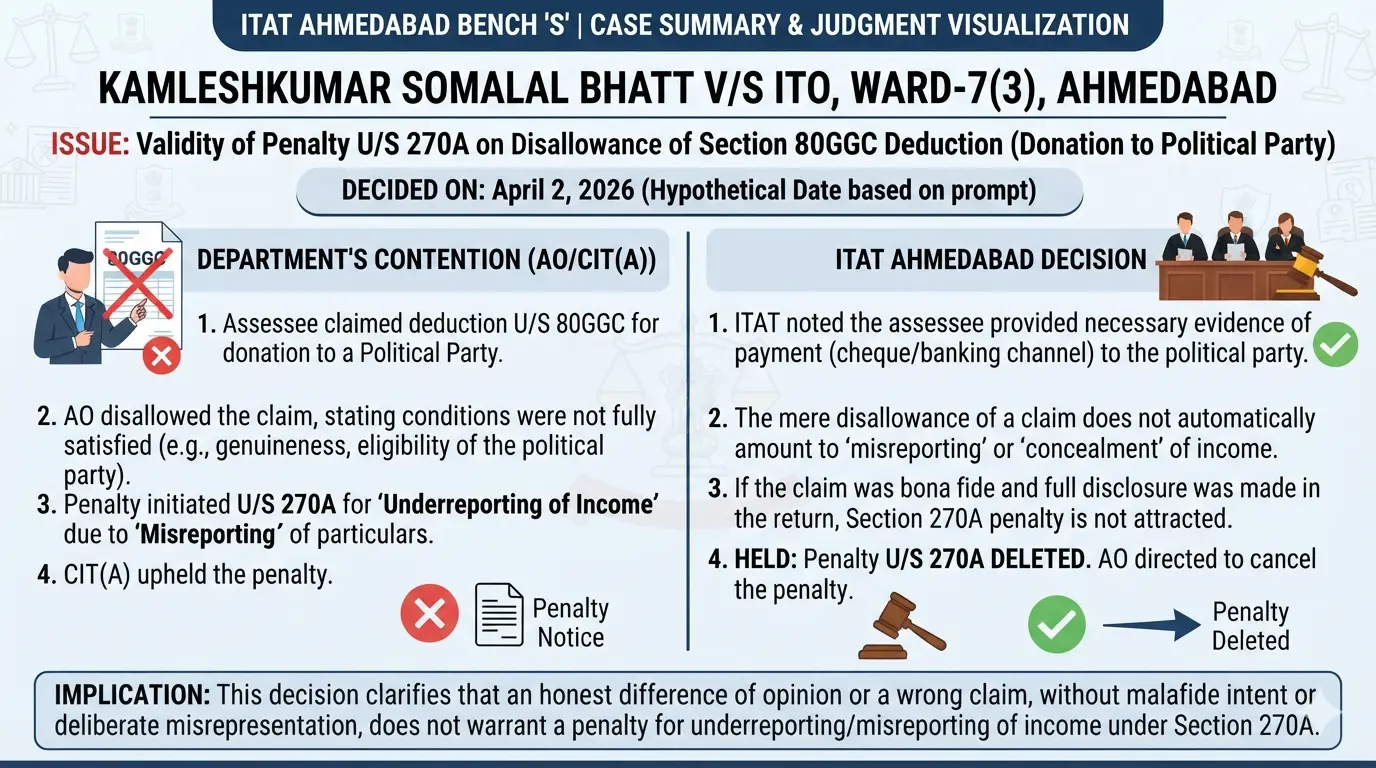
- 80GGC penalty under Section 270A: whether a disallowed deduction for a political party donation can be treated as misreporting of income attracting a 200% penalty
- Issue
- Where an assessee claimed a Section 80GGC deduction openly in the return and later withdrew it after reassessment based on investigations into registered unrecognised political parties, could the Assessing Officer levy a penalty of Rs.3,12,000 for misreporting under Section 270A(8) read with Section 270A(9)?
- Appeal no.
- ITA No. 2130/AHD/2026, order pronounced on 21 October 2026
- Forum
- ITAT Ahmedabad, “SMC” Bench (Dr. B.R.R. Kumar, Vice President)
- Assessment year
- 2019-20
- Provisions
- Sections 80GGC, 147, 148, 148A and 270A, Income-tax Act 1961 (Section 270A corresponds to Section 439, and Section 80GGC to Section 137, of the Income-tax Act 2025)
- Outcome
- In favour of assessee
Background
Facts of the Case
- The assessee, an individual from Himatnagar in Gujarat, filed his original return for AY 2019-20 on 19 August 2019, declaring total income of Rs.13,86,810.
- In that return, he claimed a deduction of Rs.5,00,000 under Section 80GGC for donations to political parties. He stated that the donations were made through banking channels and were supported by donation receipts and bank statements.
- The department later investigated several registered unrecognised political parties (RUPPs). Based on that information, proceedings under Section 148A were started in his case in connection with a donation of Rs.2,00,000 made to Apan Desh Party.
- According to the assessee’s grounds of appeal, he withdrew the Section 80GGC deduction in the return filed in response to the notice under Section 148 and paid the tax voluntarily. The reassessment under Section 147 then accepted that returned income without any further addition.
- The Assessing Officer then levied a penalty of Rs.3,12,000 under Section 270A, treating the case as under-reporting of income in consequence of misreporting under Section 270A(8) read with Section 270A(9).
- The CIT(A), NFAC, dismissed the assessee’s appeal on 11 December 2025 and confirmed the penalty. The grounds of appeal record that the CIT(A) reasoned that the assessee would have “gone scot free” but for the reassessment. The assessee then appealed to the Tribunal.
The calculation
How the Rs.3.12 Lakh Misreporting Penalty Works Out
- Deduction
- Rs.5,00,000 claimed under Section 80GGC and later withdrawn
- Tax rate
- 30% slab rate plus 4% health and education cess, an effective 31.2% for AY 2019-20
- Tax on it
- Rs.1,56,000 (31.2% of Rs.5,00,000)
- At 200%
- Rs.3,12,000: the penalty for misreporting under Section 270A(8), which is the amount levied
- At 50%
- Rs.78,000: the penalty for simple under-reporting under Section 270A(7), which the assessee claimed in the alternative
The order does not set out this computation. The table is our own working, and the levied amount matches 200% of the tax on the full Rs.5,00,000 deduction, not only on the Rs.2,00,000 donation to Apan Desh Party.
The ruling
Summary of Decision: What the Tribunal Held
Allowing the assessee’s appeal and deleting the penalty of Rs.3,12,000, the Tribunal held:
- That, as both parties agreed, the issue was covered by the coordinate bench decision in Hiro Mulchand Tanwani v. ITO (ITA No. 110/Ahd/2026, order dated 15 May 2026), which also concerned a Section 80GGC deduction for AY 2019-20. [Para 7 of the order]
- That, following that decision, and in the absence of any contrary decision or distinguishing facts, the penalty levied under Section 270A for misreporting of income was not sustainable. [Para 8 of the order]
- That the penalty levied by the Assessing Officer and confirmed by the CIT(A) was therefore deleted, and the appeal was allowed. [Paras 8 and 9 of the order]
Why
Reasoning Behind the Decision
- The case was covered by Hiro Mulchand Tanwani. In that case, the assessee had claimed a deduction of Rs.1,50,000 under Section 80GGC for a donation to Manvadhikar National Party. The reassessment disallowed it and a penalty of Rs.93,600 was levied for misreporting. The Tribunal, deciding the present appeal, reproduced the operative part of that order and followed it, because both the assessee and the Departmental Representative accepted that the issue was the same. One factual difference should be noted: in Hiro Mulchand Tanwani the Assessing Officer disallowed the deduction, whereas here the assessee withdrew it himself in the return filed under Section 148. [Para 7 of the order]
- Not appealing is not an admission. In Hiro Mulchand Tanwani, the Assessing Officer had treated the assessee’s decision not to appeal against the disallowance as acceptance of misreporting. The Tribunal held that an assessee may accept a small addition simply to avoid long litigation. That choice is not an admission of concealment or of furnishing false particulars, because penalty proceedings are separate from assessment proceedings. [Para 7 of the order, quoting para 4 of Hiro Mulchand Tanwani]
- Misreporting of income has a closed list. Section 270A treats under-reporting and misreporting differently. The coordinate bench held that misreporting is attracted only in the specific cases listed in Section 270A(9). Under the statute, these are misrepresentation or suppression of facts, failure to record investments, claiming expenditure not substantiated by any evidence, recording a false entry, failure to record a receipt that affects total income, and failure to report an international or specified domestic transaction. A penalty for misreporting must therefore rest on one of these cases. [Para 7 of the order]
- A disclosed claim that fails is not a false claim. The donation was shown in the return and the deduction was claimed openly in the belief that it qualified. The disallowance arose only because the Assessing Officer was not satisfied about the genuineness or eligibility of the donation. There was no material showing that the assessee produced false evidence, suppressed facts or made a deliberate misrepresentation. A deduction that is finally held inadmissible does not, by that fact alone, amount to misreporting. [Para 7 of the order]
- The Revenue must prove a knowingly false claim. The Tribunal held that unless the Revenue shows, with cogent evidence, that the claim was bogus and was knowingly made on false particulars, the 200% penalty cannot stand. At most, such a case may fall within under-reporting, and even then the Assessing Officer must establish that the conditions of Section 270A are met. [Para 7 of the order]
- No distinguishing facts were shown. The Revenue cited no contrary decision and pointed out no fact that set this case apart. The Tribunal therefore followed the coordinate bench and deleted the whole 80GGC penalty under Section 270A. It did not separately decide the assessee’s other grounds, such as the alternative plea for a 50% penalty or the argument that no under-reported income existed because the reassessment accepted the returned income. [Para 8 of the order]
Practice point
Key Takeaway: Can the AO Levy an 80GGC Penalty Under Section 270A for Misreporting?
- Challenge the misreporting label first. When facing an 80GGC penalty under Section 270A, ask the Assessing Officer to state which clause of Section 270A(9) applies. Hiro Mulchand Tanwani holds that misreporting arises only in the cases listed in that sub-section.
- Show that the claim was disclosed. Keep the donation receipt, the bank statement and the party’s registration details. A deduction claimed openly through banking channels is the basis on which ITAT Ahmedabad rejected the 200% penalty, both here and in Hiro Mulchand Tanwani.
- Withdrawing the claim is not an admission. Many taxpayers have withdrawn Section 80GGC claims after receiving notices about political party donation claims involving RUPPs. This ruling, following Hiro Mulchand Tanwani, holds that accepting a disallowance to avoid litigation does not prove misreporting.
- Keep the alternative plea for 50%. Always argue in the alternative that the case is, at most, under-reporting under Section 270A(7). Here the difference was Rs.3,12,000 against Rs.78,000.
- The deduction itself is a separate question. This ruling deals only with the penalty. It does not hold that the donation to Apan Desh Party was genuine, and the tax on the withdrawn deduction was not in dispute.
- The order has a drafting slip. It is headed “SMC” Bench before the Vice President alone, but the signature block also names Shri Rahul Chaudhary, Judicial Member. The slip does not affect the result.
Keep reading