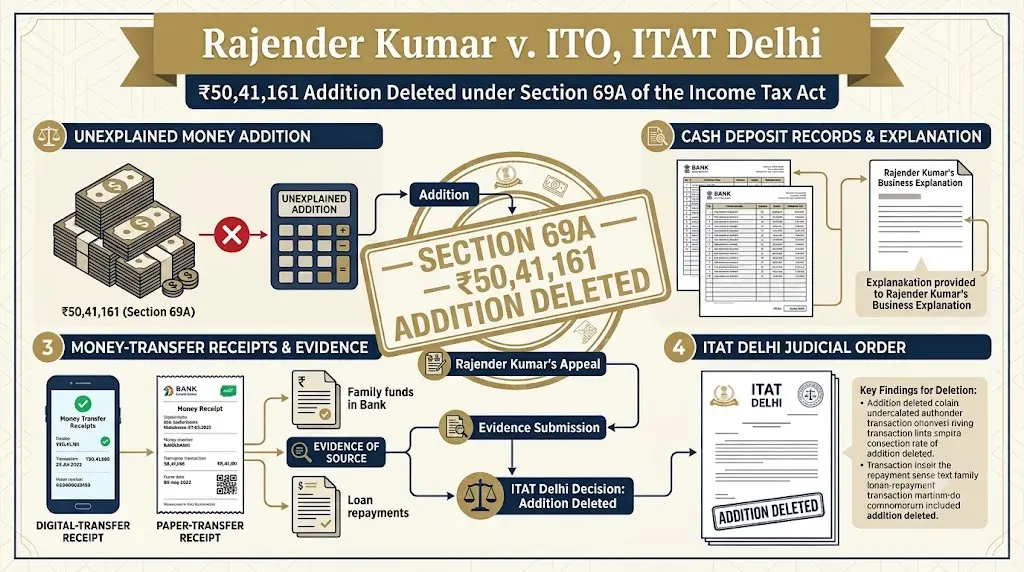
A small operator handling DTH collections, mobile recharges and online money transfers for customers deposited Rs.75.73 lakh in cash during the demonetisation year. The Assessing Officer added the whole amount. The CIT(A) accepted the recharge and DTH deposits but sustained Rs.50.41 lakh, largely because the assessee could not produce an RBI licence, agency agreements or confirmations from the money-transfer platforms. ITAT Delhi has now deleted that cash deposit addition under Section 69A, holding that the section asks the assessee to explain the nature and source of money, not to prove regulatory compliance.
Quick Answer
Can a cash deposit addition under Section 69A be sustained because the assessee has no RBI licence or agency agreement for a money-transfer business?No. ITAT Delhi held that Section 69A only requires the assessee to satisfactorily explain the nature and source of the money. Whether the assessee held an RBI licence or complied with payment regulations is not an inquiry Section 69A permits. Where the assessee produces prima facie evidence — cash registers, bank statements showing onward remittances, and commission income offered to tax — the burden shifts to the Revenue to rebut it, and allegations of hawala must rest on actual investigation, not suspicion.
Case Snapshot
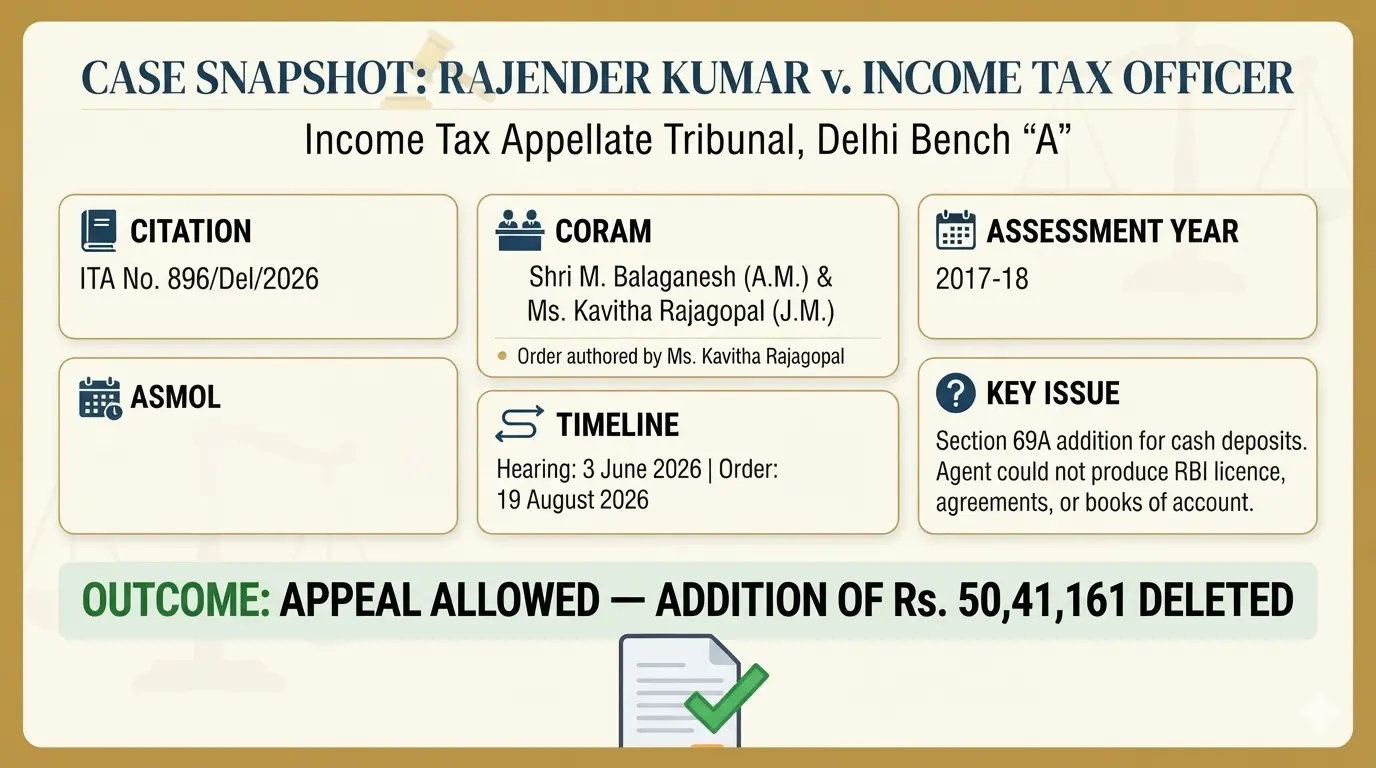
| Case Name | Rajender Kumar v. Income Tax Officer, Ward-35(8), New Delhi |
| Citation | ITA No. 896/Del/2026 |
| Court / Bench | Income Tax Appellate Tribunal, Delhi Bench “A”, New Delhi |
| Coram | Shri M. Balaganesh (Accountant Member) & Ms. Kavitha Rajagopal (Judicial Member); order authored by Ms. Kavitha Rajagopal |
| Assessment Year | 2017-18 |
| Date of Hearing | 3 June 2026 |
| Date of Order | 19 August 2026 |
| Key Issue | Whether a Section 69A addition for cash deposits can be sustained because a collection and money-transfer agent could not produce an RBI licence, agency agreements, platform confirmations or books of account |
| Outcome | Appeal allowed — addition of Rs.50,41,161 under Section 69A deleted |
Table of Contents
Legal Issue: Cash Deposit Addition Under Section 69A and the Limits of the Inquiry
Section 69A of the Income-tax Act, 1961 allows money found to be owned by an assessee, and not recorded in any books maintained, to be deemed income where the assessee offers no explanation about its nature and source, or the explanation is not satisfactory in the Assessing Officer’s opinion. The question before the Tribunal was how far that inquiry can go. For an agent who collects cash from customers and remits it to service providers, can the department demand proof of regulatory authorisation — an RBI licence, formal agency agreements, platform confirmations — and treat their absence as a failure to explain the source? Or is the assessee’s burden limited to showing where the money came from and where it went?
Facts of the Case
The assessee, an individual, filed his return for AY 2017-18 declaring total income of Rs.4,25,570, with business income offered under the presumptive scheme of Section 44AD and gross receipts of Rs.7,58,460. (The order prints the return date as “31.0.2018” — the month is missing.) The case was selected for limited scrutiny through CASS to examine cash deposits. The AO found cash deposits of Rs.75,73,335 across four bank accounts — Rs.72,17,335 in one Bank of India account, Rs.40,000 in a second Bank of India account, Rs.2,30,000 in Karur Vysya Bank and Rs.86,000 in Punjab and Sind Bank.
Finding the deposits unexplained, the AO passed an assessment order under Section 143(3) dated 17 December 2019, adding the full Rs.75,73,335 under Section 69A and determining total income at Rs.79,98,875. By order dated 29 December 2025, the CIT(A) accepted that Rs.25,32,174 had been explained and sustained the balance of Rs.50,41,161.
The assessee’s explanation, as tabulated in the Tribunal’s order, attributed Rs.66,10,174 of the deposits to cash collected from customers on behalf of nine service providers: DEN Networks (DTH, Rs.11,37,174), Oxigen Services (mobile recharge/bill payment, Rs.5,10,000), Tata Tele Nxtgen Solutions (mobile recharge, Rs.8,85,000), and six online money-transfer platforms — Bankit Services/AEPS (Rs.12,10,000), Eko India Financial Services (Rs.2,05,000), Mobisafar (Rs.20,33,000), Payism Global (Rs.2,80,000), Quicksun Technologies (Rs.1,30,000) and Transerv (Rs.2,20,000). Reading the figures together, the Rs.25,32,174 the CIT(A) accepted equals exactly the DTH, recharge and bill-payment entries; the Rs.50,41,161 sustained equals the six money-transfer entries (Rs.40,78,000) plus Rs.9,63,161 for which the assessee offered no specific source at all. (This reconciliation is ours, worked out from the order’s figures; the order does not set it out in this form.)
The CIT(A) sustained the money-transfer portion because the assessee did not produce an RBI or other regulatory authorisation for money-transfer services, agency agreements with the platforms, confirmations from them, commission statements or reconciliations, or evidence of regulatory compliance during demonetisation. The CIT(A) also noted that no regular books were maintained and characterised the transactions as circular, hawala-type transactions in which the assessee was merely a conduit.
Arguments of the Parties
For the Assessee (Sh. Saubhagya Agarwal, Adv.; Sh. V. Rajakumar, Adv.; Ms. Suman Jain, CA)
- The assessee provided DEN cable services and acted as an agent for mobile recharge, bill payment and direct money transfer, collecting cash from customers, depositing it in his bank accounts and remitting it to the service providers.
- Only the commission retained was his income, and it had already been offered to tax under Section 44AD; being under the presumptive scheme, he did not maintain books or a date-wise cash book.
- Bank statements, invoices, daily cash collection registers, cash-flow statements, payments to principal service providers and commission receipts had been furnished but were not properly considered.
- Alternatively, the enhanced rate under the amended Section 115BBE could not be applied without identifying the portion of deposits made before the amendment, relying on CIT v. Vatika Township Pvt. Ltd., 227 Taxman 121 (SC), as a substantive change operates only prospectively. This ground had been raised as an additional ground before the CIT(A), who did not adjudicate it.
For the Revenue (Sh. Rajesh Tiwari, Sr. DR)
- The assessee had not discharged the onus under Section 69A with supporting documentary evidence.
- The assessee had furnished evidence only of payments to DEN Networks Ltd. towards DTH services, with DEN’s ledger account, and the CIT(A) had given relief of Rs.25,32,174 after considering it. (On the order’s own figures, that relief also covered the Oxigen and Tata Tele recharge entries.)
- For the remaining Rs.50.41 lakh, the assessee failed to produce relevant documents, so the CIT(A)’s order should be upheld.
Court/Tribunal’s Decision
The Tribunal set aside the CIT(A)’s order and directed deletion of the entire sustained addition of Rs.50,41,161 under Section 69A, holding that the assessee had discharged the primary onus cast on him. The appeal was allowed.
Reasoning Behind the Decision
Section 69A asks about nature and source, not regulatory compliance. Reading the provision, the Tribunal held that the assessee’s onus is to satisfactorily explain the nature of the money and its source. By asking whether the assessee held an RBI licence and complied with payment regulations, the CIT(A) went beyond what Section 69A requires; a possible breach of RBI regulations is not a subject of inquiry under that section.
Prima facie evidence shifts the burden. The assessee had produced sample cash registers showing regular daily collections from retail customers, bank statements showing payments to service providers out of the deposits, and commission income from those providers offered in his return. Once such evidence is produced, the Revenue must rebut it. The AO recorded no finding that he had verified the service providers, issued notices to them, examined bank trails or disputed the remittances.
The hawala finding had no investigative basis. The CIT(A)’s characterisation of the deposits as hawala or circular transactions was not supported by any recorded investigation — no beneficiaries or accommodation entries were identified. Suspicion, however strong, cannot replace proof, and the flow of funds visible in the bank statements was never analysed.
The CIT(A)’s conclusion was internally inconsistent. Having accepted that the assessee genuinely acted as a collection agent for DTH, mobile recharge and bill payment, the CIT(A) did not explain why the same business model could not extend to the other service providers. The Tribunal described this finding as arbitrary and not meeting the requirements of law.
Key Legal Principle
Under Section 69A, the assessee’s burden is to explain the nature and source of the money — not to prove licensing or regulatory compliance for the business that generated it. Where a collection or money-transfer agent produces prima facie evidence linking cash deposits to customer collections and onward remittances, the burden shifts to the Revenue to rebut that evidence through actual verification. An addition cannot be sustained on the absence of regulatory documents, or on an unsupported allegation of hawala.
Practical Implications for Practitioners
- Build the evidence chain the Tribunal relied on: Daily cash collection registers, bank statements showing cash coming in and remittances going out to the principal companies, and the commission credits reflected in the return. This combination is what shifted the burden here.
- Push back on regulatory-document demands at the CIT(A) stage: A request for an RBI licence or formal agency agreements tests regulatory compliance, not the source of money. Cite this ruling to keep the inquiry within Section 69A.
- Make the AO do the verification: Where the explanation names specific service providers, ask in writing that notices be issued to them or bank trails examined. An AO who rejects the explanation without verifying it is exposed on appeal.
- Section 44AD is not a shield for unexplained gaps: Presumptive filers need not keep regular books, but they still need to account for every rupee deposited. Deposits outside the explained figure remain at risk (see the Limitations section).
- Demonetisation-year appeals are the most obvious use: If you are contesting an AY 2017-18 cash deposit addition under Section 69A for a retail agent or small operator, check whether it rests on the same kind of reasoning; many such appeals may still be pending before the CIT(A) or the Tribunal.
Related Judgments and Limitations
| Case | Forum | Relevance |
|---|---|---|
| CIT v. Vatika Township Pvt. Ltd., 227 Taxman 121 (SC) | Supreme Court | Relied on by the assessee for the alternative Section 115BBE argument that a substantive amendment applies only prospectively; not decided, as the addition was deleted on merits |
| Umacharan Shaw & Bros. v. CIT, (1959) 37 ITR 271 (SC) | Supreme Court | Not cited in this order, but the source of the well-settled principle the Tribunal applied — that suspicion, however strong, cannot take the place of evidence |
Frequently Asked Questions
Per this ruling, no. ITAT Delhi held that Section 69A only requires the assessee to explain the nature and source of the money. Whether the assessee held an RBI licence or complied with payment regulations is outside the scope of that inquiry.
Sample daily cash collection registers, bank statements showing remittances from the deposited cash to service providers, and commission income from those providers offered to tax in the return. Together, these were treated as prima facie evidence that shifted the burden to the Revenue.
Regular books are not required under the presumptive scheme, and the Tribunal did not hold their absence against the assessee. But the taxpayer must still be able to explain the source of the deposits through other records, such as cash registers and bank trails.
No. The Tribunal held that the hawala characterisation was unsupported by any recorded investigation, with no beneficiaries or accommodation entries identified, and reiterated that suspicion, however strong, cannot replace proof.
Section 104 of the Income-tax Act, 2025 deals with unexplained assets, covering money, bullion, jewellery and virtual digital assets. It retains the requirement that the assessee explain the “nature and source” of acquisition, so the reasoning in this ruling should remain relevant.
Final Verdict
Based on the above facts and reasoning, ITAT Delhi allowed Rajender Kumar’s appeal for AY 2017-18 and deleted the cash deposit addition of Rs.50,41,161 under Section 69A. The Tribunal held that the CIT(A) went beyond the statute by demanding RBI and regulatory documents, that the assessee’s cash registers, bank trails and taxed commission income discharged his primary onus, and that the Revenue’s hawala allegation was unsupported by any investigation. For collection and money-transfer agents facing similar additions, the ruling is a useful authority, provided every deposit can actually be traced to a source.
Also Read
- Cash Deposits During Demonetisation: How to Respond to a Section 69A Addition
- Section 115BBE Explained: When Does the Higher Tax Rate on Unexplained Income Apply?
- Section 44AD Presumptive Taxation: What Records Should You Still Keep?
- Presumptive Taxation FAQs – 44AD 44ADA 44AE (India)
- Income Tax Calculator Excel For Traders Free Download AY 2026-27
Corresponding Provisions Under the Income-tax Act, 2025
This case was decided under the Income-tax Act, 1961, as it concerns Assessment Year 2017-18. Under the Income-tax Act, 2025, Section 69A corresponds to Section 104 (unexplained asset), which covers money, bullion, jewellery and other valuable articles and now expressly includes virtual digital assets. Section 104 retains the requirement that the assessee explain the “nature and source of acquisition” of the asset, so the Tribunal’s reading of the assessee’s burden should carry over. The special rate on unexplained income under Section 115BBE is reported to correspond to Section 195 of the 2025 Act; readers should verify the rate applicable to the relevant tax year, as it has been the subject of recent amendment proposals.
Source Judgment: Rajender Kumar v. ITO, Ward-35(8), New Delhi, ITA No. 896/Del/2026, ITAT Delhi “A” Bench, order dated 19 August 2026. This order can be looked up on the official ITAT judicial search portal using the ITA number above.
Want the full order copy? Download it here.
Legal Disclaimer: This article is for general informational purposes only and analyses a specific Tribunal order under the Income-tax Act, 1961, as it applied to Assessment Year 2017-18. It is not legal or tax advice, and it does not account for developments after the date of publication or for the specific facts of any reader’s case. The alternative Section 115BBE ground in this matter was not decided, as noted above. Readers should verify the applicable current position and consult a qualified Chartered Accountant or tax professional before acting on this or any similar matter.