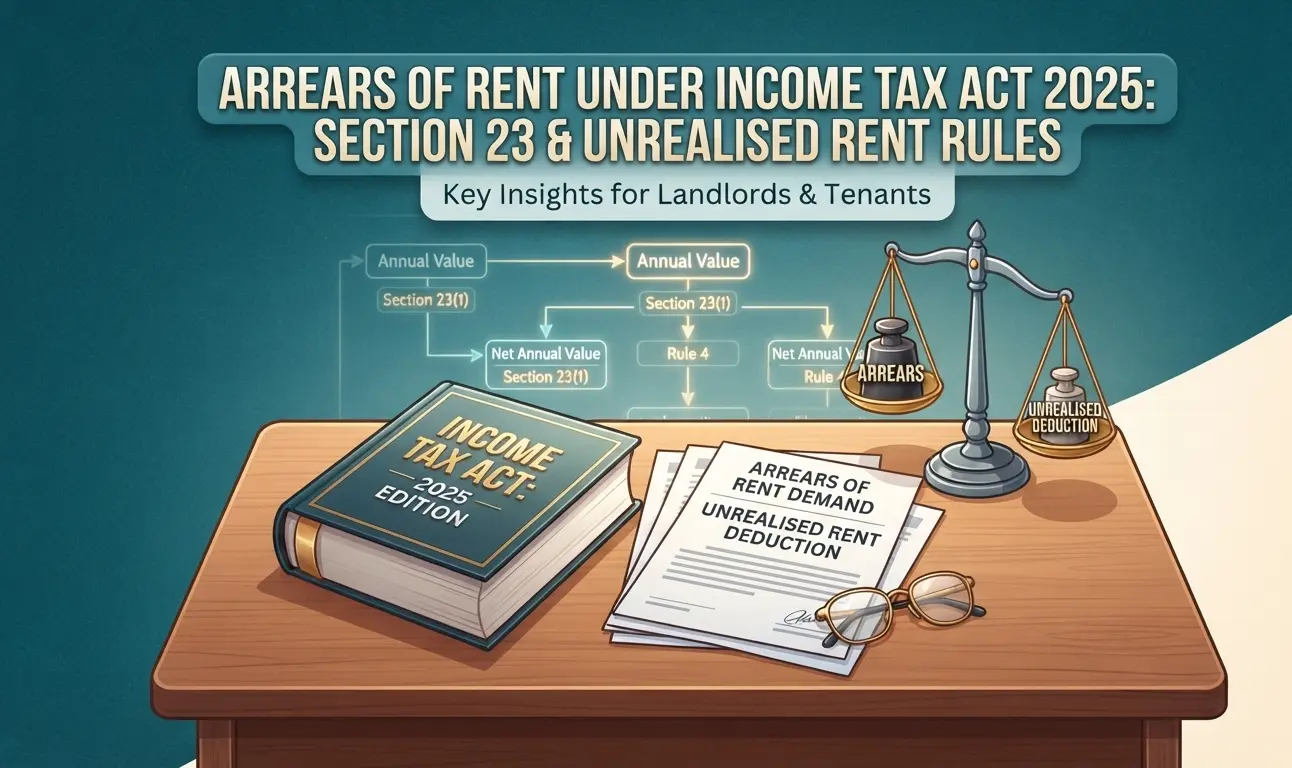
Your tenant finally clears two years of overdue rent in one cheque. It feels like old money, but the tax return does not see it that way: it lands in the year you receive it.
Parts 1 to 4 treated rent as something earned and received in the same year. Real landlords know it rarely works that tidily. Rent gets revised retrospectively, tenants pay late, and some tenants simply stop paying. This final part of the series explains arrears of rent under the Income Tax Act 2025 and how unrealised rent is treated, so you know when late rent is taxed, how much of it is taxed, and when lost rent can be left out of your income altogether.
Applicability note: Section 23 of the Income-tax Act, 2025 (corresponding to Section 25A of the Income-tax Act, 1961) applies from Tax Year 2026-27 onward. The unrealised-rent conditions, earlier found in Rule 4 of the Income-tax Rules, 1962, now sit in Rule 21 of the Income-tax Rules, 2026. For FY 2025-26 (AY 2026-27), the 1961 Act provisions still apply.
Arrears of Rent Under the Income Tax Act 2025
Arrears of rent are rent that fell due for an earlier period but reaches you only now. A common case is a rent revision applied retrospectively, where the tenant pays the extra amount for past months in one go. Section 23 gives these receipts their own rule, and it has three parts worth knowing.
Taxed When Received
Section 23(1): the amount is income from house property for the tax year of receipt, not the year it relates to
Owner or Not
Section 23(2): taxed whether or not you own the property in the year you receive it
Flat 30% Deduction
Section 23(3): 30% of the amount is deducted; the rest is taxable
The second point catches people out. Suppose you sold the flat last year and, months later, the old tenant clears dues from the time you owned it. Section 23(2) says the receipt is still included in your total income under the head Income from house property, because the test is whether you received the money, not whether you currently own the house.
Note what this 30% is and is not. It is the deduction Section 23(3) itself provides for this receipt, and it is a separate calculation from the standard deduction on net annual value covered in Part 3. You apply it to the arrears amount, not to your regular annual value.
Meera let out a flat for ₹30,000 a month. In Tax Year 2026-27 the court fixes the rent at ₹35,000 backdated by 12 months, and the tenant pays the extra ₹60,000 in one instalment. Under Section 23, that ₹60,000 is income from house property for Tax Year 2026-27. The 30% deduction is ₹18,000, so ₹42,000 is added to her income that year, on top of her regular rent for the year.
Unrealised Rent Under the Income Tax Act 2025: When Lost Rent Is Left Out
Now the opposite problem: rent that falls due but never arrives. When you calculate annual value for a let-out property (Part 1), the actual rent you use does not include unrealised rent, but only if it qualifies. The test sits in Rule 21 of the Income-tax Rules, 2026, made for the purposes of Section 21(4), which carries over the old Rule 4 approach. The rent must be proved to be lost and irrecoverable, and all four conditions below must be met.
| Condition | What it means in practice |
|---|---|
| Bona fide tenancy | The letting is genuine, ideally backed by a written rent agreement |
| Tenant has vacated | The defaulting tenant has left, or you have taken steps to make them leave |
| No other property occupied | The defaulting tenant is not occupying any other property of yours |
| Recovery action | You have taken all reasonable steps to institute legal proceedings, or can satisfy the Assessing Officer that such proceedings would be useless |
The burden of proving these facts is on you. Keeping the rent agreement, notices sent to the tenant, bank statements showing non-payment, and any legal notice or complaint is what turns “my tenant did not pay” into a position you can defend if the Assessing Officer asks.
The Tribunals have applied this strictly. In ITO v. Yashovardhan Tyagi, (2020) 184 ITD 461 (Delhi Trib.), a landlord had let commercial property on a three-year lease but collected rent for only two months. The Tribunal refused to exclude the unpaid rent because he produced no evidence that the defaulting tenant had vacated, and showed no steps taken to make the tenant leave. That was decided under the 1961 Act and old Rule 4, but Rule 21 keeps the same conditions, so the reasoning remains a useful guide. It is a Tribunal decision, so it is persuasive rather than binding on every Assessing Officer.
- Leaving out unpaid rent just because the tenant has not paid — non-payment alone is not enough; all four Rule 21 conditions must be met
- Assuming a tenant still living in the property can be treated as vacated — the rule needs the tenant to have vacated, or steps taken to make them vacate
- Reporting arrears in the year they relate to — Section 23 taxes them in the year of receipt
- Assuming a sale of the property ends the tax on late rent — arrears received afterwards are still taxed under Section 23(2)
- Applying the 30% to the wrong base — the Section 23(3) deduction is on the arrears or unrealised rent received, not on your regular net annual value
When Unrealised Rent Is Recovered Later
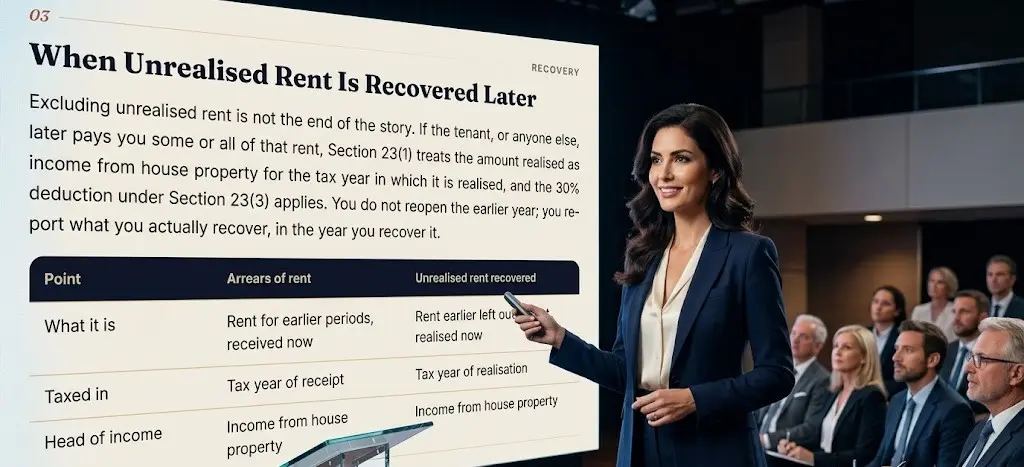
Excluding unrealised rent is not the end of the story. If the tenant, or anyone else, later pays you some or all of that rent, Section 23(1) treats the amount realised as income from house property for the tax year in which it is realised, and the 30% deduction under Section 23(3) applies. You do not reopen the earlier year; you report what you actually recover, in the year you recover it.
| Point | Arrears of rent | Unrealised rent recovered |
|---|---|---|
| What it is | Rent for earlier periods, received now | Rent earlier left out as lost, realised now |
| Taxed in | Tax year of receipt | Tax year of realisation |
| Head of income | Income from house property | Income from house property |
| Deduction | 30% of the amount | 30% of the amount |
| Owner needed in that year? | No | No |
Rohit excluded ₹90,000 of rent as unrealised after his tenant vacated and he issued a legal notice. In Tax Year 2027-28 the tenant settles and pays ₹50,000. Rohit reports ₹50,000 as income from house property for Tax Year 2027-28, claims the 30% deduction of ₹15,000, and ₹35,000 is taxable that year.
Frequently Asked Questions
How is arrears of rent taxed under the Income Tax Act 2025?
Under Section 23, arrears of rent received from a tenant are treated as income from house property for the tax year in which you receive them, not the year the rent related to. A deduction of 30% of the amount is allowed, and the balance is taxed under the head Income from house property.
Is the 30% deduction allowed on arrears of rent and unrealised rent?
Yes. Section 23(3) allows a deduction equal to 30% of the arrears of rent or the unrealised rent received subsequently. So if you receive ₹1,00,000, ₹30,000 is deducted and ₹70,000 is taxable.
I sold the house last year. Do I still pay tax on arrears of rent received now?
Yes. Section 23(2) says the amount is included in your total income whether or not you are the owner of the property in the tax year in which you receive it. Selling the house does not take arrears received afterwards outside the net.
What is unrealised rent and when can I leave it out of my rental income?
Unrealised rent is rent you were entitled to receive from a tenant but could not collect. Under Rule 21 of the Income-tax Rules, 2026 it is left out only if it is proved to be lost and irrecoverable and four conditions are met: the tenancy is bona fide, the defaulting tenant has vacated or steps have been taken to make them vacate, the tenant does not occupy any other property of yours, and you have taken all reasonable steps to institute legal proceedings for recovery or can satisfy the Assessing Officer that such proceedings would be useless.
What happens if a tenant later pays rent that I had excluded as unrealised?
The amount you actually recover is treated as income from house property for the tax year in which it is realised under Section 23(1), with the 30% deduction under Section 23(3). You do not go back and reopen the earlier year.
Do I have to prove the tenant has left before I can exclude unpaid rent?
Yes, or at least that steps have been taken to make the tenant vacate. Vacating, or steps to compel vacating, is one of the four Rule 21 conditions. In ITO v. Yashovardhan Tyagi, (2020) 184 ITD 461 (Delhi Trib.), decided under the old Rule 4, the unpaid rent was not excluded because there was no evidence that the defaulting tenant had vacated or that any steps had been taken to compel the tenant to leave.
Which section of the Income-tax Act, 2025 replaces Section 25A of the 1961 Act?
Section 23 of the Income-tax Act, 2025 covers arrears of rent and unrealised rent received subsequently, and corresponds to Section 25A of the Income-tax Act, 1961. The unrealised-rent conditions that sat in Rule 4 of the old Income-tax Rules, 1962 now appear in Rule 21 of the Income-tax Rules, 2026.
Income From House Property — Series Index
Chargeability & Annual Value: How House Property Income Is Computed
Sections 20 and 21 — what is taxable and how annual value is worked out.
Part 2Deemed Let Out Property: The Two-House Rule
Which houses get a Nil value, and which are taxed on notional rent.
Part 3Deductions: The 30% Standard Deduction & Home Loan Interest
Turning Net Annual Value into taxable income, and the ₹2 lakh cap most people get wrong.
Part 4Co-Ownership & Deemed Ownership: Who Actually Pays Tax
Sections 24 and 25 — jointly owned property and the deemed-owner rules.
Arrears of Rent & Unrealised Rent: The Special Situations
Section 23 — rent recovered late, and rent you never collected at all.
Two habits keep you safe. When rent arrives late or backdated, report it in the year you receive it, take the 30% deduction, and do not worry about whether you still own the property. And when rent never arrives, do not simply leave it out: leave it out only when you can show that the tenancy was genuine, the tenant has gone, and you have taken proper steps to recover it.
Sources & References
- Income-tax Act, 2025 [Act No. 30 of 2025] — full text, as amended by Finance Act, 2026Income Tax India, incometaxindia.gov.in
- Section 23 — Arrears of rent and unrealised rent received subsequentlyIncome Tax India, incometaxindia.gov.in
- Rule 21 — Unrealised rent, Income-tax Rules, 2026Income Tax India, incometaxindia.gov.in
- ITO v. Yashovardhan Tyagi, (2020) 184 ITD 461 (Delhi Trib.) — digestITAT Online
- Section 25A — Special provision for arrears of rent and unrealised rent received subsequently (Income-tax Act, 1961)Income Tax India, incometaxindia.gov.in
Section 23 of the Income-tax Act, 2025 and Rule 21 of the Income-tax Rules, 2026 are taken from the Income Tax Department’s published text. The case reference is a Tribunal decision under the 1961 Act. Always cross-check against the official Act and Rules linked above and consult a Chartered Accountant before relying on this for a filing decision.
Disclaimer: This article is for general informational purposes only and does not constitute tax or legal advice. The Income-tax Act, 2025 and related rules are subject to notifications and amendments by the CBDT. Please consult a qualified Chartered Accountant for advice specific to your situation.