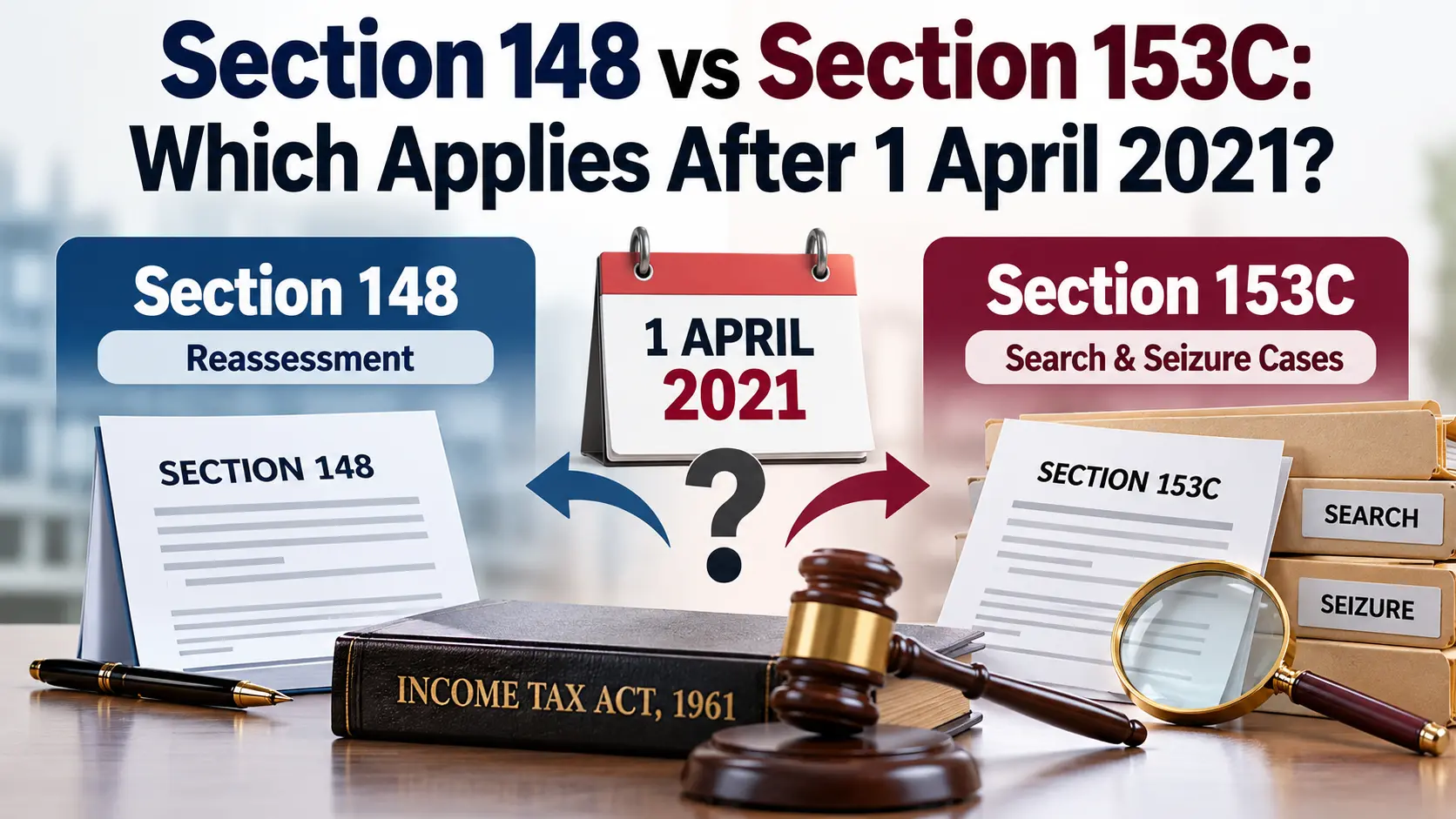
Same search, same seized ledger, same taxpayer. Whether the department must use Section 153C or Section 148 can turn on a single date most people never check.
When income tax officers search one person and find material about another, they need a legal route to assess that other person. Until 31 March 2021 the route was Section 153C. From 1 April 2021 it moved to reassessment under Section 148, and from 1 September 2024 to block assessment. The Section 148 vs Section 153C question decides whether a notice is valid at all, and the answer depends less on when the search happened than on when the seized material reached your Assessing Officer. This guide sets out the rule, the cases behind it, and where the Income-tax Act, 2025 leaves it.
Applicability note: This guide is written under the Income-tax Act, 1961 (Sections 147 to 151 and 153A to 153C), which governs the searches and assessment years discussed. Section 148 corresponds to Section 280 of the Income-tax Act, 2025; Section 153C has no numbered successor. See Section 05 and our old vs new Act mapping hub.
Why the 1 April 2021 Date Matters
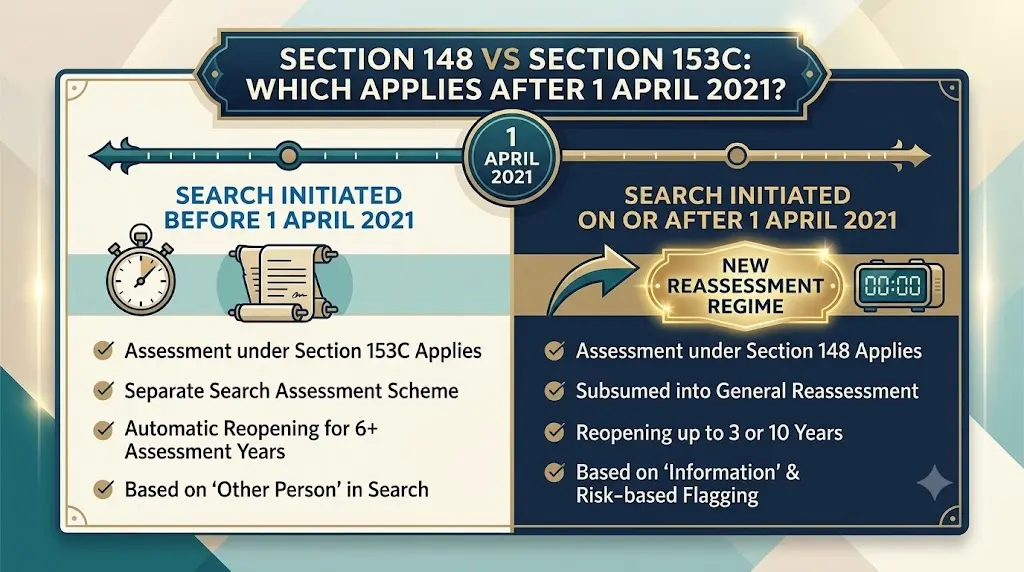
The Finance Act, 2021 closed the Section 153A and 153C regime for new searches. Section 153A(1) now applies only to searches initiated on or before 31 March 2021, and Section 153C(3), the sunset clause, says that nothing in Section 153C applies to a search initiated under Section 132, or a requisition under Section 132A, on or after 1 April 2021. Searches after that date were brought into the ordinary reassessment provisions, with Explanation 2 to Section 148 treating a search as information that income has escaped assessment.
The difficulty is the person in between: material about them was seized in a search on someone else before 1 April 2021, but it reached their Assessing Officer only later. For that person, the first proviso to Section 153C(1) moves the search date to the date the material reached their Assessing Officer. That is where most disputes start.
Before 1 April 2021
Section 153A for the searched person; Section 153C for the other person
1 April 2021 to 31 August 2024
Reassessment under Sections 147 and 148, with Explanation 2 deeming the search to be information
From 1 September 2024
Block assessment, with Section 158BD for the other person
Section 148 vs Section 153C: The Decision Table
Work out two dates before anything else: the date of the search on the other party, and the date the seized material reached your Assessing Officer. Then read across.
| Search on the other party | Material reaches your Assessing Officer | Route for you |
|---|---|---|
| Before 1 April 2021 | Before 1 April 2021 | Section 153C |
| Before 1 April 2021 | On or after 1 April 2021 | Section 153C barred by Section 153C(3), per Harigovind and the Delhi Tribunal rulings below |
| 1 April 2021 to 31 August 2024 | Any date | Section 148, with Explanation 2 and the approval it requires (check the transitional position if the notice is issued after 31 August 2024) |
| On or after 1 September 2024 | Any date | Block assessment; Section 158BD for the other person |
A trading group is searched in January 2020. A ledger seized there shows cash entries against Mr. Shah, who is assessed in another city. The ledger and a satisfaction note reach Mr. Shah’s Assessing Officer in June 2022, and a Section 153C notice follows. Applying Harigovind, Mr. Shah’s search date is June 2022, which is after 1 April 2021, so Section 153C(3) takes the notice outside the section altogether, however strong the ledger looks.
The second row is the one that matters most in practice, because the department often moves the material across jurisdictions slowly. Our case-law analysis of Section 153C proceedings after 1 April 2021 in I Home and Infrastructure applies exactly this reasoning.
The Deemed Search Date for the Other Person
The first proviso to Section 153C(1) says that, for the other person, the reference to the date of initiation of the search is to be read as the date the seized material is received by their Assessing Officer. The Revenue has argued that this proviso is only about which pending assessments abate. The courts have rejected that.
| Ruling | What it decided |
|---|---|
| CIT v. Jasjit Singh, [2023] 458 ITR 437 (SC) | The proviso is not confined to abatement. For the other person, the handover date is the search date for the purposes of Section 153C. |
| Harigovind v. ACIT, (2026) 485 ITR 509 (Madras), 28 Oct 2025 | Material handed over on 25 November 2022; Section 153C notices for AY 2013-14 to 2019-20 quashed because the deemed search date fell after 1 April 2021 and Section 153C(3) applied. |
| B.H. Trading Co. v. DCIT, ITAT Delhi, 14 Aug 2026 (ITA 3601/Del/2025) | Search on 30 January 2020, satisfaction note on 4 February 2022; Section 153C notice held to be without jurisdiction. |
| Abhisar Estates Pvt. Ltd. v. DCIT, ITAT Delhi (AY 2017-18) | No record of the handover date, so the satisfaction date of 10 May 2022 was treated as the relevant date; notice and assessment held invalid. |
The Abhisar Estates point is worth noticing. Where the department cannot show when the material was received, the satisfaction note’s date has been used in its place. That makes the date on the note, which we cover in the Section 153C satisfaction note checklist, a matter of jurisdiction, not paperwork.
- Looking only at the search date — for the other person, the handover date usually decides which route applies
- Assuming Section 148 automatically covers a Section 153C case that fails — Explanation 2’s deeming applies to searches and seizures on or after 1 April 2021, so an older search does not fit it neatly
- Missing the approval — the third-party clauses of Explanation 2 need the Principal Commissioner’s or Commissioner’s prior approval
- Treating every year as open — reopening still needs material that relates to the year reopened
How Section 148 Handles Third-Party Search Material
For searches and seizures on or after 1 April 2021, Explanation 2 to Section 148 deems the Assessing Officer to have information suggesting that income has escaped assessment in four situations.
- A search on the assessee under Section 132, or a requisition under Section 132A, on or after 1 April 2021.
- A survey on the assessee under Section 133A, other than sub-section (2A), on or after 1 April 2021.
- Valuables seized from someone else: money, bullion, jewellery or other valuables seized or requisitioned from another person on or after 1 April 2021, which the officer, with the prior approval of the Principal Commissioner or Commissioner, is satisfied belong to the assessee.
- Books or documents seized from someone else: seized or requisitioned on or after 1 April 2021, which, with the same approval, the officer is satisfied pertain to the assessee or contain information relating to the assessee.
The last two are the Section 148 counterparts of Section 153C. Two procedural points follow from the text as inserted in 2021. First, Section 148A’s show-cause procedure does not apply where the search is on the assessee, or where the officer, with prior approval, is satisfied that material seized from another person belongs or pertains to the assessee. Second, the time limits are in Section 149: three years from the end of the relevant assessment year, extendable towards ten years where the escaped income represented in an asset, expenditure or entry is ₹50 lakh or more. These provisions were amended in 2022, 2023 and 2024, so check the version that applies to the year in front of you.
Reopening still has to be tied to the year. In our case-law analysis of Section 148 reopening based on search material (Maharashtra Seamless), ITAT Delhi quashed a reassessment because the seized documents did not pertain to the specific year reopened.
After 1 September 2024 and Under the Income-tax Act, 2025
From 1 September 2024, Section 148 was substituted and no longer contains a search-deeming provision; its list of information covers surveys under Section 133A from that date, but not searches. Searches conducted from that date go to block assessment, and Section 158BD handles undisclosed income of a person other than the one searched. So for new searches, the Section 148 vs Section 153C question no longer arises: neither route applies.
| Income-tax Act, 1961 | Income-tax Act, 2025 | Note |
|---|---|---|
| Section 147 | Section 279 | Income escaping assessment |
| Section 148 | Section 280 | Its list of information includes surveys under Section 253, but not searches |
| Section 148A | Section 281 | Procedure before a Section 280 notice |
| Section 149 | Section 282 | Four years and three months; up to six years and three months where escaped income is ₹50 lakh or more |
| Section 153C | No numbered successor | Search cases go to Sections 292 to 295; Section 295 covers undisclosed income of any other person, as Section 158BD does today |
The practical result under the 2025 Act is a cleaner split than the 1961 Act ever had: material found in a search goes to block assessment, and reassessment under Section 280 is for other kinds of information. Use the Income Tax Act 2025 section mapping to check any other provision.
Frequently Asked Questions
What is the difference between Section 148 and Section 153C for third-party search material?
Both let the department assess a person whose income shows up in material seized from someone else. Section 153C was the route for searches initiated before 1 April 2021. For searches from 1 April 2021 to 31 August 2024, the route is reassessment under Sections 147 and 148, with Explanation 2 to Section 148 treating the seized material as information that income has escaped assessment.
Does Section 153C apply if the search was before 1 April 2021 but the material reached my Assessing Officer later?
Courts have held that it does not. In Harigovind v. ACIT, (2026) 485 ITR 509 (Madras), decided on 28 October 2025, the High Court treated the date the seized material was handed over to the other person’s Assessing Officer as the search date for that person. Because that date fell after 1 April 2021, Section 153C(3) barred the proceedings. The court followed the Supreme Court’s decision in CIT v. Jasjit Singh, [2023] 458 ITR 437.
What did Section 153C(3) change?
It provides that nothing in Section 153C applies to a search initiated under Section 132, or a requisition under Section 132A, on or after 1 April 2021. Read with the first proviso to Section 153C(1), it closes the Section 153C route for any other person whose deemed search date falls on or after that day.
How does Section 148 treat material found in a search on someone else?
For searches and seizures on or after 1 April 2021, Explanation 2 to Section 148 deems the Assessing Officer to have information suggesting escaped income where, with the prior approval of the Principal Commissioner or Commissioner, the officer is satisfied that seized money, bullion, jewellery or valuables belong to the assessee, or that seized books or documents pertain to the assessee or contain information relating to the assessee.
Is the Section 148A show-cause procedure needed in these cases?
Under the text of Section 148A as inserted from 1 April 2021, the procedure does not apply where a search is initiated on the assessee, or where the Assessing Officer, with prior approval, is satisfied that material seized from another person belongs or pertains to the assessee. Check the version in force for the year concerned, because the reassessment provisions were amended in 2022, 2023 and 2024.
What applies to searches made on or after 1 September 2024?
Neither route. Block assessment was revived for searches conducted on or after 1 September 2024, and undisclosed income of a person other than the one searched is dealt with under Section 158BD. Section 148, as substituted from 1 September 2024, no longer contains the search-deeming provision.
Which sections of the Income-tax Act, 2025 correspond to Sections 148 and 153C?
Section 148 corresponds to Section 280 and Section 148A to Section 281, with time limits in Section 282. There is no numbered successor to Section 153C. Search cases go to the block assessment scheme in Sections 292 to 295, and Section 295 deals with undisclosed income of any other person. Section 280’s list of information does not include a search.
Read Next
What Must a Valid Section 153C Satisfaction Note Actually Say? A Practitioner’s Checklist
The note that decides whether a Section 153C assessment stands.
Case LawSection 153C Proceedings After 1 April 2021 Are Void (I Home and Infrastructure)
ITAT Delhi follows Harigovind on the deemed search date.
Case LawSection 148 Reopening Based On Search Material: ITAT Ruling (Maharashtra Seamless)
Seized documents must pertain to the specific year reopened.
Case LawSection 153C Limitation Period Runs From the Satisfaction Note, Not the Search Date (Blue Water Enterprises)
How the handover date fixes the six-year window.
153A vs 153C: How the Limitation Period Differs for Searched and Non-Searched Persons
Six years from the search, or from the handover.
The Extended Ten-Year Block Period Under Section 153A
The ₹50 lakh condition and the satisfaction it needs.
Explanation 2 to Section 148: When a Search Counts as “Information”
How each clause works, and the approval it needs.
Income Tax Law Mapping: Old vs New Act, Rules, Forms and Schedules
Find the 2025 Act provision for any 1961 Act section.
Before arguing a single addition in a third-party search case, build the date line: when the other party was searched, when the material reached your Assessing Officer, and which notice was issued. If the handover is on or after 1 April 2021 and the notice is under Section 153C, that alone may end the case. If the notice is under Section 148, check the Explanation 2 clause relied on, the approval, and whether the material relates to the year.
Sources & References
- Section 153A (Income-tax Act, 1961) — limited to searches on or before 31 March 2021Income Tax India, incometaxindia.gov.in
- Section 148 with Explanation 2 (version in force before 1 September 2024)Income Tax India, incometaxindia.gov.in
- Section 148 as substituted with effect from 1 September 2024Income Tax India, incometaxindia.gov.in
- Section 148A (2021 text) — exception for search casesIncome Tax India, incometaxindia.gov.in
- Section 149 — time limits for noticeIncome Tax India, incometaxindia.gov.in
- Section 158BD — Undisclosed income of any other personIncome Tax India, incometaxindia.gov.in
- Section 280 (Income-tax Act, 2025) — Issue of notice where income has escaped assessmentIncome Tax India, incometaxindia.gov.in
- Section 282 (Income-tax Act, 2025) — Time limit for notices under Sections 280 and 281Income Tax India, incometaxindia.gov.in
- Section 295 (Income-tax Act, 2025) — Undisclosed income of any other personIncome Tax India, incometaxindia.gov.in
- CIT v. Jasjit Singh, [2023] 458 ITR 437 (SC)Supreme Court of India
- Harigovind v. ACIT, W.P. Nos. 23014 of 2023 and connected matters, Madras High Court, 28 October 2025, reported at (2026) 485 ITR 509High Court of Madras
- Income Tax Appellate Tribunal — Orders (official ITAT website; search by ITA number)B.H. Trading Co. v. DCIT, ITA No. 3601/Del/2025 (14 August 2026); Abhisar Estates Pvt. Ltd. v. DCIT (AY 2017-18). Both ITAT Delhi.
Case details are taken from published reports of the judgments and orders; read the full text before relying on any ruling. The reassessment provisions were amended several times after 2021, so confirm the version that applies to the assessment year in question.
Disclaimer: This article is for general informational purposes only and does not constitute tax or legal advice. The Income-tax Act, 2025 and related rules are subject to notifications and amendments by the CBDT. Please consult a qualified Chartered Accountant or tax counsel for advice specific to your situation.