Case at a glance
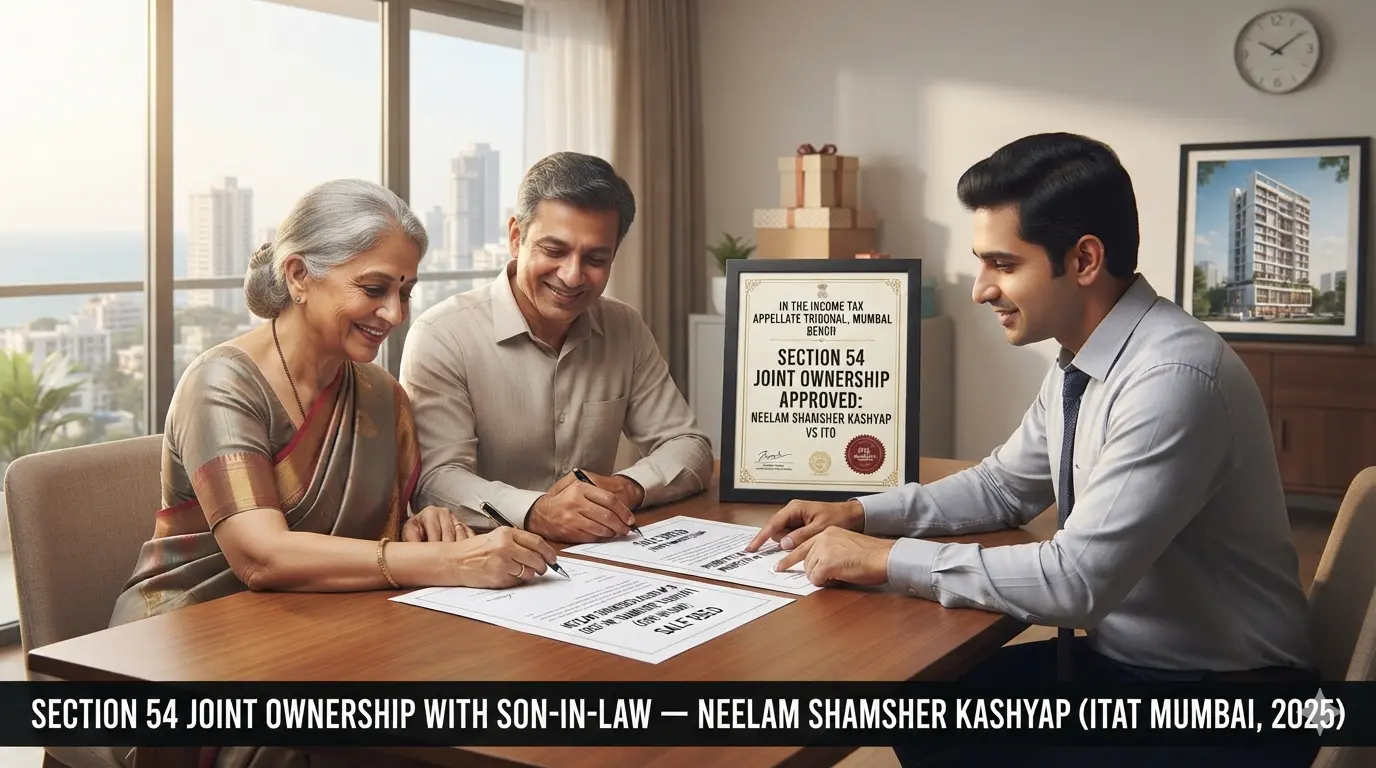
Case Name: ITO v. Neelam Shamsher Kashyap (ITAT Mumbai, 2025)
- Subject
- Section 54 joint ownership: whether the deduction can be cut to 50% because the new house was bought jointly with the assessee’s son-in-law, and how the fair market value as on 1 April 2001 is capped by the stamp duty value
- Issue
- Where the assessee paid Rs.3,67,94,500 of the price of a new house bought jointly with her son-in-law, who paid Rs.50,00,000, could the Assessing Officer restrict her Section 54 deduction to 50% of the investment merely because the house was jointly owned?
- Appeal no.
- ITA No. 2053/Mum/2025 (Revenue’s appeal), order pronounced on 27 October 2025
- Forum
- ITAT Mumbai “B” Bench (Shri Amit Shukla, Judicial Member, and Ms. Padmavathy S, Accountant Member); order authored by Ms. Padmavathy S
- Assessment year
- 2021-22
- Provisions
- Sections 54, 55(2)(b) and 250, Income-tax Act 1961 (Section 54 corresponds to Section 82 of the Income-tax Act 2025)
- Outcome
- In favour of assessee
- Order copy
- Download the full order
Background
Facts of the Case
- The assessee, an individual from Mumbai, filed her return for AY 2021-22 on 17 December 2021, declaring total income of Rs.89,08,020.
- She sold two properties during the year, earned long-term capital gains and claimed a deduction of Rs.4,00,84,000 under Section 54 for the purchase of a new residential house.
- The new house was bought jointly with her son-in-law. Of the total cost of Rs.4,17,94,500, she paid Rs.3,67,94,500 and her son-in-law paid Rs.50,00,000. The purchase agreement did not state each owner’s share.
- In the scrutiny assessment, the Assessing Officer accepted that the assessee had paid the balance of the price. Even so, he treated the house as owned 50:50 and restricted the deduction to Rs.2,00,42,000, which is 50% of the claim.
- He also rejected the assessee’s registered valuer’s report on the fair market value of the properties sold as on 1 April 2001. Instead, he adopted the ready reckoner rate of Rs.5,078 per square foot, which reduced the cost of acquisition.
- Before the CIT(A), the assessee filed a registered rectification deed stating each owner’s share in the new house, and a certificate from the Sub-Registrar, Andheri, valuing the property sold at Rs.1,70,61,370 as on 2001. The CIT(A) forwarded these to the Assessing Officer for a remand report, received no reply, and allowed the appeal on 30 January 2025. The Revenue appealed to the Tribunal.
The numbers
The Section 54 Claim and the Cost of Acquisition in Figures
- New house
- Total cost Rs.4,17,94,500: assessee Rs.3,67,94,500 (about 88%) and son-in-law Rs.50,00,000
- Claimed
- Rs.4,00,84,000 deducted under Section 54 in the return
- AO allowed
- Rs.2,00,42,000, being 50% of the claim, on the basis of joint ownership
- CIT(A) allowed
- Rs.3,67,94,500, the amount the assessee herself invested in the new house; upheld by the Tribunal
- FMV by AO
- Rs.91,70,868 as on 1 April 2001 at the ready reckoner rate (Rs.2,76,04,312 after indexation)
- FMV by assessee
- Rs.1,71,57,000 as on 1 April 2001 per the registered valuer (Rs.5,16,42,570 after indexation)
- Stamp value
- Rs.1,70,61,370 as on 2001, per the Sub-Registrar’s certificate filed before the CIT(A)
Two points the order does not explain. First, the claim of Rs.4,00,84,000 is higher than the Rs.3,67,94,500 the assessee actually invested, and the CIT(A) allowed the lower figure. Second, the valuer’s figure is Rs.95,630 higher than the stamp value; the Tribunal treated the two as matching.
The ruling
Summary of Decision: What the Tribunal Held
Dismissing the Revenue’s appeal and upholding the CIT(A)’s order, the Tribunal held:
- That, since the Assessing Officer did not dispute that the assessee paid Rs.3,67,94,500 towards the new house, restricting her Section 54 deduction to 50% only because she co-owned the house with her son-in-law was not justified. [Para 6 of the order]
- That the CIT(A) had examined the documentary evidence, including the amended purchase deed, and had decided the issue on merits after the Assessing Officer failed to respond to the remand request, so there was no infirmity in his order. [Para 6 of the order]
- That the fair market value as on 1 April 2001 adopted by the assessee matched the value certified by the stamp duty authority and was supported by a valuer’s report based on comparable sales, so there was no breach of the proviso to Section 55(2)(b). [Paras 7 and 8 of the order]
Why
Reasoning Behind the Decision
- The 50% split had no basis in the documents. In this Section 54 joint ownership dispute, the Tribunal noted that the purchase agreement for the new house did not state the shares of the assessee and her son-in-law. The Assessing Officer’s assumption of equal ownership was therefore not supported by any document. [Para 6 of the order]
- The investment was never in doubt. The Assessing Officer had himself accepted that the assessee paid the major part of the price. His only reason for cutting the deduction was the joint ownership. The Tribunal held that this reason was not substantiated, particularly when the amount invested was undisputed. [Para 6 of the order]
- Section 54 looks at the amount invested. The Tribunal explained that Section 54 allows a deduction where the assessee buys or constructs a new residential house, and the deduction equals the capital gain or the cost of the new house, whichever is lower. Following the CIT(A), it accepted that the assessee is entitled to the deduction for the amount she herself invested in the new house. [Paras 3 and 6 of the order]
- The amended deed was examined, not taken on faith. The Revenue argued that the rectification deed stating each owner’s share was an afterthought, and that the CIT(A) should not have decided the appeal without the remand report. The Tribunal noted that the CIT(A) had called for a remand report, that the Assessing Officer did not respond, and that the CIT(A) examined the documents, including the amended deed, before deciding on merits. The CIT(A) had also observed that the assessee would be entitled to the deduction for her own investment even without the rectification deed. [Paras 3, 4 and 6 of the order]
- The 2001 valuation stood within the stamp value cap. The proviso to Section 55(2)(b), which applies from AY 2021-22, provides that the fair market value of land or building as on 1 April 2001 cannot exceed its stamp duty value on that date. The Revenue argued that the assessee’s valuation breached this cap. The Tribunal found that the Sub-Registrar’s certificate put the stamp value at Rs.1,70,61,370, which matched the Rs.1,71,57,000 adopted by the assessee, so the proviso was not breached. [Paras 4, 7 and 8 of the order]
- The valuer’s report was reasoned. The Tribunal also examined the registered valuer’s report. It found that the valuer had considered comparable sale instances from the same period and had explained why the value differed from the ready reckoner rate. There was therefore no reason to reject the assessee’s valuation. [Para 8 of the order]

Practice point
Key Takeaway: How Section 54 Joint Ownership Claims Are Decided
- Claim what you paid, not your title share. In a Section 54 joint ownership case, keep bank statements showing exactly how much each co-owner paid. Here, the undisputed payment record carried the claim even though the agreement was silent on shares.
- State the shares in the purchase deed. Write each co-owner’s share into the agreement at the time of purchase. This assessee had to execute a rectification deed during the appeal, and the Revenue attacked it as an afterthought.
- A family co-owner is not fatal. Adding a son-in-law or another family member as co-owner did not reduce the deduction for the amount the assessee herself invested. The co-owner’s own payment, however, gives the assessee no deduction.
- Check the 2001 stamp value cap. For AY 2021-22 onwards, the fair market value as on 1 April 2001 cannot exceed the stamp duty value on that date. Get a certificate of the 2001 stamp value from the Sub-Registrar, alongside the registered valuer’s report.
- Remember the Rs.10 crore cap. For AY 2024-25 onwards, Section 54 ignores the cost of a new house above Rs.10 crore. It did not apply here, but it matters for high-value purchases.
- Note the date of this order. It was pronounced on 27 October 2025. Check for later rulings before relying on it in a current case.
Read the full Tribunal order
Download the complete order copy as a PDF.
Download order
Keep reading